Key Takeaways
- A realistic MOQ for borosilicate glass bottle custom orders is usually 1,000-3,000 units per SKU
- Most 500-750 ml retail bottles use 1.8-2.2 mm borosilicate glass wall thickness
- Logo methods change cost by about USD 0.12-0.80 per unit depending on print area and process
- Plan 25-40 days production after sample approval for a standard China FOB order
A borosilicate glass bottle customizable for your wellness brand sounds simple until you ask for a quote. Then the supplier asks about glass thickness, silicone sleeve Pantone, cap material, logo method, 1.2 m carton drop test, barcode label size, and whether you need REACH or LFGB documents. If you only compare unit price, the math doesn't work. Last month QC pulled a 550 ml sample with a 1.8 mm wall near the shoulder; it looked fine on a desk, then failed after the third drop.
As a Zhejiang, China drinkware factory team, we see this on about 7 out of 10 new glass bottle inquiries: buyers want a clean sustainable bottle, but the buying spec is too loose. The line can run it, but loose specs create 12 days of sample back-and-forth instead of 5, weak inner trays, and retail complaints about chipped mouths or loose bamboo caps. One buyer flagged a PO typo on “borosilicate” after artwork was already plated. Use the questions and checklist below before you place a borosilicate glass bottle bulk order.
What Are You Actually Buying?
When a supplier says “borosilicate glass bottle,” ask for the material spec and the build, not just a polished photo. Borosilicate is picked for reusable bottles because it handles thermal shock better than soda-lime glass. For daily use, buyers usually land on 500 ml, 600 ml, 750 ml, or 1,000 ml. Body diameter usually sits at 65-75 mm. At the line, QC pulled a 2.0 mm sample with a caliper, and the 75 mm unit still missed most cup holders. That is the part buyers forget.
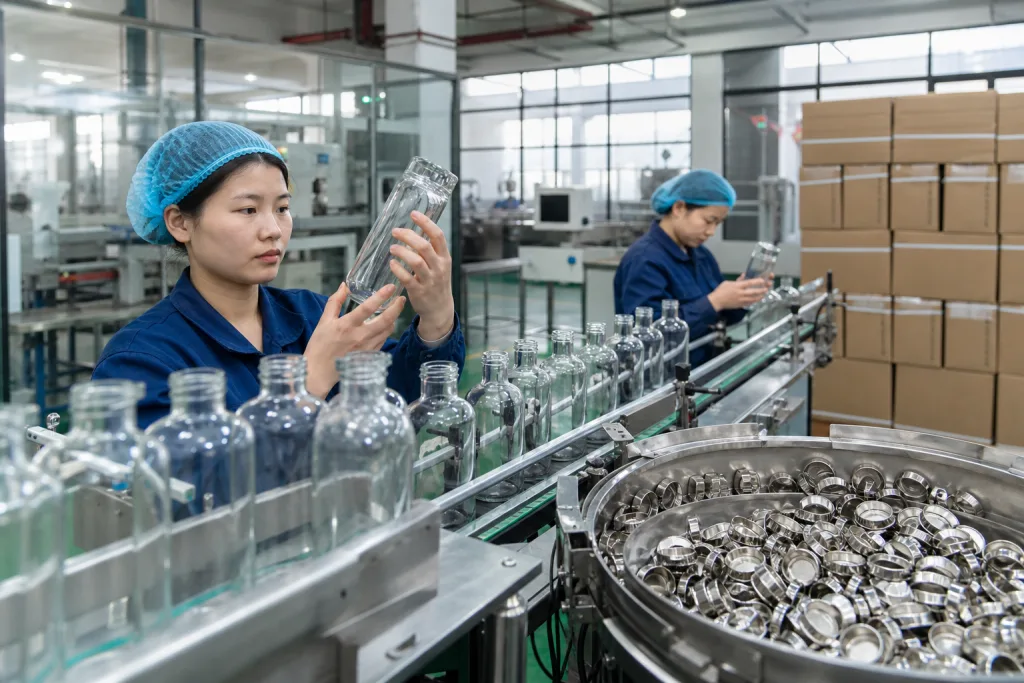
You are not buying glass alone. You are buying a stack of parts: glass body, cap, seal, sleeve, carry loop, decoration, retail box, and outer carton. A customizable glass water bottle with a weak cap gasket fails fast. We have seen a buyer approve a thin insert box, then 1,200 units arrived with chipped necks after an LCL move. The math does not work if the pack-out is weak. Our pack bench keeps a drop test log for that reason.
For wellness brands and sustainable retailers, I would start with 550-750 ml, 1.8-2.2 mm glass wall, food-grade silicone sleeve, and a bamboo or stainless steel cap with a silicone sealing ring. That spec sells clean and ships with less drama. A 750 ml bottle often weighs 420-520 g before packing, depending on wall thickness and sleeve coverage. On one run, the buyer flagged the 520 g target, so we trimmed the sleeve area and kept the fill line at 750 ml instead of pushing a heavier body.
Procurement rule: do not approve a borosilicate glass bottle factory quotation unless it states capacity, glass thickness, cap material, sleeve material, packing method, and testing standard.
Customization Choices That Affect Cost
A borosilicate glass bottle customizable project gets expensive when the buyer moves away from molds already sitting in the factory rack. Cheapest and safest: use an existing bottle mold, then change the logo, silicone sleeve color, bamboo cap engraving, or color box. We run these jobs every month. For wellness brands, yoga studios, refill shops, and promo buyers, that level of customization usually covers the brief without opening a new mold.
Typical decoration options include:
- Silkscreen printing: best for simple 1-2 color logos, usually USD 0.12-0.30 per unit; QC checks position with a 0.5 mm tolerance ruler.
- Heat transfer or decal: better for larger graphics, often USD 0.35-0.80 per unit; curved bodies need a print trial before mass production.
- Laser engraving on bamboo cap: clean and durable, with good fit for low-waste branding; the buyer often flags shallow logos on the first sample.
- Custom silicone sleeve color: practical MOQ is often 1,000 units per color if using an available Pantone match; special colors can push lead time from 12 days to 18 days.
- Custom retail box: usually starts from 1,000-2,000 units, depending on box structure and print finish; matte lamination shows scratches faster during carton drop tests.
If you ask for a fully custom borosilicate glass bottle shape, budget for mold cost, extra sampling, and at least 2-3 rounds of corrections. Tooling may run from USD 800 to USD 3,000 for a simple new glass body, higher if the shape has a narrow neck, sharp shoulder, or thin base. For a first order, using existing tooling is the smarter move. The math doesn’t work if you spend USD 3,000 on a private mold before you know your sell-through rate.
For borosilicate glass bottle promotional orders, keep artwork simple. A one-color logo on the sleeve or bottle body prints faster, passes inspection more cleanly, and has fewer problems in tape or abrasion testing. Full-wrap graphics look nice in a rendering, but we’ve seen this go sideways when the bottle curve distorts the artwork and QC pulled 7% scrap from the line.
Supplier Questions Before You Pay
Whether the supplier calls itself a borosilicate glass bottle vendor, manufacturer, or factory, first check what it controls under its own roof. A trader can still do a clean job, but you need names for each step: tube cutting on the glass line, mouth finishing after annealing, silicone sleeve assembly, logo printing, and final QC under 600-800 lux lamps.
Ask these questions before deposit. Do it before the PI is stamped, not after the buyer flagged a missing LFGB report on Friday afternoon.
- Is the bottle body made in-house or sourced from a partner glass workshop?
- What is the monthly output for this model? A stable line should handle at least 80,000-150,000 units/month.
- What is the MOQ per size, per sleeve color, and per logo design?
- Can you provide LFGB, FDA, REACH, or California Prop 65 test reports for food-contact parts?
- Do you use AQL inspection? Which defect is counted as critical, which one is major, and which scratches or print marks fall into minor?
- Can you send a packing drop test video or report?
In Zhejiang, China, our standard MOQ for an existing glass bottle model is 1,000 units per SKU, with better pricing from 3,000 units. Production lead time is normally 25-40 days after sample approval and deposit. Rush orders are possible, but this is the wrong place to be heroic: a silicone sleeve color matched to Pantone under a light box can take 2-3 rounds, and pushing the kiln schedule usually shows up later as bubbles or mouth cracks.
A real borosilicate glass bottle manufacturer should discuss defects without acting offended. We run checks for cracks, bubbles, sharp rim, poor sealing, sleeve color deviation, misprinted logo, cap odor, and carton damage; QC pulled one sample last month because a 0.4 mm rim chip passed the first bench check. If the supplier only says “quality is no problem,” keep asking. Quality is not a slogan. It is a checklist and a rejection rule.
Checklist For Retail-Ready Specification
Write one specification sheet for every borosilicate glass bottle wholesale project. One page is enough. It should remove guesswork before we cut the first sleeve mold or print the first logo film. For borosilicate glass bottle distributors and sustainable retailers, this sheet is the document QC checks against when cartons land and the buyer says, “This cap feels different from the sample.” We have seen that go sideways over a 1 mm logo shift.
Core product checklist
- Capacity: 500 ml, 600 ml, 750 ml, or 1,000 ml, with tolerance stated in ml and checked by fill test.
- Glass: borosilicate, 1.8-2.2 mm wall thickness for most retail bottles; confirm if the buyer wants lighter hand feel or stronger warehouse handling.
- Cap: bamboo, stainless steel, PP, or combination cap; confirm inner thread size, gasket material, and whether the gasket is glued or removable.
- Seal: food-grade silicone ring, odor-free, removable if required; QC should run an upside-down leak test before packing.
- Sleeve: silicone thickness, Pantone color, coverage height, and texture; 0.5 mm off at the bottom edge is easy to see on shelf.
- Logo: exact position, size in mm, color code, and process; send artwork with the PO, not by chat screenshot.
- Packaging: individual box, kraft tube, egg-crate insert, or mailer-safe box; state flute type if the bottles ship by e-commerce parcel.
Compliance checklist
- LFGB or FDA for glass and food-contact silicone, with the test item matching the final cap and seal material.
- REACH SVHC for EU retail channels; do not assume a bamboo cap automatically passes because it looks natural.
- Prop 65 review if selling into California, especially for decorated parts, ink, coating, and metal components.
- Carton drop test for e-commerce or distributor handling; we run corner, edge, and face drops before approving mailer packs.
- AQL inspection before shipment, commonly critical 0, major 2.5, minor 4.0; define what counts as a major defect before the inspector arrives.
For a bulk glass water bottle order, define carton quantity and weight on the PO. A typical 750 ml bottle may pack 24 units per master carton, with carton gross weight around 14-17 kg depending on packaging. If your distributor glass water bottle program goes through warehouses with a 15 kg handling limit, the math does not work with heavy gift boxes. We once had QC pull a carton at 17.6 kg because the inner kraft tube spec changed after sampling. Small change. Big freight headache.
Pricing, MOQ, And Lead Time
For a standard customizable borosilicate glass bottle using existing tooling, FOB China pricing often lands around USD 2.20-4.80 per unit. The low end is a clear bottle, basic PP or bamboo-style cap, and plain white box. The higher end means a full silicone sleeve, real bamboo cap, 1-color or 2-color printing, and retail packaging with an insert card. Watch quotes below USD 2.00. We have seen suppliers remove the spare sealing ring, thin the carton from 5-layer to 3-layer, or quote 280 g glass when the drawing shows 320 g. The math doesn’t work if the spec stays the same.
MOQ depends on which part is custom. A stock bottle with logo may start at 500-1,000 units. A custom sleeve color is more often 1,000 units because the silicone line needs color mixing and cleanup after the run. A private color box usually needs 1,000-2,000 units. A new molded glass body may require 5,000 units or a mold charge. For borosilicate glass bottle distributors carrying multiple colors, split the order with care. Three colors at 1,000 units each is usually easier than six colors at 500 units each, because the line loses time changing sleeve bins, checking Pantone chips, and relabeling outer cartons. We had one PO typo last year, “mint green” written as “mild green,” and the buyer flagged it only after QC pulled the sample.
Normal timeline from a China supplier is:
- Artwork confirmation: 1-3 days.
- Pre-production sample: 7-12 days for logo and sleeve color.
- Mass production: 25-40 days after sample approval.
- Inspection and booking: 3-7 days.
- Ocean freight to Europe or North America: often 25-45 days port-to-port, depending on route.
Do not approve mass production from a digital mockup only. Wrong question. For a custom glass water bottle, a physical sample shows sleeve tightness, cap sealing, print alignment, bottle weight, and box strength under hand pressure. We check sleeve fit with a 0.5 mm feeler gap standard, fill the bottle overnight for leakage, and drop-test the color box in the master carton before we run bulk. A sample fee of USD 80-200 is cheap compared with a container of unsellable product.
Packaging For Fewer Breakages
Glass bottle sourcing fails most often at packaging, not at the glass furnace. Borosilicate handles temperature change well, but it is still glass. We have seen a 550 ml bottle pass leak testing on the line, then crack at the shoulder after a loose 5-ply master carton took one hard corner drop in QC.
For borosilicate glass bottle bulk shipments to distributors, a color box with internal paper wrap works when the master carton uses strong corrugated board, such as 5-ply K=A or BC flute. For e-commerce or FBA-style fulfillment, upgrade the pack. Use a molded pulp insert, honeycomb sleeve, or reinforced mailer box with at least 3 mm clearance around the glass. If your product will be sold as a gift set, do not let the gift box carry the protection job by itself. We pushed back on this last season; the buyer wanted a pretty thin gift box, but the math did not work after the first carton drop.
Ask your borosilicate glass bottle supplier for a 1.0 m drop test on the packed master carton: one corner, three edges, and six faces. For parcel-ready packaging, test the individual retail pack too. QC should check breakage, cap dents, sleeve scuffing, and box deformation, then record the result with photos and carton weight. Small detail, big difference. On one 24 pcs carton, QC pulled the sample after testing and found no broken glass, but 6 boxes had crushed corners, which still becomes a buyer complaint.
Labeling also matters. If you need FNSKU labels, warning labels, recycling marks, batch codes, or multilingual care instructions, put them in the purchase order. Around 70% of Amazon-bound glass bottle orders we ship need at least one extra label beyond the retail barcode. Borosilicate glass bottle suppliers can apply barcode stickers in China for USD 0.03-0.08 per unit, using a Zebra printer or roll label applicator. It is cheaper than relabeling in a North American or European warehouse, and it avoids the classic PO typo where the carton mark says “glass bottel” on 1,200 cartons.
How To Choose The Partner
The best borosilicate glass bottle manufacturer for you is not always the cheapest one. It is the factory that can hold your spec on the 2nd, 3rd, and 8th repeat order. Wellness brands need consistency because customers spot a 1 mm sleeve color shift, cap odor from silicone, or a logo sitting 3 mm off-center. Sustainable retailers need documents ready because their buyers often ask for LFGB, FDA, and material declarations before they open the listing form.
If you are comparing borosilicate glass bottle manufacturers, score them on five points: how close the sample matches your drawing, whether sales replies within 4 working hours, whether test reports match the actual material, whether the carton survives a 10 kg drop test, and whether the factory will write down AQL defects before production. Price comes after that. We have seen this go sideways. A distributor borosilicate glass bottle program can carry a USD 0.15 higher unit cost; the math does not work with 6% breakage or a recall over non-compliant silicone. QC pulled one sample last year because the cap smelled sharp after 24 hours in a sealed PE bag.
For first cooperation, place a controlled order instead of overcommitting. Start with a 1,000-3,000 unit pilot order, then check production quality, carton strength, retail feedback, and whether reorder timing is 12 days or 18 days after deposit. That tells the truth. After that, you can negotiate better pricing for 5,000-10,000 units or schedule quarterly production with color sleeves and spare caps locked in. One buyer once sent a PO with “bamboo lid” typed as “bambo lid”; the line still paused to confirm it because small typos become wrong cartons.
BottleForge Industrial operates from Hangzhou, Zhejiang, with drinkware capacity across glass, stainless steel, and plastic programs for export buyers. For borosilicate glass bottle custom projects, we prefer a clear spec, a physical pre-production sample, and a written inspection standard with logo position tolerance, sleeve Pantone, cap torque, and carton drop requirement. We run the sample on the bench, not just in a PDF. That is less exciting than a glossy rendering, but it is how you receive bottles you can actually sell.
Send Your Bottle Spec For A Factory Quote
Share capacity, logo, sleeve color, packaging, destination port, and target quantity. We will price the project without hiding the practical trade-offs.
Frequently asked questions
What MOQ should I expect for a borosilicate glass bottle customized with my logo?
For an existing bottle shape, a practical MOQ is usually 1,000 units per SKU. If you only need a one-color logo on the bottle or cap, some suppliers may accept 500 units, but the unit price will be higher. Custom silicone sleeve colors usually start at 1,000 units per color because the silicone mixing and molding setup has fixed cost. Custom retail boxes often need 1,000-2,000 units. A fully custom glass mold can push the project to 5,000 units or require a separate mold charge of about USD 800-3,000.
Is borosilicate glass safe for hot and cold drinks?
Yes, borosilicate glass has better thermal shock resistance than standard soda-lime glass, which is why it is used for tea bottles and kitchenware. Still, a water bottle is not laboratory glassware, and cap or sleeve parts may have lower temperature limits. For retail use, tell customers not to pour boiling water into a cold bottle or place a sealed hot bottle into a bag immediately. Ask your supplier for food-contact test reports for the glass, silicone gasket, sleeve, and any plastic parts, especially if selling in the EU or North America.
What is a normal FOB price for borosilicate glass bottle wholesale orders?
For a 500-750 ml bottle using existing tooling, FOB China pricing often ranges from USD 2.20 to USD 4.80 per unit. The final price depends on wall thickness, cap type, silicone sleeve coverage, logo process, packaging, and order quantity. A bamboo cap and custom sleeve can add USD 0.40-1.20 compared with a very basic cap and no sleeve. If your quote is much lower than the market, check whether the supplier excluded retail packaging, inspection, barcode labeling, or thicker export cartons.
Can I use one supplier for both glass bottles and other drinkware?
Often yes, and it can make sourcing easier if the supplier has a real drinkware export system. A factory group or manufacturer handling glass, stainless steel, and plastic bottles can align packaging style, carton marks, logo artwork, and shipment timing. The risk is assuming every material follows the same process. Glass needs stronger packaging and breakage control, while stainless steel needs vacuum insulation testing. If combining products in one order, keep separate inspection checklists and AQL defect definitions for each category.
What documents should a borosilicate glass bottle vendor provide?
At minimum, ask for material test reports for food-contact glass and silicone, plus any cap materials that touch liquid. EU buyers commonly request LFGB and REACH SVHC. North American buyers may ask for FDA food-contact confirmation and California Prop 65 review. For retail chains, you may also need BSCI or Sedex factory audit documents, carton drop test records, and an AQL inspection report. Test reports should show the tested material, date, lab name, and standard, not just a generic certificate cover page.