Key Takeaways
- A usable borosilicate glass bottle supplier should quote MOQ at 3,000-5,000 pcs, not hide behind vague terms.
- For everyday retail, 1.5-2.0 mm wall thickness is a practical range; thinner glass raises breakage risk.
- Lead time from a Zhejiang borosilicate glass bottle factory is usually 25-35 days after sample approval.
- For export programs, ask for REACH, food-contact declarations, and carton drop-test specs before you confirm.
If you are sourcing a custom glass water bottle for a wellness brand or a sustainable retail line, the first bad move usually happens before the quote. You treat every borosilicate glass borosilicate glass bottle supplier like a catalog vendor, when the real question is whether they can hold wall thickness at 2.5 mm, keep the closure fit clean, and ship export docs without drama. In Zhejiang and across China, plenty of factories can make a nice-looking bottle. Fewer can keep the same neck finish, logo alignment, and carton count across a 10,000-unit run. QC pulled the sample on the line, and the neck gauge caught a 0.8 mm mismatch before it turned into a buyer complaint.
The better approach is to lock four things early: the use case, the glass spec, the decoration method, and the order math. A custom borosilicate glass bottle for retail is not the same as a promo bottle for events, and a bulk glass water bottle for Amazon is not the same as a boutique distributor program. This is the wrong question to ask if you start with price alone. We’ve seen that go sideways when the PO typo changed the cap color code and the buyer flagged it after sampling. Get the basics right, and supplier talks get short fast.
Start With the Sales Channel
Before you compare a borosilicate glass bottle manufacturer on price, decide where the bottle will actually sell. A wellness brand on DTC needs a different spec than a borosilicate glass bottle distributor supplying specialty shops, and both differ from a retailer running a bulk borosilicate glass bottle private-label program. If the bottle sits on a shelf, the graphic area and finish carry more weight. If it ships through Amazon, carton strength, FNSKU labeling, and breakage control matter more. If it goes into a subscription box, weight and pack efficiency can beat premium feel.
We see buyers overbuy the glass and underbuy the supply chain. A customized glass water bottle with a heavy base may look premium, but if it pushes landed cost up by $0.18 to $0.40 per unit and adds 8% freight weight, the math does not work. QC pulled a 320g sample on the line last month, and the buyer flagged it after seeing the carton count drop by 12%. A practical borosilicate glass bottle supplier in China should ask about channel, monthly forecast, and target carton count before quoting the final spec. The better factories in Zhejiang think like export partners, not just production lines.
Use this channel logic:
- DTC wellness: stronger unboxing, higher decoration detail, MOQ around 3,000 to 5,000 units
- Retail wholesale: stable replenishment, consistent color, lower defect rate at AQL 2.5
- Promotional program: faster production, simpler tooling, unit cost kept tight
Choose the Glass Spec First
Borosilicate looks like one material choice, but the buying call is thickness, thermal resistance, and how steady the forming line runs. For a custom glass water bottle, 1.5 mm to 2.0 mm wall thickness is usually the right zone. Under 1.2 mm, the unit price drops, and breakage shows up in packing and transit. Over 2.2 mm, the bottle feels heavy and freight climbs, especially on a bulk glass water bottle shipment to North America or Europe.
Ask the supplier whether the glass is Type I borosilicate or a general high-borosilicate formula. If they cannot state the coefficient of thermal expansion or the heat resistance range, this is not a serious borosilicate glass bottle factory. We’ve seen this go sideways when a buyer approved a 28/410 cap on paper, then QC pulled the sample and found the neck was off by 0.3 mm. For beverage use, you need a clean mouth finish and tight neck tolerance, or the cap starts leaking after filling.
Good buyers ask for three physical details in the quotation:
- Wall thickness tolerance, ideally within ±0.15 mm
- Neck finish and thread standard
- Drop test method for packed cartons
If you want a customizable borosilicate glass bottle line, insist on a sample with your closure, not just a naked bottle. The cap-to-neck interface is where projects fail. The buyer flagged it on one PO because the cap spec said 38 mm, but the drawing had a typo and the thread did not match the line setup.
Decoration Changes Everything
Most buyers treat decoration as a branding decision. The line says otherwise. On a borosilicate glass bottle custom order, silk-screen printing works well for one or two colors and keeps cost low, but it is not the same job as laser engraving, frosted etching, or full-wrap UV decoration. If the bottle runs through dishwasher cycles or repeated cold-fill use, weak ink will fail fast. We saw a 12-day wash test beat one ink system in our QC room, and the buyer flagged it on the third round. For a premium customized glass water bottle, test abrasion and wash resistance first, then check the logo.
Decoration changes the supply chain. Silk-screen is usually the cheapest route, often adding only $0.10 to $0.35 per bottle depending on color count and plate setup. Laser marking costs more at the start, but it removes ink wear concerns and saves headaches on repeat orders. Frosted finishes and color spray need tighter QC because overspray, pinholes, and coating mismatch show up right away under retail lights. On one 500 ml run, a 0.3 mm spray drift turned into a shelf reject, and that was not a small issue. If you are buying borosilicate glass bottle wholesale for a chain account, keep the decoration simple unless the margin can carry the extra work.
Ask the borosilicate glass bottle supplier for a pre-production sample with the actual print size, not a generic sample with a tiny logo.
For wellness brands, subtle usually sells better than loud. A clean logo, even ink density, and correct placement build more trust than a crowded print. That matters when the PO shows one typo in the logo position note and the buyer wants 3,000 pcs rechecked before shipment. For a sustainable retailer program, packaging discipline matters as much as product quality. We run it that way for a reason.
MOQ and Price Are Linked
Buyers usually push for the lowest unit price first. That is the wrong question to ask. For a borosilicate glass bottle wholesale program, the math sits on MOQ, mold status, decoration method, and packing spec. A plain stock shape can start around $1.05 to $1.80 FOB China with simple export packing. Once you add a printed logo, special lid, and retail box, a custom borosilicate glass bottle can land in the $2.20 to $4.50 range, and under 3,000 pcs the setup cost and packing labor hit hard. We have seen the line slow down on a 2,400 pcs trial because the buyer changed the lid spec after the PO was issued.
A serious borosilicate glass bottle manufacturer should spell out the breakpoints. At 3,000 pcs, you can still run a pilot without burning margin. At 5,000 to 10,000 pcs, the unit price settles down. At 20,000 pcs and above, carton count, pallet size, and outer box dimensions matter as much as the bottle. This is where a borosilicate glass bottle vendor that knows export work saves real money by reducing carton volume, increasing pallet count, and cutting wasted freight. QC pulled the sample on a 10,000 pcs order last month and found the carton CBM was 12% too high. The buyer flagged it before booking.
Watch for hidden extras:
- Charge for color matching or Pantone confirmation, usually tied to one sample round
- Mold or tooling fee for a custom closure or cap, often quoted separately from the bottle
- Retail box upgrade or insert fee, especially if the insert thickness changes from 1.5 mm to 2 mm
- Extra testing fee for REACH, LFGB, or drop-test reports, depending on whether the buyer wants lab copies or originals
If you plan to sell through more than one channel, ask for both FOB and landed-cost numbers. A supplier in Zhejiang can often give a sharp ex-factory rate, but the final math depends on packing density and carton loading. We ship a lot of these, and the PO typo that hurts most is a box spec written as 24 pcs/carton when the quote was built on 12 pcs/carton.
Check the Factory, Not the Samples
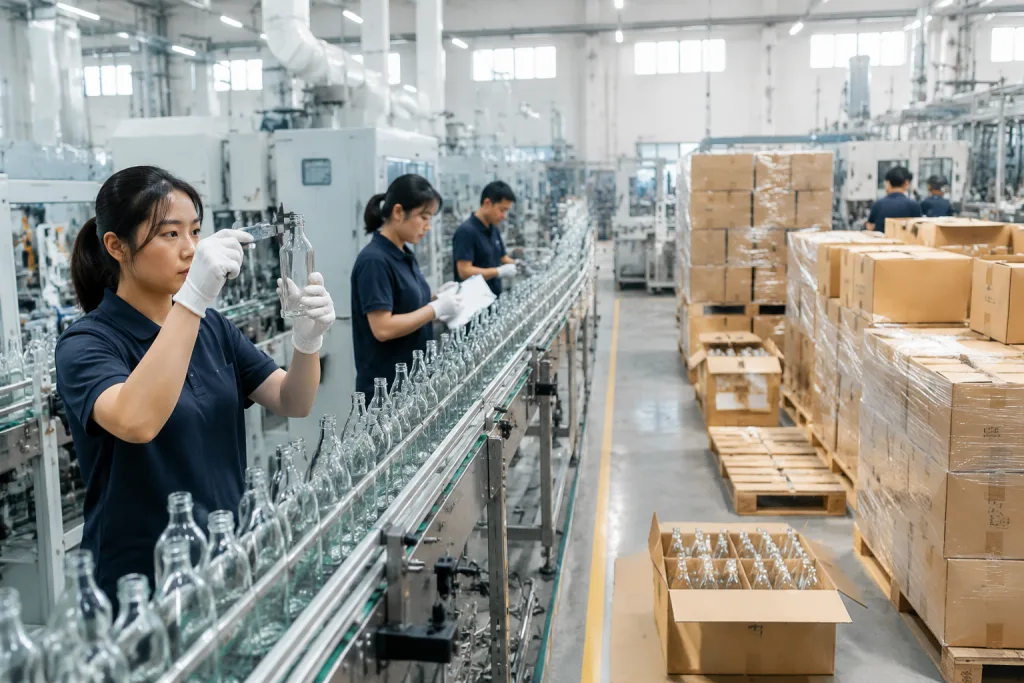
Anyone can ship a polished sample. The real test is whether the line can repeat it 30,000 times without drift. A borosilicate glass bottle factory should show monthly output, defect control, and packing discipline. At BottleForge Industrial, we run multiple glass bottle lines with monthly capacity above 800,000 units, and that number matters because replenishment stops being a negotiation. A true borosilicate glass bottle supplier in China should show actual QC checkpoints, not just nice photos.
Ask for AQL levels and ask where inspection happens. For export drinkware, buyers often use AQL 2.5 for major defects and 4.0 for minor defects, but the plan should fit the channel. We’ve seen this go sideways when a buyer assumed the carton test was enough and skipped neck checks; the first 2,000 units came back with a cap fit issue. Ask whether the factory performs incoming material checks, in-line neck inspection, and final carton compression tests. If they do private label or customized glass water bottle work often, they should have a standard process for logo approval, sample retention, and pre-shipment photo records.
Useful factory proof points include:
- BSCI or similar social compliance audit
- REACH or food-contact declarations for Europe
- Carton drop testing and palletization notes
- Sample approval and golden sample retention
Do not ignore location. Zhejiang has a dense supply chain for closures, boxes, and decoration, which cuts lead times and reduces handoff mistakes. That is why many borosilicate glass bottle manufacturers in China quote steadier timelines than a disconnected trading setup. One buyer once flagged a PO typo on the cap color code, and the local supplier fixed it same day because the decorator was 18 km away; that kind of speed is hard to fake.

Build the Export Plan Up Front
If your buyers are in Europe or North America, export compliance is day-one work. A borosilicate glass bottle supplier should know whether your target market needs LFGB, REACH, FDA food-contact support, or carton text for the destination port. We had a buyer flag a PO typo on the outer carton mark last month; that small miss would have stalled customs. If the bottle goes to Amazon, you also need FNSKU labels, suffocation warnings, and master carton marks that match the inbound booking. For distributor sales, carton pack count and barcode scan rate matter more than a pretty gift box.
Shipping structure hits your margin fast. A bulk borosilicate glass bottle packed 24 pcs per carton looks efficient until the carton fails a 1-meter drop test and breakage climbs. QC pulled the sample after one corner crush showed up at 18 kg compression; the math does not work if you chase a few cents and lose three cartons in transit. For a customizable borosilicate glass bottle sold into wellness retail, we would take the heavier carton and the cleaner claim record. This is the wrong question to ask if you only compare unit price.
Typical lead time from a borosilicate glass bottle supplier in Zhejiang is 25 to 35 days after sample approval for standard custom work, and 35 to 50 days when you add complex decoration or special packaging. If a vendor says 10 days, they are either clearing old stock or cutting steps on the line. We ship on process, not promises. Ask how many days for mold correction, print proof, and final inspection, then check whether they can hold that schedule with your MOQ.
Get a factory quote built around your channel
Send your target volume, closure, and decoration spec. We will quote a borosilicate glass bottle program with MOQ, lead time, and export packing matched to your market.
Frequently asked questions
What MOQ should I expect from a borosilicate glass bottle supplier?
For a real custom project, expect 3,000 to 5,000 pcs as a practical MOQ. A simple stock shape may start lower, sometimes 1,000 to 2,000 pcs, but once you add logo printing, a special cap, or retail packaging, the economics change fast. If the supplier offers under 1,000 pcs with full customization, check whether they are using ready stock or charging high setup fees. A serious borosilicate glass bottle manufacturer in China will explain the price break at 3,000, 5,000, and 10,000 pcs so you can judge the trade-off clearly.
How much does a custom glass water bottle usually cost FOB China?
For a standard borosilicate glass bottle custom order, FOB China pricing often sits around $1.05 to $1.80 for simple stock shapes and basic decoration. Add a custom lid, premium print, or retail box and you can move into the $2.20 to $4.50 range depending on volume. The biggest drivers are wall thickness, decoration method, and carton spec. If you are comparing borosilicate glass bottle wholesale quotes, make sure every supplier is quoting the same closure, packing count, and testing standard, or the numbers will mislead you.
What thickness is best for a borosilicate glass water bottle?
For most retail and wellness use cases, 1.5 mm to 2.0 mm wall thickness is the best balance of durability and cost. At 1.2 mm or below, breakage risk rises during packing and shipping. Above 2.2 mm, the bottle becomes heavier and freight cost increases. If your product is a customized glass water bottle for e-commerce, ask the supplier to show thickness tolerance, ideally within ±0.15 mm, and to test the packed carton for drop resistance before mass production.
How long is production from a borosilicate glass bottle factory in Zhejiang?
For standard custom orders, a borosilicate glass bottle factory in Zhejiang usually needs 25 to 35 days after sample approval. If you add special decoration, custom packaging, or a new mold, plan for 35 to 50 days. Shipping time is separate. This is why buyers should lock the print file, carton spec, and closure choice early. A good factory will not rush the approval stage because that is where the cost of mistakes is lowest.
What should I ask before choosing a borosilicate glass bottle distributor?
Ask whether they are the actual manufacturer or a borosilicate glass bottle distributor buying from multiple borosilicate glass bottle manufacturers. Then ask for MOQ, lead time, carton specs, test reports, and defect policy. If they cannot provide AQL targets, REACH or food-contact support, and sample approval records, you are taking unnecessary risk. For a distributor glass water bottle program, consistency matters more than a one-off low quote. You want the same bottle, same closure, and same pack count for every reorder.