Key Takeaways
- Most borosilicate glass bottle MOQ starts at 3,000-5,000 pcs, with lead time around 25-35 days after sample approval.
- A 3.0 mm wall and ASTM-style thermal shock target of 120°C is common for a premium bulk glass water bottle spec.
- Private label printing usually adds USD 0.18-0.65 per unit, depending on one-color silk screen, laser, or decal.
- For export buyers in Europe and North America, REACH, LFGB, and drop-test packaging matter as much as the bottle itself.
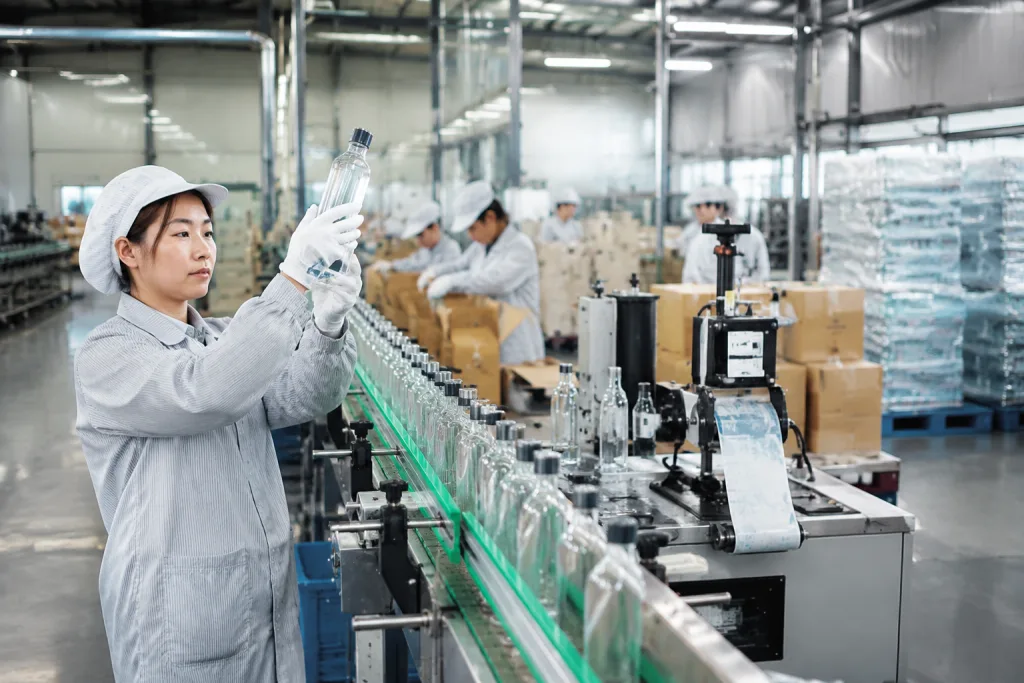
If you buy a borosilicate glass borosilicate glass bottle private label program for a wellness brand or sustainable retail line, the hard part is not finding a nice bottle. The hard part is making the glass thickness, thermal performance, closure, decoration, and packaging hold up from our line in China to your warehouse. We have seen a sample pass photos and still fail a 90 cm drop test, or come back with cap leakage after 20,000 units on a vibration run.
That is why I read this kind of project as a spec sheet, not a mood board. Go line by line: glass grade, wall thickness, capacity tolerance, surface finish, lid material, carton strength. If you buy from a borosilicate glass bottle factory in Zhejiang, you can get tighter control, but only when you ask for the numbers early; a 0.5 mm wall gap or a missed PO typo on the lid code turns into real cost fast.
Start With the Glass Grade
The first line on your spec sheet should be the glass composition. For a borosilicate glass borosilicate glass bottle private label program, ask the supplier to write low-expansion borosilicate, not a loose phrase like “heat-resistant glass.” Put the coefficient of thermal expansion on the PO, usually around 3.3 x 10^-6/K for true borosilicate. We run into this mismatch all the time. A buyer says the sample passed boiling water, then QC pulls a cracked bottle after a cold-room drop test at 4°C.
A real borosilicate glass bottle manufacturer should tell you whether the body comes from tubing or press-molded blank glass. Tubing usually gives tighter wall consistency for a premium custom glass water bottle; molded forms give more shape options and a lower unit price. That is the tradeoff, plain and simple. If your retail program needs a customized glass water bottle, the material callout should also say lead-free and cadmium-free. For Europe, ask for REACH documents; for food-contact orders headed to Germany or Austria, ask for LFGB. We ship enough of these to know the buyer will flag any vague wording on the draft spec.
Buyer impact: glass grade changes breakage rate, claim support, and whether you can market the bottle for hot and cold beverage service without overpromising.
Wall Thickness and Weight
Wall thickness is where buyers either overpay or end up with a bottle that cracks too easily. On the line, 3.0 mm is the number we usually land on for a bulk borosilicate glass bottle: solid in hand, still sane on freight. We’ve seen a buyer push for 2.0 mm to save cost, then QC pulled the sample and flagged the breakage risk on a simple drop test from 1 m. Go to 3.5 mm or above, and the math starts hurting fast in cartons of 24 or 36 pieces.
Ask the borosilicate glass bottle supplier for average unit weight by size, not just nominal capacity. A 500 ml bottle usually sits around 280-380 g, depending on shoulder shape, base glass, and lid fit. A 750 ml promotional bottle often comes in at 420-560 g. That weight changes master carton gross weight, pallet count, and the landed price. We once caught a PO typo where 0.38 kg became 0.18 kg, and the buyer flagged it before production. On a borosilicate glass bottle wholesale quote, a USD 0.12 spread can vanish once freight and breakage are on the table.
- 2.2 mm: lower cost, higher breakage risk
- 3.0 mm: balanced for retail and DTC
- 3.5 mm+: premium feel, higher freight
Capacity Tolerance Matters
Do not accept a “500 ml” line without a tolerance band. Good borosilicate glass bottle manufacturers state fill capacity and brimful capacity separately. A 500 ml usable fill might be 520 ml brimful, with a ±5% tolerance. That matters when the bottle goes into recipes, tea infuser sets, or hydration tracking.
If you are a distributor borosilicate glass bottle buyer serving multiple retailers, tight tolerance cuts complaints and keeps shelf sets consistent. For a customizable borosilicate glass bottle in wellness, you also need matching dimensions for sleeves, carry loops, and carton inserts. Ask for neck finish drawings and the outer diameter at the widest point. A 70 mm body may fit one lid SKU cleanly; a 73 mm body can trigger a second tooling pass and a new sample round.
“Capacity is not a marketing detail. It is a packaging and inventory detail.”
On the line, we run random checks from each batch with a graduated cylinder, not just a single golden sample. QC pulled three bottles at 20 °C last week, and one ran 8 ml over spec. If a factory in Zhejiang cannot state the check method, the math does not work and the numbers are loose.
Closures and Seal Performance
Most leakage complaints come from the cap, not the glass. We see this on the line all the time. For a borosilicate glass bottle customized program, lock the neck finish, gasket material, and seal test before mass production starts. For hot-fill or tea use, food-grade silicone gaskets are the normal choice; for cold drinks, a PP cap or bamboo-style cap works if the liner sits flat. Ask for a 24-hour inversion test and a 1-meter drop test with water inside. That is the real check.
If you are buying custom borosilicate glass bottle sets for a retail chain, make the supplier show cap torque data and confirm whether the thread is standard or proprietary. One buyer flagged a PO typo on the neck finish once, and the whole carton run stalled. Proprietary looks neat in a sample room, but it can trap you with one borosilicate glass bottle vendor. Standard neck finishes are easier for repeat orders and spare-part sales. For a borosilicate glass bottle wholesale program, we prefer a closure that can be sourced in China without special tooling.
Practical note: bamboo lids lift the shelf look, but they bring more variation. QC pulled the sample and found one lid off by 0.8 mm on the inner ring. If you need a borosilicate glass bottle promotional item with low defect risk, PP caps are the safer first order. That is the better bet.
Decoration and Private Label
Private label is where the bottle starts paying for itself. For borosilicate glass borosilicate glass bottle private label work, we usually run silk screen, laser engraving, ceramic decal, and UV print. Silk screen is the lowest-cost route, around USD 0.18-0.40 per unit for one color at volume. Laser engraving sits higher, often USD 0.30-0.65, but it gives a permanent mark on some cap parts and certain glass surfaces. Decals work for multi-color branding, and we have to control curing temperature tightly or the edge starts to lift.
A custom glass water bottle is not just “a bottle with a logo.” You need the logo size in mm, Pantone number, print position, and the rub target in writing. If the bottle goes into dishwashers, we see inks fade faster than the buyer expected. That is the wrong question to ask if you only approve a photo proof. A borosilicate glass bottle customizable program should include an adhesion rub test and a dishwasher cycle test; QC pulled the sample, ran 50 cycles, and the weak ink showed it fast. If your brand wants a clean premium look, the logo choice can move the product from generic stock to a retail SKU.
For a distributor glass water bottle business, decoration consistency matters as much as artwork quality. We had one PO with an off-center logo on 5,000 units, and the buyer flagged it before packing; the margin math stopped working. On the line, a 1.5 mm shift looks small until the cartons are open. That is why we lock the artwork and the first-article sample before mass print.

Packaging for Export Damage
Packaging decides whether your landed cost survives the trip from Zhejiang to your DC. A borosilicate glass bottle factory should quote inner packaging, master carton spec, drop performance, and pallet pattern separately. We run export packs on the line with a tape measure and a 32 kg master carton limit in mind. For ecommerce and retail, molded pulp trays or EPE inserts are common. Thin sleeve-only packing looks cheaper, but if the bottles hit a transshipment point in Singapore or Los Angeles, the savings disappear into claims and replacements.
For a bulk glass water bottle shipment, ask for a carton that passes a 1.0-meter or 1.2-meter drop test with full bottles. We have seen the buyer flag a PO typo on case pack count and the whole lot get held at warehouse receiving. Many serious buyers also ask for AQL 2.5 for major defects and 4.0 for minor defects on final inspection. That does not kill every claim, but it gives you a clean acceptance standard. If you sell into Amazon, you may also need FNSKU labeling, suffocation warnings, and case pack counts that fit fulfillment rules.
- Single-wall carton: low cost, weak for export lanes
- Double-wall carton: better crush resistance for long-distance freight
- Molded pulp: cleaner retail look, higher unit cost
In China, good factories can optimize carton dimensions to cut volumetric weight. QC pulled the sample last week and found a 6 mm gap that was costing air. That is not a small detail; it can move freight by 8-15% on some lanes.
MOQ, Pricing, and Factory Reality
Price only makes sense after you lock MOQ and lead time. A typical borosilicate glass bottle supplier in Zhejiang may ask for 3,000 pcs MOQ on a stock shape with logo, or 5,000-10,000 pcs when you open a new mold. For simple private label work, ex-works pricing on a 500 ml bottle often starts around USD 1.15-2.40, depending on the lid, print method, and carton spec. If you want a gift set or infuser-style assembly, the math climbs fast.
Lead time is usually 25-35 days after sample approval for standard tooling, and 45-60 days if you need new molds or special decoration. A serious borosilicate glass bottle manufacturer should state monthly output capacity in plain numbers. At BottleForge Industrial in Hangzhou, our glass-bottle line runs about 180,000 units per month across standard and custom orders, and that matters when a distributor wants split shipments instead of one big drop.
Buyers in North America and Europe should ask for FOB Ningbo or FOB Shanghai, then compare that against their own freight model. We’ve seen this go sideways: a lower unit price looks good until the carton fails a drop test or the factory slips ship dates by 12 days. Reliable borosilicate glass bottle manufacturers win on repeatability. QC pulled the sample, checked the bottle mouth at 2.5 mm, and that is the real test.
Send your bottle spec, get a factory quote
Share capacity, wall thickness, logo method, and target MOQ. We’ll quote a borosilicate glass bottle private label program from Zhejiang with clear numbers.
Frequently asked questions
What is a normal MOQ for a borosilicate glass bottle private label order?
For a stock shape with your logo, 3,000-5,000 pcs is common. If you need a new mold, expect 5,000-10,000 pcs minimum. Some borosilicate glass bottle vendors will quote lower, but the unit price usually rises sharply. In Zhejiang, a practical launch order for a wellness brand is often 3,000 pcs per SKU, enough to test retail sell-through without overcommitting cash.
How much does a custom borosilicate glass bottle usually cost?
At volume, a basic custom borosilicate glass bottle can land around USD 1.15-2.40 ex-works depending on size, cap, logo method, and packaging. A printed 500 ml bottle with a standard lid is usually cheaper than a customized glass water bottle with bamboo parts and gift box. Freight, import duty, and local warehousing can add another 25-60% to landed cost.
What tests should I ask for before buying bulk borosilicate glass bottle stock?
Ask for thermal shock, drop test, seal/leak test, dishwasher resistance if relevant, and food-contact compliance documents. For Europe, REACH is a baseline request; for some markets, LFGB is useful. A good factory should also show AQL inspection results, usually AQL 2.5 for major defects. If the supplier cannot explain the test method, the test is not worth much.
Can I get a customizable borosilicate glass bottle with low breakage risk?
Yes, but the design matters. A 3.0 mm wall, rounded shoulder, and a carton with molded pulp or EPE insert gives you a better starting point than a thin, tall bottle in a sleeve-only pack. Breakage risk drops further when the borosilicate glass bottle factory uses consistent neck finish control and performs carton drop tests before shipment.
Should I buy from a borosilicate glass bottle distributor or directly from a manufacturer?
If you need fast small quantities, a distributor can be easier. If you need private label control, recurring pricing, and packaging customization, direct factory sourcing is usually better. A borosilicate glass bottle distributor may bundle stock, while a borosilicate glass bottle manufacturer in China can adjust the mold, print placement, and carton spec. For long-term programs, direct factory sourcing in Zhejiang is usually the cleaner route.