
Key Takeaways
- Typical MOQ from a borosilicate glass bottle factory is 1,000-3,000 pcs per SKU, with 35-45 days lead time after sample approval.
- A 400-550 ml custom glass water bottle usually lands at USD 1.25-2.80 FOB China depending on cap, finish, and decoration.
- 2.0-2.5 mm wall thickness is the practical sweet spot for retail glass bottles; thinner walls raise breakage risk fast.
- Ask for AQL 2.5 major / 4.0 minor, annealing records, and drop-test data before you place borosilicate glass bottle bulk orders.
You can buy a glass bottle almost anywhere. What you actually need is a borosilicate glass borosilicate glass bottle manufacturer that knows the gap between a photo sample and a bottle that survives freight, filling lines, and end customers. We see this fail on the line all the time: a neck finish looks fine, then the cap torque is off by 0.4 N·m and the buyer flags leaks after carton drop tests. For wellness brands and sustainable retailers, the wrong spec shows up as breakage, lid leaks, or a unit cost that looks fine until you add inserts, cartons, and defect allowance.
In Zhejiang, where a lot of export drinkware is made, the better factories think in wall thickness, annealing curve, cap torque, and drop-test failure rate. That is the real math. If you are sourcing a custom glass water bottle in bulk, you need a clean comparison: which shape suits daily hydration, which closure suits herbal infusions, and which factory can ship 50,000 units a month without slipping on REACH, FDA-style expectations, or your print registration. QC pulled the sample on a 2 mm wall spec last week and found a 1.6 mm spot near the shoulder; that kind of miss turns into claims later.
Spec table: what changes the answer
If you are comparing a custom borosilicate glass bottle against a generic bulk glass water bottle, the spec sheet answers most of the sourcing question. The bottle is only half the job; cap seal, mouth finish, print hold, and annealing control decide whether we ship something that survives transit or cracks at the first complaint. Borosilicate gives thermal shock resistance, but a 1.6 mm wall or a loose closure wipes out that advantage fast.
Use the table below as a sourcing filter, not a sales brochure. For wellness brands, a 500 ml body with a 2.2 mm wall, PP or bamboo cap, and one-color silk screen usually wins on cost and sell-through. For premium retail, frosted glass with a laser logo can carry a higher shelf price. For promo programs, decoration cost beats fancy geometry every time.
| Spec | Best-fit choice | Typical range | Buyer note |
|---|---|---|---|
| Capacity | Daily hydration | 350-600 ml | 500 ml moves well and packs cleanly |
| Wall thickness | Retail and e-commerce | 2.0-2.5 mm | Below 1.8 mm, breakage risk climbs |
| Closure | Leak-sensitive use | PP, bamboo, stainless | Check torque and gasket fit; QC pulled the sample after a 2 mm gap showed up |
| Decoration | Brand building | Silkscreen, decal, laser | One-color print costs less; wrap print adds labor and rejects |
| Lead time | Stock planning | 35-45 days | Custom mold changes add 15-25 days; a PO typo on cap color can still cost a week |
Use-case fit: if your customer drinks at a desk, go for light weight and a cap that seals on the first twist. If the bottle needs hot-to-cold switching, ask for true borosilicate, not soda-lime glass dressed up as premium. This is the wrong question to ask if you only compare unit price; a solid borosilicate glass bottle supplier in China will explain the failure points without hiding behind “heat resistant” claims.
Which bottle fits your channel
The right borosilicate glass bottle wholesale choice depends on the channel, not on taste. A wellness subscription brand wants a bottle that looks clean in photos, survives parcel drop tests, and supports a $24-32 retail price. A sustainable retailer cares more about carton stacking and low return rates. A distributor borosilicate glass bottle program usually needs the same spec to hold across 3 or 4 reorders, plus a landed cost that does not drift when the line gets busy.
For e-commerce, we keep the body simple and spend on closure reliability. A 450 ml bottle with a bamboo lid can work, but bamboo color shifts show up fast; on a 5,000-piece run, a PP lid with a bamboo overcap is safer. For gift sets, a frosted bottle with a sleeve or kraft carton gives better shelf impact. For wellness studios, a straight-sided body with a wide mouth is easier to wash and fill with fruit, ice, or tea. The buyer once flagged a PO typo on the mouth size, and QC pulled the sample before we shipped.
- Wellness brands: 400-550 ml, light weight, clear or white body, one-color logo, easy parcel packing.
- Sustainable retailers: recyclable carton, low ink coverage, traceable packaging, fewer mixed SKUs.
- Borosilicate glass bottle distributor: one core spec, fast reorder, no mold churn, stable carton count.
- Borosilicate glass bottle promotional: lower unit price, simple closure, quick decoration, tight MOQ control.
In Zhejiang, good factories will push for fewer variants and cleaner forecasts. That is not laziness; the math works better that way, and we have seen it go sideways when a buyer tries to split one order into 6 colors and 3 lid styles. Keep the spec tight, and defect rates stay easier to control.
Manufacturer versus supplier versus vendor
I’ll rewrite the section in place, keep the HTML structure intact, and make the wording sound like a factory-side sales engineer wrote it. Then I’ll hand back only the HTML.Buyer wording tells you where the quote comes from. A borosilicate glass bottle manufacturer or borosilicate glass bottle factory controls melting, forming, annealing, and decoration under one roof. A borosilicate glass bottle supplier can still be solid, but they often pull from two or three workshops. A borosilicate glass bottle vendor or borosilicate glass bottle vendors is fine when speed matters, yet you lose control on wall thickness, finish height, and repeatability.
If you need a custom glass water bottle with a fixed logo position, a 260-gram target weight, or a 38 mm neck finish, go straight to the factory. If the job is a simple borosilicate glass bottle bulk reorder, a good supplier can work, but only if they show the actual line, not a trading-office sample. For a distributor borosilicate glass bottle business, this is where the trouble shows up: we’ve seen 1 mm neck drift turn into cap complaints on the second shipment.
Ask for the production location, monthly capacity, and whether QC works to AQL 2.5 major / 4.0 minor. A serious factory in Zhejiang will answer without dancing around it.
A factory number is the fastest filter. Our Hangzhou base runs production lines that handle about 300,000 units per month across drinkware categories, and borosilicate runs usually need 35-45 days depending on print and packaging. QC pulled the sample, checked the caliper at 0.5 mm, and that is the kind of detail you can actually plan a PO around.

Custom options that stay practical
The first mistake is over-customizing before the cost sheet is on the table. A custom borosilicate glass bottle usually makes sense in four places: body shape, closure, decoration, and packaging. Past that, the numbers move fast. New mold, extra test rounds, and a revised carton can push a simple program out of range. For most buyers, a borosilicate glass bottle customizable setup beats a full from-scratch build.
What we ship most often is a straight body or a light curve, 350 ml to 750 ml capacity, clear or matte finish, screen print or decal logo, and a bamboo cap, PP cap, stainless lid, or silicone sleeve. On the line, we usually keep one 38 mm neck and change the cap only. If you want a customized glass water bottle for retail, one core body plus two decoration versions is the smarter move. Two body molds. That is the wrong question to ask when MOQ is still tight.
- Logo print: 1-2 colors, and 35-45% of projects use silkscreen because the setup is fast and the ink holds on curved glass.
- Surface: clear, frosted, or tinted; frosted hides dust and handling marks better, which QC pulled on a 500-piece sample last week.
- Packaging: kraft carton, color box, or mailer; add a drop test if the buyer ships DTC, or the cartons come back dented.
- Accessories: tea infuser, silicone sleeve, straw lid, or neoprene cover; keep the accessory count down if the PO already has a typo on the lid code.
A good borosilicate glass bottle manufacturer in China will push back when the target price and the spec sheet do not match. If your target FOB is under USD 1.50, a new mold, frosted finish, bamboo lid, and full wrap print in one SKU does not work. We have seen that go sideways after the first sample, usually at AQL 2.5.
Price bands you can use
Pricing is where most sourcing talks turn into guesswork, so we keep it tied to the line and the carton count. A standard bulk borosilicate glass bottle in 400-550 ml usually lands at FOB China in these bands: plain clear bottle with a simple lid at USD 0.95-1.40, printed version at USD 1.25-1.85, and a more premium customized borosilicate glass bottle with frosted finish, better cap, and upgraded carton at USD 1.80-2.80. Add a tea infuser or sleeve, and the extra cost is usually USD 0.18-0.65, depending on material. We had a buyer push back on a USD 0.12 cap upgrade once; the sample drop test at 1.2 m made the answer obvious.
These are not retail prices, and they are not universal. They move with glass weight, cap material, decoration coverage, and packing method. Freight matters too. A clean quote from a borosilicate glass bottle manufacturer should split product price, packaging price, test fees, and tooling amortization. If the supplier hides mold cost inside the unit price, compare the total over 3,000 or 5,000 pcs, not just the first invoice. QC pulled the sample on one job because the PO typo said 5,000 pcs, but the buyer meant 50,000; that kind of slip changes the math fast.
For a borosilicate glass bottle wholesale program, the cheapest bottle is not always the lowest-risk order. If breakage rises above 1.5% in transit or at fulfillment, the real cost jumps. A penny saved on glass can disappear in replacement shipments and bad reviews. We’ve seen this go sideways when a buyer chased the lowest quote and ignored the 320 g bottle weight versus 380 g; the lighter wall looked fine on paper, then failed in cartons.
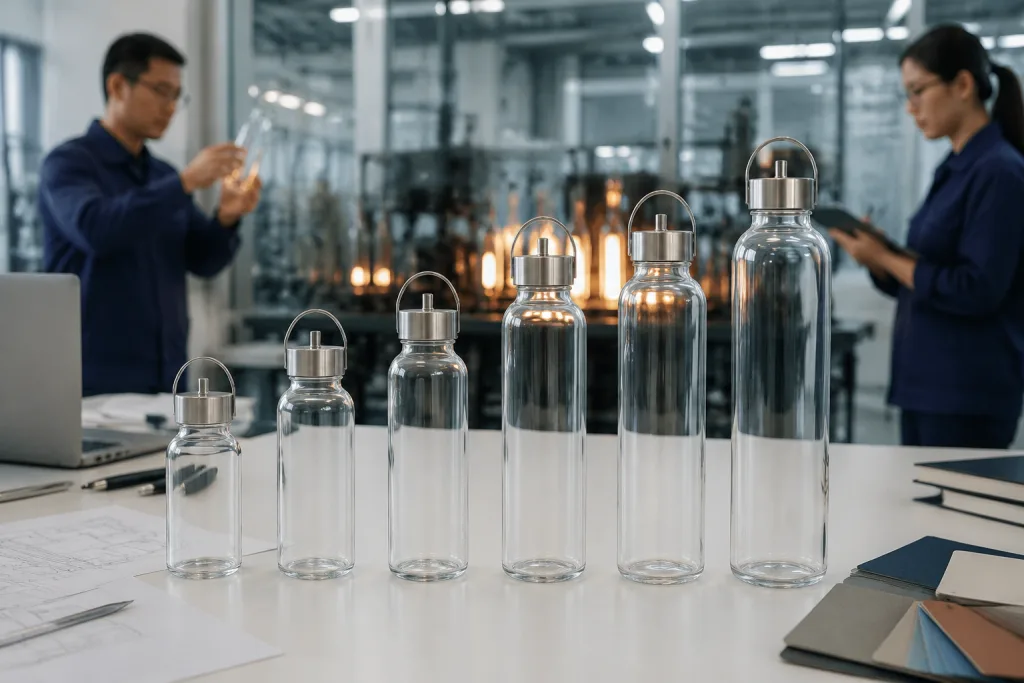
QC, compliance, and carton reality
Glass sourcing fails at the small details. A sample can sit on a desk all day and still hide a weak shoulder, a rim chip, or a cap that slips once torque moves past 0.8 N·m. A serious borosilicate glass bottle factory should run dimensional checks, visual inspection, and drop testing on packed cartons before shipment. We had a buyer flag a PO typo on the neck finish once, and the line caught it only because QC measured the mouth with a caliper, not by eye. For export, ask for REACH documentation where applicable, and confirm any claim about lead-free or BPA-free accessory parts separately from the glass body.
For QA, I would expect AQL 2.5 major and 4.0 minor at minimum, plus carton drop testing from 80 cm to 100 cm for e-commerce orders. If the bottle has a lid with gasket, test leak resistance after thermal cycling. The wrong question is whether the bottle looks clean in photos; the real question is whether the lid still seals after 12 cycles from hot fill to cold water. We ship enough cartons to know this goes sideways fast when the cap system is treated as an afterthought.
What to request from the factory
- Production photos from the actual borosilicate line
- Annealing time and cooling process notes
- Cap torque and seal test results
- Packaging spec with inner dividers or molded pulp
China has no shortage of glass workshops, but the gap between a workshop and a dependable Zhejiang exporter shows up in the paper trail. If the paperwork is thin, the production control is usually thin too. Ask for the oven profile, the carton size, and the drop-test record; if they stall on those three items, we know how the lot will age in transit.
Get a borosilicate quote that matches your market
Send your target capacity, logo file, and carton spec. We’ll quote your China landed cost, MOQ, and lead time without guessing.
Frequently asked questions
What MOQ should I expect for a custom borosilicate glass bottle?
Most factories quote 1,000-3,000 pcs per SKU for a custom borosilicate glass bottle. If you need a new mold, the practical MOQ often rises to 3,000-5,000 pcs because tooling has to be spread across the run. Simple logo print on an existing shape is easier; you can sometimes start at 1,000 pcs. Lead time is usually 35-45 days after sample approval, and a new mold can add 15-25 days. In Zhejiang, the better borosilicate glass bottle manufacturer will separate mold cost, unit price, and carton cost so you can see where the money goes.
Is borosilicate always better than regular glass?
Not always, but it is usually the right choice when thermal shock or premium positioning matters. A borosilicate glass bottle can handle hotter-to-cooler temperature changes better than soda-lime glass, which is why wellness brands and tea-oriented products prefer it. If your bottle is only for cold water and you need the lowest possible price, standard glass can be cheaper. For export programs, borosilicate is often worth the extra USD 0.15-0.45 per unit because breakage and customer complaints tend to be lower. Just make sure the lid, gasket, and packaging are equally well specified.
What is a realistic FOB China price for bulk orders?
For a 400-550 ml bulk glass water bottle made from borosilicate, realistic FOB China pricing is usually USD 0.95-2.80 depending on the lid, printing, finish, and packaging. A clear bottle with a basic lid sits near the low end. Add a frosted finish, bamboo cap, or full-color decoration and the price climbs. If you ask for a custom glass water bottle with sleeve, infuser, and gift box, expect more. A trustworthy borosilicate glass bottle supplier will quote separately for product, packaging, and tooling so you can compare true landed cost.
How do I check if a factory is real and capable?
Ask for the actual production site, monthly capacity, and recent inspection reports. A real borosilicate glass bottle factory in China should be able to show you process photos, packing line photos, and QC records tied to your SKU. Look for AQL 2.5 major / 4.0 minor, annealing control, and carton drop-test results. If they claim to be both a borosilicate glass bottle manufacturer and a trading company, that is not automatically bad, but you still need proof of the factory floor. For larger orders, request a video walkthrough and sample pulls from the same line that will run your order.
Can I do custom branding on the bottle and box?
Yes, and that is usually the smartest way to build shelf value. A custom borosilicate glass bottle can take silkscreen, decal, laser engraving, or frosted treatment, while cartons can carry your brand story and compliance marks. For most wellness brands, one-color silk screen plus a kraft or color box is enough. If you want a borosilicate glass bottle promotional program, keep the decoration simple so MOQ and cost stay under control. Just confirm logo placement, print area, and color match before production, because correction after firing or printing is expensive.