Key Takeaways
- Borosilicate bottles usually start at MOQ 3,000 pcs and sample lead time of 7 days at a Zhejiang factory.
- A 2.0 mm wall is a practical baseline for a bulk glass water bottle; thinner walls save cost but raise breakage risk.
- FOB China pricing often lands around USD 1.20 to 3.80 per piece depending on size, lid, print, and packaging.
- REACH, LFGB, FDA, and AQL 2.5/4.0 checks matter more than a pretty spec sheet when you buy custom bottles.
If you are sourcing a borosilicate glass borosilicate glass bottle factory, the first mistake is treating every clear bottle as the same product. It is not. Wall thickness, thermal shock resistance, cap system, print method, and packaging change your landed cost and your complaint rate. On the line, we check 2.0 mm with a caliper, and QC pulled the sample when one neck finish drifted by 0.3 mm. In Zhejiang and across China, the factories that know their job talk in numbers: 400 ml, MOQ 3,000 pcs, lead time 25 to 35 days, sampling in 7 days. That is the level you should expect.
Wellness brands and sustainable retailers usually want a custom glass water bottle that looks premium, survives shipping, and passes EU and North American compliance checks. The hard part is matching the spec to the channel. A borosilicate glass bottle wholesale order for retail shelves is not the same as a borosilicate glass bottle promotional program for events. We saw one buyer flag a PO typo on cap color and the order got stuck for two days. This is the wrong question to ask: "Which bottle is best?" The better question is how you sell, how you pack, and how many units you can commit to per SKU.
What Makes Borosilicate Worth It
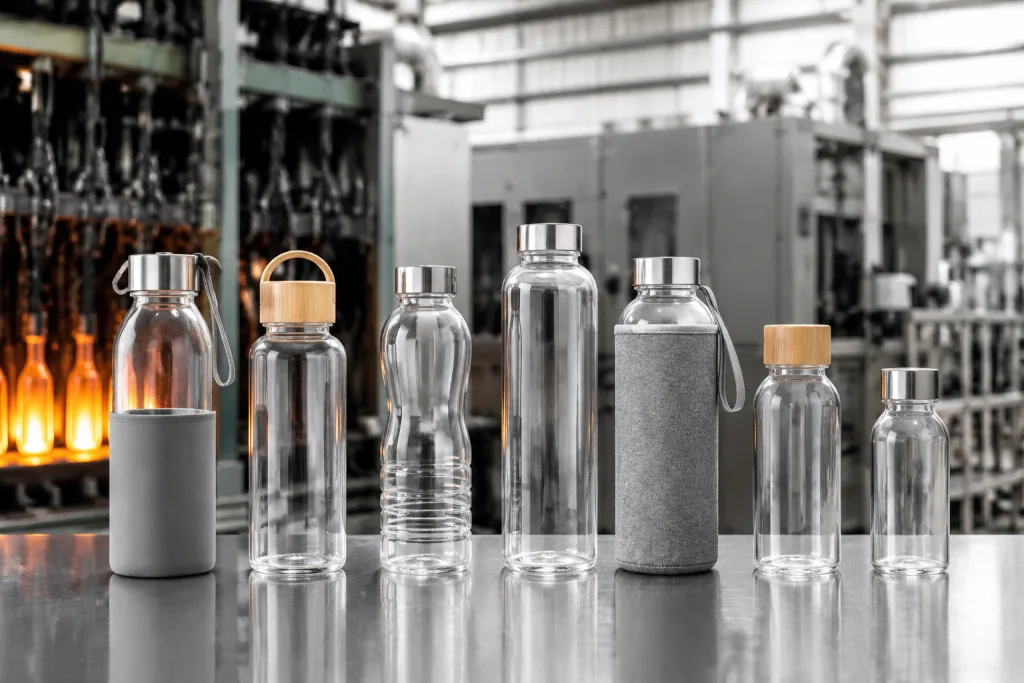
Buyers comparing a customizable glass water bottle with soda-lime glass usually land on borosilicate for one reason: it takes heat swings better. We ship a lot of tea bottles and studio bottles at 2.0 mm to 2.2 mm wall thickness, and that spec holds up better in hot-fill, cold-fill, and the carton drop test than a thin decorative bottle that looks fine on a render and chips on the line.
The price is higher. A borosilicate glass bottle manufacturer will quote more than a standard glass plant because the raw material runs hotter and the forming window is tighter. The math still works if your buyers read reviews and track breakage, because one cracked case can wipe out the margin on a whole PO. For Europe and North America, borosilicate also gives a cleaner premium story for reusable drinkware, and the buyer flagged that point fast on a recent 5,000-piece order.
Best fit: premium hydration, hot/cold beverage use, infuser programs, direct-to-consumer bundles.
Poor fit: ultra-low-price giveaways where the bottle is only a one-time promo item.
Head-to-Head Spec Table
Use the spec table below as a buyer filter, not sales copy. If a borosilicate glass bottle supplier cannot answer these numbers cleanly, the PO is not ready.
| Spec | Entry Borosilicate | Retail-Ready Borosilicate | Promotional Borosilicate |
|---|---|---|---|
| Capacity | 350 ml | 500 ml | 500 ml to 750 ml |
| Wall thickness | 1.8 mm | 2.0 to 2.2 mm | 2.0 mm |
| Cap | PP screw cap | 304 stainless cap or bamboo lid | Basic screw cap |
| 1-color silk screen | Laser logo or 2-color print | Simple one-side print | |
| Packaging | Egg tray + master carton | Color box + divider | Bulk pack |
| MOQ | 3,000 pcs | 5,000 pcs | 2,000 to 3,000 pcs |
| FOB China | USD 1.20 to 1.85 | USD 1.90 to 3.80 | USD 1.10 to 2.20 |
Blunt answer: if you need a custom borosilicate glass bottle for retail, pay for the color box and the drop test. If you need a borosilicate glass bottle bulk order for a distributor program, keep the decoration simple and put the money into carton strength. For Amazon FBA, label placement and carton size are part of the spec. We run that check on the line before packing, because the buyer will flag a 2 mm mismatch fast.
Ask for a sample carton test, not only a bottle sample. A bottle can pass hand inspection and still crack in a 1.2-meter drop if the carton flute is wrong.
Where Each Bottle Wins
Different sales channels need different bottle builds. A customized glass water bottle for a wellness subscription box has to feel good in the hand, while a borosilicate glass bottle wholesale order for a distributor lives or dies on carton strength and repeatable decoration. We run these as two jobs on the line, not one. The buyer who mixes them up usually gets the wrong quote.
Retail shelf
For shelf sales, the bottle needs a clean profile, a cap that sits tight, and packaging that survives 1.2 m drop tests. A 500 ml bottle with a bamboo lid and silicone sleeve moves well because the value reads fast on the shelf. If you are a borosilicate glass bottle distributor, this version can carry a better margin, but QC pulled the sample on color drift before. Color, print, and pack details all have to match.
Promotional and gifting
A borosilicate glass bottle promotional order should stay simple. This is the wrong question to ask if the campaign runs 90 days: do not spend on mold changes that will never pay back. One-color logo, standard cap, and bulk packing keep the math sane, and we have seen it go sideways when a buyer requested three artwork versions for a 2,000-piece run. This is where a distributor glass water bottle program works best with fixed cartons and barcode labels that scan clean on the warehouse floor.
Wellness and food use
If the bottle is for herbal tea, detox water, or infused drinks, borosilicate earns its keep. Heat resistance, no smell transfer, and clear glass matter here. A 380 g bottle with a 38 mm mouth is easier for tea use, and a PO typo on the cap code can slow the whole shipment by two days. For this buyer, a custom glass water bottle with laser engraving or a plain print usually beats a busy decorated body.
Factory Questions That Matter
When you work with a borosilicate glass bottle factory in Zhejiang or anywhere in China, skip vague questions like “Can you make it better?” Ask for numbers. You need answers you can line up against another borosilicate glass bottle manufacturer on the same sheet, not sales talk.
- What is your monthly capacity in units? A real export line should give you a number like 200,000 to 500,000 pcs per month, and the line supervisor should know it without checking twice.
- What is the MOQ by size and decoration? For custom work, 3,000 pcs is common; for complex packaging, 5,000 pcs is more realistic, especially when the carton insert is custom-cut.
- Can you provide REACH, LFGB, and FDA food-contact documentation? QC pulled the file on the last audit, and a missing test report is where orders get stuck.
- What AQL level do you inspect to? For export, AQL 2.5 for major defects and 4.0 for minor defects is the benchmark we run on a proper packing line.
- What is your sample lead time and mass production lead time? A Zhejiang plant that is organized can often do samples in 7 days and production in 25 to 35 days, if the PO text is clean and the cap spec is locked.
The value of a borosilicate glass bottle custom project is not just the bottle. It is whether the factory holds tolerances on neck finish, lid fit, logo placement, and carton count. We’ve seen this go sideways on a 0.3 mm neck mismatch, and that is where many so-called borosilicate glass bottle vendors fall apart. They quote a nice price, then ship mixed caps or cartons that crush in transit. This is the wrong question to ask: “Is your price low?” Ask whether the production team can ship a clean export lot.
At BottleForge Industrial in Hangzhou, Zhejiang, our glass bottle line runs up to 300,000 units per month, which keeps repeat orders moving without turning your project into a waiting game. That scale matters when a buyer flags a rush reorder for Europe and North America, or when the MOQ on a 450 ml bottle needs to stay fixed across two packaging styles.
Custom Options Without Regret
The best custom spec is the one that cuts returns, not the one that looks flashy in a render. For a customizable borosilicate glass bottle, the decisions that move cost are neck finish, cap material, print method, sleeve thickness, and carton layout. We run this math on the line every week, and those five items change the quote faster than any buyer expects.
If you want a custom glass water bottle that feels premium, laser engraving stays clean and holds up well. Silk screen is cheaper; 1 to 2 passes in one color is usually enough. UV print gives stronger shelf impact, but it adds process risk and can lift unit cost by USD 0.20 to 0.50. For a customized borosilicate glass bottle, a mold change can add USD 800 to 2,500 one time, so the buyer needs a real forecast, not a hope.
Packaging needs the same discipline. A box that looks good but fails ISTA-style transit testing is damage with a nice print on it. QC pulled the sample last month and the corner crush told the story. For retail programs, ask for inner dividers, 3 mm to 5 mm EPE protection, and a master carton burst strength that matches export handling. For wholesale, keep the pack tight and efficient. A borosilicate glass bottle supplier should help you pick the right version for the channel, not push the most decorated one.
Practical rule: if your annual volume stays below 20,000 pcs, skip complex shape changes. Put the money into lid quality, logo clarity, and a better carton. That is the right spend.
Sourcing Risks in China
Buying from China is simple only when the supplier is real and the paperwork matches the factory. The risk is not China itself; the risk is weak qualification. A borosilicate glass bottle vendor can look polished online and still have no export control. We run into this all the time in Zhejiang. One plant had a clean website, but the business license showed trading scope only, no production. That is the wrong question to ask: ask who owns the line.
Start with the business license, factory audit, and product test reports. If the supplier claims to be a borosilicate glass bottle manufacturer, ask for photos or video of the forming line, annealing lehr, and packing area. QC pulled the sample from the lehr end on one visit, and the wall thickness was 1.2 mm on one side and 1.6 mm on the other. Then ask for a sample that matches your final spec: same lid, same print, same carton. If the sample arrives with a different cap, you are not sampling the final product.
For North American and European buyers, compliance has to be written into the PO. Put the approved artwork file, tolerance on dimensions, AQL, carton marks, and whether you need FNSKU labels or retailer barcodes. We once saw a PO with a typo on the carton mark code, and the buyer flagged it only after the first 3,000 pcs were packed. If you buy through a borosilicate glass bottle distributor, make sure they are not hiding the actual manufacturing source. A distributor is fine if it adds value; it is not fine if it blurs who made the goods.
China sourcing works best when the buying spec is strict and boring. That is the difference between a repeat order and a chargeback.
Pricing and Ordering Reality
Pricing for a borosilicate glass bottle wholesale order is not just glass. We price the bottle, lid, decoration, carton spec, and freight load together. A 500 ml bottle in plain bulk pack usually lands around USD 1.20 to 1.80 FOB China. A retail set with a stainless lid, sleeve, and color box can run USD 2.80 to 3.80. We had one buyer flag a PO typo on carton size, and the math changed the quote by a full container slot.
A smart buyer asks for three quotations: sample spec, target spec, and lower-cost fallback. Clean move. It gives room to negotiate without cutting straight into quality. If you are planning a bulk glass water bottle launch, check carton count per case, pallet height, and the loading plan for a 20-foot or 40-foot container. On our line, a 5 mm carton gap or one extra layer can swing freight efficiency by 8% to 15%.
For a borosilicate glass bottle customizable program, I would take 5,000 pcs with controlled packaging over a cheap 20,000 pcs order that cracks in transit. QC pulled the sample, dropped it from 80 cm, and the sleeve failed before the glass did. The cheapest bottle is the one you do not replace. This is the wrong question to ask: “What is the lowest unit price?” The better question is “What lands safely, with fewer claims?” That is the logic experienced importers in Europe and North America use, and it is the same logic we use when we quote from Hangzhou, Zhejiang.
If you need long-term supply, ask your borosilicate glass bottle suppliers about reorder consistency, spare carton stock, and replacement policy for breakage above AQL. We ship better when the buyer locks carton art, lid code, and MOQ early. That is how you protect margin after launch.
Get your custom borosilicate quote
Send your size, lid, print, and packaging target. We’ll turn it into a factory-ready spec with MOQ, FOB price, and lead time.
Frequently asked questions
What MOQ should I expect from a borosilicate glass bottle factory?
For a standard custom project, expect 3,000 pcs MOQ at a capable Zhejiang factory, with 5,000 pcs more common when you add special caps, sleeves, or color boxes. If you need a true custom mold, the tooling fee can run USD 800 to 2,500 depending on complexity. For repeat orders, some factories will support 1,000 to 2,000 pcs if the mold is already open, but pricing is usually less efficient. Ask for sample lead time too; 7 days is a realistic benchmark for simple specs.
Is borosilicate better than regular glass for water bottles?
Yes, if you care about thermal shock, premium perception, and lower complaint risk. Borosilicate handles hot and cold changes better than ordinary soda-lime glass, which matters for tea, infused drinks, and reusable hydration bottles. It usually costs more, often USD 0.20 to 0.80 per piece at factory level depending on size and decoration. If your program is a low-cost promo with no repeated use, the advantage is smaller. For wellness brands and sustainable retailers, borosilicate usually justifies the price difference.
What documents should I request for Europe and North America?
At minimum, ask for REACH and LFGB for Europe and FDA food-contact support for North America. Also request the factory’s business license, recent test reports, and a QC checklist with AQL 2.5 major / 4.0 minor defect targets. If your bottle has print or coatings, confirm those materials are covered too. If you sell through Amazon or retail chains, ask the factory to support barcode labeling, carton marks, and any retailer-specific compliance file you need. A real export factory in China should be able to provide these without delay.
How much should a custom borosilicate glass bottle cost FOB China?
A plain 350 ml to 500 ml bottle with simple print can start around USD 1.20 to 1.85 FOB China. A retail-ready set with better cap, sleeve, or box often lands around USD 1.90 to 3.80. If you add custom tooling, premium packaging, or multi-color decoration, the first order cost rises quickly. Freight, duty, and carton volume can add another 20% to 45% to landed cost. Ask for a separate quote for bottle, lid, packaging, and test fees so you can compare suppliers properly.
Can a factory handle both wholesale and promotional orders?
Yes, but the spec should change by channel. A wholesale order should focus on repeatability, carton efficiency, and consistent decoration. A promotional order should focus on speed and cost, usually with 1-color print, standard lid, and bulk packaging. For a Zhejiang plant with around 300,000 units per month capacity, this is manageable if the scheduling is organized. The key is to avoid mixing promo requirements with retail packaging expectations. Tell the factory whether you are a distributor, brand owner, or retailer so they quote the right structure.