Key Takeaways
- Most borosilicate glass bottle custom projects land at MOQ 3,000-5,000 pcs and 35-45 days lead time after sample approval.
- Borosilicate glass typically handles thermal shock better than soda-lime, making it the safer choice for hot-fill or daily reuse.
- A 2.0-2.5 mm wall thickness is common for retail bottles; thinner builds lower cost but increase breakage risk.
- FOB China pricing for bulk borosilicate glass bottle programs usually sits around USD 1.80-4.20 depending on size, lid, and decoration.
If you sell wellness products or eco retail goods, you already know the headache: glass looks simple until the buyer asks for lid color, wall thickness, packaging, drop-test data, and whether the bottle survives a 35-day ocean freight from China. That is where borosilicate glass bottle custom sourcing gets real. The material matters, but the spec sheet decides the order.
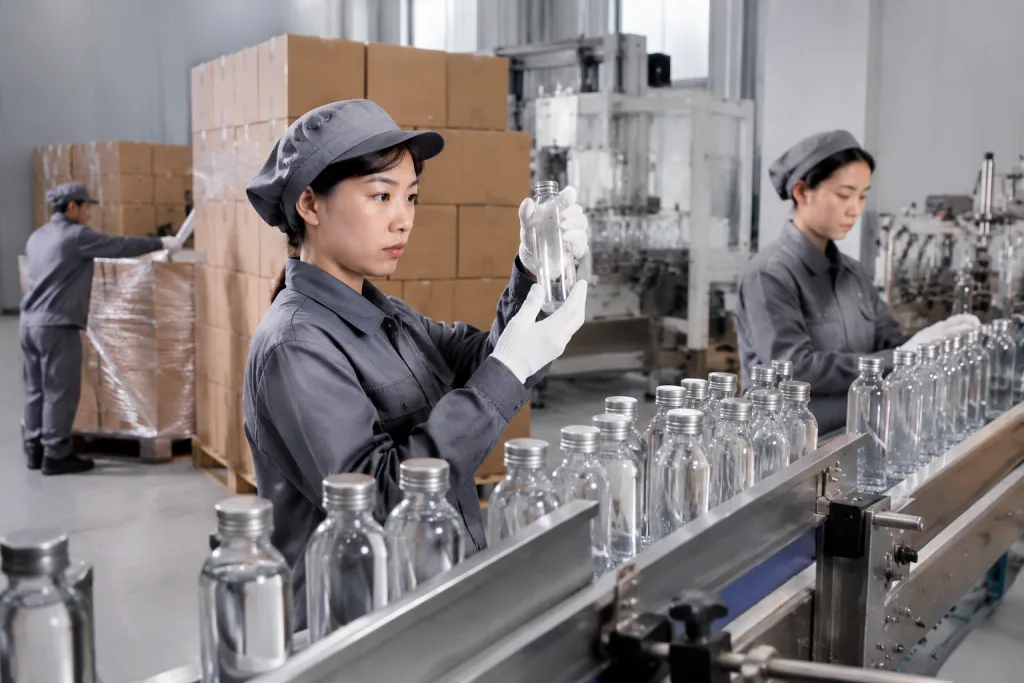
We run this in Zhejiang, China, and we see the same pattern every week on the line. Brands want a custom glass water bottle that looks premium, handles hot and cold use, and does not come back as a return. The cheapest quote usually misses the point. The better choice fits your channel, your MOQ, and how customers actually use the bottle.
Spec Table Before You Buy
For a borosilicate glass borosilicate glass bottle custom project, start with the spec table, not the mood board. We run samples this way at the line: if the buyer cannot tell us capacity, wall thickness, and lid type first, the project drifts fast. Compare the numbers, and you can spot a real borosilicate glass bottle manufacturer from a trading-only borosilicate glass bottle supplier that is guessing on the technical side.
| Spec | Retail Wellness Bottle | Promo Gift Bottle | High-Volume Distributor Bottle |
|---|---|---|---|
| Capacity | 350-500 ml | 500-650 ml | 500-1000 ml |
| Wall thickness | 2.0-2.5 mm | 1.8-2.2 mm | 2.2-3.0 mm |
| Lid type | Bamboo, stainless, PP | Basic screw cap | Leakproof steel or silicone |
| Decoration | Logo print or laser | 1-color print | Minimal, cost-controlled |
| Target FOB | USD 2.40-4.20 | USD 1.80-2.80 | USD 2.10-3.60 |
This is not academic. A customizable borosilicate glass bottle for a yoga brand needs a different spec than a customized glass water bottle for warehouse club resale. QC pulled the sample and the buyer flagged it because the 2.2 mm body looked too thin for a premium shelf pitch; that happens. If your channel wants premium presence, choose heavier glass and cleaner finishing. If the channel is price-sensitive, keep the design simple and put the money into carton protection instead.
Practical rule: when the bottle is sold for hot tea, infusions, or daily carry, borosilicate is the safer material. When it is a simple promotional item, you can still use borosilicate, but do not overspec it. The math does not work. A lid upgrade from basic PP to leakproof steel can add more cost than the bottle body itself, and we have seen that go sideways on PO lines where the buyer typed 5000 pcs but wanted 3000 pcs shipped in 12 days.
Borosilicate vs Regular Glass
You do not need a chemistry lecture. You need to know what changes your warranty claims and freight damage. Borosilicate glass handles thermal shock better than soda-lime glass, which is why a custom borosilicate glass bottle is often the right call for tea drinkers and health-conscious buyers. It also reads more technical on shelf. That helps wellness brands sell at a higher price point.
In a side-by-side test, borosilicate gives you more room for hot-fill use and washing cycles. But it is still glass. We had a buyer flag a 12-day transit lane where the bottle passed drop test but the carton failed at the corners. If your distributor borosilicate glass bottle program goes into gyms, office pantries, or subscription boxes, the cap and outer box matter as much as the bottle body.
- Thermal shock: borosilicate beats regular glass in hot-to-cold switching.
- Weight: you can run thinner walls, but do not push below 1.8 mm.
- Perceived value: it usually supports a higher retail price than standard glass.
- Risk profile: better for heat changes, still needs carton testing and AQL 2.5 checks.
If you are comparing borosilicate glass bottle wholesale quotes, ask each borosilicate glass bottle vendor the same four things: composition, wall thickness, annealing process, and breakage rate on the last export batch. QC pulled the sample on a 500 pcs lot last week and found two lip chips after annealing was rushed. A real borosilicate glass bottle factory in China answers fast and gives numbers. If they cannot, the math does not work.
Lid, Seal, and Leak Control
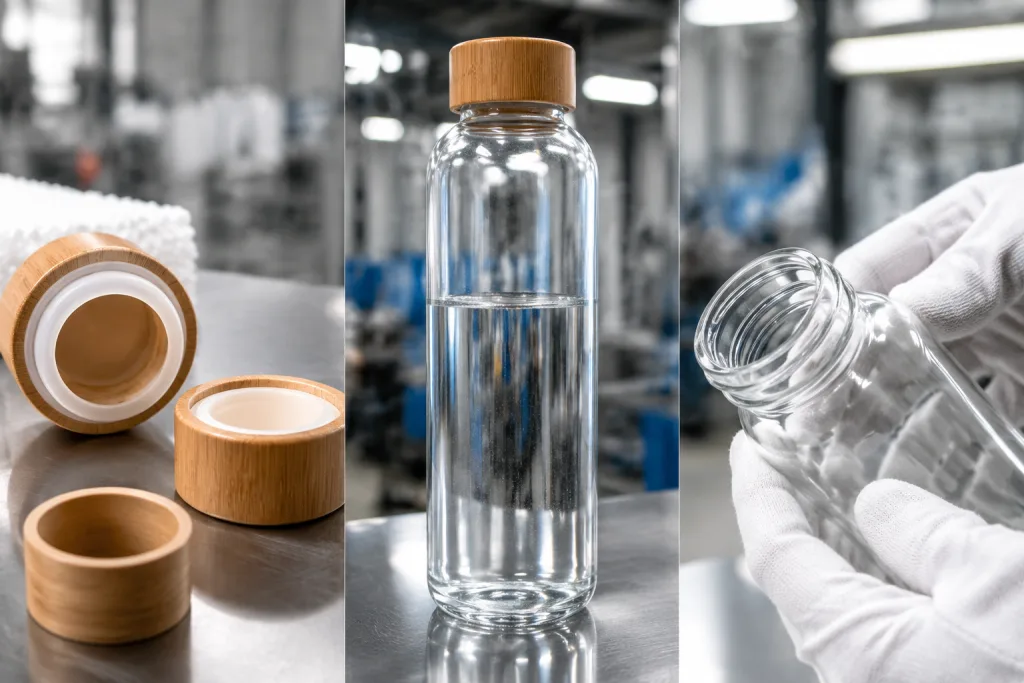
Most bottle complaints start at the closure, not the glass. We see it on the line all the time. A custom borosilicate glass bottle can pass body inspection and still leak in a backpack if the cap stack is wrong. For wellness brands, a stainless lid with a food-grade silicone gasket is the safer setup. Bamboo can sell the look, but the sealing face needs tight machining if you want the same result on every 5,000-unit run.
For a borosilicate glass bottle customizable program, write the cap spec into the sample approval sheet. Do not settle for “same as sample” unless the supplier names the gasket material, thread pitch, torque range, and top-load tolerance. The buyer flagged a missing gasket code on a PO before, and that typo cost us a round of re-samples. If you are buying bulk borosilicate glass bottle units for retail, this is where a 0.3 mm gap turns into a claim.
Ask for a leak test at 30-50 kPa, a 1-meter drop test, and a hot-cold cycle test before mass production.
That is why experienced borosilicate glass bottle manufacturers in Zhejiang or elsewhere in China treat the cap as part of the product, not an accessory. QC pulled the sample on a 100% leak check once and found one loose gasket out of 200 lids. If the bottle is sold as a daily carry, that check beats a pretty sleeve every time.
MOQ, Pricing, and Lead Time
Buyers often ask for a custom glass water bottle quote first, then start talking about channel. That is the wrong order. MOQ and lead time follow the build. For a standard borosilicate glass bottle bulk order with a stock lid and one-color print, our factory usually sets MOQ at 3,000 pcs. If the package needs special cap tooling or a printed carton, 5,000 pcs is the cleaner number.
In Zhejiang, China, a borosilicate glass bottle manufacturer that runs mixed programs will usually ship 80,000-120,000 units per month, depending on line changeovers and decoration steps. We run those numbers against oven slots, pad-print setup, and carton packing speed. Typical lead time is 35-45 days after sample sign-off and deposit, then 20-35 days by ocean freight to Europe or North America. A supplier promising 12 days on a fully customized order is selling stock or hiding a shortcut somewhere.
- FOB China: expect USD 1.80-4.20 per unit for most retail-ready builds.
- Sample cost: usually USD 40-120, based on tooling and logo setup.
- Tooling: simple printing may be free at volume; custom molds are separate.
- Payment: 30% deposit, 70% before shipment is still standard.
For a borosilicate glass bottle distributor, stable supply and cartons that survive transit matter more than the first quote on the spreadsheet. We have seen this go sideways: the low bid looks fine until breakage, rework, and delayed delivery hit the landed cost. QC pulled the sample last week and found one carton with a 3 mm print shift; that is the kind of miss that turns into a claim.
Quality Checks That Matter
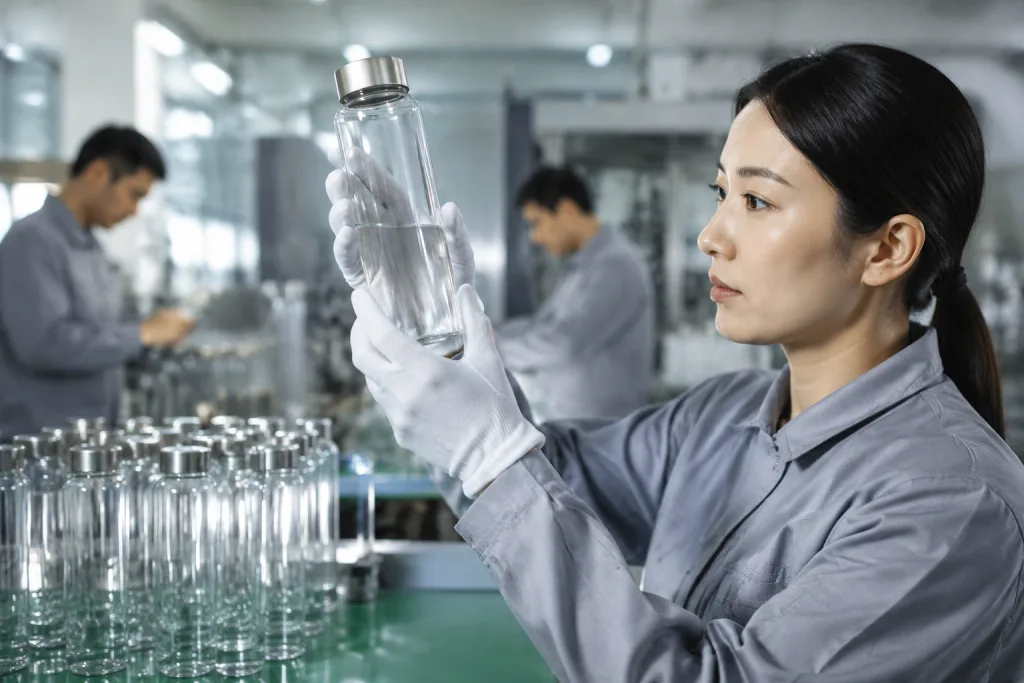
A borosilicate glass bottle supplier should show more than a clean product photo. We want numbers. For export orders, ask for AQL sampling on appearance and functional defects, carton drop tests, and raw material declarations. If the bottles go to the EU or North America, check REACH for coatings, inks, and gasket materials, then ask for food-contact declarations where they apply. QC pulled a sample on the line last week, and the wall thickness was 1.6 mm on one side and 1.9 mm on the other. That is the sort of spread that turns into breakage after 12 days in transit.
The checks that protect margin are plain:
- Dimensional tolerance: confirm bottle mouth, height, and capacity stay within the agreed limits; a 500 ml bottle that fills at 470 ml creates a buyer problem fast.
- Wall consistency: uneven glass creates stress points and higher breakage.
- Annealing quality: poor cooling raises crack risk during transport; we have seen this go sideways after a pallet drop.
- Decoration adhesion: print should survive washing and normal handling.
- Packaging performance: inner carton and master carton must pass transit tests.
If you are buying a borosilicate glass bottle promotional item, do not skip these checks just because the unit price is low. The math does not work. Promo bottles get tossed, stacked, and shipped hard, and the first breakage wave can hurt your brand more than a weak campaign ever will. A real borosilicate glass bottle factory in China will usually share sample reports and can arrange third-party inspection before shipment. We once caught a PO typo that listed the carton as 24 pcs instead of 20 pcs, and that kind of miss is exactly why we check every export pack list.
Best Fit by Channel
Not every custom borosilicate glass bottle fits the same channel. Wellness brands usually ask for a cleaner finish, better carton presentation, and a premium story they can defend at 30% gross margin. Sustainable retailers watch shelf appeal, drop-test results, and reorder stability. Distributors care about margin, carton density, and how fast the line can pick and pack without slowing warehouse flow.
Here is the practical fit map: we ran these specs through QC on a 350 ml sample, and the buyer flagged the lid torque before approval.
- Wellness brand: choose 350-500 ml, a premium lid, laser logo, and a heavier bottle wall that feels good in hand.
- Sustainable retailer: choose recyclable packaging, one-color decoration, and carton protection that survives a 1.2 m drop test.
- Distributor: choose a standardized customized glass water bottle with fewer SKU changes and easier replenishment.
- Promotional buyer: choose a simpler customized borosilicate glass bottle with tighter decoration cost and a clean PO spec.
If your business model is wholesale, a borosilicate glass bottle wholesale program has to stay repeatable. That means the same cap source, print placement locked within 2 mm, and a carton spec that survives pallet stacking. If you are a borosilicate glass bottle distributor serving multiple accounts, ask the factory to freeze the spec for one quarter before changing anything. The math does not work when one PO says 500 ml and the next line on the file says 550ml. China can produce fast, but too many revisions will clog inventory and make forecasts useless. Zhejiang factories that export every week know this, and they will push back when a buyer wants to tweak the lid color after sample sign-off.
How to Brief the Factory
The fastest way to get a usable quote is a tight brief. For a borosilicate glass bottle custom project, we want the capacity, target price, lid material, decoration method, carton spec, test items, and destination market on day one. If those seven points are missing, the quote drifts and QC ends up chasing blanks later.
Use this structure when you send RFQs:
- Product: custom borosilicate glass bottle, 500 ml, for hot and cold drinks.
- Material: borosilicate glass, target wall 2.2 mm.
- Closure: stainless lid with silicone gasket.
- Decoration: one-color logo print or laser engraving.
- Order size: 5,000 pcs bulk glass water bottle program.
- Compliance: REACH, food-contact declaration, AQL inspection.
- Delivery: FOB Ningbo or Shanghai, China.
We run quotes faster when the brief looks like this, because the factory can line up the same inputs and stop guessing. A buyer once sent “500ml bottle” with no lid spec; the sample came back with a mismatched cap and the PO typo only made it worse. If you source from Zhejiang, this matters even more, since one plant may only do assembly while another handles melting, forming, and packing in-house. Give clear numbers, and the quote comes back cleaner.
Request your borosilicate bottle spec sheet now
Send your target price, volume, and market, and we will map the right bottle build, MOQ, and export-ready test plan.
Frequently asked questions
What is the usual MOQ for a borosilicate glass bottle custom order?
For a standard borosilicate glass bottle custom run, MOQ is usually 3,000 pcs. If you want special lid tooling, printed packaging, or multiple colors, 5,000 pcs is more realistic. Very simple stock-based orders can go lower, but once you change the mold, cap, or carton, the economics move up fast. A serious borosilicate glass bottle factory in China will tell you the MOQ early instead of hiding it until sample approval.
How much does a bulk borosilicate glass bottle cost?
Most bulk borosilicate glass bottle programs land around USD 1.80-4.20 FOB China per unit. The final number depends on capacity, wall thickness, lid type, decoration, and packaging. A 500 ml bottle with a basic steel cap will sit near the low end. A premium customized glass water bottle with laser logo, bamboo details, and retail packaging moves higher. Ocean freight, duties, and local warehousing are separate.
Is borosilicate better than regular glass for wellness brands?
Usually yes. Borosilicate handles thermal shock better, which matters if your customers pour in hot water, wash bottles frequently, or move between hot and cold liquids. It also supports a more premium positioning than ordinary glass. That said, the bottle still needs proper wall thickness and a good cap. A weak closure can ruin the user experience even when the glass itself is excellent.
What tests should I request before shipment?
Ask for AQL inspection on appearance and function, a 1-meter drop test, leak testing, and carton compression or transit simulation. For EU and North American markets, request REACH-related declarations for inks, gaskets, and coatings, plus food-contact documentation where applicable. If the supplier cannot show a basic test report, treat that borosilicate glass bottle supplier as high risk, even if the quote is attractive.
Can a distributor place a private-label order quickly?
Yes, if the spec is stable. A distributor borosilicate glass bottle order with stock mold, one-color logo, and standard carton can often move from sample approval to shipment in 35-45 days. If you want custom mold changes or special packaging, add time. For North America and Europe, plan extra transit time, since ocean freight commonly adds 20-35 days depending on port and season.