Key Takeaways
- MOQ starts at 1,000 pcs for most custom logo blender bottles, with 20-25 day lead time after sample approval
- Tritan body options typically cost USD 2.10-3.40 FOB Zhejiang depending on lid, print, and packaging
- A 0.8 mm logo pad print survives better than thin ink fills after 30-50 dishwasher cycles
- Request AQL 2.5 inspection, REACH documentation, and torque/leak testing before you approve production
When you buy a blender bottle with custom logo, the logo is the easy part. The risk sits in the spec sheet: plastic grade, lid seal, blending ball material, print durability, and whether the bottle still holds up after a 2-meter drop and 30 wash cycles. Skip those points, and you pay for a clean render but receive a weak product. We’ve seen the buyer flag a lid typo on the PO, and that small miss turned into a 2-week delay.
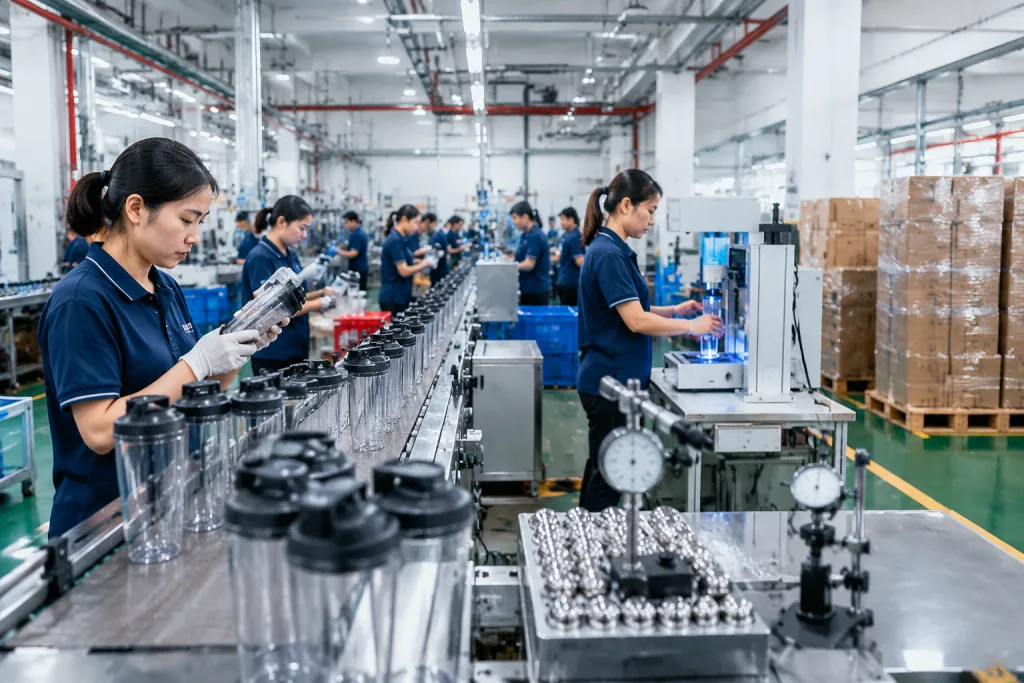
At BottleForge in Zhejiang, we see this every week from European and North American buyers. A good custom drinkware program is not just decoration. It means choosing a canteen factory or canteen supplier that holds tolerances, passes REACH or FDA-related checks, and ships on time. If you are comparing canteen manufacturers or canteen distributors, read the product like an engineer: from resin to retail carton. QC pulled the sample on the line at 1.5 mm wall thickness, and that is where the real decision starts.
Start with the bottle body
The body spec sets the feel in hand, the print result, and how the bottle survives cartons and parcel drops. For a blender bottle with custom logo, the usual picks are PP, Tritan, PET, and stainless-steel hybrid builds. If you want a retail-ready story, Tritan is the cleanest choice: clear, impact resistant, and easier to sell as premium custom drinkware. PP costs less, but the buyer flags it fast when the wall looks cloudy or the body flexes on the line.
Check wall thickness first. Do not start with the resin name. A workable range is 1.2-1.8 mm for Tritan bodies and 0.9-1.2 mm for PP. Go thinner and the bottle feels flimsy, while print registration starts drifting. For canteen customizable orders tied to gym, sports, or corporate gift programs, ask the canteen manufacturer for shrinkage data and mold cavity count. We run a 4-cavity mold in Zhejiang on some programs, and it beats a single-cavity tool on unit cost, but only when cooling and gate balance are under control. QC pulled the sample last week and found a 0.2 mm wall shift; that small gap changed both breakage rate and how the buyer judged the piece.
- Tritan: premium look, better clarity, usually USD 0.35-0.60 higher than PP
- PP: lower cost, lighter, less rigid, and more basic on shelf
- Stainless hybrid: heavier, better heat retention, and not the best fit for blender use
Lid and seal details matter
The lid is where most claims start. A blender bottle with custom logo is often judged by leak performance, not artwork. We run a 0.7 N·m close test on the torque meter, and if the cap starts biting or the thread feels rough, the buyer flags it fast. You want a screw thread with consistent engagement, a silicone gasket that sits flat, and a cap that opens without cross-threading after repeated use. A good spec sheet should name the gasket material, usually food-grade silicone with 50-60 Shore A hardness, and the closure torque target.
Ask for leak testing under inverted conditions for at least 30 minutes, and better yet 24 hours in random carton samples. On one PO, the buyer typoed the lid code by one digit, and QC pulled the sample before packing; that saved a mixed-lid shipment. For Europe and North America, buyers should ask whether the lid components are tested for REACH-restricted substances and whether the factory can support FDA-oriented material declarations where relevant. Zhejiang factories with strong export habits usually know how to package this documentation cleanly. A canteen vendor that cannot tell you gasket spec, thread pitch, and cycle-life data is not a serious long-term supplier. If you are sourcing a custom canteen or customizable growler line alongside blender bottles, keep lid families standardized. That reduces spare-part confusion and improves replenishment speed by 10-15%.
Rule of thumb: if the lid is the wrong spec, the logo does not save the product.
Choose the print method by use case
Your logo method should match the sales channel, not a mood board. For a blender bottle with custom logo, silk screen is the usual pick for 1-color or 2-color artwork on flat or lightly curved panels. Laser engraving is uncommon on plastic, but it works on stainless parts. Pad printing fits small logo areas and tighter curves. UV printing gives more color freedom, yet on daily-use bottles it needs tight curing control and adhesion checks.
If the bottle is for a canteen promotion or a distributor canteen campaign, keep the logo simple. A 35-50 mm-wide imprint usually reads cleanly and keeps setup cost down. Need a bigger brand story? Ask for wrap print, but the tradeoff is clear: more coverage means more chance of misalignment and more scrap. On the line, we usually test abrasion with 50 wipe cycles using an alcohol cloth and 30 dishwasher cycles if the buyer plans retail or gym use. Bigger is not better here. A durable custom logo beats a flashy one. For custom growler projects, the same logic applies: a smaller, higher-contrast mark often outperforms a decorative full wrap.
- Silk screen: cost-effective, strong opacity, good for 500-5,000 pcs repeats
- Pad print: better for curves and small details
- UV print: broader color range, needs tighter process control
Match the mixer to the market
The mixer is the function, not decoration. Most blender bottles run a wire whisk ball, a plastic blender grid, or a molded insert. Wire balls are the simplest build, usually stainless steel 304 with a 2.2-2.5 mm wire diameter and a 40-50 mm ball size. They break powder fast, but they clang on the line and can make a premium custom drinkware program look cheap. Plastic grids ship quieter and are safer in transit, yet the mold has to be right or the insert jams in the bottle neck.
If you are selling to sports clubs, supplement brands, or distributor drinkware promotions, ask the factory for mixing data with 30 g protein powder in 300 ml water. That test shows whether the insert cuts clumps or just spins them around. We’ve seen buyers approve a nice bottle, then the complaints start because the mixer is weak. This is the wrong question to ask: “Can it mix?” Ask, “How does it perform at our powder load?” On a canteen customized program where the bottle is a giveaway, the math is simple. A better mixer may add only USD 0.08-0.15 per unit, and QC pulled the sample faster when the blend was clean.
For buyers managing canteen distributors or distributor growler programs, keep the mixer type the same across SKUs. One mixer, one neck size, one spare part. We ship faster when the warehouse only has one replacement item, and reorders from China stay clean even if the PO has a typo on the insert code.
Packaging changes the landed cost
Packaging is where small choices turn into landed cost. A plain polybag saves cents, while a printed retail box can add USD 0.25-0.60 per unit before freight. We saw one buyer push back on a USD 0.18 insert change, then the math showed the carton cube cost more than the insert itself. If you sell through Amazon FBA or retail chains, the job gets stricter: individual barcode labels, suffocation warnings, and carton sizes that fit pallet planning. For B2B or a canteen distributor, a master carton with dividers is often enough.
For a blender bottle with custom logo, the carton has to protect the spout and cap from deformation. On our line, a 3 mm cap rib looked fine by eye, then QC pulled the sample and the closure cracked at the corner after a 90 cm drop. A good export carton in Zhejiang usually uses 5-ply board for normal shipping and moves to 7-ply if the route is rough or the bottle is heavy. Keep carton weight below 15 kg if you want easier handling in North American warehouses. Ask for drop test results on packed samples from 80 cm to 100 cm; that is where weak closures show up. If you need custom canteen and canteen promotional packaging in the same program, unify carton art, insert size, and label placement. Your forwarder sees the difference right away.
- Bulk pack: lowest cost, best for wholesale replenishment
- Retail box: higher cost, better for shelf impact
- FBA-ready pack: needs barcode, label, and carton compliance
MOQ, lead time, and factory capacity
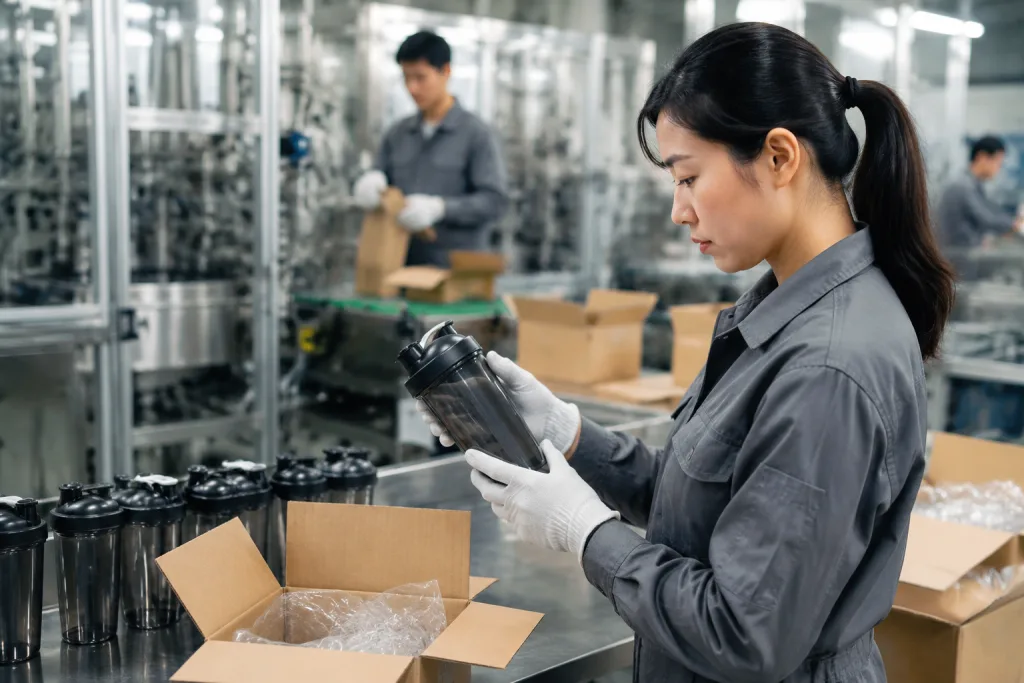
Buyers usually ask for a sample first, then find the factory has no production discipline. A serious canteen factory should put MOQ, sampling time, and monthly output on the table from the start. On our Hangzhou, Zhejiang line, a typical MOQ for a blender bottle with custom logo is 1,000 pcs per color or print version, sample lead time is 5-7 days, and mass production takes 20-25 days after confirmation. Monthly capacity runs about 300,000 units across drinkware lines. That number matters when a Q4 forecast jumps by 2x.
Do not let a low MOQ cover weak process control. A canteen manufacturer with 50,000 pcs/month capacity can still beat a broker who talks up 300,000 and then loses track of mold maintenance or inspection. We run AQL 2.5 on appearance and AQL 1.5 on critical function for retail orders. QC pulled the sample on a lid seal issue once, and the buyer flagged it before shipment; that saved a chargeback. If you are working with canteen suppliers in China, get written coverage for spare lids and replacement balls too. One order is easy. Repeat supply is the test. The math does not work if the line cannot hold raw material and printing slots without rush fees.
For North American buyers, FOB Zhejiang is usually the cleanest pricing basis. You handle freight and customs, and the factory stays on production, not shipping improvisation. We have seen buyers miss a PO typo on the port code and lose two days fixing it. That is the wrong question to ask about price alone.
Approve the sample like a buyer, not a fan
The pre-production sample should answer buyer questions, not photo questions. Check print alignment, lid fit, gasket placement, body clarity, and any sharp edges at the mouth or base. We run a caliper on the bottle and measure usable capacity ourselves. A 500 ml claim that lands at 470 ml usable capacity creates a fight with brand owners and distributors. If the bottle is for supplements or gym use, cycle the screw cap 50 times. If it squeaks, binds, or loosens, stop and revise the mold or thread tolerance.
Before production starts, ask for a signed golden sample, material declaration, carton dimensions, and a packaging photo set. If the order covers a custom canteen, customizable canteen, or customized drinkware range beyond blender bottles, use the same approval checklist across all SKUs. That keeps QC honest on the line. For European buyers, REACH documentation is still the standard ask; for North America, the spec file and label data need to match the actual product. A serious canteen supplier in China does not push back on this. We see the same process cut disputes later by a lot.
What to reject immediately: uneven logo edges, cloudy resin, loose cap torque, off-center mixer insert, carton crush after a simple drop.
Send your spec sheet for a fast quote
Give us material, logo method, quantity, and target market. We’ll return a clear FOB Zhejiang quote, sample timing, and packaging options.
Frequently asked questions
What is a normal MOQ for a blender bottle with custom logo?
For most factory-direct orders, a normal MOQ is 1,000 pcs per design or color. Some canteen manufacturers in China may quote 500 pcs, but the unit price usually rises by 15-30%. If you want multiple logo positions, custom carton art, or a special lid, expect the MOQ to move to 2,000 pcs. For repeat buyers, reorders can sometimes start at 500 pcs if the mold and print setup already exist. The key is to separate sample flexibility from production discipline; those are not the same thing.
How much does a custom logo blender bottle cost FOB?
A standard Tritan blender bottle with custom logo often lands around USD 2.10-3.40 FOB Zhejiang, depending on body thickness, lid style, print method, and packaging. A simpler PP version can come in closer to USD 1.20-1.80 FOB, while premium retail packaging or multi-color UV print pushes the price up. If you add a stainless mixer ball, individual box, and barcode label, budget another USD 0.20-0.50. Freight, duty, and last-mile costs are separate, so compare total landed cost, not just factory price.
What print method lasts longest on custom drinkware?
For most plastic bottles, silk screen with a properly cured ink system is still the most reliable option for a single-color logo. It typically holds up better than a cheap UV print when the bottle is washed regularly. A good print should survive 30-50 dishwasher cycles without obvious peeling, though exact results depend on detergent, temperature, and usage. If your artwork has fine gradients, UV printing gives more design freedom, but you need stricter adhesion testing. Always ask for abrasion tests before approving production.
Can you combine a blender bottle order with custom canteen items?
Yes, and it is often smart if you want better freight efficiency and one QA process. Many buyers combine a blender bottle with custom logo, a custom canteen, and even a custom growler into one program, provided the lids, cartons, and inspection standards are clearly separated. This works especially well for distributor drinkware orders because you can fill one container with multiple SKUs instead of spreading volume across several shipments. The factory should confirm if the items share the same printing line, packaging line, and QC team so the schedule stays realistic.
What documents should I request from a canteen supplier in China?
At minimum, ask for material declarations, sample photos, carton specs, and inspection records. For Europe, REACH-related documentation is important; for North America, request product compliance statements aligned with your channel requirements. If the bottle uses stainless parts, ask for steel grade confirmation such as 304 or 316. You should also ask for AQL inspection criteria, production lead time, and packing list format. A reliable canteen supplier or canteen vendor will give these without turning it into a negotiation drama.