Key Takeaways
- A practical blender bottle wholesale MOQ starts at 3,000 pieces per color for custom logo work
- AQL 2.5 for major defects and AQL 4.0 for minor defects is a reasonable inspection baseline
- FOB China pricing can move 8-18% depending on resin grade, lid complexity, and logo method
- A 35-45 day production lead time is realistic after sample approval for most custom shaker orders
Your buyer asks for a 700 ml shaker bottle with a mixing ball, matte finish, logo printing, and delivery before a fitness launch. Sounds easy. Then the quotes land: one supplier says USD 1.18, another says USD 2.05, and both write “food grade” on the sheet. The lowest price is the wrong question to ask. Ask what resin, what wall thickness in mm, what ball grade, and whether QC pulled the sample after the logo passed the 3M tape test.
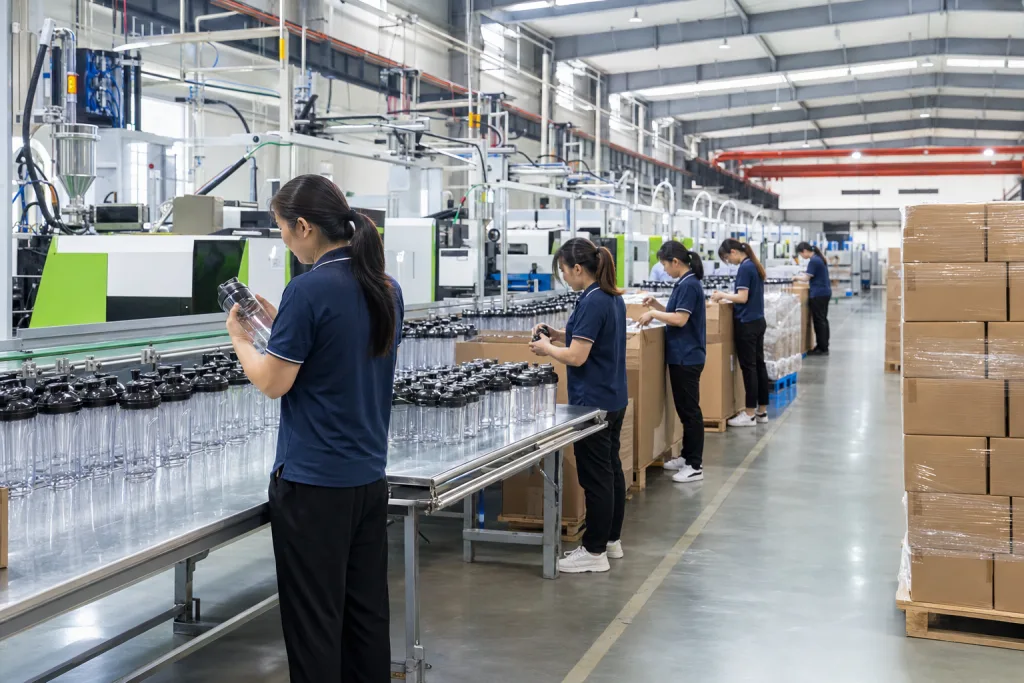
At our Zhejiang factory, we see this sourcing pattern 6 or 7 times a month from Europe and North America: buyers start with blender bottle wholesale, then add bulk drinkware or a wholesale canteen project to fill one 40HQ. The order runs clean only when the specification, compliance, decoration method, packing detail, and AQL 2.5 inspection plan are locked before the deposit leaves your account. We’ve seen this go sideways over small items, including a PO typo that changed “matte black lid” to “black bottle,” and the line had already set up the screen-printing jig.
Start With The Actual Buyer Brief
Use a real buyer brief. You are sourcing for a sports nutrition brand. The first purchase order is 10,000 pieces of 700 ml blender bottles, split into black body, smoke gray body, and transparent clear body with the same logo position. The retail channel is gyms plus online subscription bundles in North America. You need a logo on the cup body, a measurement scale, a stainless mixing ball, and carton labels that match your warehouse receiving rules. On our line, the first sample would go to QC with a digital caliper for lid thread fit and a 24-hour upside-down leak test.
This is where around 7 out of 10 blender bottle wholesale projects start to drift. The inquiry says “BPA-free shaker, best price,” so the supplier fills in the blanks. One factory quotes PP cup material, another quotes Tritan, and a third quotes PETG without saying the tooling shrinkage is different. One includes a 304 stainless ball; another includes a lighter 201 stainless ball. One lid has a silicone gasket; another relies on plastic-to-plastic sealing. Small wording, big trouble. We have seen buyers flag leakage after the pre-shipment sample because the PO only said “shaker bottle,” and the approved lid drawing never listed gasket hardness in Shore A. These details change cost, leakage risk, and customer reviews.
A useful RFQ should state how the bottle will be used. Will the consumer shake protein powder with cold water only, or pour in hot coffee after training? Will the bottle go in a dishwasher? Is the product sold as drinkware wholesale for general retail or as a branded promotional item? For PP, we usually suggest working temperature around -10°C to 100°C, but printing durability and shape stability still need testing. For Tritan, the clarity looks better on shelf and supports a higher retail price, but the resin cost is higher. The wrong question is “what is your best price?” Ask what material, lid structure, and test standard the price covers. QC pulled one sample last month where the 700 ml scale was off by 35 ml at the top mark; that is the kind of issue a clear brief catches early.
For a 10,000-piece order in China, a clean brief should include capacity tolerance, cup weight target, lid type, gasket material, ball diameter, logo size, packaging style, barcode requirements, and compliance market. Put the target carton weight in the brief too; we usually keep master cartons under 18 kg because warehouse teams complain when the receiving rule says 15 kg max and the supplier ships 19.6 kg. If you are also planning canteen bulk or alcohol flask bulk programs later, say so early. A good factory can align colors, master carton sizes, and inspection standards across the larger bulk drinkware plan. We ship smoother when the buyer gives the full plan before color matching starts.
Lock The Materials Before Pricing
The cheapest quote is often cheap because the material spec is loose. For blender bottle wholesale, we usually run PP, Tritan, or sometimes PETG on the line. PP fits value programs because it molds cleanly and keeps the resin cost down. Tritan is clearer, takes impact better, and looks right on a premium retail shelf. PETG can look nice in a sample room, but we do not like it for shaker bottles with repeated drop claims or dishwasher wording on the box. QC pulled one PETG sample last year with a cracked shoulder after the third 1.0 m drop. That is not a small issue.
For food-contact drinkware sold into the EU or North America, match the test report to the destination market before you ask for final pricing. For Europe, buyers often request LFGB or EU 10/2011 migration tests plus REACH declarations for relevant components. For the United States, FDA food-contact compliance is the normal baseline, and some retailers ask for Prop 65 documentation. If the bottle is for children, the rules tighten. If it crosses into kids bottle territory, ask about ASTM F963 and CPSIA where applicable. We have seen this go sideways when a PO says “sports bottle” but the artwork has cartoon animals and a 6+ age mark.
In Zhejiang, China, we normally split the quote into material, tooling, decoration, packaging, and testing. Then you can compare line by line instead of guessing. For example, a 700 ml PP shaker with standard screw lid and 304 ball may land around USD 1.20-1.65 FOB Ningbo at 10,000 pieces, depending on wall thickness, cap design, and logo method. A Tritan version may run USD 1.75-2.60 FOB. These are not promises; resin price and exchange rate move. If one supplier comes in 25% under the pack, this is the wrong question to ask: “Can you match it?” Ask what material grade, wall weight, gasket hardness, and test cost they removed. We once found a PO typo that changed “Tritan” to “transparent plastic,” and the math suddenly looked good for the wrong reason.
Wall thickness matters. A thin cup can save 6-10 g of resin, but it can flex during shaking and put stress on the lid thread. For a 700 ml shaker, we like enough wall strength for the bottle to survive a 1.0 m drop test when filled with room-temperature water. Not every promotional buyer pays for that standard, but if your brand name is on the cup, leakage complaints above 1-2% will cost more than the resin you saved. On our side, the caliper check at the cup body and bottom radius tells us fast whether the line is cutting it too close.
Price The Order Like A Factory
A buyer often asks, “What is your blender bottle wholesale price?” On our side, that question splits into the cost sheet right away. What is the order quantity? How many colors are on the PO? Is the lid from existing tooling, or are we cutting new tooling? Is the logo one-color silk screen, heat transfer with full artwork, or molded emboss that changes the mold insert? Is the packing bulk carton, color box, or e-commerce ready with drop-test requirements? Last month a buyer flagged USD 0.04 on the quote, then sent a revised artwork file with 6 logo colors. The math doesn’t work.
For our Hangzhou-area operation in Zhejiang, normal monthly capacity for shaker and sports bottle lines is about 450,000-600,000 units, depending on season and decoration load. A practical MOQ is 3,000 pieces per color for custom printing, with 10,000 pieces giving better resin and packing efficiency. If you ask for six colors at 500 pieces each, the unit price will suffer because color changeover takes about 35-50 minutes on the injection line, setup waste goes into the scrap bin, and print registration has to be reset on the pad printer. QC pulled the sample. The blue lid and blue cup missed by about 1.5 mm on the color chip card, so the line had to stop and adjust.
Here is how we build a sensible factory cost model. The base bottle includes cup, lid, gasket if used, mixing ball, and standard polybag. Decoration sits on top of that: one-color silk screen may add USD 0.05-0.10 per piece, while heat transfer can add USD 0.12-0.25 because film, temperature control, and rejection rate all move the cost. Laser marking applies mostly to stainless parts, not plastic cup bodies. A color box may add USD 0.12-0.35 depending on paperboard and print coverage; we usually check box size with a caliper before confirming the carton load. Testing can be a one-time charge of USD 250-800 per material set if third-party reports are required.
FOB terms are usually cleaner than EXW for overseas buyers because the factory handles local export steps to Ningbo or Shanghai. If you are mixing blender bottles with beer tumbler wholesale, wholesale growler, or bulk canteen items, ask for carton cube and gross weight early, not after the PI is signed. We ship mixed drinkware containers often, and one wrong carton measurement on a packing list can turn a 40HQ plan into a leftover-pallet problem. Freight may change the landed cost more than another USD 0.03 of factory negotiation.
Approve Samples Without Guesswork
Sample approval is not a beauty contest. It is a control gate. For a custom blender bottle wholesale order, we run three stages: reference sample for direction, pre-production sample before mass tooling is locked, and sealed production sample for QC and the third-party inspector. The sealed sample sits in a PE bag with a signed label, item code, date, and version number. If you approve a photo only, the argument starts later over lighting, angle, and “same as sample” wording on the PO.
Measure the sample like a product engineer. Use a digital caliper and scale, not a phone camera. Confirm total height, cup diameter, lid thread fit, cup weight, capacity to brim and usable fill line, ball diameter, logo size, and color against Pantone or your approved physical color chip. If the bottle claims 700 ml, define whether that means nominal capacity or practical shake capacity. This is the wrong question to leave open. A 700 ml cup filled to the top is not the same as a 700 ml usable shaker with powder, ice, and 25–35 mm air space.
Run simple functional tests next. Fill the bottle to 80% with water, close the lid, shake hard for 30 seconds, and invert it for 10 minutes on tissue paper. Drop the filled bottle from 1.0 m onto a rubber or plywood surface. QC pulled one sample last season where the flip cap looked fine, but leaked after the second drop at the hinge pin. Wash printed samples by hand 20 cycles if the logo is critical; for dishwasher claims, agree on a separate cycle test with temperature, detergent, and rack position written down. These tests are not glamorous. They catch the issues that create chargebacks.
If your range also includes drinkware bulk programs such as canteen wholesale, beer growler bulk, or alcohol flask wholesale, keep a shared approval file. We ship mixed programs often, and the warehouse team should not receive five carton label formats from five China suppliers. Standardize item code placement, barcode size, FNSKU if selling through marketplace fulfillment, and carton drop-test expectations before production. One buyer flagged a 6 mm barcode height difference after cartons arrived in Los Angeles; the math does not work when relabeling 320 cartons by hand.
Control Decoration And Packaging Risk
Logo work is where 3,000 good bottles can turn into rejected inventory. For plastic shaker bodies, silk screen printing is still the workhorse for one- or two-color marks. It keeps the price under control and holds up if the ink system matches PP, PETG, or Tritan. Curved walls and frosted texture are the trap. Last month QC pulled the sample under a 10x loupe and the buyer’s 0.3 mm slogan line had filled in at the taper. If your logo has 0.3 mm lines, do not assume it will print cleanly on a tapered bottle.
For premium retail, heat transfer or in-mold label effects can give stronger shelf impact, but MOQ and setup cost rise fast. A molded logo looks clean, yet it usually needs a tooling change; for a 1,000-piece trial order, the math doesn't work. If your purchase order includes beer tumbler in bulk or beer tumbler wholesale bulk alongside shakers, stainless steel tumblers can use laser engraving or powder-coat printing, while the plastic shaker needs a separate decoration route. Put that in the artwork approval sheet. We run separate color chips on the line, and one wrong Pantone typed on the PO can delay approval by 2 days.
Packing depends on where the bottle will be sold. Gym distribution can usually live with a master carton and inner dividers. Retail needs a color box with barcode, ingredients disclaimer if bundled with powder, and multilingual warnings. E-commerce is less forgiving; one-piece mailer protection or a stronger carton compression spec often saves the claim later. We usually recommend a master carton under 15 kg gross weight when possible because it reduces warehouse handling damage and worker complaints. Simple point. A 17.8 kg carton looks fine in the sample room, then the buyer flags crushed corners after 600 cartons hit the DC belt.
Ask for carton specifications in numbers: five-layer corrugated board, edge crush test if needed, carton size, pieces per carton, gross weight, and pallet loading. If you are planning alcohol flask in bulk, beer growler wholesale bulk, or wholesale canteen replenishment in the same quarter, carton dimensions affect container fill. Do not ask only for the lowest bottle price; this is the wrong question to ask. We’ve seen a 52 x 39 x 48 cm carton pass product testing and still waste 12% of container space because the pallet pattern did not match the forwarder’s loading plan.
Inspect Before The Balance Payment
Inspection is not distrust. It is basic buying control. For blender bottle wholesale orders, we normally book inspection when production is 100% finished and at least 80% packed, so the inspector can check appearance, function, packing, labels, and carton count before you release the balance payment. Last month QC pulled 200 pcs from a 12,000 pcs shaker order and found the carton mark printed “710ml” while the PO said “700ml”; that is exactly the kind of small mistake that becomes expensive after the container leaves Ningbo.
A typical inspection plan uses ANSI/ASQ Z1.4 sampling with AQL 2.5 for major defects and AQL 4.0 for minor defects. Critical defects should be zero. Major defects include leakage, cracked lids, wrong material, missing gasket, severe logo error, sharp plastic flash at the mouth, and barcode failure; minor defects cover small scratches, light print specks, slight color variation inside the approved range, or carton scuffing that does not affect saleability. We usually ask the inspector to record defect photos with a 0.5 mm feeler gauge or ruler beside the issue, because “small scratch” means different things to a buyer, a line leader, and a factory boss.
The inspector should run functional checks, not just count cartons. Leak test a sample lot. Verify capacity markings. Scan retail barcodes and FNSKU labels with a handheld scanner. Compare the product to the sealed sample. Check that 304 stainless mixing balls are not magnetic if that was specified, although magnet response alone is not a perfect stainless grade test. Review the factory’s internal QC records, including incoming material checks and line inspection notes; if the line report shows 38 leaking lids repaired during assembly, the buyer should see that number before paying the balance.
For mixed wholesale drinkware shipments, separate the defect lists by category. A growler bulk order has different risks than a shaker order, and this is where one shared checklist goes sideways. A stainless bulk growler or beer growler in bulk shipment needs weld, insulation, and coating checks, while an alcohol flask wholesale bulk order needs cap sealing, surface polish, and capacity accuracy. We run different inspection points for a 64 oz growler and a 500 ml flask because the math does not work if both products are judged by the same template.
Plan Reorders And Product Extensions
The first order is not just about shipping 10,000 pieces. It should prove the lane can run again without drama. After delivery, track complaints by defect type: leakage, odor, broken flip cap, weak print, missing ball, wrong carton label, or late delivery. Use the same defect names your QC team uses on the AQL sheet, not loose notes from customer service. On one 2024 shaker order, QC pulled 200 samples from the line and found 3 lids with short-shot threads on the go/no-go gauge. Small issue. Easy to fix before packing. If complaints stay under 0.5-1.0% and sell-through is strong, place the reorder with fewer changes and a cleaner production slot.
Most custom blender bottle wholesale orders need 35-45 days for mass production after sample approval, plus transit time. New tooling can add 20-35 days. Peak season before summer fitness campaigns and Q4 promotional buying can stretch lead times in China by 7-14 days, especially when cap assembly and logo printing share the same line. If you want a March retail launch in North America, final artwork and deposit should not wait until late January. We have seen this go sideways: the buyer flagged a 1 mm logo position shift after PP sample approval, and the schedule moved from 12 days buffer to zero.
Once the shaker program is stable, 4-6 buyers out of 10 ask us to extend into wholesale drinkware families: sports bottles, canteen bulk, beer tumbler bulk, beer growler wholesale, or alcohol flask wholesale. This is where the math does not always work. Keep the brand language consistent, but do not force one supplier to make products outside its real capability. A factory strong in injection-molded shakers may not be the best choice for vacuum-insulated stainless growlers unless it has TIG welding stations, vacuum testing equipment, powder coating lines, and staff who know how to control mouth ovality within tolerance. The line tells the truth.
The best wholesale drink bottle for your brand is not always the most expensive one. It is the one with a clear spec, stable production window, documented compliance, and an inspection plan your team can repeat. Put the carton mark, barcode size, lid torque range, and spare ball policy into the PO before deposit; we once had a buyer type “black carton” instead of “blank carton,” and packing almost followed the typo. That is how buyers turn drinkware wholesale from a risky one-off import into a managed product category.
Send Your Blender Bottle Spec For Factory Review
Share capacity, material, logo, market, and quantity. We will return practical MOQ, FOB pricing, sample timing, and QC suggestions.
Frequently asked questions
What MOQ should I expect for blender bottle wholesale with my logo?
For a custom logo shaker, a realistic MOQ is 3,000 pieces per color if the bottle uses existing tooling. At 5,000-10,000 pieces, pricing improves because printing setup, resin purchasing, and packing runs become more efficient. If you need a custom lid, molded logo, or exclusive bottle shape, tooling is usually required and the first order may need 10,000-20,000 pieces to make the project economical. For plain stock colors with simple one-color printing, some China factories may accept lower quantities, but the unit price and color options will be less attractive.
Which material is better for a wholesale shaker bottle, PP or Tritan?
PP is better when you need a value product for gyms, promotions, or subscription bundles. It is tough, common, and usually keeps FOB pricing around USD 1.20-1.65 for a 700 ml custom shaker at volume. Tritan is better for premium retail because it has higher clarity and a more rigid feel, but the price can rise to roughly USD 1.75-2.60 FOB depending on design. Both can be BPA-free, but you should still request food-contact documentation for your market, such as FDA, EU 10/2011, LFGB, or REACH-related declarations.
How long does production take after I approve the sample?
For an existing mold blender bottle wholesale order, expect 35-45 days after deposit, artwork confirmation, and sealed sample approval. If you add custom tooling, plan another 20-35 days for mold design, trial molding, adjustment, and sample approval. Decoration load also matters. A one-color logo is faster than full-wrap heat transfer or individual retail packing. Shipping is separate: ocean freight from Ningbo or Shanghai to North America or Europe may add 25-45 days port to port, depending on route and season.
Can I combine blender bottles with canteen or growler products in one shipment?
Yes, but combine them carefully. Blender bottles, wholesale canteen items, beer growler bulk, and alcohol flask in bulk products have different QC points and carton sizes. Ask the factory to provide carton dimensions, gross weight, HS code guidance, and production schedule for each item before you approve the shipment plan. Mixed bulk drinkware shipments can reduce freight cost, but they also create risk if one item is delayed. For first orders, we usually suggest aligning packing labels and inspection standards, then loading only after all categories pass QC.
What should my pre-shipment inspection include?
Use ANSI/ASQ Z1.4 sampling with AQL 2.5 for major defects and AQL 4.0 for minor defects. The inspector should check appearance, leakage, lid fit, gasket placement, logo position, capacity markings, barcode scanning, carton labels, and packing strength. For shaker bottles, include a water shake test and inverted leak test. For related drinkware bulk items, add category-specific checks: insulation for stainless growlers, cap sealing for alcohol flasks, and coating adhesion for tumblers. Inspection should happen when goods are 100% produced and at least 80% packed.