Key Takeaways
- Typical MOQ is 1,000-3,000 units per model for custom logo blender bottles, higher for private molds
- A realistic China production lead time is 30-45 days after artwork and sample approval
- Ask for PP, Tritan, 304 stainless steel, and silicone specs separately; do not accept “food grade” alone
- Logo method, packaging, AQL level, and FOB port terms can change landed cost by 8-18%
Buying from blender bottle vendors looks simple until the quotes hit your desk. One supplier offers PP plastic at USD 1.35, another quotes stainless steel at USD 4.80, and both call it “custom drinkware.” Same words. Different product. The real gap is material grade, shaker ball fit, leak-test pressure, logo adhesion after 20 dishwasher cycles, packaging strength, compliance, and whether the factory can repeat the same result on the second PO. We’ve seen this go sideways when a buyer approved a 600 ml sample, then the first bulk carton arrived with a 580 ml mold cavity and loose flip lids.
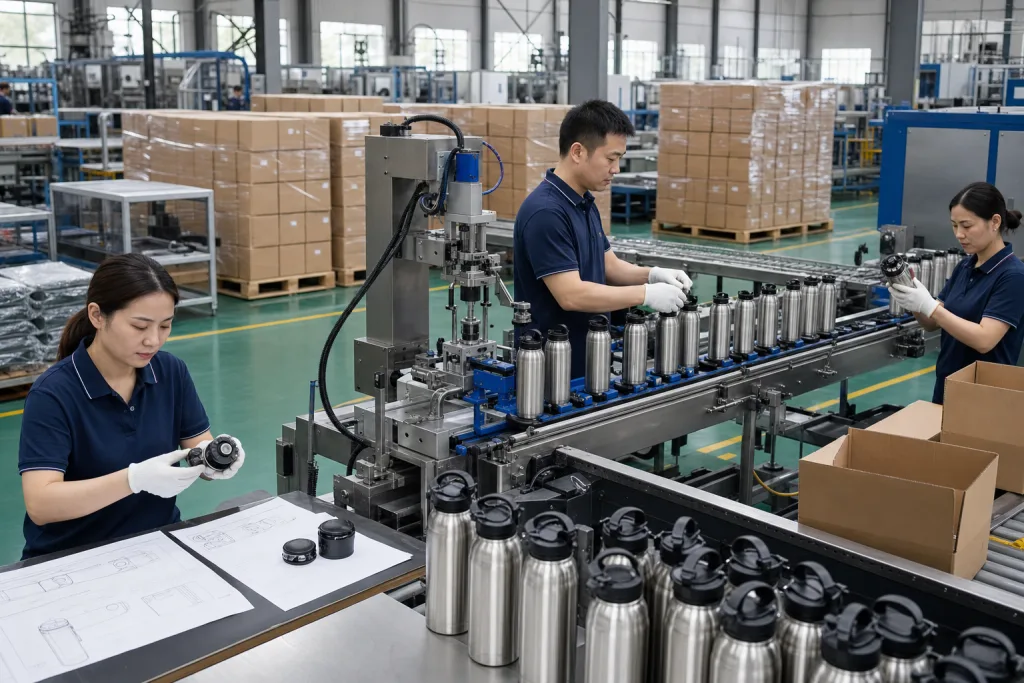
At BottleForge Industrial in Hangzhou, Zhejiang, we manufacture and export drinkware for distributors, fitness brands, and promotional buyers. China has 300+ canteen vendors and bottle traders chasing the same RFQs; fewer can explain tooling, AQL, REACH, FDA food-contact limits, and carton drop testing without guessing. On our line, QC pulled a sample last month because the silicone seal was 0.4 mm thinner than the approved drawing. That is the kind of detail buyers miss when they compare only FOB price. Use this as a practical buying checklist before you place a blender bottle, custom canteen, or customized growler order.
What are you really sourcing?
A search for blender bottle vendors usually points to one of 3 jobs, and mixing them up wastes a week of quoting. The classic shaker bottle is PP or Tritan, with a screw lid, flip cap, mixing ball or agitator grid, usually 500 ml to 900 ml; on our line, QC checks the hinge with a simple open-close jig before packing. The second job is insulated drinkware for fitness and outdoor brands, such as stainless steel sports bottles, custom growler products, or a canteen customized with powder coating. The third is promotional drinkware, where the bottle is mostly a logo carrier and the target price drives the resin grade, carton spec, and printing method.
Name the product family before you ask for a quote. A canteen manufacturer quoting 304 stainless steel vacuum insulation is not competing with a plastic shaker canteen supplier, and the math doesn't work if you compare them only by FOB price. A distributor growler order with 64 oz capacity, copper coating, and laser engraving goes through welding, vacuum testing, and a laser fixture; a 700 ml promotional shaker with one-color silk screen printing sits near the injection line and print table. We once saw a PO typo list 700 oz instead of 700 ml. QC pulled the sample before the buyer caught it.
Start with this procurement question: does the vendor own production, or are they only matching your inquiry to another factory? A real canteen factory should answer wall thickness in mm, lid mold status, sealing gasket material, daily assembly output, and defect rate from the last run without waiting 48 hours. A trading-only canteen vendor can still work for mixed-SKU orders, but price in slower answers and less control when the buyer flags leakage, color drift, or a barcode mismatch.
- For protein shaker programs, ask about PP and Tritan grade, mixing ball material, 100% leak testing method, and cap hinge life after the line runs 3,000 pieces.
- For custom canteen and customizable growler projects, ask about 304/316 stainless steel, vacuum loss rate, coating adhesion after cross-hatch testing, and laser engraving limits on curved bodies.
- For canteen promotional orders, ask about logo size in mm, carton quantity, barcode placement, and delivery date first, because a late insert card can hold 20 cartons at packing.
In Zhejiang, China, 6 out of 10 factories we visit are stronger by process than by product name. One plant can be sharp at stainless forming and polishing but only average at plastic injection; another runs lids and accessories well because it owns the molds and keeps spare pins beside the injection press. Your RFQ should match that reality. Send the wrong drawing to the wrong line, and we've seen this go sideways before the first sample invoice is paid.
Which specifications must be locked?
A vague RFQ gets a vague quote. “Please quote customized drinkware, 750 ml, logo printed” is not enough for a purchase order. Lock the body build, logo method, export carton, and test standard before you compare canteen manufacturers or canteen suppliers. We see this go sideways when one vendor quotes a plain PP bottle in an opp bag and another quotes a Tritan bottle with a color box; the FOB gap looks like USD 0.42, but the quote is not for the same item.
Start with body material. For plastic shaker bottles, common options are PP at around USD 1.10-2.20 FOB China for standard tooling, or Tritan at roughly USD 2.20-4.00 depending on lid complexity and thickness. PP is lower cost and common for gym giveaways. Tritan has better clarity and impact resistance, which supports retail shelf sales. If you need EU or North American retail, ask for FDA food-contact, LFGB or EU 10/2011 where applicable, BPA-free declaration, and REACH screening for decorated parts. On our line, QC pulled one Tritan sample at 182 g when the approved sample was 196 g; that 14 g difference usually means thinner wall or a changed mold setting.
For stainless canteen customizable programs, specify 304 stainless steel for inner wall, 201 or 304 for outer wall, and wall thickness. A typical vacuum bottle may use 0.4-0.5 mm stainless sheet before forming. If a supplier will not disclose this range, expect dents, weak insulation, or unstable unit weight later. Ask for target finished weight with tolerance, such as 315 g ± 8 g for one SKU, because a buyer flagged this exact issue after cartons arrived with bottles feeling light in hand.
Then define the lid. Most leaks start at the silicone gasket, not the body. Ask the canteen manufacturer to confirm silicone hardness, gasket cross-section, and whether the lid passes inverted leak testing for 30 minutes. For shaker bottles, request cap snap fatigue testing. A lid that feels tight in the pre-production sample can loosen after 500 open-close cycles. We run the leak rack with dyed water and white tissue under the caps; one bad gasket groove at 0.3 mm off spec is enough to fail a whole color batch.
Do not approve “same as sample” unless the sample is coded, measured, photographed, and signed off with a specification sheet.
Finally, decide decoration before you compare prices. Silk screen printing, pad printing, heat transfer, laser engraving, powder coating, and full-wrap UV printing are not interchangeable. On curved customizable drinkware, a 50 mm logo is easy; a 180-degree wrap may need a fixture and higher reject allowance. This is the wrong place to chase the cheapest line item: a full-wrap UV job might need 3-5% extra blanks, and we have seen POs with “Pantone 286C” typed as “286U,” which changes the blue enough for a brand manager to reject the carton sample.
What MOQ and pricing make sense?
MOQ is where buyer calls go off track fast. If you ask five blender bottle vendors for 300 units with custom color, custom lid, retail box, and two logo positions, two will not quote and the other three will pad the price. We run setup on injection molds, silk-screen plates, PMS color change, carton printing, and line scheduling; last month QC pulled a 300-unit sample request because the buyer wanted three lid colors on one PO.
For our Hangzhou, Zhejiang export production, a practical MOQ is usually 1,000 units per color for standard plastic shaker bottles, 2,000-3,000 units for deeper custom lid work or tight color matching, and 3,000-5,000 units for new private-mold plastic parts. Stainless custom canteen projects often start at 1,000 units per color for standard shapes. A custom growler or customized growler with special coating, handle, or gift box usually needs 1,500-3,000 units before the math works; below that, the powder-coating jig change and gift-box die line eat the margin.
Monthly output matters more than a polished brochure. A canteen factory producing 450,000-600,000 drinkware units per month can absorb a 10,000-unit distributor drinkware order without pushing smaller POs to the back of the line. A small workshop may quote low, then slip once coating, printing, and packing hit the same week; we have seen a 12-day packing plan become 18 days because the line had only one heat-transfer machine running.
Expect price bands to move with resin, stainless steel, exchange rate, packaging, and inspection requirements. As a working range, standard PP shaker bottles may sit around USD 1.10-2.20 FOB Ningbo or Shanghai. Tritan shaker bottles may sit at USD 2.20-4.00. Stainless insulated bottles often range from USD 3.20-8.50 depending on capacity, coating, lid, and carton pack. A 64 oz distributor growler with handle and powder coating can move above USD 9.00 if you add retail packaging and laser engraving; the buyer flagged this exact jump when the PO added a 350gsm color box after sample approval.
- Ask whether quoted price is EXW, FOB Ningbo, FOB Shanghai, or CIF destination, and check the port name against the proforma invoice.
- Confirm if logo setup, PMS color matching, sample freight, and master carton marks are included; one missing carton mark line can delay warehouse receiving.
- Ask for price breaks at 1,000, 3,000, 5,000, and 10,000 units, then compare mold setup and packing cost separately.
Cheap unit price only matters when the supplier can ship the same approved product on time. Otherwise, the math doesn't work.
How should you qualify vendors?
Your supplier checklist should be boring and strict. Good sourcing is not about the fastest sales reply on WhatsApp. It is about cutting surprises between the 30% deposit and the day QC opens cartons in your warehouse. We have seen a blender bottle order go sideways over a 0.4 mm lid gasket change that nobody approved.
Ask every canteen supplier or canteen vendor for the same documents: business license, export record, factory audit status, product test reports, material declarations, plus photos or videos of the production line. For European buyers, BSCI, Sedex, ISO 9001, LFGB, REACH, and EU food-contact documentation matter by sales channel; a supermarket buyer in Germany will ask different questions than a gym-chain buyer in Spain. For North America, ask about FDA food-contact compliance, California Proposition 65 screening where needed, ASTM-related physical safety tests for children’s bottles, and CPSIA if the item is marketed to children. Check the file dates. A 2021 LFGB report for a new 2025 lid material is not enough, and the buyer will flag it during onboarding.
Then test communication. A capable canteen manufacturer should answer these questions without sending only a catalog:
- What is the current mold status for the bottle, lid, and mixing insert?
- What is the standard AQL used for final inspection, for example AQL 2.5 major and 4.0 minor?
- What leak test is performed on the assembly line?
- How many units are packed per export carton, and what is the gross weight?
- Can you apply FNSKU, UPC, carton label, or Amazon-ready packaging if required?
For customized canteen or distributor canteen programs, ask who controls coating. Powder coating and spray painting are often handled outside the main bottle line in China. That is normal, but the factory still needs to control color tolerance, adhesion, rework records, and sample sign-off under D65 light. Request a cross-hatch adhesion test on coated samples, especially for matte finishes; our QC team uses a 3M 600 tape pull and checks the cut grid before approving mass production. Poor coating can pass a quick photo review at shipment, then scratch during retail handling after 3 carton drops.
If you are choosing among canteen distributors, canteen suppliers, and direct factories, be honest about your own workload. Direct factory buying can save 6% to 12% margin, but the math does not work if your team cannot manage specifications, approvals, inspections, and freight. A distributor may cost more and still be the better choice for mixed small-volume SKUs, especially when one PO has 8 colors, 3 lid styles, and a typo in the barcode file. We run direct factory programs every week, but small messy orders need tight paperwork more than a cheap unit price.
What samples prove before production?
Samples are not souvenirs. They are your first proof. For blender bottle vendors, we run three rounds: stock sample, logo sample, and pre-production sample. Skip one and you may save 7-10 days, but a leaking cap or a rubbed logo can turn into a full-container claim. On our Hangzhou line, QC pulled a cap at 30,000 open-close cycles and the buyer still wanted one more round.
The stock sample confirms shape, hand feel, lid action, capacity, weight, and whether the product fits your channel. Measure actual filled capacity, not only nominal capacity. A “700 ml” shaker may hold 700 ml to brim but only 600 ml comfortably in use. If you sell to fitness customers, shake in 20 g of powder and check whether residue traps under the mixing grid. If you buy canteen promotional goods for events, set the bottle on a 15 mm tilt board and check whether it stands stable and whether the drinking mouth feels acceptable. The buyer flagged a 2 mm wobble before, and we had to change the bottom ring.
The logo sample confirms decoration. For silk screen printing, check edge sharpness, opacity, and rub resistance. For laser engraving on 304 stainless steel, check contrast after coating. For full-wrap customized drinkware, inspect seam alignment and distortion around curves. Color matching should use Pantone numbers, but allow realistic tolerance. On powder coating, Delta E below 2.0 is excellent; many commercial orders accept Delta E 2.0-3.0 if the brand team approves. On our pad printer, a 0.3 mm shift showed up after the second wipe.
The pre-production sample is the one that matters. Use mass production material, final logo, final packaging, final barcode, and final carton mark. Sign and date it. Send one sealed sample to your inspection company if you use third-party QC. Keep one with you. Keep one at the factory. We had a PO typo on a carton mark once, and that sample set saved a 12-day reprint. This is where the arguments stop.
For custom canteen and customizable canteen projects, run hot water insulation checks on stainless bottles. For example, fill with 95°C water and measure after 6, 12, and 24 hours. For plastic shakers, perform inverted leak tests, dishwasher simulation if claimed, and odor checks after warm water storage. On the test bench, we clamp the cap at 2.5 N·m and watch the seal. Weak claims show up fast.
How do you control shipment risk?
Most expensive drinkware problems show up at the end: crushed cartons, mixed-up lids, a barcode that will not scan, or a retailer rejecting the shipment because the pack does not match the PO. We had one buyer flag a PO with "5000 pcs" on the order and "5,000" on the carton mark, and the warehouse line stopped for a day. Write shipment controls into the PO with the same care you give the logo.
Use a written QC plan. For most B2B drinkware orders, final random inspection under ANSI/ASQ Z1.4 with AQL 2.5 for major defects and 4.0 for minor defects works well. QC pulled the sample from the packing table with a 0.02 mm feeler gauge, and we still hold zero tolerance on sharp rim edges, dust or oil in the cup, severe leakage at the thread, broken glass, or a wrong resin callout. If you are ordering glass bottle or kids bottle products, tighten the test plan because breakage and safety complaints leave less room for error.
Carton strength matters. A typical export carton for bottles should pass a drop test based on carton weight and sales channel. We run a 5-ply master carton, and if the edge crush looks soft on the compression tester, it will fail fast. If you sell through e-commerce, inner protection should be stronger than for palletized wholesale delivery. For Amazon FBA or marketplace prep, spell out FNSKU label placement on the top-right panel, suffocation warning text on polybags, carton weight limits at 15 kg or your own cap, and master carton dimensions in millimeters. Do not assume a canteen factory in China knows your warehouse rule unless you write it into the order; we have seen a buyer lose a week because the PO said 48 pcs/carton while the carton mark said 24.
For freight, FOB Ningbo or FOB Shanghai is common for Zhejiang factories. Ningbo is often cleaner for container work out of Zhejiang, while Shanghai can fit some forwarder routes. Our shipping desk wants the HS code, product description, carton count, CBM to one decimal place, gross weight, and ready date at least 10 days before booking. For air shipments, bottle volume drives dimensional weight hard, so a late 2,000-unit air rescue can wipe out the margin from a cheap unit price.
Payment terms also shape risk. Common terms are 30% deposit and 70% before shipment after inspection. Once QC signs off, we release the pack list and carton labels. For repeat distributor drinkware buyers with stable volume, terms can improve over time. New buyers should skip 100% upfront unless the order is small or the vendor is already verified. We have seen that go sideways when a buyer paid in full, then asked to change the print after the line had already wrapped the first pallet.
Checklist before you issue PO
Before you send a deposit to blender bottle vendors, lock the order on the PO. The purchase order should be detailed enough that a new production manager on the line can build the item without digging through 37 WhatsApp messages and a half-renamed PDF. We have seen this go sideways when the buyer wrote “blue lid” on the PO, approved Pantone 2925C in email, and the molding team followed the PO. This matters when you source from China, where injection molding, printing, powder coating, packing, and export booking may sit with 5 different desks.
Buyer checklist
- Product type: plastic shaker, stainless custom canteen, glass bottle, travel tumbler, or custom growler. Add the model code if the vendor uses one, because “700 ml shaker” is not enough on a busy line.
- Capacity: nominal and practical fill volume, such as 700 ml nominal and 600 ml usable. Ask for the fill line position in mm if your formula serving size matters.
- Material: PP, Tritan, 304 stainless steel, 316 stainless steel, borosilicate glass, silicone, or PE straw. State food-contact grade and the part location, such as PP lid, Tritan body, silicone seal ring.
- Decoration: logo method, logo size, Pantone color, placement, and durability requirement. For silk screen, we normally ask QC to measure logo position with a caliper before bulk packing.
- Packaging: polybag, egg-crate, white box, color box, gift box, UPC, FNSKU, insert card, and carton mark. Put the barcode file name on the PO; one buyer once sent “final barcode.pdf” twice, with different numbers.
- Compliance: FDA, LFGB, EU 10/2011, REACH, Prop 65, CPSIA, BSCI, or retailer-specific audit. Name the market and retailer, because Amazon US and a German supermarket will not review the same report set.
- Inspection: AQL level, defect list, sample reference, photo requirements, and reinspection cost rule. QC pulled the sample should mean the same approved bottle, not a cleaner showroom piece.
- Commercial terms: MOQ, unit price, tooling, sample cost, lead time, FOB port, payment terms, and late shipment responsibility. Write Ningbo or Shanghai clearly, since trucking cost and booking cut-off are not the same.
One practical point: split “must have” from “nice to have.” If the lid color must match your brand, say so and approve a physical color chip, not just a screen image. If the canteen customized packaging can move from 350 gsm to 300 gsm paper to save the ship date, write the allowed range. Clear rules beat long meetings. We run better when the merchandiser, printing master, and packing supervisor all see the same decision on one PO.
BottleForge Industrial supports standard and customized drinkware programs from Zhejiang, including shaker bottles, sports bottles, stainless canteens, and growlers. Our normal lead time is 30-45 days after approved pre-production sample for most repeatable models, with faster schedules only when resin, stainless coil, cartons, and decoration slots are already reserved. The math does not work if a buyer asks for a 20,000 pcs custom shaker order in 18 days while artwork is still changing. That is not a magic promise; it is the planning window that keeps your PO realistic.
Send your blender bottle RFQ for factory review
Share quantity, material, logo method, packaging, and target delivery date. We will return practical MOQ, pricing, and production timing.
Frequently asked questions
What is the usual MOQ for custom blender bottles?
For standard plastic shaker bottles, expect 1,000 units per color for a basic logo order. If you need custom PMS body color, matching lid, retail box, or a special mixing insert, MOQ often moves to 2,000-3,000 units. Private mold work usually starts around 3,000-5,000 units because tooling, resin color change, and assembly setup must be spread over more pieces. For stainless custom canteen orders, 1,000 units per color is common when using an existing mold. Very low quantities are possible through distributors, but unit price and decoration limits will be higher.
How long does production take after sample approval?
A realistic lead time from China is 30-45 days after final artwork, packaging, and pre-production sample approval. Plastic shaker bottles with standard colors can sometimes finish in 25-30 days if material is available. Powder-coated stainless drinkware, customized growler orders, or retail gift box packaging often need 40-50 days. Add 5-10 days for logo sample development and more time if you require third-party lab testing. Do not count sample discussion time as production time; the clock should start only after written approval and deposit.
Should I choose PP or Tritan for shaker bottles?
PP is the practical choice for price-sensitive gym giveaways, canteen promotional orders, and large event programs. It is durable enough for many uses and can land in the USD 1.10-2.20 FOB China range for standard designs. Tritan costs more, often USD 2.20-4.00 FOB, but gives better clarity, a more retail-friendly look, and stronger impact performance. If your brand sells through premium fitness or outdoor channels, Tritan is usually easier to position. For either material, request food-contact documentation and confirm the lid, gasket, and mixing part materials separately.
Can one supplier make shaker bottles, canteens, and growlers?
Yes, but ask how the supplier controls each process. A canteen manufacturer may own stainless steel forming, welding, polishing, and vacuum insulation, while plastic shaker parts are made by an injection partner. That can work if the supplier has stable QC and clear responsibility. For mixed custom drinkware programs, ask for one production schedule, one defect standard, and one packing rule across all SKUs. If you order 3,000 shakers, 1,000 customized canteen units, and 800 growlers, coordination matters more than catalog width.
What quality checks should I require before shipment?
Use final random inspection, commonly AQL 2.5 for major defects and 4.0 for minor defects, with zero tolerance for critical issues such as leakage, contamination, sharp edges, or wrong material. For shaker bottles, check lid fit, cap hinge, inverted leakage, logo rub resistance, odor, capacity, and carton marks. For stainless custom canteen or customizable growler products, add insulation testing, coating adhesion, dents, welding marks, and engraving position. If selling through e-commerce, also inspect barcode readability, FNSKU placement, carton weight, and drop-test packaging performance.