Key Takeaways
- A reliable shaker bottle usually needs 18/8 stainless steel, 0.5-0.7 mm wall thickness, and a tested leak rate of 0% in 30-second inversion checks.
- Most serious factories in Zhejiang, China can handle 10,000-50,000 units/month, with standard lead times of 25-40 days after sample approval.
- For branded orders, expect MOQ around 1,000-3,000 pcs per SKU and decoration costs from about USD 0.18 to USD 1.20 depending on print method.
- Your margin is protected by compliance: LFGB, REACH, FDA, BSCI, and AQL 2.5 are not paperwork extras; they are buying filters.
If you are sourcing blender bottle suppliers, do not start with color or logo. Start with the spec sheet. We check wall thickness with a digital caliper before we talk artwork; 1.2 mm and 1.5 mm lids behave differently on the line. A shaker bottle looks simple until your team is answering for leaks, warped lids, protein smell, or a print that peels after two dishwasher cycles. In custom drinkware, the gap between a sellable bottle and a return claim is often 0.3 mm on the thread, one missing silicone gasket, or an AQL 2.5 plan nobody followed.
We build and ship drinkware from Zhejiang, China, and the buyers who do best treat every line item as a cost and risk decision. If you are a distributor, brand owner, or canteen distributor looking for custom drinkware, read the bottle like our QC team does: resin grade and odor test, lid closure torque, mixing ball or grid fit, decoration adhesion, carton drop strength, and FDA or LFGB compliance. Small details matter. Last month QC pulled the sample because the PO said “matte black” but the approved sample was Pantone 426C gloss, and the buyer flagged it before mass production. That is how you separate a real canteen manufacturer from a vendor selling catalog photos. It also shows whether the same factory can handle canteen custom, customized drinkware, or a custom growler program without turning a 30-day lead time into 45 days.
Start with the bottle’s job
Before you compare blender bottle suppliers, write down what the bottle has to do on the shelf and in the user’s hand. A gym shaker, a meal-replacement bottle, and a retail distributor program need different molds, lids, and packing methods. Start with capacity. Common sizes are 20 oz, 24 oz, 28 oz, and 32 oz. For fitness retail, we see 28 oz move better in about 6 out of 10 buyer programs because there is space for powder plus water without splash-back. For travel or office use, 20 oz is easier to carry and usually cuts carton weight by 1.5 to 2.0 kg per export carton, depending on the lid. On the line, QC checks the fill mark with a graduated cylinder, not by eye.
Next, define the use case. If the bottle will be shaken hard, lid geometry and seal design matter more than the print artwork. If it will sit in a gym bag, we run a tighter cap thread and a taller gasket lip, usually checked with a 0.05 mm feeler gauge during fitting. Shelf programs are different. For a canteen promotional line, the bottle must look clean in a display tray and survive low-cost distribution without the cap scuffing the body. The wrong question is, “Which bottle looks premium?” Ask how many pieces fit in a 60 x 40 x 50 cm carton and what that does to landed cost. A wider body feels better in the hand, but we’ve seen this go sideways when the buyer flagged freight after the pre-production sample was already approved.
Buyers who skip this step often send one line on the PO: “good custom bottle, logo printing.” That is not enough. Bad move. A serious canteen factory will ask for target retail price, sales channel, and end user before quoting, and we will also ask whether the MOQ is 1,000 pcs for a test order or 10,000 pcs for a chain account. That is the sign of a real canteen manufacturer, not a canteen vendor moving stock from a warehouse. If you want customizable canteen or customized canteen programs later, use the same discipline. The bottle has to fit the job first.
Read the material spec line by line
Material is where buyers lose money fastest. For stainless shaker bottles, 18/8 stainless steel is the safe baseline because it survives sweat, lemon water, protein residue, and daily washing better than no-name steel. If a quote says “food-grade steel” with no grade, stop the quote review and ask for composition plus test reports; last month QC pulled one sample marked 304 stainless, but the XRF gun showed the lid ring was a different alloy. For plastic components, PP is common for lids, Tritan is used when the buyer wants clear parts, and silicone decides whether the bottle leaks in a gym bag.
Wall thickness is not cosmetic. For a bottle body, 0.5 mm is workable for entry-level programs; 0.6-0.7 mm gives better dent resistance and a stronger hand feel. On a 24 oz bottle, that difference can add 15-30 g, which changes carton weight and retail perception. We check it with a digital thickness gauge at the shoulder, belly, and base because the draw line can thin out near the curve. For a custom growler or customizable growler, the wall spec matters even more because the larger body shows every soft spot. A thin wall on a 64 oz vessel looks cheap fast. The math doesn't work if the buyer saves USD 0.18 on steel and then gets 6% dent complaints after shelf delivery.
Ask for confirmation on interior coating, if any. Some buyers want bare stainless for a cleaner spec. Others ask for anti-odor treatment or a printed liner, and that needs real testing, not a supplier promise in a WhatsApp message. The factory should show migration test documents and dishwasher resistance; on our line, we run 20-cycle dishwasher checks before sending the pre-production sample. In Zhejiang and across China, 30 factories can quote a shaker bottle before lunch, but maybe 8 will document the exact steel grade, silicone hardness, and thermal performance without pushing back. That is the supplier pool you want if you are sourcing customized drinkware for retail or a custom canteen program.
- Stainless body: 18/8 preferred for long-term corrosion resistance
- Plastic parts: PP for cost control, Tritan when clarity and heat resistance matter
- Seal material: Food-grade silicone, usually 50-70 Shore A
- Practical check: Ask for weight per unit and wall thickness, not just capacity
The lid and seal decide returns
A shaker bottle usually fails at the lid first. If a blender bottle supplier cannot point out the sealing path on a cut sample, keep moving. Ask how many contact points the cap has, where the silicone gasket sits, and whether the thread pitch stays the same across SKUs; last month QC pulled a 700 ml sample where the cap was 0.35 mm loose against the neck finish. A good threaded closure should close smoothly in two to three turns, with no grinding or cross-thread risk. Bag leakage kills reviews. If your customers will toss the bottle into a gym bag, spec a lockable flip lid or a double-seal structure.
The seal test needs a written method, not a sales promise. Ask for a 180-degree inversion test with the lid hinge facing down, a shake test timed by stopwatch, and a 1.2 m drop test onto a rubber mat after filling. We run a simple commercial standard: fill to 90% capacity, close properly, invert for 30 seconds, then shake 20 times. Zero leakage is the target. If a factory will not commit to the same test every production lot, returns will show up later; we have seen this go sideways on both a canteen customizable line for a sporting goods chain and a distributor canteen program for warehouse clubs.
Mixing hardware matters too. The classic whisk ball still works, but diameter, wire gauge, and surface finish change how the bottle feels after 60 seconds of shaking. Stainless mixing balls are easier to clean and hold shape better than cheap wire inserts; our line checks them with a go/no-go ring before packing. Some buyers choose a molded agitator insert for custom drinkware with protein or powder-mix positioning, but this is often the wrong place to chase a fancy feature. Every extra component adds assembly time and QC risk. A simpler cap with a better seal often beats a flashy design.
Buy the closure as if it will be abused, because it will.
Branding that survives use
Decoration is where 3 out of 10 canteen distributors overpay. The right method comes down to substrate, order size, and wear target. For powder-coated stainless bodies, laser engraving is clean and survives daily handling; we run a 20W fiber laser and check depth on the first 5 pcs before the line continues. For colored plastic, silk screen works when the artwork is simple, while UV printing fits multi-color logos with tighter visual control. If the buyer asks for a premium promotional piece, engraving outlasts ink. The math doesn't work if you pay for 6-color UV on a giveaway bottle that will sit in a gym bag.
Keep the decoration short. One logo, one location, one clear brand message. Overprinting turns a solid product into canteen promotional clutter, and we’ve seen buyers flag it after the pre-production sample because the bottle looked cheaper than the render. If your audience is retail or fitness, a 1-color laser mark on the front panel often sells better than a full-wrap graphic. For customized canteen or customizable drinkware programs, ask the factory for decoration tolerance: how close can the art sit to the seam, handle, or lid edge without distortion? On one 750 ml shaker, QC pulled the sample because the logo sat 8 mm too close to the molded grip line.
Branding cost is usually simple. Expect laser engraving around USD 0.20-0.60 per unit, silkscreen from USD 0.12-0.35 per color per side, and full-color UV printing higher depending on setup. The factory should also confirm whether you need a proof on a white sample or production color sample. In China, a strong canteen supplier will send a decoration map before mass production, with logo size, center line, seam position, and print area marked in mm. That saves you from seeing a logo wrap awkwardly around a curve on a final carton. If you also sell canteen custom or custom growler items, keep the branding rules aligned across the range so your distributor drinkware line feels consistent.
When the order is large enough, coordinate logo placement with packaging insert cards and outer carton marks. We usually do this from 3,000 pcs up, because one wrong item code on a carton mark can slow warehouse receiving by 2 days. That is how a canteen manufacturer supports the program, not just how a printer applies ink.
MOQ, lead time, and factory reality
The commercial terms tell you fast: real factory, or just a fast-reply sales desk. A Zhejiang, China factory with actual line capacity should quote MOQ and daily output without checking with “the boss” for half a day. For custom shaker bottles, we usually see MOQ at 1,000 to 3,000 pcs per SKU and per decoration. If someone accepts 100 pcs with full custom color, logo, insert card, and carton mark, the cost is hiding in mold amortization, print setup, or freight. Ask for a full landed-cost breakdown, not only EXW or FOB. We had one buyer flag a USD 0.18 “handling fee” added after PO release; that is exactly where cheap quotes go sideways.
Lead time gets underestimated. Sample development usually takes 7-12 days. Mass production after approval often runs 25-40 days, depending on finish and packaging. For mixed-color canteen customized orders, add 3-5 days for Pantone matching, spray test, and line setup; the first QC check is usually done with a 60° gloss meter and a simple tape adhesion test. A factory with 10,000-50,000 units/month can handle repeat programs better than a trading-only canteen vendor, but only after you confirm line capacity and seasonal booking. August and Q4 fill fast across China. The wrong question is “how fast can you ship?” Ask which line is open, how many cavities are running, and whether your carton artwork is already locked.
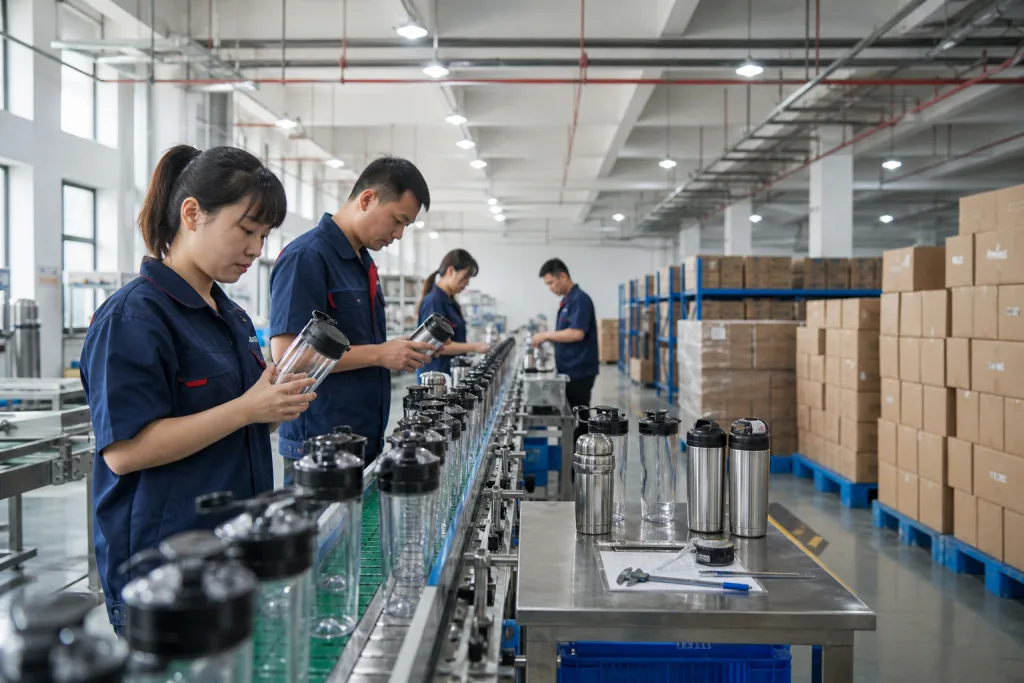
Ask for factory evidence, not marketing language. You want photos of the line, welding or assembly areas, packaging stations, and QC checkpoints. If the supplier also handles custom canteen, customized drinkware, or distributor growler projects, check whether they run separate lines or shared equipment. Shared lines are acceptable if cleaning records and batch traceability are real; we run alcohol wipe-down logs and keep rejected lids in a red QC bin, not mixed with good stock. A canteen factory that understands B2B export will show order history, carton drop-test notes, and AQL records, not only a polished sales deck.
- Typical MOQ: 1,000-3,000 pcs/SKU
- Sample lead time: 7-12 days
- Mass production: 25-40 days after sample sign-off
- Monthly output: 10,000-50,000 units depending on model and decoration
QA, packaging, and shipping
Quality control protects your margin. Do not accept “inspected before shipment” as a plan. We run AQL 2.5 for critical defects, then a separate check for cosmetics, because a glossy scuff is one issue and a leaking cap is a chargeback. For a blender bottle, critical defects include leakage, cracked caps, misshaped threads, odor, and label mismatch. Ask whether the factory tests one hundred percent of closures or only a sample. On our line, QC pulls the sample at the torque tester and checks the seal by hand. Buyers sometimes want to skip that and just inspect the cartons. That is the wrong question to ask.
Packaging should match the sales channel. If you are selling direct-to-consumer, you want a gift box with barcode, warning text, and insert. If you are supplying a canteen distributor, a simpler inner box or bulk pack can cut USD 0.18-0.45 per unit. Ask for carton drop-test data and pallet patterns before you approve artwork. We run drop tests from 60 cm, and a weak corner shows up fast on the first fall. A good product can still turn into a return problem in one freight lane. The math does not work if the pack fails.
Compliance should never be optional. For Europe, ask for REACH and LFGB where applicable. For North America, confirm FDA food-contact declarations and, if relevant, Prop 65 review. If the factory also holds BSCI or ISO 9001, that helps with audit confidence, but it does not replace product testing. A disciplined canteen manufacturer in China will know which document supports which market. We keep one test file per SKU in a blue folder on the QA desk, and that saves time when the buyer asks for the wrong report. We have seen that go sideways more than once.
One practical detail: if you use barcode labels or FNSKU stickers, confirm label placement, scannability, and carton traceability before production starts. We print a 30 x 20 mm sample label, scan it at one meter, and check the placement against the pack drawing. Small errors here cost more than the decoration itself. A one-letter typo on a PO can turn into a warehouse rejection, and the buyer will flag it after the first carton lands. This is the sort of mess that should be caught on the packing table, not at the fulfillment center.
Send your spec sheet for a fast factory quote
We can review your bottle spec, logo file, and target market, then quote MOQ, lead time, and landed cost from Zhejiang, China.
Frequently asked questions
What MOQ should I expect from blender bottle suppliers?
For a real custom run, expect 1,000 to 3,000 pcs per SKU. If you want multiple colors, lid options, or custom printing, each variant may need its own MOQ. Some canteen suppliers will quote lower quantities, but the unit price usually jumps 20% to 40% because setup cost is spread over fewer pieces. If your first order is a test, a good Zhejiang factory may offer a mixed trial of 300-500 pcs only for existing molds and standard colors. For new tooling or special packaging, budget more. Ask for MOQ by color, decoration, and carton style, not only by model.
How do I know if a supplier is a real factory or just a trading company?
Ask for line photos, QC station photos, and a live video of assembly, packing, or warehouse stock. A real canteen factory can explain daily output, shift count, and which processes are in-house. If they say 30,000 units/month, they should also say how many lines run the model and what the bottleneck is. Request business license details, BSCI or ISO documents if available, and one recent test report with your target material. Trading companies often answer fast, but they struggle with exact specs like wall thickness, gasket hardness, or lead time by decoration method. The best blender bottle suppliers from China and Zhejiang are transparent about what they make themselves.
Which decoration method lasts longest on a shaker bottle?
Laser engraving usually lasts the longest on stainless steel because it removes or marks the surface instead of sitting on top of it. For colored powder-coated bottles, the logo can stay sharp for years if the coating is stable, and the cost is often USD 0.20-0.60 per unit. Silk screen is cheaper for simple one-color branding, but it is more vulnerable to abrasion and dishwasher wear. If your channel is gym retail or distributor drinkware, laser is safer. If you are launching a canteen promotional program with a short campaign life, screen print may be enough. Always test 20-30 wash cycles before approving the method.
What compliance documents should I ask for in Europe and North America?
For Europe, ask for REACH and LFGB where the product category requires it. For North America, request FDA food-contact declarations and any relevant third-party test reports. If the bottle uses silicone, PP, Tritan, or stainless contact parts, the factory should identify the exact material batch and test scope. For retail or marketplace sales, many buyers also ask for carton labeling, traceability, and AQL inspection records. If your brand sells custom drinkware across both regions, keep one compliance file per SKU instead of mixing documents. A strong canteen manufacturer in Zhejiang will know which lab report matches which market, and they should not hesitate to share it.
Can I source other products from the same supplier?
Yes, if the factory has the right process range. Many blender bottle suppliers also produce custom canteen, customizable canteen, or custom growler programs using similar stainless and closure systems. That said, do not assume the same tooling, printing setup, or packaging line fits every category. A 24 oz shaker, a 40 oz canteen, and a 64 oz growler each have different wall, lid, and carton requirements. If the supplier can show stable production for multiple categories, you may save time on audits and sampling. Just keep the spec sheets separate so your canteen distributor or distributor growler order does not inherit the wrong lid, box, or barcode.