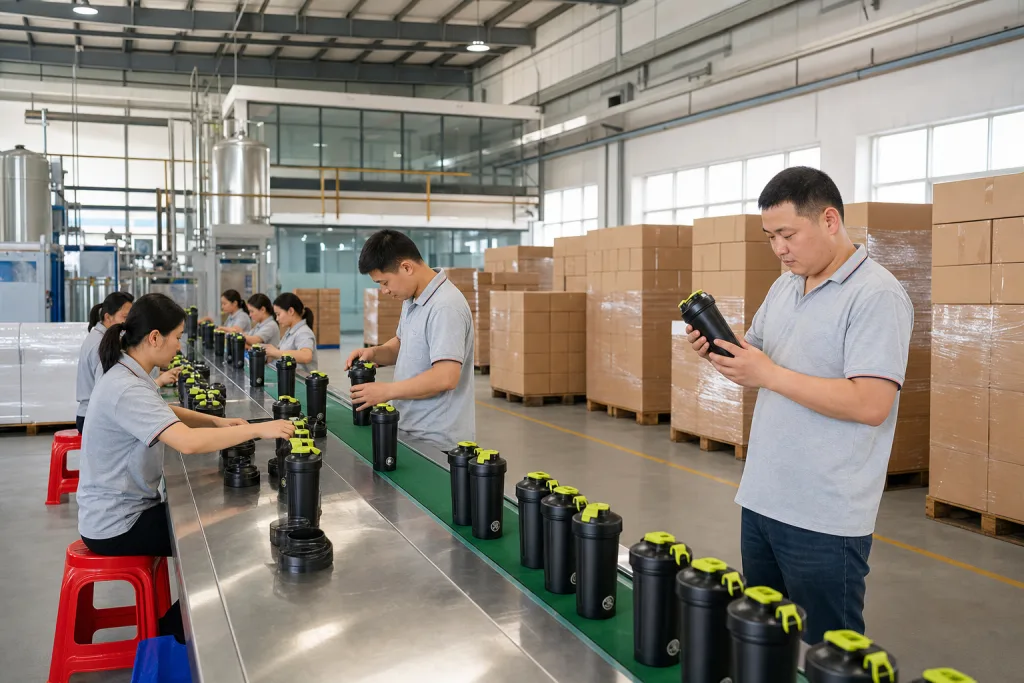
Key Takeaways
- Typical MOQ starts at 1,000-3,000 pcs per color for blender bottle promotional projects
- Food-contact PP, Tritan, 304 stainless steel, and silicone seals should be confirmed before sampling
- Logo method changes unit cost by USD 0.08-0.45 depending on print area and durability target
- Plan 25-35 days for bulk production after sample approval, plus 3-7 days for inspection and export handling
A blender bottle promotional order looks simple until you have to approve lid fit, logo rub resistance, inner bag spec, carton marks, and the ship date. The problems usually start before we cut the first sample: capacity listed as “600 ml” but buyer expects 24 oz, a 6 g mixing ball that rattles badly, PP grade missing from the PO, or a logo process that looks clean in a PDF and then fails after 20 dishwashing cycles in our test sink. QC pulled one sample last month where the flip cap gap was 0.8 mm over spec. That order was not ready.
If you buy custom drinkware for retail shelves, gyms, supplement brands, event campaigns, or distributor programs, get factory numbers before issuing the PO: resin grade, lid torque, logo area in mm, carton weight, MOQ, and a real production lead time such as 12 days for sampling and 18 days for mass goods. From our Zhejiang production base in China, we see buyers win when they treat a shaker bottle like engineered packaging, not a cheap giveaway. This is the wrong question to ask: “What is your lowest price?” Ask what changes when the wall thickness drops from 2.2 mm to 1.8 mm. The math changes fast.
What Are You Actually Buying?
When a buyer says “blender bottle promotional,” the factory does not hear one item. We hear 3 possible builds: a 600 ml PP shaker with a wire whisk ball, a 700 ml Tritan sports shaker with a carry loop, or a stainless steel insulated protein bottle for a higher-value retail bundle. The first job is to define the item so clearly that three canteen suppliers quote the same construction, lid mold, and packing method. This is where buyers lose time. Last month QC pulled two “same” samples from the line: one lid used a 54 mm thread, the other was 58 mm, so the gasket could not be shared.
For most promotional programs, the practical baseline is a 600-800 ml bottle, screw lid, flip cap, leak-resistant silicone ring, measurement scale, and mixing element. PP works for gym campaigns where the math is tight. Tritan costs more but gives cleaner clarity and a better shelf look. Stainless steel is heavier, usually USD 3.80-7.50 FOB China depending on size, lid, and finish, but it suits a custom growler or distributor growler line where perceived value matters. We run PP shakers faster, usually around 18-22 cartons per hour on a small assembly line; stainless bottles slow down because powder coating, vacuum testing, and lid fitting add steps.
Do not start with only a logo file and target price. Start with a buying specification. The buyer flagged it too late once on a 5,000 pcs order: the PO said “700 ml,” the artwork scale showed 600 ml, and the carton mark said 750 ml. Nobody wants that email at 11 p.m.
- Capacity: 500 ml, 600 ml, 700 ml, 800 ml, or 1,000 ml, measured to brim or practical fill line.
- Material: food-grade PP, Tritan, 304 stainless steel, silicone, PE straw, or 316 stainless for special cases, with resin grade confirmed before sampling.
- Closure: flip cap, screw cap, push button, straw lid, or carry loop, including thread diameter and gasket position.
- Mixing system: 304 stainless wire ball, plastic grid, or fixed agitator, packed inside the bottle or loose in the polybag.
- Compliance: LFGB, EU 10/2011, REACH, FDA food contact, or Prop 65 as required, matched to the selling market instead of copied from an old test report.
This is also where “canteen custom” language gets messy. Some buyers use canteen to mean a military-style flask, some mean sports bottle, and some mean any refillable drinkware. If you ask a canteen factory for a quote, attach a drawing or reference photo and specify whether it is a blender shaker, custom canteen, or customizable canteen program. This is the wrong question to ask: “Can you quote our bottle?” Ask: “Can you quote this 700 ml Tritan shaker with 63 mm screw lid, 304 wire ball, 1-color logo, and 48 pcs per carton?” We ship cleaner when the RFQ is that plain.
MOQ, Price, and Real Lead Time
MOQ is not a factory penalty. It comes from how the line runs: color batching, print setup, lid molding stock, carton packing, and the hours your order takes on the press and assembly tables. If you are buying a standard blender bottle promotional order with existing molds, MOQ is usually 1,000-3,000 pcs per color. If you want a custom molded lid, a unique bottle shape, or a private mold body, plan on 5,000-10,000 pcs and tooling from USD 1,500 to over USD 12,000, depending on how far the mold has to change. We have seen buyers push back on this, then send a PO with no Pantone code and wonder why the first sample missed the target.
For price, start with the build, not the headline number. A basic PP shaker may quote around USD 1.10-2.20 FOB Ningbo or Shanghai. Tritan versions often sit around USD 2.10-3.80. Double-wall stainless models can range from USD 4.20-8.80. Logo, packaging, testing, and inspection are not always included, and that is where the math breaks. On our quoting sheet, a one-color silk print, a plain polybag, and a carton with 5-ply export strength are separate lines. A supplier that throws out one low number and skips those details is leaving you exposed.
At BottleForge Industrial in Zhejiang, China, standard monthly drinkware capacity is about 450,000 units across stainless bottles, sports bottles, tumblers, and shaker-related items. QC pulled the first sample off the pad printer table before the shift started, which is why we trust the next dates only after artwork is locked. For existing molds, a normal project timeline is:
- Artwork check: 1-2 working days, if the buyer sends a clean AI or PDF file with clear Pantone calls.
- Pre-production sample: 5-10 days depending on logo method, lid color, and whether the print needs a second pass.
- Bulk production: 25-35 days after sample approval and deposit, with the line running to the confirmed spec.
- Inspection and booking: 3-7 days. Our QC team checks carton drop, logo placement, and random unit count before space is booked.
- Sea freight: usually 25-40 days to Europe or North America, depending on port and season.
If you are a canteen distributor building a seasonal campaign, do not approve artwork on Friday and expect delivery in three weeks. Air freight can save a small run, but it can add USD 1.50-4.00 per bottle. On a 2,000 pcs order, that can wipe out the margin fast. If the buyer asks only for the lowest unit price, this is the wrong question to ask. Ask for landed cost, pack spec, and ship date, or the deal can go sideways.
Material Choices Buyers Should Challenge
The cheapest bottle is not always the lowest-cost order. We have seen a soft cap split after a 1.2 m drop test, a cloudy plastic body get rejected under showroom lighting, and a silicone ring come back with odor complaints after 3 dishwasher cycles. For blender bottle promotional programs, ask three direct questions: which material contacts the drink, which part touches the mouth, and which part is just decoration. This is the wrong question to ask if the buyer only says, “Can you make it cheaper?”
Food-grade PP is common because it is light, impact-resistant, and economical. We run it often for canteen promotional orders where 5,000-20,000 pcs are handed out at events or packed with protein powder. Tritan looks clearer on the shelf and resists tea, coffee, and supplement stains better, so buyers usually accept the higher unit price for retail channels. Stainless steel gives durability and insulation, but not every stainless bottle mixes powder well; if the mouth is too narrow or the shoulder angle traps powder, QC will find dry clumps after the shake test.
For stainless steel, 304 is the normal food-contact choice. Wall thickness matters. A typical single-wall stainless sport bottle may use 0.5-0.6 mm material. A vacuum insulated bottle may use inner wall around 0.4-0.5 mm and outer wall around 0.5-0.6 mm depending on size. Ultra-thin walls save weight and cost, but we have seen 0.35 mm outer walls dent inside a 12 kg export carton before the goods even reached the retailer.
For plastic, ask for the resin code and test standard. For Europe, EU 10/2011 and LFGB are common. For the United States, FDA food-contact requirements and sometimes California Prop 65 screening may apply. For children’s drinkware, ASTM and CPSIA concerns may enter the conversation. A responsible canteen manufacturer will not say “all materials pass everything” before checking your destination market, artwork position, lid structure, and color masterbatch; the buyer flagged one PO last year because the order said “PP lid” but the approved sample used Tritan.
Procurement rule: test the final production material, not only the raw resin certificate. Colorants, seals, coatings, and printed inks can change compliance risk.
This point matters across customized drinkware, customized canteen, and customized growler projects. The body material may pass, while the printed coating, rubberized finish, or lid gasket fails migration or odor checks. We ship clean samples from the first trial, then QC pulls the sample after printing and assembly because that is where the math can go sideways.
Logo Method Is a Cost Decision
Brand owners often spend 90% of the call on artwork and 10% on process. That is backwards. For a blender bottle promotional order, the logo method changes price, lead time, MOQ, scratch resistance, and the hand-feel buyers notice when they pick up the sample. The most expensive method is not always the right one; we have seen clean USD 0.10 prints beat “premium” decoration when the bottle is meant for a gym giveaway.
Silkscreen printing is still the workhorse for 1,000 to 20,000 pc promotional orders. It is economical for one or two colors, especially on PP or stainless bodies. A simple one-color print may add USD 0.08-0.18 per piece, depending on size and order quantity. On the line, we check the curved body with a paper positioning jig and a 0.5 mm registration tolerance, because multi-color printing adds setup cost and can drift on shaker curves. The buyer usually flags this only after seeing the second color sitting a little low.
Laser engraving works best on stainless steel and coated metal. It will not peel, and it gives a clean look for corporate programs, distributor canteen ranges, and higher-grade custom drinkware. It may add USD 0.15-0.45 per unit depending on logo area. For plastic shaker bottles, laser is usually the wrong question to ask unless the material and finish support it. QC pulled one PP sample last year where the laser mark looked grey and weak after the alcohol rub test.
Heat transfer and full-wrap printing give a larger visual area. They work well when a supplement brand needs shelf impact or when a canteen vendor is building a retail display. The downside is QC time: bubbles at the shoulder, edge lifting near the seam, color shift after curing, and abrasion resistance all need checking. We run a fingernail check, 3M tape pull, and a 300 g rub test before packing. Powder coating plus print or engraving is common for stainless items, including a customizable growler or customized growler line.
Logo checklist before sampling
- Send vector artwork in AI, EPS, or PDF format. A JPG pulled from a website will slow sampling by 1-2 days.
- Define Pantone colors, not only CMYK screenshots. We have had a PO typo where 286C became 268C, and the blue came out purple.
- Confirm logo size in millimeters and exact placement from the base or seam. “Centered” is not a production instruction.
- Ask whether the print passes 3M tape test, alcohol rub, or dishwasher test if needed. For promo orders, say which test matters before we quote.
- Approve one physical sample, not only a digital mockup. A screen mockup will not show ink thickness, seam distortion, or coating shine.
A good canteen manufacturer will tell you when your design is too detailed for the selected method. That is not pushback. It is how we stop a 5,000 pc production run from going sideways after the first carton inspection.
Packaging, Cartons, and Distributor Needs
Buyers often leave packaging until the last email. For distributor drinkware, that is the wrong time to decide it. We price a blender bottle promotional order from day one with the packing method included, because bulk polybag packing, retail shelf packing, Amazon prep, club-store trays, and gift-campaign sets all change labor time on the line. Last month QC pulled a 700 ml shaker sample that looked fine, but the buyer’s gift box was 3 mm too short after the whisk ball was added.
The lowest-cost packing is one bottle in a polybag, 24-48 pcs per export carton. Good for events. The team can unpack the bottles before handout, and nobody cares about shelf appearance. For retail, you may need a color box, kraft box, hang tag, barcode label, or insert card with warranty text and washing instructions. A basic white box can add USD 0.12-0.30. A printed color box can add USD 0.25-0.75 depending on paper weight, size, and quantity. On our floor, a 350 gsm color box runs slower than a plain polybag setup because workers must align the front logo panel before closing the tuck flap.
If you sell through North American e-commerce, ask early about FNSKU labels, carton drop testing, suffocation warnings for polybags, and master carton limits. Amazon-style prep is not hard, but it needs a packing sheet before mass production starts. A carton over 22 kg or a barcode placed on curved shrink wrap can cause receiving problems. We have seen this go sideways: the buyer flagged 6 cartons because the FNSKU scanned on the loose polybag but not through the outer wrap. For European distributors, language requirements and recycling marks also need checking. Germany, France, and the Nordic markets can be stricter than a buyer expects.
For a canteen distributor or canteen vendors managing multiple accounts, carton marking consistency matters. Ask your canteen factory to print PO number, SKU, color, quantity, gross weight, net weight, carton size, and destination mark on every master carton. If your warehouse receives 40 mixed SKUs, missing carton marks turn into labor cost fast. We have seen one PO with the color written as “balck” on the carton label; the goods were correct, but the receiving team still opened 12 cartons to confirm.
Typical carton specs for a 700 ml plastic shaker might be 24 pcs per carton, around 8-11 kg gross weight, but this changes with bottle diameter and packaging. For stainless custom canteen or custom growler orders, 12-24 pcs per carton is more common to avoid denting and carton breakage. The math does not work if you chase the highest carton quantity and then pay for crushed boxes, dented lids, or rework at the destination warehouse. We usually run a tape-sealed drop sample before final packing, especially when the bottle has a wide cap or powder-coated finish.
Quality Control Questions to Ask
A promotional bottle usually fails in plain, annoying ways: leaking lids, loose hinges, ΔE color drift, scratched powder coat, logo 4 mm off-center, missing mixing balls, or cartons crushed because the pallet was stacked 2.1 m high with no corner boards. Boring problems. Expensive claims. You do not need aerospace-level inspection, but you do need a written standard the factory, inspector, and sales engineer all read before the line starts.
For bulk orders, AQL inspection is the shared language. About 7 out of 10 B2B drinkware buyers we work with use AQL 2.5 for major defects and 4.0 for minor defects, with critical defects at 0. The inspection should happen when at least 80% of goods are finished and packed. If the factory has only made loose parts, the check is half blind; you cannot test final leakage, confirm carton marks, scan barcodes, or see whether the inner polybag is rubbing the logo during transport. We have seen this go sideways when a buyer pushed inspection 3 days early to meet a vessel cut-off, then found 2,400 lids with weak snap fit after assembly.
For blender bottle promotional projects, your QC checklist should include:
- Capacity check with water filled to the stated measurement line, using a calibrated measuring cylinder, not a quick guess from the operator.
- Leak test: inverted bottle for 30-60 minutes, plus shake test with water; QC should record how many pieces were tested, such as 32 pcs from the inspection sample.
- Cap hinge open-close test, commonly 500-1,000 cycles for better programs; ask whether the line uses a hinge-cycle jig or only manual flipping.
- Logo position tolerance, often ±2 mm for standard curved surface printing, measured from a fixed seam, center line, or molded mark.
- Color check against approved sample or Pantone reference, under a light box if the order uses matched lids, sleeves, or printed cartons.
- Odor check after sealing bottle for 24 hours; one buyer flagged a whole batch because the silicone gasket held a rubber smell after packing.
- Carton drop test for retail or e-commerce packing, with the actual master carton weight and insert layout, not an empty display mockup.
If your order includes canteen customized parts, such as a unique lid color, private molded handle, or custom silicone sleeve, add those parts to the inspection standard. Do not assume the inspector knows which feature matters to your brand. Write it down: sleeve thickness 2.0 mm, lid color same as signed sample, handle surface free from flow marks. This is the wrong question to ask: “Will your QC check everything?” Ask instead, “Which points are on the checklist, and what is the rejection limit?”
Ask for production photos at three stages: material arrival with resin or stainless batch labels, logo application on the first 20 pcs, and final packing before cartons are sealed. From China, a 20-second video of the leak test or assembly line is easy to send on WeChat, and it often catches problems before 15,000 pcs are packed. At our Zhejiang facility, we prefer buyers to approve a signed pre-production sample, then we run that sample as the inspection reference; if the PO says “black lid” but the approved sample is charcoal, the buyer needs to flag it before mass production starts.
Checklist Before You Issue the PO
Before you issue a blender bottle promotional PO, take 30 minutes and check if the quote can turn into a clean shipment. Good buyers do not win by squeezing USD 0.03 from the unit price; they win by clearing the gray areas before we cut steel, mix Pantone ink, or book the line. We have seen a PO arrive with “blue lid” written once and PMS 2925C shown in the artwork. QC pulled the sample. The buyer flagged it.
- Product: confirm capacity in ml and oz, body material, lid type, mixing ball or grid, measurement scale position, and body/lid color against a Pantone code or signed sample.
- Compliance: list FDA, LFGB, EU 10/2011, REACH, Prop 65, BSCI, or other customer requirements, then confirm which report must show the exact model, material, and color.
- Decoration: lock the logo method, Pantone color, print position in mm, logo size, rub or dishwasher test requirement, and written sample approval before bulk printing.
- Commercials: confirm MOQ, unit price, tooling cost, sample cost, payment term, FOB port, quote validity, and whether spare lids or extra mixing balls are included.
- Timing: write down sample lead time, bulk lead time, inspection date, freight schedule, and delivery deadline; 12 days for a plain sample is not the same as 18 days with UV print and a custom color lid.
- Packing: specify polybag thickness, box style, barcode, FNSKU, insert, carton marks, pallet requirement, spare parts, and drop-test standard if the goods go to Amazon or retail DC.
- QC: agree on AQL level, defect definitions, leak test method, color tolerance, and the approved golden sample; our inspectors usually run a 24-hour inverted leak check on pulled samples.
Use the same discipline whether you source a customizable drinkware campaign, canteen promotional gift, customizable canteen, or distributor growler assortment. The product name changes. The trouble usually does not. We see the same 4 problems on the factory floor: loose specification, artwork without a clear size in mm, testing arranged after mass production, and freight booked before cartons pass inspection.
One practical point: tell the canteen supplier your real sales channel. A bottle for a trade show giveaway can run with simpler packing than a retail boxed item for a pharmacy chain with barcode scan checks. A customized drinkware order for gyms may need a dishwasher claim backed by test data; a corporate gift buyer may care more about engraving depth, coating scratch marks, and whether the logo looks clean under a 6500K light booth. Hiding the channel to “protect the project” is the wrong move. The factory may quote the wrong construction, and the math does not work after you ask for retail packing on a promo price.
A capable canteen manufacturer in China should question your brief without making drama. If a quote comes back in 20 minutes, USD 0.20 below market, with no questions about lid thread, gasket material, carton size, or artwork, be careful. Custom drinkware is manageable when details are controlled; we have seen it go sideways when the buyer discovers the leak-test standard after 10,000 pcs are already packed.
Send Your Blender Bottle Specification for Factory Review
Share quantity, logo, material, and destination market. We will check feasibility, MOQ, compliance needs, and FOB pricing before you commit.
Frequently asked questions
What is a realistic MOQ for a blender bottle promotional order?
For existing molds, a realistic MOQ is usually 1,000-3,000 pcs per color. If you choose a stock body color and one-color logo, some factories may support 500 pcs, but the unit price is higher and color options are limited. A custom PMS body color often needs 3,000-5,000 pcs because the plastic or coating batch must be set up separately. Private mold work for a new lid, shape, or grip can require 5,000-10,000 pcs, plus tooling from roughly USD 1,500-12,000. Always confirm whether MOQ applies per color, per logo, or per total order.
Which material is best for promotional shaker bottles?
For budget campaigns, food-grade PP is usually the most practical choice because it is light, durable, and cost-effective. For a better retail look, Tritan is clearer and more resistant to staining, but it can add USD 0.60-1.50 per unit versus basic PP. Stainless steel works for premium custom drinkware or custom growler-style programs, but it is heavier and costs more, often USD 4.20-8.80 FOB depending on insulation and lid design. The best material depends on your sales channel, target price, compliance market, and whether the buyer expects dishwasher use.
Can you make the bottle leakproof?
We can design and test for strong leak resistance, but buyers should be careful with the word “leakproof.” A screw lid with a properly fitted silicone gasket can perform well in an inverted 30-60 minute water test and normal shaking test. Flip caps need tighter QC because hinge pressure, gasket hardness, and molding tolerance all affect performance. For protein shaker use, we recommend testing with water first, then powder mix, because residue around the thread can affect sealing. Your PO should define the leak test method, sample size, and acceptable failure rate under AQL inspection.
How long does sampling and production take from China?
For an existing bottle mold, artwork checking normally takes 1-2 working days. A logo sample usually takes 5-10 days depending on silkscreen, laser, heat transfer, or packaging. After sample approval and deposit, bulk production commonly takes 25-35 days. Add 3-7 days for final inspection, export carton preparation, and vessel booking. Sea freight to Europe or North America often takes 25-40 days port to port, longer during holiday or peak season. If you need retail testing, add another 7-15 days before mass production.
What should I send to get an accurate quotation?
Send capacity, material preference, target quantity, logo file, number of colors, destination country, packaging requirement, and required compliance standard. If you are comparing canteen manufacturers or canteen vendors, also include photos or drawings showing the lid type, mixing ball, carry loop, and finish. A target FOB price helps, but do not use only price as the specification. For distributor canteen or distributor drinkware programs, include carton labeling, barcode, pallet, and delivery window requirements. With complete information, a factory can quote within 24-48 hours and avoid later price revisions.