Key Takeaways
- A practical MOQ for custom shaker bottles is usually 1,000-3,000 units per color and logo design
- PP, Tritan, and stainless steel each fit different retail price points and compliance requirements
- Leak testing, AQL inspection, and logo adhesion checks matter more than a low FOB price
- A 30-45 day production lead time is realistic after sample approval for most China drinkware orders
Blender bottle promotional products look simple until you approve the first production sample. Then the real questions show up: Does the mixing ball rust after a 24-hour salt-spray check? Will the flip cap leak when QC shakes it upside down with 600 ml of water? Is the logo still readable after 300 dishwasher cycles? For B2B buyers, one bad call means returns, a missed campaign date, or a distributor account that does not reorder.
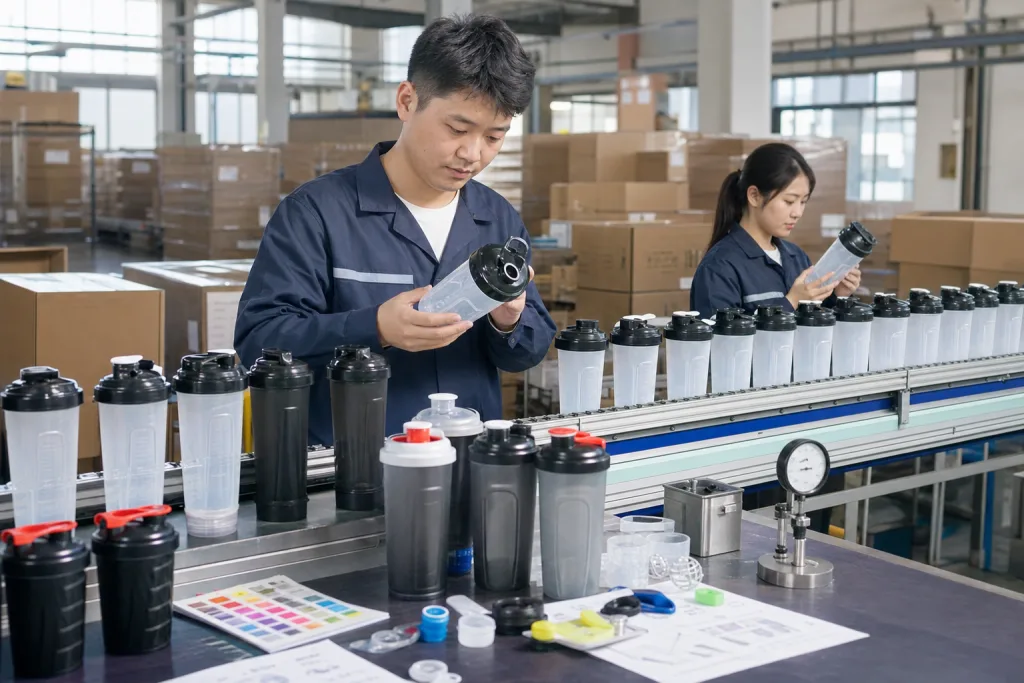
At our Zhejiang factory, we treat shaker bottles and related custom drinkware as engineered promotional items, not cheap handouts. We run the quote around four decisions: bottle structure, material and compliance, decoration method, and supply risk. The buyer often asks for the lowest unit price first; that is the wrong question to ask if the lid tolerance is off by 0.3 mm. Once those choices are locked, pricing, MOQ, and lead time are much easier to control.
Start With The Use Case
Do not start with color or logo. Start with where the bottle will sit after delivery, and how many times the user should open it before your brand name looks worn out. A protein powder brand usually asks us for tighter leak testing than a university canteen giveaway; a gym onboarding kit may need individual polybags, while a retail distributor will push for cleaner UPC placement. Last month QC pulled 12 shaker samples from the line and found 2 caps with weak snap feel at the hinge, so we changed the cap before logo printing.
For a one-day event, a PP shaker with a screw lid, 600-700 ml capacity, and printed logo is often enough. For a paid bundle or employee wellness kit, Tritan or stainless steel makes more sense, with thicker wall construction and a cap hinge that survives daily use. Cheap hinges fail fast. We have seen a buyer save USD 0.18 per unit, then get complaints after roughly 40 openings because the flip cap felt loose; the math does not work when the reorder is at risk.
Most blender bottle promotional products we ship fall into these buying positions:
- Budget promotion: PP body, wire mixing ball or plastic mixer grid, 500-700 ml, FOB around USD 1.20-2.10 depending on order volume. Good for 5,000-20,000 pcs event orders where the buyer cares more about logo visibility and on-time loading than retail shelf finish.
- Mid-range brand item: Tritan body, better clarity, odor resistance, leak-resistant flip cap, FOB around USD 2.30-4.20. We run these with a closer lid-fit check, usually using a simple water inversion test before packing because buyers often flag cap seepage first.
- Premium kit: stainless steel shaker or insulated custom canteen style, 600-900 ml, powder coating or laser logo, FOB around USD 5.50-9.80. This level needs cleaner surface inspection; one dust dot under powder coating can turn into a photo complaint from the buyer’s sales team.
You do not need the most expensive specification. You need the one that matches the channel. A canteen distributor selling to sports clubs may need 8 stock colors and 18-day repeat production, not a fancy box. A brand owner launching a subscription box may care more about packaging, barcode labels, and carton strength; we once had a PO typo where “24 pcs/ctn” became “42 pcs/ctn,” and the carton test failed on weight before shipment. Define the job first, then write the product brief.
Choose Material Without Guesswork
Material choice sets weight, shelf value, compliance files, and drop-test results. In the last 30 shaker RFQs we checked, 17 buyers wrote “BPA free” and left the resin blank. That is not enough. Put the resin, food-contact standard, colorant limit, and sales market on the PO. For Europe, ask for LFGB or EU 10/2011 where applicable. For North America, FDA food-contact compliance and California Proposition 65 screening are common. For children’s items, ASTM and CPSIA questions may enter the discussion. QC will ask for the same details before we release a 500 g color masterbatch to the injection line.
PP is cost-effective and impact-resistant, but it has a softer look and can hold odor if users leave protein powder inside for 3 days. Tritan gives better clarity and a retail-ready look. It costs more, but the math works better for customizable drinkware programs where the recipient should use the bottle for six to twelve months. Stainless steel is strongest for premium custom drinkware, especially when the same range includes a custom growler or travel tumbler. We had one buyer reject PP after seeing the first counter sample under a D65 light box; the logo looked fine, but the body looked too cloudy for a gym retail kit.
Wall thickness matters. A light PP shaker may be 1.2-1.5 mm at the body wall. A sturdier version may sit closer to 1.8-2.2 mm depending on mold design. Stainless steel bodies are often made from 0.4-0.6 mm gauge material for single-wall units and 0.5 mm inner plus 0.5 mm outer for insulated models. Thinner is cheaper, but it dents fast and feels cheap in hand. We test this with a caliper at the shoulder, waist, and base; the buyer usually notices the weak base first.
Do not approve a material from a catalog photo. Ask for the material declaration, test history, and a physical sample from the same mold family.
As a canteen manufacturer in Zhejiang, China, we see about 8 RFQs a month where the buyer writes “same as sample” but cannot name the plastic or steel grade. That creates quotation gaps. This is the wrong question to ask. A serious canteen factory will push back before pricing because material mistakes get expensive after tooling, printing screens, and packaging are confirmed. Last month QC pulled the sample after finding “304 stainless” on the artwork file while the PO listed PP body; that one typo stopped the line for 2 days.
Cap Design Decides Complaints
The cap is where most shaker bottle complaints start. The bottle body can be glossy and the logo can pass tape test, but one leaking cap puts the buyer’s name on the problem. We see it in repeat orders: out of 10 claim emails on blender bottle promotional products, 6 or 7 are about the cap, not the cup wall. Check four items before artwork approval: thread fit, seal material, hinge strength, and drinking comfort at the lip. QC should pull a filled sample from the line, not just twist an empty cap at the packing table.
A screw cap is safer than a snap-only cap for liquid shaking. Look for clean thread engagement of at least 1.5 turns, with no gritty drag or cross-thread bite. The silicone gasket should sit flat in the groove and stay there after a wash test; we use tweezers to lift the edge and check whether it pops out too easily. For flip caps, ask the canteen supplier to test open-close cycles. For a mid-range order, 1,000 open-close cycles is a reasonable internal benchmark. For budget items, some buyers accept lower performance, but get that trade-off written on the quote. Verbal approval disappears fast when cartons arrive.
The mixer system is another decision. Stainless wire balls mix powder well and feel familiar to fitness users, but they add cost and must pass rust and food-contact checks. Plastic mixer grids reduce metal concerns and pack cleaner, but they do not always mix thick protein powders smoothly. We once had a buyer flag clumps after testing 30 g whey with 250 ml cold water, even though the bottle itself passed leak testing. If your promotion is for nutrition, gym, or wellness use, do not save USD 0.08 by choosing a weak mixer that leaves powder clumps. The math does not work.
For canteen customizable projects, buyers often request carabiners, carry loops, pill compartments, or powder storage bases. These features raise retail value on a sales sheet, but every added part means another mold tolerance, another assembly step, and another spot for AQL inspection to fail. On a 5,000 pcs order, even 6 seconds extra assembly per bottle adds close to 8.3 labor hours before packing. If you are a canteen vendor serving corporate clients, a simpler bottle with a stronger cap usually creates fewer after-sales issues than a complex bottle with five accessories. We have seen this go sideways.
Before mass production, run a practical leak test: fill to 80%, close cap, shake hard for 30 seconds, invert for 10 minutes, then check carton simulation after vibration. Simple test. Real result. On our line, QC marks the test sample with a black Sharpie and records any water stain on the inner carton flap after the vibration table run. It is not glamorous, but it catches the problems buyers remember.
Logo Method Changes The Price
Decoration is the point where a shaker bottle stops being stock goods and starts carrying the buyer’s brand. It is also where RFQs get messy fast. “Logo included” is not a spec. We need print size in mm, color count, position, durability target, and whether the mark must pass dishwasher use. Last month QC pulled a 600 ml PP bottle sample where the PO said “front logo,” but the artwork showed a 72 mm wrap print across the measuring scale. That changes the quote.
For PP and Tritan shaker bottles, silkscreen printing is the normal low-cost choice. One-color silkscreen on one side may add USD 0.08-0.18 per unit depending on size and quantity. Multi-color printing adds screen charges, and the line has to control registration, especially when the logo crosses a curved rib near the grip. Heat transfer handles gradients and detailed artwork, but it costs more and does not behave well on every curved surface. We reject that method on some 28 oz shaker shapes because the edge can lift after the 3M tape test. For stainless steel custom canteen or customizable growler projects, laser engraving and powder-coat printing are common. Laser is durable and clean, but it shows as the base metal color and does not reproduce full-color artwork.
If you are buying for a campaign, ask who will receive the bottle: a gym member, supplement customer, charity runner, or retail distributor growler buyer. The right method changes. A distributor canteen program might need 12 small logo batches for different local clubs, so lower setup cost and fast changeover beat fancy decoration. A national promotion needs strict Pantone matching and pre-production approval because 20,000 units with the wrong blue is a real problem. We have seen this go sideways: the buyer approved “navy” by email, then flagged the bulk goods because their brand book called for Pantone 2965 C.
Packaging belongs in the same branding decision. Bulk pack in polybags is cheapest. A white box improves handling and gift value. A retail color box with barcode, warning text, and FNSKU label is necessary for some e-commerce programs. Carton strength needs checking, especially for North American distribution where cartons often pass through 3 warehouses before final delivery. A common export carton is 5-ply corrugated, but bottle weight and packing count decide the exact board grade. For a 24 pcs/carton shaker bottle order, we run a carton drop test before shipment; if the corner crushes, the math on cheap packaging does not work.
Our China sales engineers normally ask for AI or PDF artwork, Pantone codes, target market, and expected wash instructions before confirming decoration cost. Small step. Big difference. It prevents most logo disputes, including the classic typo where a PO says “black logo” but the attached file is 2-color black plus silver.
Set MOQ And Lead Time Early
MOQ is not just a factory rule. It comes from resin buying, color masterbatch mixing, pad-print setup, lid assembly speed, and carton packing on the line. For standard blender bottle promotional products, a workable MOQ is usually 1,000 units per logo and color on stock molds. For custom color resin, 2,000-3,000 units is the number we prefer because one mixer batch is easier to control than two half-batches. For stainless steel customized drinkware with powder coating, MOQ often starts around 1,000 units per color, but custom lids or new molds can push the economic minimum higher. Ask this early. We have seen buyers spend three days arguing over a 500-piece trial, then lose the production slot anyway.
At BottleForge Industrial in Hangzhou, Zhejiang, our monthly drinkware capacity is about 650,000 units across stainless steel bottles, tumblers, canteen customized orders, and shaker-style products. That does not mean every order ships tomorrow. Sampling, component scheduling, printing capacity, and inspection slots still need planning; QC still needs to pull the sample, check logo position with a 0.5 mm ruler, and run the shaker leak test before we release bulk printing. For most stock-mold shaker orders, expect 7-12 days for a printed sample and 30-45 days for mass production after sample approval and deposit. Sea freight to Europe or North America may add 25-40 days depending on port and season.
If you need goods for a fixed event date, work backward from the delivery day. Build in artwork approval, sample courier delivery, production, inspection, export customs, ocean freight, import customs, and inland trucking with real dates, not hope. A buyer once sent us a PO with the event date typed as 06/08, then later said it meant August 6, not June 8. That went sideways. If you request delivery in four weeks but want a custom color, retail box, and full inspection, the math points to air freight or a cut corner somewhere.
FOB pricing is the cleanest basis for factory comparison. EXW can look lower but leaves local trucking, warehouse loading, and export handling on your side; those small charges add up fast on 80 cartons. DDP is convenient, but it hides freight, duty, and risk assumptions, so one quote may include bonded warehouse storage while another does not. If you are a canteen distributor or distributor drinkware buyer comparing quotes from several canteen suppliers, ask each one to quote the same Incoterm, same packing, same inspection level, and same compliance documents. Same basis first. Then compare.
Inspect Before The Cartons Leave
Agree on quality control before the purchase order, not after the goods are sealed in cartons. For promo blender bottles, some buyers skip inspection because the unit price is USD 1.20–2.80. Bad math. If 8% of caps leak or 12% of logos are scratched, the campaign loss beats a USD 180–350 inspection fee fast. Last month, QC pulled the sample after the line packed 62 cartons, and the buyer flagged ink rub-off on the black logo before the goods left Hangzhou.
A normal pre-shipment inspection can use ANSI/ASQ Z1.4 sampling with AQL levels such as 0 for critical defects, 2.5 for major defects, and 4.0 for minor defects. Critical defects include unsafe materials, sharp edges, contamination, or severe leakage. Major defects include wrong logo, wrong color, broken cap, missing mixer ball, or carton shortage. Minor defects include small cosmetic marks within an agreed tolerance, such as a 1 mm speck outside the logo area. We run this with a torque gauge, water table, 3M tape, and a simple carton count against the packing list.
For blender bottles, the inspection checklist should include:
- Capacity measurement to the stated fill line and brim volume, checked with a 500 ml graduated cylinder.
- Leak test by shaking for 30 seconds, inversion for 10 minutes, and hand pressure on the spout.
- Logo position in mm from the mold line, Pantone color, adhesion, and scratch resistance after 10 rubs.
- Cap thread fit, hinge movement, gasket placement, and spout closure, including any loose silicone ring found by QC.
- Carton drop or vibration review for export packing, especially for 12 kg master cartons.
- Barcode, FNSKU, carton mark, and country-of-origin checks if needed, including PO typos like “Made in PRC” versus the approved artwork.
Compliance files must match your market. Europe buyers often ask for REACH and food-contact documentation. North American buyers ask for FDA-related declarations and Prop 65 review. If the order includes a customized growler, customizable canteen, or kids-related bottle, the testing scope can change. Do not assume one old test report covers a new resin color, new coating, or new lid material. We have seen this go sideways when a buyer changed from clear PP to smoke gray PP at artwork approval, then expected the old report to pass customs questions.
A reliable canteen manufacturer will not be offended by third-party inspection. We prefer it because it creates a shared record. The worst case is a vague complaint six weeks after arrival with no retain samples, no defect photos, and no agreed AQL standard. Take photos before loading. Keep 2–3 sealed samples from the inspection lot. If a buyer pushes back on the extra day, I tell them straight: one day at origin is cheaper than 18 days of arguing after delivery.
Build A Reorder-Friendly Program
The smartest buyers look past the first PO. If your blender bottle promotional products sell through, can the same factory match the Pantone chip, cap mold, logo height at 42 mm from the base, and inner carton layout in 90 days? If the answer is uncertain, you are not building a program. You are betting on one batch.
Ask your canteen vendors to keep a golden sample, artwork file, Pantone record, packing specification, and inspection report, with revision dates marked on each file. For distributor canteen and distributor growler programs, this matters because your customers may reorder in 300, 800, or 1,200 pcs waves after the first shipment. We run into this every season: the buyer flagged a reorder because the PO said “matte navy,” while the approved sample card was Pantone 2965C with a gloss clear coat. A canteen supplier that controls repeat documents saves hours before production starts.
Think about family design early. A shaker bottle can share the same coating code and logo treatment with a custom growler or stainless sports bottle, while a travel tumbler and canteen promotional item can use matching cartons for retail programs. Your catalog looks planned, not patched together. The line benefits too: shared powder coating settings, the same laser fixture, and one carton dieline cut down the places where operators make mistakes.
Price still matters. But for B2B custom drinkware, the lowest quote only works if the factory can repeat it with stable quality. A USD 0.25 saving disappears fast when you need 600 replacement caps, air shipment at USD 6.80 per kg, or customer credit notes after QC pulled the sample for loose flip lids. The better question is simple: which canteen manufacturer can hold the specification, warn you before a problem becomes urgent, and ship the second order as cleanly as the first?
This is the practical way to buy. Choose the use case, material, cap design, decoration, MOQ, and inspection standard before you chase pennies. A Zhejiang, China factory can produce competitive customized drinkware, but the buyer still needs a clear specification sheet, not a two-line email with a blurry logo. The clearer your brief, the sharper your FOB price and the fewer surprises at delivery.
Send Your Shaker Bottle Brief For Factory Review
Share quantity, material, logo artwork, target market, and delivery date. We will return a practical FOB quote and production timeline.
Frequently asked questions
What MOQ should I expect for blender bottle promotional products?
For stock mold shaker bottles, expect 1,000 units per logo and color as a normal starting point. If you need custom resin color, a special cap, or matching accessories, 2,000-3,000 units is more realistic because the factory must purchase material, set up printing, and control color consistency. Stainless steel versions may also start at 1,000 units per powder-coated color. If you only need 300-500 units, ask about stock colors with one-color printing, but the FOB price will be higher and decoration options narrower.
Is PP, Tritan, or stainless steel better for a promotional shaker bottle?
PP is best when budget is the main driver and the bottle is used for event giveaways. Tritan is better for mid-range promotional programs because it has clearer appearance, better odor resistance, and stronger perceived value. Stainless steel fits premium kits, gym memberships, and retail bundles where the recipient should keep the product for years. A PP shaker may quote around USD 1.20-2.10 FOB, while Tritan may be USD 2.30-4.20 and stainless versions may reach USD 5.50-9.80 depending on lid, coating, and packaging.
How long does production take after I approve the sample?
For a standard stock-mold blender bottle with one-color logo, sample production usually takes 7-12 days after artwork confirmation. Mass production normally takes 30-45 days after sample approval and deposit. Add another 25-40 days for ocean freight to many Europe or North America destinations. Custom colors, retail boxes, third-party testing, and peak season capacity can add time. If your event date is fixed, share the in-hands date at RFQ stage, not after the purchase order.
What quality checks should I require before shipment?
At minimum, require capacity checks, leak testing, logo inspection, cap function review, gasket placement checks, and carton count verification. For formal inspection, many buyers use ANSI/ASQ Z1.4 with AQL 0 for critical defects, 2.5 for major defects, and 4.0 for minor defects. Ask the factory to keep a golden sample and send production photos before final inspection. If the bottle is for Europe or North America, compliance documents should match the actual material, color, coating, and lid used in production.
Can one factory supply shaker bottles, canteens, and growlers together?
Yes, if the factory has the right product range and decoration capacity. Many buyers prefer one canteen supplier for shaker bottles, custom canteen items, travel tumblers, and custom growler projects because colors, logo methods, packaging, and inspection standards are easier to align. The practical limit is production specialization. A strong stainless steel factory may not be best for low-cost plastic shakers unless it has partner lines or in-house plastic capacity. Ask for monthly capacity, sample history, and photos from current production, not only catalog renders.