Key Takeaways
- Set AQL at 2.5 for major defects and 4.0 for minor defects before mass production
- Confirm PP, Tritan, stainless steel, and silicone grades by market, not by generic material names
- Budget 25-35 days for tooling, sampling, and logo approval before a 30-45 day bulk lead time
- Test carton drop strength at 76 cm for export packaging, especially for FBA and distributor orders
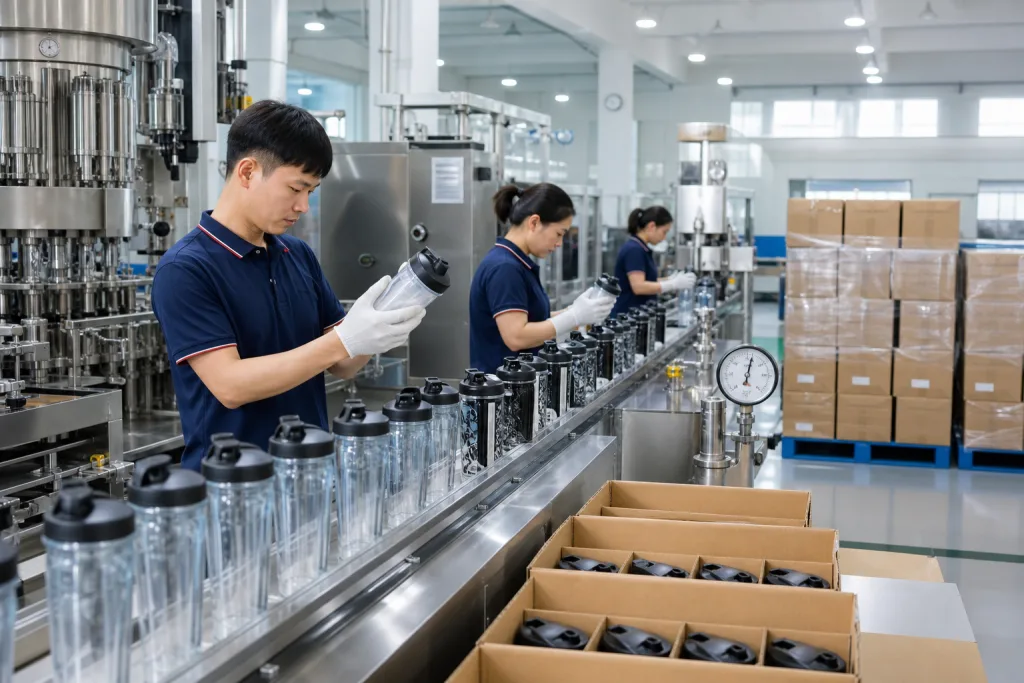
Blender bottle private labeling looks simple until the first container lands with leaking lids, weak shaker balls, scratched logos, or cartons rejected at FBA intake. It is rarely one big factory mistake. It is usually five early decisions made on a thin spec sheet: PP grade written as “food grade” with no test standard, cap tooling approved before a 24-hour inverted leak test, logo artwork sent without Pantone and curing notes, AQL terms left open on the PO, and packaging built for a nice photo instead of a 76 cm carton drop. We’ve seen this go sideways.
If you are buying custom drinkware from China for retail, gyms, corporate gifting, or a distributor drinkware program, quote the failure modes before you chase the lowest FOB price. Our Zhejiang team produces about 450,000 drinkware units per month across shaker bottles, stainless tumblers, sports bottles, and canteen customized projects, and QC pulled samples last month where a 0.3 mm lid flash was enough to cause seepage after shaking. The buyer flagged the leak. Fair point.
Failure one: the bottle leaks
Leaking is the costliest failure in blender bottle private labeling because the product can pass carton inspection and still come back after one customer shakes protein powder in a gym bag. We’ve seen this go sideways. QC pulled 32 samples that looked clean on the table, then 3 started weeping at the cap after a 30-second shake test. The weak points are usually not in the bottle body; they sit in the thread tolerance, flip cap hinge, silicone gasket compression, and the match between cap ID and mouth OD.
For plastic shaker bottles, write the cap material and closure test into the PO. A basic PP body with a PP cap works for a 5,000-piece giveaway order, but retail shelves need better clarity and drop performance, so ask for Tritan or Eastman-certified material where transparency and impact resistance matter. For a stainless shaker or custom canteen line, specify 18/8 stainless steel, inner wall thickness around 0.4 mm, outer wall around 0.5 mm, and food-grade silicone gaskets. “Food grade” alone is too loose. The math doesn’t work when a buyer saves USD 0.06 on gasket material and then eats returns from leaking lids.
Your purchase order should require a leak test on assembled units, not loose caps and bodies in separate bins. We normally run it this way: fill the bottle to 80 percent, close it, invert for 10 minutes, then shake for 30 seconds. For sports caps, add a side-pressure test on the flip lid using a simple fixture or a 5 kg hand press on the drinking spout area. For a canteen manufacturer in Zhejiang or elsewhere in China, this is basic process control, but it has to be written into the QC checklist beside AQL 2.5 and the packing check.
If you are building a canteen custom or customizable canteen program with multiple lids, test every lid combination before mass production. A wide-mouth cap, straw lid, and shaker lid may share the same neck drawing, but gasket height can differ by 0.2-0.4 mm. That gap is enough to create slow leakage under pressure. Last summer, the buyer flagged “random leaking” on a 12,000-piece order; the drawing was correct, but the straw lid gasket was 0.3 mm lower than the shaker lid sample approved by email.
Failure two: material claims do not match
About 6 out of 10 buyer disputes we see start with one sentence: “But the supplier said it was safe.” Safe is not a material spec. For blender bottle private labeling, compliance has to match the sales market printed on the PO and carton mark. Europe buyers usually ask for LFGB, REACH, and sometimes EU 10/2011 for plastic food contact. North America buyers may ask for FDA food contact compliance, California Prop 65 review, and BPA-free declarations. For kids or school channels, ASTM and CPSIA concerns may enter the discussion. QC pulled one 600 ml shaker sample last May because the test report said PP, while the injection mark inside the lid showed “PETG.” That shipment stopped for 9 days.
The risky part is simple: a canteen supplier may quote different materials under the same product photo. We see this on RFQs every week. One quotation may be PP, another Tritan, another PETG. All three can be transparent. They are not equal. PP is cost-effective and flexible but less glass-clear; under our light box, haze shows fast on a 1.0 mm wall. Tritan costs more, often adding USD 0.35-0.80 per unit depending on capacity and design, but gives better clarity and impact performance. PETG can look attractive in samples yet may not be acceptable for all heat or dishwasher claims. The buyer flagged this once after the first dishwasher cycle at 70°C, and the math did not work after repacking 3,000 pcs.
For stainless customized drinkware, ask for the stainless grade on both inner and outer walls. If a canteen factory quotes “304 inside, 201 outside,” that may be acceptable for a budget distributor canteen order, but not for a premium fitness or outdoor line exposed to moisture. We run PMI spot checks with a handheld XRF gun when the order value justifies it; one mixed-wall batch showed 201 on the outer shell after the supplier’s PI only said “304 stainless.” For powder coating, request a coating adhesion test and a cross-hatch test. For colored plastic parts, confirm that pigments are food-contact suitable.
A practical spec sheet should include material grade, capacity tolerance, temperature claim, dishwasher claim, test standard, and document type required. Add wall thickness in mm and target capacity tolerance, such as 700 ml ±3%, so the line has something to measure with a caliper and scale. This protects you from a canteen vendor who wins the order with a low FOB price and then substitutes a resin that passes appearance checks but fails compliance review. We have seen this go sideways: one PO had “BPA fee” instead of “BPA free,” and nobody caught the typo until the retailer compliance team asked for a revised declaration.
Failure three: the logo looks cheap
Private label buyers will spend 12 days arguing over bottle shape, then approve decoration in one email at 6:40 p.m. That is backwards. Your customer sees the logo before they notice the shaker ball or lid thread. On blender bottles, we see two failures most often on the line: silk screen ink with patchy opacity after the second pass, and heat transfer film lifting 1-2 mm at the edge after the tape test. QC pulled a black matte sample last month where the white logo looked gray under D65. The buyer flagged it immediately.
Start with the surface. A matte powder-coated stainless shaker takes laser engraving differently from glossy plastic, because the laser bites through coating while UV ink sits on top. A curved 700 ml bottle also stretches large artwork near the side wall; our pad-printing jig shows it fast. If your logo has fine lines below 0.3 mm, do not use low-cost silk screen on a strongly tapered body. The math does not work. If you need Pantone matching, write the Pantone code on the PO and set an acceptable Delta E range where possible. For most custom drinkware orders, buyers still approve by eye under D65 light, but retail programs should control color with a meter, not hope.
MOQ matters here. A simple one-color logo on a stock shaker can start around 500-1,000 units per SKU in our Zhejiang facility. Full custom molding or a special cap color may push MOQ to 3,000-5,000 units, because the injection line will not change resin for 600 lids. We ship canteen promotional orders where laser engraving is the safest choice for durability, but it gives you no real color. UV print gives stronger graphics, then it needs abrasion testing; we run 500 cycles on the rub tester when the bottle is likely to hit cup holders or gym lockers. Dishwasher racks are worse.
Ask for a pre-production sample using the final artwork, not a “similar” logo from last season. We have seen this go sideways when the sample used a bold icon, but the final PO had a 0.25 mm slogan under it. Require the factory to keep one signed golden sample on the line, with the date and SKU written on masking tape or a sample card. A serious canteen manufacturer or custom canteen supplier should accept that without debate. It cuts arguments because inspectors compare production to a physical bottle, not a PDF attachment from six weeks ago.
Failure four: shaker parts feel weak
A blender bottle is an assembly, not a single molded cup. Body, lid, hinge, spout, gasket, mixing ball or grid, storage cup, carry loop, and printed scale all need to work as one set. We have seen 8 parts pass incoming checks, then the finished bottle still feels cheap because the cap takes two hands to open. QC pulled one sample last year where the PP body was fine, but the silicone gasket sat 0.4 mm proud and made the lid feel crooked. Buyers usually find the problem too late, after customers complain that the cap is stiff, the mixing ball rusts, or the scale rubs off in a dishwasher cycle.
For the mixing element, specify stainless steel 304 for wire balls unless you intentionally choose plastic grids. Wire diameter, spring tension, and weld quality matter. A cheap ball may save USD 0.03-0.06 per unit, then create rust claims that wipe out the saving on the first 2,000 pcs. The math does not work. On our line, we check ball rebound by hand and inspect the weld point under a 10x loupe; rusty stock usually shows up around the weld first. If the design uses a plastic mixing grid, test it with 30 g protein powder and 400 ml cold water, not just clean water in a showroom. Some grids look smart on CAD but trap clumps in the corners.
For hinges and flip caps, request cycle testing. A reasonable baseline is 1,000 open-close cycles for standard retail quality, with no cracking or loss of closure force. We run this on a simple fixture, but the result is easy to read: if the cap starts clicking loose after 300 cycles, the buyer will flag it. For carry loops, define a hanging load test, such as 5 kg for 60 seconds, if the bottle is marketed for gym or outdoor use. For a customized growler or custom growler format, the carry handle needs stricter testing because filled weight is much higher than a 600 ml shaker; a 1.9 L unit can put more than 2 kg on the handle before the user even adds ice.
Printed scales fail quietly. If you need ounce and milliliter markings, decide whether they are molded, silk printed, or embossed. Printed scales on translucent plastic are cheaper, but they should pass rubbing tests, such as 50 cycles with a wet cloth and 1 kg hand pressure. Molded marks cost more upfront and may add 7-12 days to mold adjustment, but they are safer for long-term use. We have seen this go sideways when the PO said “ML/OZ scale,” while the approved artwork showed only ounces. Customizable drinkware only works when the functional details survive normal handling.
Failure five: cartons fail before retail
Packaging is where a clean bottle turns into a bad order. On our packing line, we have seen a carton spec pass sample stage and fail at dispatch because the buyer wanted 24 pcs per outer, but the retail case needed 6 pcs x 4 inners. A canteen distributor may need shelf-ready color boxes. An online seller may need FNSKU labels and carton sizes that fit fulfillment rules. A corporate gifting buyer may need plain gift boxes with no factory marks. If packaging is left to the end, the factory will grab the fastest carton that protects the ship date, not your channel.
For export drinkware, spell out the inner bag, divider, color box, master carton, label layout, and pallet requirement. On one order, QC pulled the sample after the carton edge crushed at 76 cm in a drop test, so we changed the board to 5-layer and held the outer weight under 22.5 kg. That is the number that matters for most FBA lanes. If the bottle has a clear plastic body, add scratch protection. Transparent shaker bottles show scuff marks fast, and the buyer will flag it on first open.
A distributor growler or distributor canteen program often ships mixed colors to regional warehouses. That creates a different risk: wrong assortment. Use carton marks that show SKU, color, capacity, logo version, quantity, gross weight, net weight, and country of origin. If you need “Made in China” on the product or packaging, define the exact panel before production starts. We have seen a PO typo like “Mdae in China” hold up a proof for two days at the art desk, and customs does not care that the mistake was small.
Do not assume one pack plan fits every channel. A canteen promo order for an event can go out in a polybag and bulk carton, no problem. A retail customized canteen needs barcode control and a cleaner face. A warehouse-direct B2B order needs stronger cartons and scannable labels more than glossy graphics. This is the wrong question to ask if someone says, “Can we use the same box for all three?” We run different packs for a reason, and the line shows it when a 250 gsm color box looks fine but the master carton fails a corner crush test at 12 kg.
Failure six: QC starts too late
The worst time to write a QC plan is when 80 percent of the order is already packed. At that point, the canteen vendor can only sort bad pieces on the packing table, not stop the line from making them. For blender bottle private labeling, QC should start at drawing approval, then move through incoming material checks and final random inspection before shipment. We run calipers on lid fit, check shaker ball weight, and confirm logo position against the approved artwork before bulk packing starts.
Put AQL terms in the purchase order. For most B2B drinkware orders, AQL 2.5 for major defects and 4.0 for minor defects is a practical starting point. Critical defects should be zero tolerance. Major defects include leaking, wrong material, broken hinge, incorrect logo, unsafe sharp edge, and failed barcode. Minor defects include small cosmetic marks within an agreed size limit, slight color variation, or minor packaging scuffs. Write the limit down, such as “black dot under 0.5 mm allowed on non-logo area,” or QC will argue with packing for two hours and still have no standard.
Ask your canteen suppliers for production photos at three stages: raw materials and components, first finished units, and packed cartons. If the order is above USD 15,000, use either your own third-party inspection or a factory inspection report with photos, sample size, defect list, and pass/fail result. For repeat programs with canteen manufacturers in China, keep a defect history by SKU. We have seen one flip lid pass in March, then fail in June because the hinge pin mold had wear of about 0.2 mm. The buyer flagged leaking after delivery. That gets expensive fast.
Lead time must include QC. A normal stock-shape private label order may take 30-45 days after deposit and artwork approval. New tooling can add 25-35 days before bulk production. If you demand a 20-day shipment on a new customizable growler with special coating and retail packaging, you are not buying speed. You are buying risk. The math does not work: coating needs curing time, cartons need a drop test, and QC pulled the sample only after the barcode label matched the PO instead of the old SKU from last season.
Pricing that hides future defects
Low FOB pricing is not automatically bad. It turns risky when you do not know what got cut to hit it. On our line, a USD 0.18 drop can come from 0.3 mm thinner carton board, a lower resin grade, a softer gasket, skipped leak checks, or no spare parts bag. QC pulled the sample, squeezed the lid three times, and the hinge started to whiten. On 5,000 units, that is USD 900. If 3 percent leak in stores, the replacement bill and return freight can wipe it out fast.
Compare quotations line by line. Capacity, weight, material, lid type, logo method, packaging, compliance documents, inspection standard, and Incoterm should all show the same spec. A 700 ml PP shaker with one-color silk screen and bulk carton is not the same job as a Tritan shaker with UV logo, color box, FDA paperwork, and drop-tested master carton. We had a buyer flag a PO once because the artwork file said 750 ml and the spec sheet said 700 ml. That typo would have burned a mold change. The same issue shows up in canteen customizable and customized growler projects.
For new buyers, start with a stock mold, 500-1,000 units, one logo method, and standard colors. Use that first run to see if the market moves. Once sell-through is proven, move to custom cap colors, special surface finishes, or private tooling. We run a 30-second vacuum leak test on the line for these trial orders, and that catches more trouble than a pretty render ever will. Do not jump into tooling before you have sales data.
Good sourcing is not about finding the cheapest canteen vendors in China. It is about making the commercial risk visible before production. If your specification forces every canteen supplier to quote the same construction, tests, packaging, and AQL terms, the price gap means something. If it does not, the math does not work. This is the wrong question to ask: "Who is cheapest?" Ask who can hold the same spec, pass the same inspection, and ship the same result.
Send your bottle spec before you quote
Share capacity, material, logo, packaging, compliance market, and target MOQ. We will flag cost and QC risks before sampling.
Frequently asked questions
What MOQ should I expect for blender bottle private labeling?
For a stock blender bottle with a one-color logo, a realistic MOQ is usually 500-1,000 units per SKU. If you need custom plastic colors, special lids, or matched accessories, expect 3,000-5,000 units because resin coloring and component setup create waste. Full private mold development can require 5,000-10,000 units depending on size and tooling cost. In Zhejiang, we often suggest starting with stock molds for the first order, then moving to custom tooling after sell-through data is clear.
Which logo method is best for private label shaker bottles?
It depends on the surface and sales channel. Silk screen is cost-effective for one or two colors and works well on simple plastic bodies. UV print is better for multi-color artwork but needs abrasion testing. Laser engraving is excellent on powder-coated stainless steel because it will not peel, but it does not provide printed color. For most retail custom drinkware, approve a physical pre-production sample and keep Pantone references in the file. Do not approve decoration based only on a digital mockup.
How do I confirm a blender bottle is food safe?
Ask for material-specific documents, not a general food-safe statement. For Europe, buyers commonly request LFGB, REACH, and EU food-contact declarations for plastics. For the U.S., FDA food-contact compliance and BPA-free declarations are common, with Prop 65 review if selling in California. The test report should match the material actually used in your order, such as PP, Tritan, silicone, or 304 stainless steel. If the factory changes resin supplier, ask whether the documents still apply.
What lead time should I plan for a private label order?
For stock molds with existing colors, plan around 30-45 days after deposit, artwork approval, and sample approval. Add 25-35 days if you need new tooling, custom lid development, or special accessories. Decoration complexity and packaging can add time too, especially for color boxes, FNSKU labels, and barcode verification. Sea freight from China to North America or Europe can add several weeks, so build your launch calendar backward from the required warehouse arrival date, not the factory ship date.
Should I buy from a trading company or a factory?
Both can work, but you need transparency. A direct canteen manufacturer may give better control over tooling, material, and line QC. A trading company may help if your order combines shaker bottles, stainless canteens, glass bottles, and gift packaging from several sites. The key is whether they provide clear specs, AQL terms, production photos, and accountability when defects appear. For orders above USD 15,000, consider a third-party inspection even if the supplier has BSCI or ISO documents.