Key Takeaways
- Set thread, gasket, and leak-test specs before sampling; 100% lid leak testing is reasonable on shaker bottles
- For logo work, require adhesion testing after 24 hours of curing, not only a visual check at the line
- MOQ normally starts at 3,000 units per SKU for custom blender bottles, higher for private mold or special resin colors
- Use AQL 2.5/4.0 inspection plus drop, torque, odor, and carton compression checks before final payment
A blender bottle looks simple until the first shipment lands with wet master cartons, loose mixing balls, rubbed logos, and bottom-layer cartons crushed under 18 kg stack weight. For B2B buyers, the failure is rarely one big miss. It is ten loose decisions on the PO: PP or Tritan resin grade, thread tolerance in mm, gasket Shore hardness, print curing time, carton burst strength, and AQL 2.5 inspection level. QC pulled a sample last month where the lid passed a quick hand-tight test, then leaked after a 30-second inverted shake. That is the kind of small miss that becomes a chargeback.
If you are choosing a blender bottle oem manufacturer in China, write the product the way the line will build it, not the way a sales deck describes it. At our Zhejiang drinkware production base, we quote custom drinkware from 3,000 units per SKU, with normal sampling in 7-10 days and bulk lead time around 30-45 days after approval. Buyers sometimes ask for “premium quality” on the inquiry sheet; this is the wrong question to ask. Give us the lid torque target, logo size, resin requirement, packing method, and drop-test standard, and we can quote a bottle that we can actually ship.
Leaks Start With Loose Specifications
Most blender bottle failures start at the lid, not the cup body. We have seen buyers approve one desk sample that held water overnight, then bulk cartons land with 2-5% leaking after truck vibration. QC usually traces it to thread mismatch, gasket compression loss, flip-cap hinge fatigue, or a drinking spout that is 0.3 mm too shallow to seal under pressure.
Your purchase spec should state the cup material, lid material, gasket material, thread type, cap torque, and leak-test method. For PP blender bottles, we usually recommend food-grade PP body, PP or PE lid, silicone gasket at Shore A 50-60, and a flip cap designed for at least 3,000 open-close cycles. Tritan-style copolyester works when the buyer wants cleaner clarity, but confirm EU food-contact compliance and US FDA food-contact suitability with the canteen supplier before mold work starts. On the line, we run a go/no-go thread gauge and a Shore A durometer before signing off the first 50 lids.
Do not write only “leakproof.” That word causes arguments. Write the test. A practical factory standard is: fill to 90% capacity with room-temperature water, close at approved torque, shake vertically 30 times, invert for 10 minutes, and check for visible leakage. For sport nutrition use, add a mild pressure test because powder drinks foam and build pressure; our QC team uses a torque screwdriver first, then pulls failed caps apart to check gasket seating.
One sample passing is not a standard. A written leak test with a pass/fail rule is a standard.
A serious canteen factory in Zhejiang or elsewhere in China should be willing to perform 100% lid leak testing on blender bottle bulk orders. It adds handling time, usually 6-8 seconds per piece at packing, but the math still works. Replacing 3,000 leaking bottles after a distributor drinkware customer rejects a container is where we have seen this go sideways.
Wrong Plastic Creates Bigger Claims
Material mistakes get expensive fast because you cannot fix the resin after the mold has shot 20,000 bodies. A canteen manufacturer may offer PP, PE, PETG, copolyester, stainless steel, or glass depending on the bottle type. For blender bottles, the normal argument is PP versus clear copolyester. PP costs less, takes drops better, and works for opaque or semi-transparent colors. Copolyester gives the clear shelf look buyers like, but the molding window is tighter; we run lower shear and check the first 30 pieces for flow marks, gate blush, and stress cracking under the thread.
If you sell to Europe, ask for test reports aligned with EU food contact rules and REACH expectations. If you sell to North America, ask about FDA food-contact materials and California Proposition 65 risk screening where relevant. For kids, fitness, or canteen promotional programs, do not assume the factory’s old report covers your chosen pigment. That is the wrong shortcut. Color masterbatch can change the compliance result, and we have seen QC pull a red PP sample because the PO said “Pantone 186C” while the approved test report was for natural PP only.
Wall thickness should be fixed early, before mold steel is cut. For a 600-800 ml shaker, a body wall around 1.6-2.2 mm is common depending on resin and shape. Too thin, and you get denting, oval mouths, and thread distortion. Too thick, and the bottle feels heavy, cycle time moves from 28 seconds to 36 seconds, and unit price creeps up. The line checks this with an ultrasonic thickness gauge at the shoulder, waist, and base, because one pretty sample on the desk does not prove stable mass production.
For a custom canteen, customizable growler, or stainless distributor growler, the material discussion shifts to 304 stainless steel, inner polishing, vacuum insulation performance, and powder coating adhesion. A buyer sourcing customized drinkware should not use one generic material checklist for every product family. Blender bottles fail at threads, lids, odor, and drop impact. A custom growler fails at welds, heat retention, coating chips, and leakage after air-pressure testing at 0.6 MPa. We ship both types, and the math does not work when one spec sheet tries to cover them all.
Logo Defects Are Usually Predictable
Brand owners catch logo defects before they catch a 0.4 mm lid tolerance issue. A lid can pass leak testing on the line, but if the logo rubs off after 3 cartons slide across each other in the warehouse, the order is still a sales problem. On blender bottles, we watch curved cup walls, textured flip lids, dark PP resin, and low-surface-energy plastics; last month QC pulled a black 600 ml cup where the white ink passed visual check, then lost edges after a fingernail rub.
For custom drinkware, we run silk screen printing, pad printing, heat transfer, in-mold labeling, laser marking on stainless parts, and shrink sleeve work. On PP blender bottles, silk screen works for one or two colors when the artwork is simple, but the ink system and oven curing decide the result; cheap ink saves maybe USD 0.02 per piece and can kill the reorder. Before mass production, we ask buyers to sign off Pantone code, artwork size in millimeters, print position tolerance, and adhesion standard, because one PO typo like “45 mm” instead of “54 mm” can move the logo straight into the grip area.
Run a cross-hatch tape test after curing. Simple test. Let the printed area sit for 24 hours, cut a light grid with a 1 mm blade, then pull with 3M 600 or equivalent tape at a steady angle. For dishwasher-safe claims, the wrong question is “will it survive washing”; ask for cycle count, water temperature, and detergent type. We have seen low-cost prints pass 10 hand washes and fail after 18 hot detergent cycles, so if your distributor canteen program needs dishwasher resistance, put those test conditions on the spec sheet before deposit.
Laser engraving is not a rescue plan for plastic bodies. It works on stainless steel custom canteen or customized growler items, where the beam gives a clean mark and the surface does not need ink adhesion. For plastic shaker cups, a canteen vendor should give straight decoration advice instead of promising every logo on every curve; we have rejected artwork with 0.2 mm lines on a ribbed lid because the pad print plate could not hold it cleanly. Good canteen vendors sometimes say no. That saves chargebacks.
Mixing Parts Need Their Own QC
The mixing ball, grid, or agitator looks like a small add-on, but it is the part that sends complaints first. QC pulled three wire balls from the line last month, and one showed brown spots after the 24-hour salt-spray check. Stainless steel wire balls rust when the grade is off or passivation is weak. Plastic mixing grids warp when the resin is too soft or the tool leaves ribs too thin. Loose agitators rattle in transit, scratch the inner wall, and make the bottle feel cheap.
For wire balls, ask for 304 stainless steel and lock down diameter plus wire gauge. A 600-700 ml blender bottle often uses a 50-55 mm mixing ball, but that depends on bottle diameter and mouth opening. We had one buyer flag a PO typo that called for 55 mm on a narrow-mouth bottle; the sample could not even pass the neck. If the ball is too large, users fight to remove it. Too small, and protein powder stays lumpy. This is the wrong question to ask if you only test with water. For canteen customized products sold into protein, supplement, or gym retail channels, run the mixing test with real powder.
For plastic grids, define the resin, fit tolerance, and drop behavior. The 8-cavity mold on our side is set with a 0.15 mm check on the snap tabs, because a grid that locks in too hard traps powder and drives cleaning complaints. A loose grid is easier to wash, but it can click during shipping and give the buyer a bad first impression. We’ve seen this go sideways more than once. There is no one-size answer. It depends on how the end customer shakes and washes the bottle.
Accessory counting belongs in QC, full stop. A 10,000-unit order missing 300 mixing balls creates a packing mess for a canteen distributor, and the math does not work when the retail box is already sealed. Your inspection list should confirm bottle, lid, gasket, agitator, instruction sheet, barcode label, and polybag or paper wrap for each retail set. QC should count against the carton list, not memory.
Packaging Fails Before The Bottle
Many buyers fixate on the bottle and call packaging “standard export carton.” That is the wrong question to ask. Blender bottles are light, but they stack high, get squeezed in transit, and take rough handling at receiving. We have seen a 0.5 mm lid rim warp because the carton wall was soft, and the print on the body picked up scuff marks before the buyer even opened the pallet.
At our Zhejiang line, we size the master carton around bottle height, carton weight, and the loading plan. A 24-piece carton can work for a 600 ml bottle. A 12-piece pack is the safer call for a large custom growler or a stainless insulated item. On the bench, QC pulled the sample and checked burst strength, edge crush strength, inner dividers, and polybag thickness before we signed off. If the carton is too thin, the math does not work.
If you sell through e-commerce or distributor drinkware channels, barcode and label control matter as much as carton strength. FNSKU, UPC, carton marks, country of origin, batch code, and warning labels should be checked on a pre-production packing sample, not after the first shipment leaves. We have had a buyer flag a PO typo on the carton mark and a factory can still ship the right bottle in the wrong box. That creates a mess at the DC.
Drop testing has to match the channel. For wholesale canteen distributors, a standard carton drop test may be enough. For parcel-ready units, ask for individual box drop testing from 76 cm on edges, corners, and faces. We run this on the packaging test rig, and the weak point shows up fast. If the shipment goes FOB Ningbo or Shanghai, the carton still has to survive inland trucking in China, port handling, ocean freight, and your local warehouse. Cheap carton, expensive lesson.
Audits Catch Process Problems Early
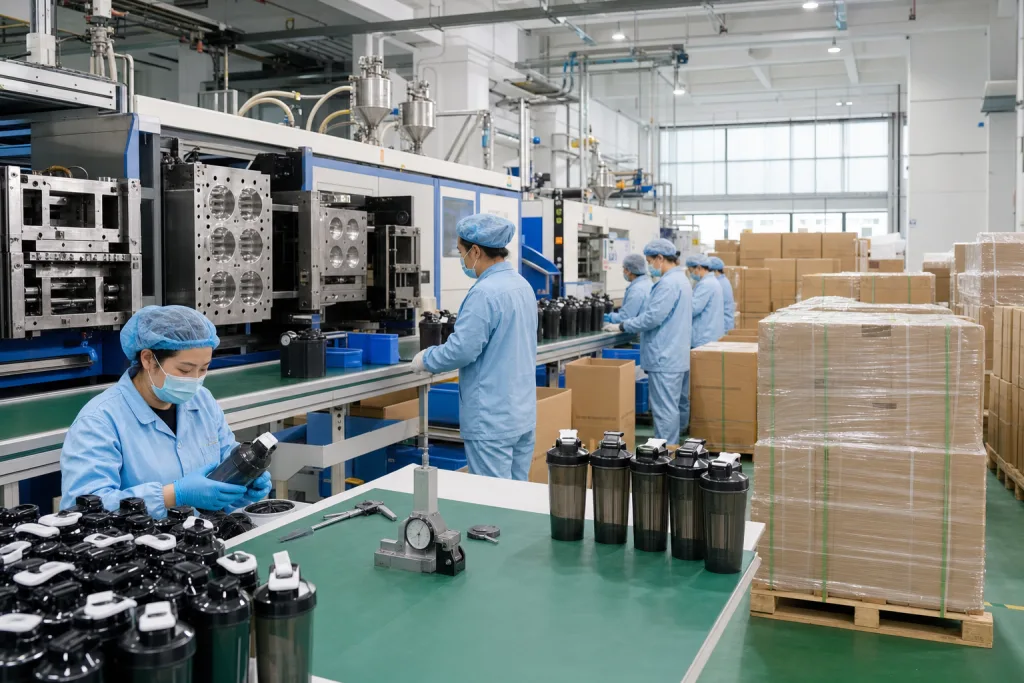
A factory audit is not paperwork for big-box buyers only. It tells you whether the canteen manufacturer can repeat one approved sample 20,000 times without drifting on lid fit, shaker ball size, or logo position. Blender bottle production runs through injection molding, decoration, assembly, leak testing, packing, and final inspection. We check the molding machine tonnage, the 0.2 mm lid thread tolerance, and the leak-test jig on the line. If those steps sit with loose subcontractors, find out before the 30% deposit leaves your account.
Ask where molding is done, where printing is done, and who signs off incoming material inspection. A capable blender bottle oem manufacturer should show resin traceability, approved color chips, first-article inspection records, and line QC records. We like to see the actual PP resin lot number on the warehouse card, not a clean PDF made after the buyer asks. Certifications may include ISO 9001 for quality systems, BSCI or Sedex-type social audits for larger retail programs, and food-contact test reports from recognized labs. Certificates cut some blind spots, but they do not replace inspection.
For QC, AQL 2.5 for major defects and 4.0 for minor defects is a common starting point. Critical defects such as leakage, sharp edges, wrong material, heavy odor, and unsafe contamination should be rejected at 0 tolerance. Include functional checks: leak test, cap opening force, print adhesion, odor check after 24 hours closed, assembled weight range, and carton drop test. QC pulled one 700 ml sample last year because the flip cap opened at 0.6 kg instead of the agreed 1.2 kg. Small miss. Big return risk.
China has at least 80 capable canteen manufacturers for this category, and plenty of trading layers that hide the real production site. That does not make every trader bad. It means you should know who owns the tooling, who controls QC, and who signs the corrective action report when something fails. We have seen this go sideways when the PO lists “factory direct,” but the mold sits 90 km away in another workshop and nobody wants to pay for rework.
Commercial Terms Can Create Defects
Price pressure creates technical failures faster than most buyers expect. If you push a canteen supplier down by USD 0.08 per unit without changing the specification, the saving often comes from a 0.15 mm thinner cup wall, cheaper silicone on the gasket, weaker K=K carton board, or a shorter inline QC check. On a 20,000-unit order, that USD 1,600 saving can disappear with one rejected pallet. We have seen QC pull 32 leaking lids from a 200-piece pre-shipment sample because the buyer forced the target price after the mold trial.
For a standard PP blender bottle with one-color print, realistic China factory pricing may range roughly from USD 1.20-2.40 FOB depending on capacity, resin, lid complexity, decoration, packaging, and order volume. Copolyester bodies cost more because the resin price moves fast and the injection line needs tighter temperature control, usually checked at the barrel by the machine setter every 2 hours. Special lids, retail boxes, or custom molds also increase the cost. A private mold can require USD 3,000-15,000 or more depending on cavities and complexity. MOQ is often 3,000 units per color for existing molds, while special colors or private tooling may require 5,000-10,000 units.
Clarify Incoterms before you argue about unit price. FOB Ningbo, FOB Shanghai, EXW Hangzhou, and DDP to your warehouse are different jobs, not different spellings on a PI. For new buyers, FOB is usually cleaner because you control freight and import costs. If you need DDP, ask the supplier to separate product cost, inland freight, ocean or air freight, duty, and final delivery so you can see what you are paying. We once had a PO typo showing “FOB Hangzhou”; the buyer flagged it, and they were right, because Hangzhou is not the loading port for that shipment.
A good canteen supplier or distributor growler source should push back on unrealistic targets. If you ask for premium customizable drinkware at the lowest promotional price, the math does not work. Something has to give: use PP instead of copolyester, choose one-color silk screen instead of heat transfer, pack in a plain white box instead of a retail box, or accept less margin on the factory side. Do not let the factory decide silently. That is how the line ships pretty samples and weak mass production.
Send your blender bottle spec for a factory review
We will check material, lid structure, decoration, MOQ, packaging, and QC risks before you lock the purchase order.
Frequently asked questions
What MOQ should I expect from a blender bottle OEM manufacturer?
For an existing mold, expect about 3,000 units per SKU or color for a PP blender bottle. If you need a special Pantone body color, custom lid, retail box, or private mold, MOQ often moves to 5,000-10,000 units. A full private mold may need a tooling budget of USD 3,000-15,000 depending on cavity count and structure. Small trial orders are sometimes possible, but unit price rises because color setup, printing setup, and packing labor are spread across fewer units.
How long does sampling and bulk production usually take?
For standard custom drinkware using an existing mold, a plain sample can often be ready in 3-5 days. Logo samples normally take 7-10 days after artwork approval. Bulk production is usually 30-45 days after deposit and signed sample approval. Add time for lab testing, custom packaging, or private tooling. A new injection mold may add 25-40 days before the first T1 sample. During peak China export periods before summer and Q4, build in another 7-14 days of safety.
Which tests should I require before shipment?
At minimum, require AQL inspection with 2.5 for major defects and 4.0 for minor defects, plus 0 tolerance for critical safety issues. Add a 100% or sampled leak test, cap open-close test, print adhesion test, odor check, weight check, barcode scan, carton drop test, and accessory count. For Europe, request food-contact and REACH-related documentation where applicable. For North America, confirm FDA food-contact material suitability and any Proposition 65 risk review if selling into California.
Can one supplier handle blender bottles, custom canteens, and growlers?
Yes, but check whether they actually manufacture each category or only trade some items. Blender bottles are usually injection molded plastic products. A customized canteen may be plastic, aluminum, or stainless steel. A customized growler often involves stainless steel forming, welding, polishing, vacuum insulation, and powder coating. The QC skills are different. If you want one canteen vendor for all items, ask for production photos, process flow, capacity, test reports, and sample references for each product family.
What information should I send to get an accurate quotation?
Send capacity in ml or oz, material preference, lid type, body color, logo method, logo size, packaging style, destination market, order quantity, and Incoterm such as FOB Ningbo or DDP. Include artwork in AI, PDF, or high-resolution vector format if available. If you are a canteen distributor, also state barcode, carton mark, pallet, and delivery window requirements. With complete information, a factory can usually quote within 24-48 hours. With vague information, the first price is only a guess.