Key Takeaways
- A basic PP blender bottle usually lands at USD 1.25-2.40 FOB China at 3,000-10,000 units
- Custom mold work can add USD 1,200-6,000 and 18-35 days before mass production
- Normal production lead time is 25-40 days after sample approval and deposit
- AQL 2.5/4.0 inspection is realistic for leakage, appearance, assembly, and carton checks
Buying from blender bottle manufacturers is not the same as buying a plain stainless tumbler. The lid has to seal, the shaker ball or mixer grid has to move cleanly, and the cup needs to pass smell checks after PP injection. We have seen a USD 0.08 cheaper lid fail a 24-hour inverted leak test because the silicone ring was 0.3 mm undersized. Bad math.
From our Zhejiang factory desk, the pattern is familiar: a buyer asks for 3,000 custom bottles, then the line stops at sampling because the Pantone color, retail box, logo plate, and food-contact report were not fixed on the PO. QC pulled one sample last month where the buyer wrote “matte black” in email but “gloss black” on the artwork file. China can still ship fast, but only when the spec is locked before we open the sample order.
Where the bottle cost starts
The first cost driver is the body material. In our Hangzhou costing sheet, 8 out of 10 blender bottle RFQs start with PP, Tritan, stainless steel, or a mixed body with a plastic lid. PP is the budget workhorse for fitness promos and canteen giveaway programs. Tritan costs more, but it gives clearer shelf presentation, better drop resistance, and a tighter retail feel in hand. Stainless steel makes sense for insulation or a premium custom canteen style; the line then moves from injection molding into welding, vacuum testing, and different lid assembly checks.
For a standard 600-750 ml PP shaker bottle with screw lid, flip cap, measurement marks, and stainless mixing ball, expect roughly USD 1.25-2.40 FOB Ningbo or Shanghai at 3,000-10,000 units. Tritan often runs USD 2.10-3.80. A stainless double-wall shaker or customized growler format can move to USD 5.50-11.00 depending on capacity, lid design, powder coating, and packing. We had one buyer push back on a USD 1.18 target last month; after adding the 65 g PP body, 7 g ball, color box, and 5-ply export carton, the math did not work.
Wall thickness is not cosmetic. A PP body at 1.8 mm will feel cheaper than one at 2.3-2.6 mm, and it will deform faster under carton compression. QC pulled the sample with a Mitutoyo caliper after a 24-hour stack test, and the thin body showed an oval mouth before the lid torque test even started. For stainless items, buyers should ask for the steel grade and gauge: 304 inner, 201 or 304 outer, typically 0.4-0.5 mm sheet thickness for common drinkware. If a quote is 12-18% lower than others, the saving is often hidden in thinner walls, lighter lids, weaker silicone, or a smaller ball.
As a canteen manufacturer in Zhejiang, we prefer to quote with a parts list: body resin, lid resin, gasket material, ball grade, capacity tolerance, carton size, and packing method. Short spec, bad quote. We once received a PO that said “SS ball” with no grade; purchasing read it as 201, while the buyer expected 304. Without the parts list, you are not comparing suppliers; you are comparing guesses.
MOQ tiers and real unit pricing
MOQ is where 7 out of 10 new buyers misread the project. A factory may say the MOQ is 1,000 units, but that usually means an existing mold, stock colors, and a simple one-color logo on the cup body. Ask for a Pantone body color, custom lid color, printed retail box, or a canteen customizable feature, and the real MOQ moves. We see this on the line when the injection machine has to be purged between colors; one 700 ml PP cup color change can scrap 8-15 kg of resin before the shade is clean.
For existing blender bottle molds, a sensible MOQ is usually 3,000 pieces per color. At 1,000 pieces, you may get a quote, but the unit cost can be 20-35% higher because color matching, machine setup, packing material, and QC time are spread across fewer units. At 5,000 pieces, pricing becomes more stable. At 10,000-30,000 pieces, resin purchasing and production scheduling improve, and a canteen supplier can usually hold tighter pricing for repeat orders. The math doesn't work if the buyer wants six lid colors and only 500 pieces per color; QC pulled samples from a job like that last quarter, and two lids were off by more than 1.0 mm on thread fit.
Here is a practical FOB cost ladder for a 700 ml PP shaker with one-color logo and OPP bag or simple box: 1,000 units at USD 2.10-2.80, 3,000 units at USD 1.65-2.25, 5,000 units at USD 1.45-2.05, and 10,000 units at USD 1.25-1.85. Add USD 0.18-0.45 for a color box, USD 0.08-0.20 for barcode and FNSKU labeling, and USD 0.15-0.60 for upgraded logo treatment. Simple enough. The buyer flagged it once because the PO said “matte black,” but the approved artwork called for glossy black; that kind of typo can hold a packed carton at final inspection.
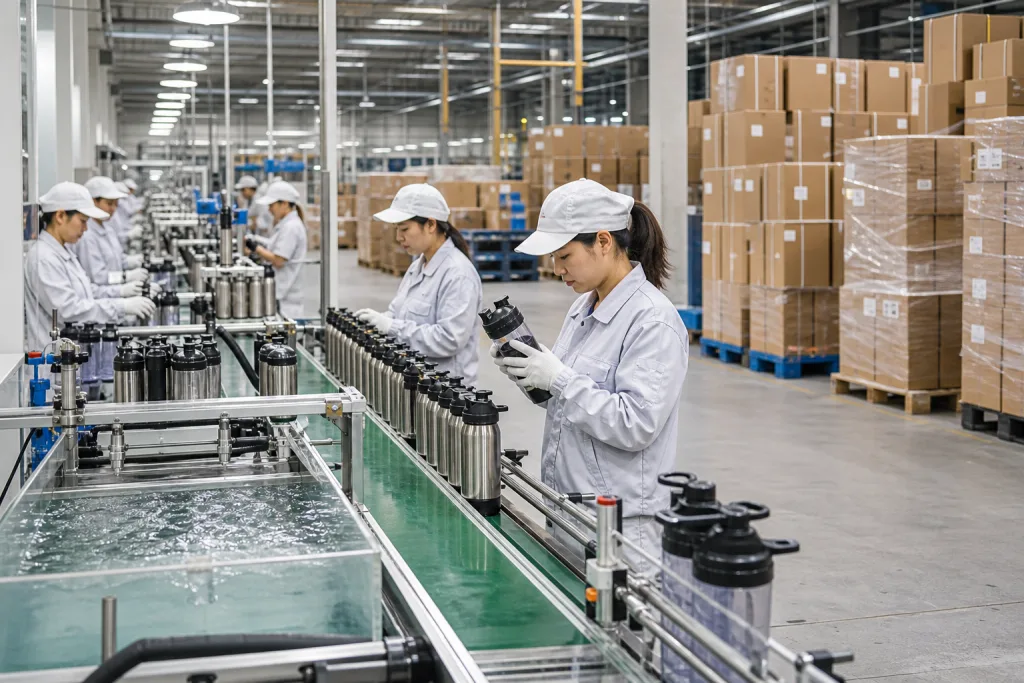
Our Hangzhou-area production line can handle about 420,000 plastic drinkware units per month across shaker bottles, sports bottles, and custom canteen orders. For distributor drinkware programs, we still recommend splitting SKUs carefully. Five colors at 1,000 pieces each usually cost more and run slower than two colors at 2,500 pieces each. We run faster when the same mold stays mounted and the packing table uses one carton spec, not five near-identical boxes with different barcodes.
Logo, color, and packaging charges
Decoration is the second place the quote moves. For customized drinkware, a one-color silk screen logo is still the lowest-risk choice on PP or Tritan. We run a 120-mesh screen for most shaker bottle logos, and QC checks the first 20 pcs under a 3M tape test before the line continues. Expect a screen setup cost of USD 35-80 per color and a running cost of USD 0.05-0.12 per print position. Pad printing fits curved lids or small badges where the silicone pad can reach the edge cleanly. Heat transfer can handle gradients, but the math doesn't work if the bottle is used every day in gyms and the buyer skips abrasion testing.
Laser engraving belongs on stainless bodies, not standard PP. Powder coating for stainless custom growler or blender-style metal bottles adds cost and lead time because coating thickness, adhesion, and color consistency need real control, not a quick visual check. On our line, we check coating at 60-80 microns with a thickness gauge and pull samples after the curing oven, because one thin batch can show scratches before the goods leave Hangzhou. A typical powder coat add-on is USD 0.35-0.90 per unit, with higher cost for matte, metallic, or soft-touch finishes.
Pantone color matching is possible, but buyers should treat it as a controlled range, not a magic switch. Resin color can shift under D65 light versus office LED light, and lid and body materials may not match perfectly if one is PP and one is PE or Tritan. We usually approve against a physical Pantone chip and 2 signed samples, not a screen image from a laptop. This is the wrong question to ask if the buyer says, “Can you match 100%?” Better ask what color difference is acceptable before the resin is mixed.
Packaging needs an early decision. Bulk pack is cheapest for a canteen distributor selling into corporate channels. Retail box works better for ecommerce and shelf display, but it adds dieline work, printing time, carton volume, and damage risk if the board is too thin. For Amazon or other marketplace programs, ask your canteen vendor to quote FNSKU label application, carton drop-test strength, and master carton weight under 15-18 kg when possible. We have seen a PO typo list 18 kg while the packed carton was 21.4 kg, and the buyer flagged it after the forwarder measured the first pallet. Cheap packaging saves cents and creates warehouse claims later.
Tooling and sample timing
If you use an existing mold, sampling is simple. We run blank samples in 3-7 days when stock lids, cups, gaskets, and shaker balls are already in the parts bins. A logo sample usually needs 7-12 days after artwork approval; last month QC held one because the buyer’s AI file showed Pantone 186 C, but the PO typed 186 U. A pre-production sample in final color and final packaging normally needs 12-18 days because resin matching, printing plates, silicone gasket fit, and box proofs must land together.
Custom tooling changes the rhythm. A new lid, proprietary mixing grid, special grip texture, or unique customized canteen silhouette often means mold work on the line. A small insert modification might cost USD 300-900 and take 7-15 days; our mold room will usually check the steel insert with a caliper before the first T0 shot. A new injection mold for a lid or body can cost USD 1,200-6,000 for common drinkware sizes, with 18-35 days for mold build and first trial. More complex molds cost more, especially if the design has undercuts, multiple sliders, or tight sealing surfaces.
Do not approve mass production from a beauty sample only. This is the wrong question to ask. Blender bottles need function checks: the lid must thread smoothly, the flip cap must resist accidental opening, and the gasket must sit consistently after washing. QC pulled the sample from a 500-cycle open-close test once and found the flip cap popping at 38 N, so we cut the batch before it became a shipment problem. For shaker balls, ask whether the wire is 201 or 304 stainless steel. 304 costs more but is a better choice for food-contact export orders to Europe and North America.
A good canteen factory will ask for your target market before sampling. REACH, LFGB, FDA food-contact expectations, California Prop 65 considerations, and ASTM child-use issues can affect material selection. We ship FDA jobs with one test route and LFGB jobs with another, and the lab slot alone can add 5-10 working days before a buyer even sees the final report. China factories can prepare compliant goods, but you need to budget testing time and cost before the purchase order is already late.
Production calendar from PO to ship
For most blender bottle manufacturers, the clock starts only after three boxes are ticked: deposit received, sample signed off, and artwork confirmed. Miss one, and the order is still sitting in email, not on the line. On an existing mold order, we usually see 7-15 days for sample and color approval, 25-40 days for mass production, 2-5 days for final inspection and booking, then vessel or air transit based on destination. QC pulled the first article against a 0.2 mm print tolerance last week, and that is the sort of check that tells you whether the schedule is real or just paper.
For Europe, ocean freight from Ningbo or Shanghai usually takes 30-40 days port to port. For the US West Coast, 16-25 days port to port is standard, while the US East Coast can be 28-40 days. Add customs clearance, inland trucking, and warehouse appointment time. If your retail launch date is fixed, work backward from delivery and hold 10-14 days as buffer. The wrong question is “can you ship in time?” The better one is whether your DC will take the cartons on the day your forwarder books, because a PO typo like “Los Angles” can push the booking back a week.
Rush orders are possible, but they are not free. A canteen supplier may charge more when production has to run overtime or when packaging needs express material purchasing. Air freight can rescue a late launch, but it may add USD 1.50-4.00 per bottle depending on weight and destination. That can wipe out margin on distributor canteen programs. We’ve seen this go sideways when a buyer asked for 5,000 gift boxes at the last minute and changed the sleeve thickness from 0.35 mm to 0.5 mm after the carton cutter was already set.
The cleanest timeline we see in Zhejiang is simple: technical spec locked before quotation, artwork ready before sampling, deposit paid within 48 hours of proforma invoice, and inspection booked one week before completion. When buyers change color, carton quantity, or logo size after sample approval, a 35-day lead time can turn into 50 days fast. One carton spec change on the PO can force a new packing test, and the line does not care about the sales promise. We ship what is confirmed, not what was intended.
Quality checks that protect margin
Blender bottles fail in the same places. Flip caps seep, hinge pins crack, resin with poor drying leaves odor, pad print rubs off, and loose polybag packing scuffs the body before the carton is even sealed. “No problem” from a supplier does not protect your margin. A locked checklist does. On our line, QC pulled 32 samples last month because the cap gap measured 0.6 mm wider than the approved sample after the second trial shot.
For B2B custom drinkware, AQL 2.5 for major defects and 4.0 for minor defects is common. Critical defects should be zero tolerance. Major checks should cover leakage after inversion, thread fit with a go/no-go gauge, cap opening force in N, gasket placement, capacity verification at the fill line, logo position against the artwork file, barcode scan, carton marking, and drop condition. For a 5,000-unit order, a third-party inspection usually samples 200 units under general inspection level II, depending on the chosen standard. We have seen buyers lose 12 days on rework because “black logo” on the PO became dark gray on the approved PDF.
Leak testing needs to match real use. We run filled bottles upside down and sideways for a fixed time, then shake them if the bottle is sold as a shaker. No guesswork. For stainless customizable growler or insulated shaker items, vacuum performance also matters: hot or cold retention should be tested against the agreed hours, not sales copy. If the spec says 12 hours cold, the inspector needs a thermometer, start temperature, room temperature, and a recorded reading, not a photo of a bottle on a desk.
Ask your canteen vendors for incoming material controls, not final inspection photos alone. Silicone gaskets should be food-grade, resin batches should be traceable by lot number, and stainless steel should match the quoted grade. If you are a canteen distributor selling to gyms, universities, outdoor retailers, or corporate programs, one recall costs more than proper QC. We ship to buyers who push back on a USD 180 inspection fee, but the math does not work when 600 leaking caps hit a campus store program. A practical factory partner in China will accept a clear checklist because it cuts arguments before shipment time.
Choosing the right supply partner
The best supplier is not always the lowest FOB line. For blender bottle manufacturers, the real question is whether the factory can control injection molding, silicone seals, PP lids, decoration, inner cartons, export documents, and food-contact testing without guessing. A trading company works for mixed gift sets, but for repeat custom canteen and distributor growler programs, direct factory talk saves days. Last month one buyer pushed for USD 0.06 off the lid, then QC found a 0.4 mm gap at the flip cap seal. The math didn't work.
Ask direct questions. What is the monthly capacity by product type: 80,000 shaker cups, 50,000 stainless canteens, or something else? What is the MOQ per Pantone color? Which food-contact test reports can be arranged? Is the factory audited under BSCI, Sedex, ISO 9001, or another system? What percentage of output goes to Europe and North America? Can they provide a golden sample and keep one sealed at the factory for comparison? We keep ours in a labeled PE bag with the PO number, color code, and approval date, because one typo on a PO can turn “matte black” into “metallic black.”
Watch how the canteen manufacturers respond before you place the order. If they quote a custom bottle in two lines with no material grade, lid structure, or packing weight, be careful. If they challenge your lid design because the hinge may fail after 3,000 open-close cycles, that is a good sign. Good canteen suppliers stop bad orders early. We have seen this go sideways when a buyer approved a nice 3D render, then the line found the carry loop was too thin for the drop test.
At BottleForge Industrial in Hangzhou, Zhejiang, we build RFQs around cost, lead time, and risk: existing mold or new mold, resin and steel grade, decoration method, MOQ tier, packing plan, test requirement, and shipping route. For an existing mold, we normally talk about 12 days for sampling versus 18 days when a new color masterbatch and logo plate are involved. Whether you are buying a promotional shaker, customizable drinkware set, custom canteen, or retail-ready custom growler, the job is the same: remove assumptions before production begins. QC pulled the sample, sales checked the carton mark, and the buyer flagged it before mass production. That is how we prefer to ship.
Send your blender bottle RFQ for a grounded quote
Share capacity, material, logo, MOQ, target market, and delivery date. We will return cost drivers, lead time, and sampling options.
Frequently asked questions
What MOQ should I expect from blender bottle manufacturers?
For an existing mold, 3,000 pieces per color is the most realistic MOQ for stable pricing and production. Some factories accept 1,000 pieces, but the unit price may rise 20-35% and Pantone color matching may be limited. For a new mold or custom lid, expect 5,000-10,000 pieces per SKU because tooling setup, resin purchasing, and QC time need volume. If you are a canteen distributor testing a new market, start with fewer colors rather than forcing five small color runs.
How long does a custom blender bottle order take?
For existing molds, plan 7-18 days for sample approval and 25-40 days for mass production after deposit. Add 2-5 days for inspection and export booking. Ocean freight from China adds around 16-40 days depending on destination port. If you need new tooling, add 18-35 days for mold making and first trial. A safe retail launch calendar is usually 75-110 days from RFQ to warehouse delivery.
What tests are needed for Europe and North America?
For Europe, buyers often request LFGB or EU food-contact testing plus REACH screening for restricted substances. For the US, FDA food-contact material expectations are common, and California Prop 65 may apply depending on sales channel. For children’s products, ASTM and CPSIA issues may become relevant. Budget USD 250-900 per material group for common lab testing, depending on scope. Confirm the exact market before the supplier chooses resin, pigment, gasket, or coating.
Is PP, Tritan, or stainless steel better for custom drinkware?
PP is best when you need low cost, light weight, and promotional volume, usually around USD 1.25-2.40 FOB at 3,000-10,000 units. Tritan is better for a clearer retail appearance and stronger impact resistance, often USD 2.10-3.80. Stainless steel costs more but supports premium insulated shaker, customized growler, and outdoor canteen customized programs. The right choice depends on target retail price, compliance needs, and whether the bottle must feel premium or simply functional.
Can one factory supply blender bottles, canteens, and growlers?
Yes, but verify the factory’s real production scope. Plastic blender bottles require injection molding and sealing control. Stainless custom canteen and custom growler orders require forming, welding, polishing, vacuum testing, and coating. Some China suppliers coordinate both through partner workshops. That can work if responsibilities are clear. Ask for product-specific capacity, sample history, inspection photos, and test reports. A capable canteen factory should quote each category with separate MOQ, lead time, and defect checkpoints.