Key Takeaways
- A realistic OEM MOQ for custom shaker bottles is usually 3,000-5,000 units per color
- Food-contact PP, Tritan, 304 stainless steel, and silicone parts must be tested separately
- AQL 2.5 for major defects and AQL 4.0 for minor defects is common for export orders
- Normal lead time from approved pre-production sample is 30-45 days in Zhejiang, China
A blender bottle looks simple until the first pallet lands with 8 leaking caps, the wire ball shows orange spots, or the logo peels after 20 dishwasher cycles. We see it on the line. For a B2B buyer, one bad bottle turns into chargebacks, launch delays, warranty claims, and dead stock you cannot move. This is the wrong place to chase the lowest unit price.
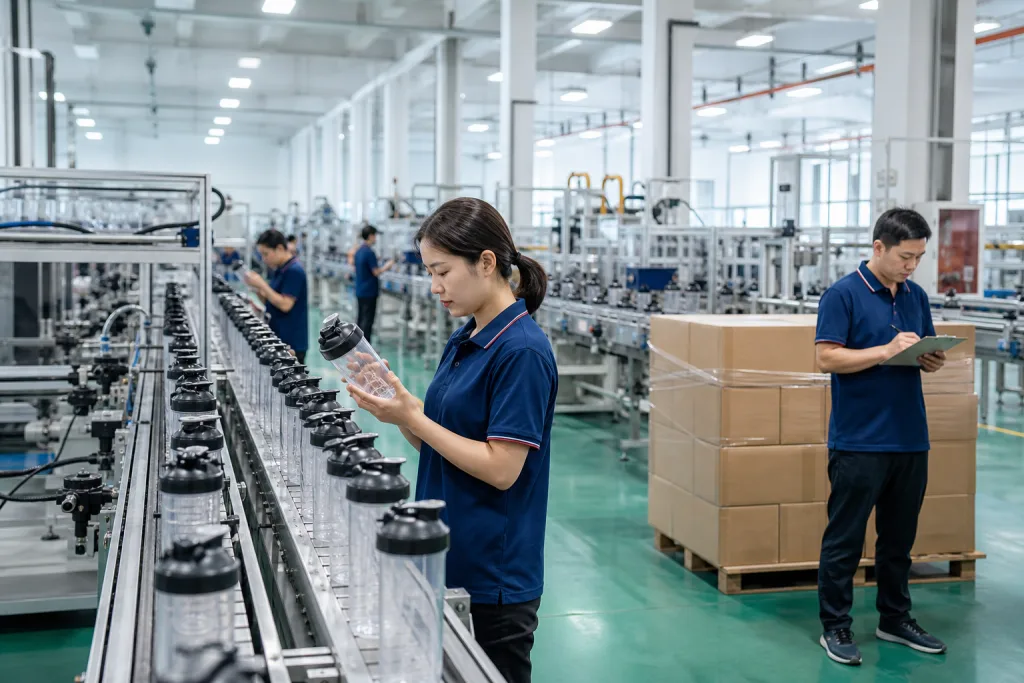
At our Zhejiang factory, we treat the spec sheet as the contract. QC pulled the sample with a 0.02 mm feeler gauge on the lid, and we caught a buyer’s PO typo on carton count last week; wall thickness, lid fit, PP grade, AQL 2.5, carton drop testing, and decoration method decide whether the program runs or stalls. We ship enough of these to know the math does not work if a cap passes at 12 days in transit and fails at 18.
Capacity, shape, and real fill volume
On a blender bottle spec sheet, capacity comes first: 500 ml, 600 ml, 700 ml, 24 oz, 28 oz, or 32 oz. Treat that line as a packaging and freight decision, not a label choice. A 32 oz cup sits in a different carton layout from a 24 oz one, and the mold we ran for a 700 ml bottle last month added 4 mm at the shoulder, which changed the case pack and the fit in a standard gym bag.
For shaker-style custom drinkware, keep the fill line 20 to 30 mm below the lid thread. Fill a 700 ml bottle to the rim and you will hear it leak on the bench-top shaker once the powder foams up. QC pulled one sample after a 15-second shake and the cap ring had wet marks, so we set the usable volume lower. If you sell into distributor channels, print metric and ounce graduations. U.S. buyers still ask for ounces; EU accounts usually want milliliters in 50 ml or 100 ml steps.
Shape changes the job. A straight cylinder costs less to mold and gives a cleaner silkscreen band. A tapered waist feels better in hand, but it can cut usable print area by 10% to 20% and distort a wrap label; we saw a 1-color logo stretch by 12% on a 300 mm body. Wide mouths in the 50 to 65 mm range load powder faster and wash clean. Narrow mouths look sharp on a sales sheet, then the buyer flags powder spills on the counter. The math doesn't work if the logo is the hero.
If you are sourcing a custom canteen, a growler, or another bottle from the same factory, do not copy those dimensions into a blender bottle order. Outdoor carry shapes are built for straps and balance, not for hard shaking. A 750 ml growler mold can hold 690 ml to the shoulder, and a PO typo that says 760 ml will waste a round of samples. Ask for measured usable capacity, not just mold capacity. We run that check with a graduated cylinder before we sign off.
Body material and food-contact compliance
Most blender bottles we run are PP, Tritan, stainless steel, or mixed-material builds. PP works for promo and mid-market orders because the price holds and the body survives normal gym-bag abuse. A normal 700 ml PP shaker body weighs around 95-130 g depending on wall thickness and design; QC checks this on a 0.1 g bench scale before we freeze the pre-production sample. Tritan costs more, but the clarity looks cleaner on a retail shelf. Stainless steel pushes the unit cost up, yet buyers accept it faster for distributor growlers and higher-end fitness gift sets.
For Europe and North America, ask for food-contact documents before you approve the pre-production sample. For the EU, that usually means EU 10/2011 for plastic food-contact materials plus LFGB where required by the retailer. For the U.S., FDA food-contact compliance is common, and California buyers may also ask about Prop 65. If the lid uses silicone seals, test the gasket separately; we have seen a black gasket pass fit testing and fail odor review after 24 hours in a sealed sample bag. The same rule applies to the mixing ball if it is stainless steel.
Wall thickness separates a cheap sample from a stable mass-production order. For PP shaker bodies, 1.8-2.5 mm is common. Below 1.6 mm, the risk is real: hot filling, dishwasher cycles, or carton compression can push the body out of shape, and the buyer flagged this once when a 6 kg top-load carton test left oval mouths on 18 samples. For stainless steel blender bottles, 0.5 mm inner and 0.5 mm outer 304 stainless steel is a typical starting point for double-wall construction, though lightweight designs may use thinner gauge. Thin saves freight. It also creates complaints if the dent rate climbs.
China has hundreds of canteen suppliers and canteen vendors who can quote low prices before lunch. That is the wrong question to ask. The better question is whether they control resin source, drying parameters, injection temperature, and batch traceability; a RMB 0.18 cheaper body does not pay for a rejected container. In our Zhejiang plant, monthly drinkware capacity is about 450,000 units across shaker bottles, canteen customized products, travel tumblers, and sports bottles, with incoming material checks recorded by batch. We log PP resin lot numbers at the injection line and keep the drying sheet with the PO, even when the buyer sends a file with “Trian” typed instead of Tritan.
Lid system, seal, and mixing insert
The lid is where most blender bottle failures happen. Buyers will spend 30 minutes on logo size and 3 minutes on the cap hinge. Wrong priority. On the line, we see lids fail at the hinge pin, snap lip, or gasket groove after repeated opening, powder residue, dishwasher heat, and pressure from shaking.
Key lid specs include thread type, gasket material, flip-cap retention force, spout diameter, and whether the lid is one-piece or assembled from multiple parts. A screw lid with a silicone gasket is safer than a push-on lid for protein shakers; we have seen push-on samples leak after the buyer filled them to 70% and shook them in the office sink. A flip cap should close with a clear click and should not pop open when the bottle is shaken upside down for 30 seconds. For internal QC, we normally check leak resistance after 1 minute inverted, then after shaking with water at 60-70% fill volume. QC pulled one sample last month because the cap needed 1.8 kg of pull force to open, which felt too stiff for gym use.
The mixing component may be a stainless steel wire ball, plastic grid, internal whisk, or removable agitator. The stainless steel ball is familiar to a lot of users and works well, but buyers should specify 304 stainless steel, not vague “food grade steel.” Plastic grids are quieter in a gym bag and give more branding space, but the mold finish matters. We check the grid corners with a 10x loupe because trapped powder in a 1 mm corner radius turns into a complaint after two weeks of use.
If your program includes canteen promotional items, a canteen customizable line, or distributor canteen bundles, standardizing lid colors across SKUs reduces inventory risk. Black, white, and translucent lids can cover 6-8 body colors and keep replacement part stock under control. The MOQ for custom lid colors is often the same as the body color, commonly 3,000-5,000 pieces, because color masterbatch setup and barrel cleaning take time. The math does not work for 500 neon-green lids unless you accept a surcharge and 12 days added to sampling.
Branding method and artwork tolerances
Custom drinkware sounds simple: send a logo, get a branded bottle. In production, the real choice is decoration life versus unit price. For blender bottles, we usually quote silkscreen printing, heat transfer, in-mold label, pad printing, laser engraving on stainless steel, or full-wrap labeling. Each one comes with its own MOQ, color limit, lead time, and failure mode; last month QC pulled 8 samples from a 2,000 pcs trial run because the logo edge lifted after the 3M tape test.
Silkscreen is usually the best value for simple 1-3 color logos on a straight or lightly curved body. On PP, artwork adhesion depends on surface treatment. Ask whether the factory uses flame treatment, corona treatment, or a tested ink system for PP. Without proper treatment, the logo can pass a fingernail test at the factory and still fail after 6 dishwasher cycles. For promotional orders, we often recommend a tape adhesion test and 50-cycle hand wash simulation, depending on budget; for orders under 3,000 pcs, the math sometimes does not support a full dishwasher test.
Heat transfer gives sharper gradients and wider coverage, which retail buyers usually want on custom drinkware. It costs more and needs careful alignment; our line normally controls the vertical seam within 1.5 mm, but tapered cups can still show stretch near the bottom radius. Full-wrap designs can look strong on a shelf, but the seam and distortion near the taper must be approved on a physical sample, not just a 3D render. Laser engraving works only on stainless steel surfaces and gives excellent durability, but it is not suitable for plastic bodies.
For a customized canteen, custom growler, or customizable growler, the branding area is usually larger and the surface may be powder coated. Blender bottles have tighter geometry limits because of volume markings, grip areas, and lid clearance; we have seen buyers approve a 90 mm logo, then flag it later because it crossed the 500 ml scale. Give your blender bottle manufacturer vector files, Pantone references, print size in millimeters, and placement from a fixed point such as the bottom edge or center seam. “Make it like the mockup” is not a production spec.
MOQ, price build, and tooling risk
A serious quote from a blender bottle manufacturer should show included costs and excluded costs line by line. For a standard existing mold, a 600-700 ml PP shaker with one-color logo may start around USD 1.10-1.80 FOB China at 5,000 units, based on PP grade, lid structure, retail box spec, and required testing. Tritan may push the range to USD 2.00-3.20. Stainless steel shaker bottles sit higher, especially with powder coating or double-wall insulation. Check the small print. Last month QC pulled a 700 ml sample and found the flip cap gap at 0.6 mm; that small lid adjustment changed both the quote and the lead time.
MOQ comes from resin color purchase, printing setup time, component matching, and carton purchasing. For existing molds, 3,000 units per color is possible for some projects, but 5,000 units gives better control over price and line efficiency. For a new mold, tooling cost can range from USD 3,000 to more than USD 15,000 based on body shape, lid parts, and cavity count. A simple single-cavity prototype mold is not the same as a production mold. We see this go sideways when a buyer approves a hand sample, then expects 12,000 pcs output from tooling that was never built for stable mass production.
Buyers sometimes ask one canteen supplier to quote a shaker, a canteen manufacturer to quote a stainless canteen, and a different canteen vendor to quote a growler. That can work, but it creates color mismatch, mixed carton markings, and separate audit files that slow approval. If you are building a broader customized drinkware line, check whether one canteen factory can control shared packaging, testing reports, and documentation. Not every canteen supplier can make a tight shaker lid. We run into this often: the buyer flagged the same Pantone color looking different on PP, powder-coated steel, and printed kraft cartons.
Payment terms also affect price. A normal structure is 30% deposit and 70% balance before shipment, or before release of bill of lading for established buyers. FOB Ningbo or FOB Shanghai are common from Zhejiang, China. If you need DDP to a U.S. warehouse or Amazon prep with FNSKU labels, put that in the RFQ stage, not after production is packed. The math does not work after cartons are sealed; our packing team once had to reopen 186 cartons because the PO missed one digit in the FNSKU.
Inspection, testing, and cartons
Put QC terms on the purchase order, not in a WeChat note after the deposit. AQL is not a decoration; it is the sampling rule that decides whether the shipment passes. For blender bottles, AQL 2.5 for major defects and AQL 4.0 for minor defects is a practical default. Critical defects, such as sharp edges, contamination, broken lids, or unsafe material mix, should be zero tolerance. We run this with a printed AQL table at final inspection, and QC pulled the sample last month because 3 lids had rough injection gates near the drinking spout.
Common inspection checkpoints include body weight, capacity, lid torque, leakage, logo position, color Delta E, odor, gasket fit, barcode scan, and carton drop test. Add the tools to the checklist: digital scale, torque meter, Pantone book, 3M tape, barcode scanner, and a 1.2 m drop-test corner drop. For export cartons, use at least 5-ply corrugated board when the gross weight approaches 12-15 kg. A retail gift box may look fine at the factory but crush during ocean freight if the master carton is weak or packed with 25 mm of empty space on each side. Cheap cartons are not savings. We have seen this go sideways.
Testing depends on market. EU buyers may need REACH, food-contact testing, and sometimes BSCI or Sedex audit support from the factory. U.S. buyers may ask for FDA food-contact confirmation, ASTM-related checks for children’s products if the design is for kids, and Prop 65 assessment. If the bottle is sold as dishwasher safe, define the test method. “Dishwasher safe” without a cycle count is too vague for a serious PO. Write 50 cycles at 70°C if that is your claim, then we can match the PP lid, silicone gasket, print ink, and 304 stainless whisk ball to the test.
Lead time should be tied to sample approval. For our Zhejiang production schedule, a normal custom blender bottle order is 7-10 days for artwork sample, then 30-45 days for mass production after deposit and approved sample. Peak season before summer fitness campaigns or Q4 gifts can add 10-15 days. If you are a canteen distributor or managing multiple canteen distributors, build that buffer into your launch calendar. The wrong question is “Can you ship faster?” Ask whether the line has mold time, print-room capacity, and carton material booked; 12 days promised on paper can become 18 days if the buyer changes the logo file after the pre-production sample.
Packaging and channel requirements
Packaging is not just a box around the bottle. It tells the line how the order moves, how we stack it, and how much damage risk we can carry. A 5,000-piece promo shaker for an event needs a different pack than a retail canteen, a distributor set, or an e-commerce bundle with a custom growler. On our packing table, QC checks the first carton after the first 30 minutes, and that is usually where the buyer’s first pushback shows up: the pack looks cheap, but the freight math is still the wrong question to ask.
For B2B bulk orders, the low-cost pack is usually one bottle in a polybag or paper sleeve, then 50-100 units per master carton depending on size. Retail buyers usually go with a color box, hang tag, paper belly band, or window box. If you ship through e-commerce, the pack should pass a drop test from at least 76 cm on corners, edges, and faces. For warehouse receiving, carton labels should show SKU, PO number, quantity, color, gross weight, net weight, country of origin, and carton number. We print those labels on a Zebra printer beside the taping machine, and a single PO typo can stop receiving at the dock.
Sustainability claims need discipline. A canteen promo campaign may ask for recycled packaging, FSC paper, or less plastic. Fine. Do not print broad claims such as “eco-friendly” unless you have material evidence. For plastic blender bottles, recycled-content claims get complicated once food-contact use enters the picture. For stainless steel canteen customized programs, recycled steel content may be requested, but certification and traceability have to be checked before quoting. QC pulled a sample last month, wiped the print with alcohol, and the green claim came off; that is the kind of problem that turns into a chargeback.
If you buy from China for Europe or North America, confirm packaging language, recycling marks, warning labels, and importer details early. Changing cartons after mass production starts can cost 7-14 days and several hundred dollars in reprinting. We lock carton artwork before the first 5,000 pcs go through the line. A practical blender bottle manufacturer will ask where the product is sold before it asks what color you like. That is the right order.
Send your shaker bottle spec for review
We will check material, lid design, MOQ, decoration, packaging, and export risks before you commit to production.
Frequently asked questions
What MOQ should I expect from a blender bottle manufacturer?
For an existing mold, expect 3,000-5,000 units per color for most custom blender bottle orders. If you need a custom body color, matching lid, silicone gasket, and printed logo, 5,000 units is more realistic because each component has setup loss. For a simple black or clear stock body with one-color logo, some factories in China may accept 1,000-2,000 units, but the unit price will be higher and color options limited. New tooling usually needs a commercial commitment of 10,000 units or more to make sense.
Which material is best for customized drinkware shakers?
PP is the most practical material for value-driven shaker bottles because it is light, impact resistant, and cost-effective. Tritan gives better clarity and a more premium feel but usually adds USD 0.50-1.20 per unit depending on size and market testing. Stainless steel is best when you want a premium gift or retail item, but it increases weight and cost. For any customized drinkware program, confirm food-contact compliance for the body, lid, gasket, and mixing ball separately. One certificate covering only the plastic body is not enough.
Can one supplier make blender bottles, custom canteens, and growlers?
Sometimes, yes, but check the actual production process. A canteen factory that specializes in stainless steel vacuum bottles may not have strong injection molding experience for shaker lids. A plastic shaker factory may not handle welding, vacuum insulation, or powder coating for a customized growler. A mixed program can work if the supplier has verified partner workshops and controls inspection under one QC system. Ask for factory photos, audit documents, monthly capacity by category, and samples from each product type before placing one combined PO.
How long does production take after sample approval?
For standard molds, plan 7-10 days for logo sampling and 30-45 days for mass production after sample approval and deposit. Add 5-10 days if you need third-party lab testing before shipment. New mold development can add 25-45 days for tooling, trial shots, revisions, and pre-production approval. During busy seasons in Zhejiang and other China drinkware hubs, lead times stretch quickly, especially for custom colors and retail packaging. Lock artwork, Pantone codes, and carton marks before the factory books production.
What should be included in my RFQ?
Send capacity, material, target unit price, order quantity by color, logo method, Pantone colors, packaging type, testing requirements, destination port, and delivery term such as FOB Ningbo or DDP warehouse. If you are a canteen distributor buying multiple SKUs, include the full range so the factory can plan shared components and carton sizes. Attach vector artwork, not only JPG mockups. Also state whether you need BSCI, Sedex, REACH, FDA food-contact documents, FNSKU labeling, or Amazon carton limits. A complete RFQ can save 3-5 days of back-and-forth.