Key Takeaways
- A realistic blender bottle MOQ starts around 3,000-5,000 pcs per color for custom molding or color matching
- Factory-direct FOB China pricing usually changes by USD 0.08-0.25 per unit depending on lid, ball, and packaging choices
- Use AQL 2.5 for major defects and require 100% leak testing before carton packing
- A normal production timeline is 25-35 days after deposit and artwork approval in Zhejiang, China
A buyer request lands on your desk: 5,000 shaker-style blender bottles for a fitness retail chain, custom logo, two body colors, retail packaging, and a fixed delivery window before a spring promotion. Looks simple. Then the quote starts changing once you check PP grade, lid gasket hardness, mixing ball weight, 60×40×50 cm export cartons, and whether the factory included logo film cost or buried it in the unit price.
Buying blender bottle factory direct from China saves money only when the specification is locked before pricing. We see this at our Zhejiang drinkware line every month: the buyer asks for customized drinkware, the supplier quotes the cheapest mold option, and leak testing gets discussed after QC pulled the sample and found 3 caps dripping at the thread. That is the wrong time to find out the seal design was never approved.
Start With The Real Order
Start with a real PO, not catalog talk. Say the order is 5,000 blender bottles, 700 ml capacity, PP body, flip cap lid, stainless steel mixing ball, one-color logo, and retail-ready packaging. The end customer is a sports nutrition brand in North America. They need a practical bottle at shelf price, but the buyer will still reject leaking caps, cloudy plastic, or a lid that feels loose after 20 open-close cycles on the test bench.
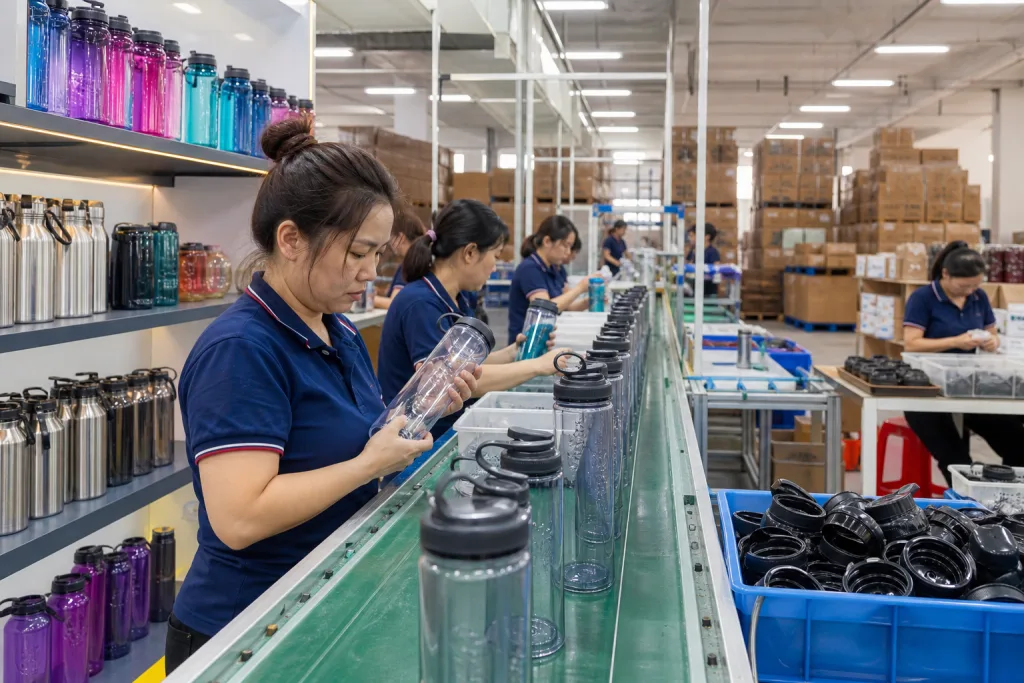
At BottleForge Industrial in Hangzhou, Zhejiang, this is a normal mid-size run for us. We ship about 420,000 units per month across shaker bottles, stainless tumblers, sports bottles, and canteen customized projects. For a standard shaker bottle, our normal MOQ is 3,000 pcs per color. If you need a Pantone-matched body, plan on 5,000 pcs because color masterbatch purge, barrel cleaning, and 90-120 minutes of injection machine setup all hit the cost sheet.
The first decision is open tooling or a new shape. Open tooling is the smarter route for most distributor drinkware programs, and we’ve seen this go sideways when buyers spend mold money before testing sell-through. You can still build a custom drinkware item with logo, body color, packaging, and accessories. New tooling makes sense when annual volume reaches 50,000 pcs or more, or when the brand owner needs a protected shape that competitors cannot pick from the same shelf.
A direct factory order should start with a spec sheet, not a photo from a trade show booth. The sheet should name material, capacity, wall thickness, lid design, logo method, packaging, compliance documents, inspection standard, and shipping term. We run into trouble when a PO says “clear bottle” but the artwork file calls for frosted PP; QC pulled one sample like that last March before mass packing. If a canteen supplier or shaker bottle vendor cannot answer these points clearly, the low price is not a real quote.
Lock The Bottle Specification Early
For a factory-direct blender bottle, the main cost drivers are simple: material grade, body weight, lid structure, mixing insert, packaging spec. A typical 700 ml PP shaker body uses 90-115 g of polypropylene depending on wall thickness and shape. We run most main bodies at 1.8-2.2 mm because the hand feel is better and the bottle does not ovalize as much after carton stacking. Thin 1.4 mm bottles can pass a quick sample review, then look cheap after a 12-day sea leg plus warehouse handling; QC pulled one sample last season with a sidewall dent right under the logo panel.
Most buyers choose PP because it is lightweight, BPA-free, and more impact-resistant than brittle plastics. Tritan looks clearer on the shelf, but the resin cost can add USD 0.35-0.70 per unit, so the math does not work for every promo order. Stainless steel is a different program if you are sourcing a custom growler, customizable growler, or distributor growler program rather than a shaker bottle. Do not mix those categories in one RFQ. We had a PO last March listing “700 ml PP shaker” on page 1 and “vacuum growler” on page 3, and the buyer flagged the price gap as a factory mistake.
The lid needs more attention than the body. A screw lid with a silicone gasket is safer than a cheap snap-only structure, especially when the line tests leakage by shaking filled bottles upside down for 30 seconds. Ask whether the gasket is removable, what shore hardness is used, and whether spare gaskets are available. For the mixing ball, 304 stainless steel is the normal choice. If your target market is Europe, ask for food-contact compliance and REACH-related declarations where applicable. For the US, many buyers also ask for FDA food-contact material confirmation.
Logo choice matters too. Silkscreen is economical for 1-2 colors and large flat areas, but we still check registration with a 0.2 mm tolerance gauge before mass packing. Heat transfer gives a stronger retail look and needs better abrasion testing; we have seen this go sideways when a buyer approved a glossy sample but skipped the 3M tape pull test. Laser engraving is not relevant for a PP shaker body, but it is common on stainless custom canteen and customized growler orders. The right decoration depends on the product material, not just the buyer’s preferred look.
Price The Order Without Guesswork
A buyer often asks, “What is your best blender bottle factory direct price?” Wrong first question. Send the full spec sheet first. For a 5,000 pc 700 ml PP shaker with 304 mixing ball, one-color print, polybag, and white box, a workable FOB Ningbo or FOB Shanghai range is around USD 1.25-1.85 per unit, depending on the weekly PP resin price and whether the lid uses a simple flip cap or a locking spout. A color box can add USD 0.12-0.28. A premium handle lid can add USD 0.10-0.22. A custom color below MOQ can add a setup surcharge. On our line, QC pulled a 700 ml sample last month with a 0.6 mm thinner wall than quoted; that small change is exactly where cheap prices hide.
You should ask every canteen manufacturer, canteen factory, or shaker bottle factory to break out the price. Body and lid, logo cost, mixing insert, packaging, testing fee, and inland freight need their own lines on the quotation. No magic number. When a canteen vendor quotes USD 0.92 and another quotes USD 1.45, the gap is usually not clean profit. It can be thinner material, recycled resin risk, missing silicone gasket, 5-layer carton changed to 3-layer, or no inspection support. We’ve seen this go sideways when the buyer flagged a leaking lid only after 38 cartons reached the warehouse.
Payment terms change the real cost too. Standard China factory terms are 30% deposit and 70% before shipment after inspection. For larger canteen distributors or distributor canteen programs with repeat orders, credit terms can be discussed after 3-5 stable shipments, but new buyers should not expect open account terms on the first order. The math does not work for a factory buying resin, cartons, gaskets, and stainless balls upfront. One PO we received even had “70% after sales” typed instead of “70% before shipment”; our merchandiser caught it before the deposit invoice went out.
For freight, compare FOB, CIF, and DDP line by line. FOB gives you control if you already have a forwarder. DDP is easier for small importers, but duties, customs clearance, and final delivery must be written clearly on the PI. If the shipment is going to an Amazon warehouse, carton labels, FNSKU labeling, and pallet requirements must be confirmed before mass production, not at the port. We run label checks with a barcode scanner before sealing cartons; fixing a wrong FNSKU at Ningbo warehouse can take 2 days, while fixing it after arrival can eat 12 days vs 18 days during peak season.
Approve Samples Like A QC Engineer
The pre-production sample is not a souvenir. It is the order standard. Keep one approved sample on your desk, one at the factory QC desk, and one sealed for the third-party inspector. We label ours with sample approval date, Pantone number, logo size in mm, lid fit result, packaging version, and tolerance notes; last month QC pulled one shaker sample because the PO said “blue lid” while the artwork file said Pantone 299C.
For a blender bottle, check the obvious points and the boring ones. Fill it with water, close the lid, invert it for 3 minutes, then shake it hard for 30 seconds. No shortcuts. Check thread engagement, gasket compression, flip cap resistance, and whether the cap opens with one hand without feeling loose. Put the bottle in a carton and rub the printed logo against the packing surface for 20 strokes. Poor ink adhesion shows up before shipment if you test it like the line will handle it, not like a showroom sample.
For custom canteen, customizable canteen, or canteen promotional products, use the same thinking but change the tests. Stainless models need vacuum insulation checks, coating adhesion tests, and salt spray evaluation for some finishes; we run 95°C water hold checks on insulated samples before mass production. Plastic shaker bottles need leak, odor, drop, and print rub tests. Glass bottles bring annealing and impact concerns. One inspection checklist cannot cover all custom drinkware categories, and forcing it usually means someone misses the defect that matters.
Ask for a golden sample report with measured data. Body weight should be recorded in grams. Capacity should be checked to brim and recommended fill line. Logo size should be measured in mm, not “looks okay.” Packaging dimensions and gross weight matter because they affect freight cost; the buyer may push back on carton changes, but the math is simple. For one recent Zhejiang order, changing from a 5-ply oversized export carton to a fitted 5-ply carton reduced carton volume by 11%, which saved more freight than the buyer expected.
Control Production Before It Drifts
After the deposit lands and artwork is signed off, normal production for 5,000-20,000 pcs in China takes about 25-35 days. The first 6-7 days usually go to PP resin booking, Pantone chip matching under a D65 light box, and carton/insert proofing. Then we run injection molding, logo printing, assembly, leak testing, and packing. Tight window? Ask for a dated production schedule with mold time, print time, packing date, and ETD, not a “no problem” message on WeChat.
Production drift starts with small choices made off the PO. We have seen cartons changed from 5-layer K=A to a softer B flute, a gasket supplier swapped because the original had a 3-day delay, and a logo color adjusted because the first ink mix clogged the pad-printing plate. A good canteen manufacturer or blender bottle supplier stops the line and asks. A weak canteen vendor ships first and hopes the buyer’s warehouse does not catch it. That math does not work.
Use checkpoints. First, approve resin color chips before molding, with the Pantone code written on the sample bag. Second, review first-off molded parts before full production; QC should check flash, part weight, and mouth diameter with a digital caliper. Third, approve printed samples from the actual production line, not a hand-made sample from the sample room. Fourth, require inline QC photos and defect data after 20-30% of the order is complete. For larger customized drinkware programs, we recommend an inline inspection instead of relying only on final inspection.
Defect categories should be written before the line starts. Critical defects include contamination, unsafe sharp edges, wrong material, and severe leakage; one bad leak test at 180-degree inversion is enough to stop the carton. Major defects include poor logo position, cap misfit, obvious scratches, deformation, or wrong packaging. Minor defects include small cosmetic marks inside agreed limits, such as a 1 mm speck on a non-logo area. Most B2B buyers use AQL 0 for critical, AQL 2.5 for major, and AQL 4.0 for minor defects. If you expect retail-perfect goods at promotional pricing, say it early because the extra sorting labor, usually 2-4 workers per shift, has to be priced into production.
Inspect, Pack, And Ship Cleanly
Final inspection should start when at least 80% of goods are packed and 100% are finished. For a 5,000 pc order, a third-party inspector commonly pulls samples under ISO 2859-1. The check needs to cover quantity, workmanship, function, barcode, carton drop condition, product dimensions, color, logo, packaging, and shipment marks. Small misses get expensive. Last month QC pulled a sample where the carton mark showed “700ml” but the PO line said “600 ml”; that one typo would have split the shipment at the buyer’s warehouse.
Leak testing needs a tougher rule than random AQL sampling. We run 100% leak testing before packing for shaker bottles and custom canteen products with screw lids, usually with a water-fill test and 180° inversion on the line. It adds labor, but the math doesn't work if a canteen distributor starts filing claims after retail delivery. For vacuum stainless items, insulation testing should be done by batch with clear pass criteria, such as hot water temperature loss checked after 6 hours using a digital probe thermometer.
Carton design is quality work, not decoration. A common export carton for 700 ml shaker bottles may pack 24 pcs, with a 5-ply corrugated carton and inner dividers if the finish scratches easily. Keep gross weight under 15 kg where possible because warehouse handling damage rises when cartons get too heavy. If you sell through retail or ecommerce, ask whether the unit box can survive a 60-80 cm drop test inside a master carton. Pretty packaging that collapses in transit is not retail packaging. We’ve seen glossy 350 gsm boxes look perfect in the showroom and come out crushed after one corner-drop test.
For shipping, Zhejiang factories usually move goods through Ningbo or Shanghai. Ningbo is often faster for factories around Hangzhou, Shaoxing, Jinhua, and Yongkang; from our Hangzhou plant, the truck usually reaches Ningbo warehouse the same day if loading finishes before 2 p.m. Your forwarder should receive packing list, commercial invoice, HS code suggestion, booking details, and inspection release before container loading. If you are a distributor drinkware buyer managing mixed SKUs, consolidate only after carton marks and pallet plans are checked. Mixed custom canteen, sports bottle, and shaker bottle cartons turn into expensive chaos when warehouse labels are wrong, and the buyer flagged it once after 38 cartons landed in the wrong pick zone.
Build A Repeatable Factory Program
The first order shows whether the factory can run the job. Order 2 and order 3 show whether the account can grow without drama. If you are a canteen distributor, promotional agency, or brand owner planning seasonal launches, treat each PO as one part of a factory program. Keep one shared spec sheet with approved artwork, carton size, inspection records, and claim history; our merchandiser usually locks this in a version file before the line opens, down to lid torque and logo position in mm. Reorders move faster. Fewer arguments too.
A reliable canteen supplier should help you compare related products without squeezing every SKU into the same mold. A blender bottle factory direct order can lead to a custom canteen for outdoor retail or a customizable drinkware range for corporate gifting. A customized growler for brewery merchandise is a different job again. We run different material checks and QC points for each, but the buying discipline stays the same: clear specification, realistic MOQ, controlled samples, documented inspection, clean shipping. Last month QC pulled the sample because the silicone ring was 0.4 mm off, small on paper but enough to leak in a carton drop test.
Be careful with over-customization on the first purchase. This is where we have seen projects go sideways. A canteen customizable project with special lid tooling, unique body texture, custom color, private box, and new accessory set can take 60-75 days before shipment, sometimes longer if the color masterbatch needs a second match under D65 light. For a new supplier relationship, start with open tooling and 1 or 2 custom points that shoppers will notice. Prove sell-through first. Then move into private mold development or wider color ranges.
Factory direct does not mean you cut out every middleman and hope the factory guesses right. It means you control the technical choices that hit cost, quality, and timing. A good China factory will accept that because it reduces rework; we would rather argue about a 0.2 mm wall-thickness tolerance before mass production than sort 3,000 leaking lids after packing. If a supplier avoids written specifications, compliance questions, or AQL terms, the issue is not language. It is operating discipline.
Send Your Blender Bottle Specification For Factory Review
Share capacity, material, logo, packaging, MOQ, and target market. We will reply with practical FOB pricing and production comments.
Frequently asked questions
What MOQ should I expect for blender bottle factory direct orders?
For open-tooling blender bottles, a practical MOQ is usually 3,000 pcs per color for standard factory colors and 5,000 pcs per color for Pantone-matched bodies. If you need a private mold, the first production order often needs 10,000-20,000 pcs to make tooling and setup cost reasonable. For mixed custom drinkware orders, some factories allow carton-level assortment, but color matching, logo printing, and packaging still drive the MOQ. If a supplier offers 300 pcs with full customization at factory-direct pricing, check whether it is actually stock decoration rather than true production.
How long does a customized blender bottle order take in China?
A normal 5,000-20,000 pc order takes about 25-35 days after deposit, artwork approval, and sample confirmation. Add 5-10 days if you need Pantone color matching or custom retail packaging. New mold development can add 30-45 days before mass production starts. From Zhejiang, China, ocean freight to North America is commonly 25-40 days port-to-port depending on route and season. Europe is often 30-45 days. If your promotion date is fixed, count backward from warehouse delivery, not factory completion.
Which tests should I require before shipment?
For blender bottles, require 100% leak testing before packing, plus random checks for capacity, body weight, lid fit, gasket placement, odor, logo adhesion, and carton condition. For final inspection, many buyers use ISO 2859-1 sampling with AQL 0 critical, AQL 2.5 major, and AQL 4.0 minor. If the order is for canteen promotional use, add barcode and packaging checks because retail and event shipments often fail on labeling rather than product function. For stainless custom canteen or growler orders, include insulation testing and coating adhesion checks.
Is factory direct always cheaper than using a trading company?
Not always on the first small order. Factory direct is cheaper when you provide clear specs, meet MOQ, and manage approvals quickly. If your order is only 500-1,000 pcs across many colors, a trading company holding stock may be more convenient. For 3,000 pcs and above, factory direct usually gives better control over material, packaging, and inspection. The saving may be USD 0.10-0.35 per unit, but the bigger benefit is avoiding hidden substitutions. You also build production history with the actual canteen manufacturer instead of only negotiating through a reseller.
Can one supplier handle blender bottles, canteens, and growlers?
Yes, but you should confirm actual production capability. Some canteen suppliers are strong in stainless steel vacuum bottles but outsource plastic shaker bottles. Others make PP sports bottles but trade stainless growlers. Ask for factory photos, monthly capacity, audit documents such as BSCI if needed, and product-specific QC records. A capable China drinkware manufacturer can manage blender bottles, custom canteen projects, and customized growler orders, but the tooling, testing, and lead times are different. Do not accept one generic certificate as proof for every material and category.