Key Takeaways
- A realistic blender bottle MOQ is 3,000 units per color, not 300 units with full custom tooling
- Leak testing should cover 100% of caps and AQL 2.5 for major visual defects
- FOB Ningbo or Shanghai is usually cleaner than chasing a very low EXW quote
- Distributor packaging needs carton strength, barcode control, and spare lid planning
You are not just buying a shaker cup. As a blender bottle distributor, you are buying a product that has to survive gym bags, 60°C dishwashers, carton drops, Amazon FBA labels, and buyers who email the same day a lid seeps. The weak point is usually not the bottle shape. It is vague specs. We have seen a PO say “food-grade lid” and leave out the gasket material; that one typo costs a week on the line.
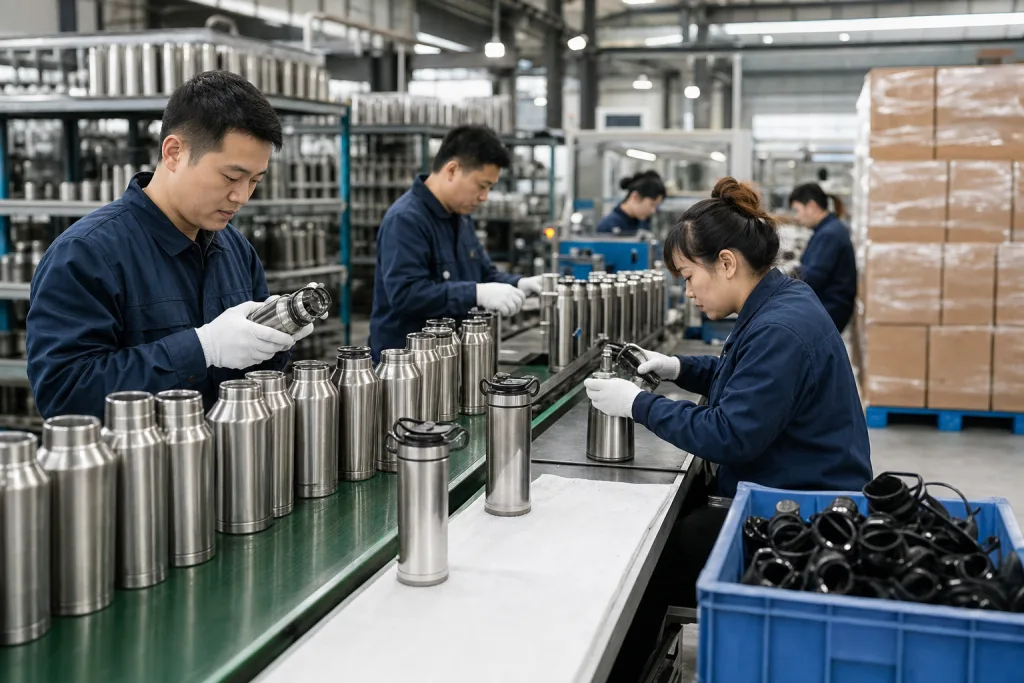
Our factory in Hangzhou, Zhejiang ships distributor drinkware for North American and European programs, from stainless bottles and PP shaker cups to custom canteen projects and promo sets. A normal OEM run starts at 3,000 units per color, sample approval takes 7-10 days, and mass production runs 30-40 days after deposit and artwork sign-off. QC pulled the sample at AQL 2.5 with a torque gauge last week, and the buyer flagged a 0.3 mm cap gap before we packed the cartons. The wrong question is “Can you print my logo?” The better one is “What will fail after 500 washes?”
Start With The Actual Sales Channel
Before you ask a canteen factory for a quote, decide where the product will be sold. A blender bottle distributor selling to gyms is not buying the same job as a distributor drinkware buyer shipping to Amazon FBA or retail chains. Same shape, different risk. Packaging, labeling, compliance files, and defect tolerance change by channel; last month QC pulled a shaker sample with a good cup body, but the hang tag hole was 3 mm off and the retail buyer flagged it at first review.
For a typical 700 ml PP shaker bottle, we ask you to confirm the channel first: wholesale cartons for a gym chain, individual color box for retail, or polybag with FNSKU for FBA. If you skip this step, the canteen supplier quotes the cheapest packing, then 10 days later you find the master carton fails a 1.2 m drop test or the barcode scans only 6 times out of 10 through the bag. Bad timing. We have seen this go sideways when the PO says “FBA ready” but the artwork file has no suffocation warning.
A clean buyer scenario looks like this: you want 12,000 units, four colors, 3,000 units per color. You need a flip cap, internal mixing ball, ml/oz scale, one-color logo on the cup, and retail-ready packing. Destination is Los Angeles, but the commercial term is FOB Ningbo. That is enough for a canteen manufacturer in Zhejiang to build a serious quote, check the mold cavity plan, and estimate carton size before the line manager books printing film.
For custom drinkware, do not start with a pretty rendering. Start with the selling situation. A canteen promotional order for an event can accept simpler packaging and faster decoration. A canteen customized retail line needs stable color matching, repeatable lid torque, UPC control, and spare parts; we run lid torque checks with a small digital torque meter because a “tight enough” cap is not a spec. Canteen distributors who define these points early usually save 5-8 days during sampling.
Build The Product Spec Sheet
The spec sheet is where 7 out of 10 blender bottle distributor projects either stay clean or start eating time. A good spec sheet is short, but tight. For a plastic shaker, call out capacity to the fill line and brimful capacity. Example: 700 ml marked capacity, about 760 ml brimful. Write the material grade clearly: food-contact PP body, PE or PP lid, 304 stainless mixing ball if used, and silicone sealing ring if the cap needs one. We have seen POs arrive with “700 ml bottle” only, then QC pulled the sample and the buyer argued about the water line after the mold was already cut.
Wall thickness matters. A light shaker might run 1.2-1.4 mm body wall thickness, but the math gets risky for distributor stock sitting in a 38°C warehouse. For distributor programs, we usually recommend 1.6-1.8 mm for better hand feel and lower deformation risk. The line checks this with a digital caliper at the shoulder, waist, and base, because thin spots near the logo panel show up first. If the order is a custom canteen or customized growler in stainless steel, use metal terms: 304 stainless interior, 201 or 304 exterior, 0.45-0.55 mm wall, copper coating if vacuum insulation is required.
For a blender bottle, the lid is the real product. Define thread style, gasket material, cap hinge cycle target, and leak test method before quoting the canteen vendor. Our simple internal rule is 60 seconds upside down after filling with room-temperature water, then 10 manual shakes. No drama. For premium customized drinkware, we sometimes add a pressure simulation or warm-water test at 45°C, but over-testing a budget promotional cup and then pushing for the lowest FOB price is the wrong question to ask. We have seen this go sideways when a buyer asked for a premium leak standard on a 20,000-piece giveaway order.
Color is another hidden cost. Stock colors keep MOQ lower. Pantone-matched body colors may require 3,000-5,000 units per color because resin mixing and injection setup create waste; one wrong digit on a Pantone code can cost half a day on the injection machine. A customizable canteen with powder coating has its own minimum batch size, usually 1,000-2,000 pieces per color depending on surface process. The buyer flagged this last spring when “matte black” from two factories did not match under a D65 light box.
- Capacity: marked ml/oz line, brimful capacity, and tolerance shown on the drawing
- Material: PP, Tritan, 304 stainless, silicone, or mixed construction with food-contact grade confirmed
- Decoration: silk screen, heat transfer, laser, embossing, or sleeve with logo size in mm
- Packing: bulk carton, color box, display tray, or FBA-ready pack with carton weight limit
Price The Order Without Guesswork
A quote that only says “USD 1.20 per piece” is not a quote you can control. For a blender bottle distributor, the working quote should break out mold, unit price, decoration, packaging, inspection, and freight term. A 700 ml PP shaker bottle from China might land around USD 1.05-1.80 FOB depending on lid complexity, wall thickness in mm, print area, carton spec, and order volume. A stainless custom growler or customizable growler sits in another price band, often USD 5.50-12.00 FOB for 1.9 L capacity depending on insulation and finish. Ask for the breakdown. Last month QC pulled a shaker sample with a 1.2 mm cup wall after the buyer’s spec sheet called for 1.5 mm; the price looked good until the drop test failed.
At BottleForge Industrial in Hangzhou, Zhejiang, we normally quote FOB Ningbo or FOB Shanghai for export orders. EXW looks cheaper on the first email, but newer buyers often miss local trucking, export declaration, port handling, and document coordination. We see this go sideways when a buyer compares EXW Hangzhou against FOB Ningbo and thinks the gap is pure margin. It is not. FOB makes the canteen supplier responsible for getting the goods cleared for export and loaded under the agreed port process. For one 20GP of blender bottles, local charges can easily change the landed math by several hundred dollars.
Tooling is another line to separate. If you use an existing mold, there may be no tooling charge. If you need a new lid shape, embossed logo, special grip texture, or proprietary blender insert, tooling can run from USD 800 for a simple logo insert to USD 8,000+ for a new injection mold set. A canteen customized project with stainless forming tools can also need fixtures, not just molds. We run trial shots on the injection machine before mass production, then check lid fit with a go/no-go gauge; a 0.3 mm mismatch at the thread can create leakage complaints.
Buyers often ask why one canteen vendor is 12% cheaper. Wrong question. Ask what was removed from the product. Sometimes it is real line efficiency. Sometimes it is thinner wall thickness, recycled material where virgin food-grade material was expected, lighter carton board, or no third-party inspection support. Ask the canteen manufacturers to quote against the same spec sheet. If two canteen suppliers are not quoting the same wall thickness, resin grade, and packing, the comparison is mostly noise. We have seen POs where “PP food grade” became just “PP” after 3 email rounds, and the buyer flagged it only after the pre-shipment sample arrived.
Approve Samples Like A Factory
Sampling is not photo approval. We need one physical golden sample on the desk and one signed approval record with date, version, and buyer name. For a new blender bottle distributor order, we run three sample stages: blank structure sample for fit and sealing, decorated pre-production sample for logo and color, then sealed production reference sample for the line. If the design uses existing molds, we usually finish this in 7-10 working days after artwork is locked. New tooling can add 20-35 days before the first real sample, especially if the mold shop has to adjust a 0.3 mm parting line or polish a cap thread insert.
When the sample arrives, do not stop at “logo looks good.” Fill the bottle to the marked line, weigh the empty body on a 0.1 g scale, measure height and diameter with calipers, check carton fit, test the cap hinge 50-100 times, and leave water inside for 24 hours. Simple checks catch ugly problems. For a canteen promotional project, this test list may look heavy, but the math doesn't work if you discover cap cracks after 12,000 units are already sitting in your warehouse. We have seen QC pull a sample with a hinge whitening after 63 flips; that is exactly the kind of issue a photo will never show.
Logo approval needs a position tolerance, not just a nice-looking mockup. For silk screen on curved plastic, ±2 mm is realistic when the operator loads bottles by hand into the screen jig. For laser engraving on stainless custom canteen products, tolerance can be tighter, but it still depends on fixture accuracy and whether the cup body has ovality. Large wrap prints need artwork distortion compensation. Your PDF may be perfect; the bottle surface is not flat, and this is the wrong question to ask after bulk printing has started.
If you are building a family line, such as a shaker, customized canteen, and distributor growler in matching colors, approve all color panels together under D65 lighting or a standard light box. Put the PP resin chip, powder-coated body, and stainless laser-marked piece side by side, then sign the same approval sheet. A Pantone reference on paper will not match PP resin, powder coating, and stainless laser marking exactly. You are approving a commercial match, not a laboratory miracle; one buyer flagged a “same black” set because the shaker cap read warm black while the growler coating read blue under store lighting.
Our practical rule: if a defect would make your sales team hesitate to show the sample to a chain buyer, define it before mass production starts.
Control Production And Inspection
After the deposit lands, production control is mostly calendar control and data control. For a normal custom drinkware order of 12,000 blender bottles, we plan material preparation, injection molding, decoration, assembly, packing, and final inspection at about 30-40 days after approved sample. On our Hangzhou line, a 600 ml shaker body usually needs the mold temperature and cycle time checked twice per shift, not guessed from the first good piece. Our Zhejiang facility and partner workshops can handle roughly 300,000 drinkware units per month across plastic and stainless categories, but capacity still depends on season and decoration process.
Use AQL, not feelings. A common inspection plan is AQL 0 for critical defects, 2.5 for major defects, and 4.0 for minor defects under ISO 2859-1. Critical defects include sharp edges, contamination, unsafe material substitution, or serious leakage. Major defects include cap failure, wrong logo, bad color deviation, missing parts, or packaging that prevents sale. Minor defects include small scratches within an agreed viewing distance. We have seen this go sideways when a buyer writes “good quality” on the PO but never defines a 30 cm viewing distance or the acceptable logo offset in mm.
For blender bottles, we recommend 100% functional leak testing at the assembly line, then random AQL inspection before shipment. The inspection checklist should include cap closing force, thread engagement, gasket placement, printed scale accuracy, logo rub resistance, odor check, and carton drop test. QC pulled the sample last month after 3 caps failed the upside-down leak test at 45 seconds, and that saved a full carton run from being repacked. For canteen manufacturers making stainless items, add vacuum retention testing, salt spray for coated parts when relevant, and inner wall inspection.
Compliance depends on your market. For the EU, ask about LFGB or EU food-contact testing, REACH for restricted substances, and packaging requirements. For the US, ask about FDA food-contact material suitability and, if children are involved, CPSIA and ASTM considerations. A canteen distributor selling adult gym shakers has a simpler path than a kids bottle program, but documentation still matters. The wrong question is “do you have a certificate”; ask whether the tested material, colorant, gasket, and printing ink match the actual SKU we ship.
Do not rely only on factory photos. Photos work for daily updates, especially when we send line shots, carton marks, and a 0.01 mm caliper reading on the lid thread, but they do not replace a final inspection report with sample size, defect count, photos, measurements, and pass/fail conclusion. China export projects move faster when both sides agree what “acceptable” means before goods are packed. No surprises at loading.
Plan Packing, Spares, And Reorders
Packing is not decoration; it is damage control and warehouse control. A blender bottle distributor should lock the master carton quantity, K=K or K=A carton board, inner bag spec, barcode position, and spare part policy before the line opens. For a 700 ml shaker, we run 24 or 48 pieces per master carton, depending on color box size and retail shelf rules. Saving USD 0.03 per unit with a soft 5-ply carton is the wrong place to cut cost; QC pulled cartons from a 1.2 m drop test last month and the thin board showed crushed corners on 7 of 20 cartons.
If you ship to Amazon FBA, confirm FNSKU placement, suffocation warning for polybags when required, carton weight limits, and mixed SKU rules before we print 3,000 labels. If you ship to a distributor warehouse, keep the carton label plain: item number and color on the first line, quantity and PO number on the second, then gross weight, net weight, carton size, and country of origin. Simple wins. A canteen vendor can print labels, but you must send clean data and signed artwork approval; we have seen one PO typo turn “matte black” into “metal black,” and the buyer flagged it during inbound scan.
Spares are boring until you need them. For shaker bottles, order 1-2% spare lids and 0.5-1% spare mixing balls if your sales channel handles replacements. For a customizable drinkware program with several lid colors, pack spare parts by color and label each PE bag with item code, Pantone, and quantity. For a customized growler, spare caps matter more than spare bodies because lost caps create most service requests; we ship 300 spare caps on a 10,000 piece growler order when the buyer sells through gyms and outdoor shops.
Reorder planning is where good canteen distributors protect margin. Keep the mold number, approved material code, Pantone or coating reference, logo file version, carton dieline, and inspection checklist in one folder, not buried across 6 email threads. When you reorder 90 days later, you should not be starting from zero. We check the old sealed sample with calipers, confirm the 304 stainless or plastic resin code, and match the carton dieline before mass production. A reliable canteen supplier in China can repeat a product well, but the approved standard must be controlled by both sides.
Choose The Supplier You Can Manage
A canteen manufacturer does not need to promise the whole catalog. You need a supplier who can say, plainly, which parts we run on our own line, which parts go outside, and where the order can fail. For a blender bottle distributor, I would look for injection molding capacity for plastic bodies, a repeatable lid and agitator assembly process, controlled logo decoration, and export staff who know FOB documents, HS codes, and when QC should pull the pre-shipment sample. If a factory says “all no problem” before checking the lid thread drawing or 0.3 mm color tolerance, the buyer should slow down.
Ask direct questions. What is the MOQ per color? What material certificate can you provide? Is the logo printed in-house or by a subcontractor? What is the lead time after sample approval? Can you support BSCI, ISO 9001, REACH, LFGB, or FDA-related testing if the order requires it? How many units did you ship last month? Good canteen vendors answer with numbers, not slogans. We had one buyer flag a PO because the approved shaker cup said “600ml” on the artwork, but the carton mark showed “650ml”; that small typo delayed booking by 2 days.
Using 2 or 3 canteen suppliers is normal if you buy across categories. A plastic shaker and a stainless custom canteen do not need the same machines, molds, polishing room, or testing setup. A glass infuser bottle and an insulated distributor growler can share a sales contact, but they should not be judged as the same production job. The wrong question is “Can this low-price factory make everything?” The better question is “Where are they proven?” China has strong specialized drinkware supply chains around Zhejiang, and Hangzhou buyers know the difference between a plant that runs PP injection molding every week and a workshop that only quoted it to win the order.
For a first order, keep the product controlled: one body, one lid, 3-4 colors, one decoration method, and a written inspection plan. Start with 3,000-12,000 units, then check sell-through, leakage complaints, barcode scans, and replacement rate before adding a canteen customizable range. Small steps pay. Once the first batch is stable, we ship seasonal colors, gift boxes, or a customized drinkware bundle with less drama because the mold, gasket fit, carton drop test, and AQL 2.5 checkpoints are already known.
Send Your Blender Bottle Spec For A Factory Quote
Share capacity, material, logo, packing, MOQ, and destination. We will return a practical FOB quote with lead time and QC notes.
Frequently asked questions
What MOQ should a blender bottle distributor expect from China?
For an existing 600-800 ml shaker mold, expect about 3,000 units per color for OEM color and logo work. Some factories accept 1,000 units if you use stock colors and simple one-color printing, but the unit price will be higher. New lid tooling or a proprietary body shape usually needs 10,000-30,000 units to make sense. For stainless custom canteen or custom growler orders, MOQ often starts at 1,000-3,000 units per color depending on coating, capacity, and packaging.
How long does a custom blender bottle order take?
If you use an existing mold, plan 7-10 working days for samples and 30-40 days for mass production after sample approval and deposit. Add 3-7 days for final inspection and port delivery. Ocean freight to the US West Coast may take about 18-25 days port to port, while Europe can be 30-40 days depending on route. New injection tooling can add 20-35 days before sample approval, so do not sell a launch date before the first physical sample passes.
Which material is better for shaker bottles, PP or Tritan?
PP is cheaper, tough, and common for gym shaker bottles. It works well for canteen promotional and distributor drinkware orders where price matters. Tritan is clearer, feels more premium, and has better visual shelf appeal, but the FOB price can be USD 0.40-1.00 higher per unit depending on size and lid. For both materials, confirm food-contact suitability, odor control, dishwasher expectations, and temperature limits. Do not approve recycled material unless your compliance and marketing claims allow it.
What inspections should I require before shipment?
Use a written AQL inspection plan: AQL 0 for critical defects, 2.5 for major defects, and 4.0 for minor defects. For blender bottles, require 100% leak testing during assembly, then random final inspection before shipment. Check cap function, gasket placement, odor, logo adhesion, fill scale accuracy, carton strength, barcode readability, and quantity per carton. For stainless customized canteen or distributor growler products, add vacuum retention, coating adhesion, and inner wall checks. A third-party inspection usually costs USD 250-350 per man-day in China.
Can one supplier handle blender bottles, canteens, and growlers?
Sometimes, but verify the production base. Plastic blender bottles need injection molding and lid assembly control. Stainless custom canteen and customized growler programs need forming, welding, vacuum insulation, polishing, and coating control. A trading-style canteen vendor may coordinate all categories, but you should know which items are made in-house and which are outsourced. For a distributor, the safer route is one accountable export supplier with clear factory audits, approved samples, and category-specific QC checklists.