Key Takeaways
- For most blender bottle customized projects, practical MOQ starts at 3,000 units per color for molded plastic and 1,000 units for stainless options.
- Logo method, lid complexity, packaging, and inspection level can change landed cost more than a USD 0.10 factory price difference.
- AQL 2.5/4.0 inspection, material declarations, and pre-production samples should be agreed before deposit.
- Typical lead time is 25-35 days after sample approval for standard models, longer for new tooling or custom shaker parts.
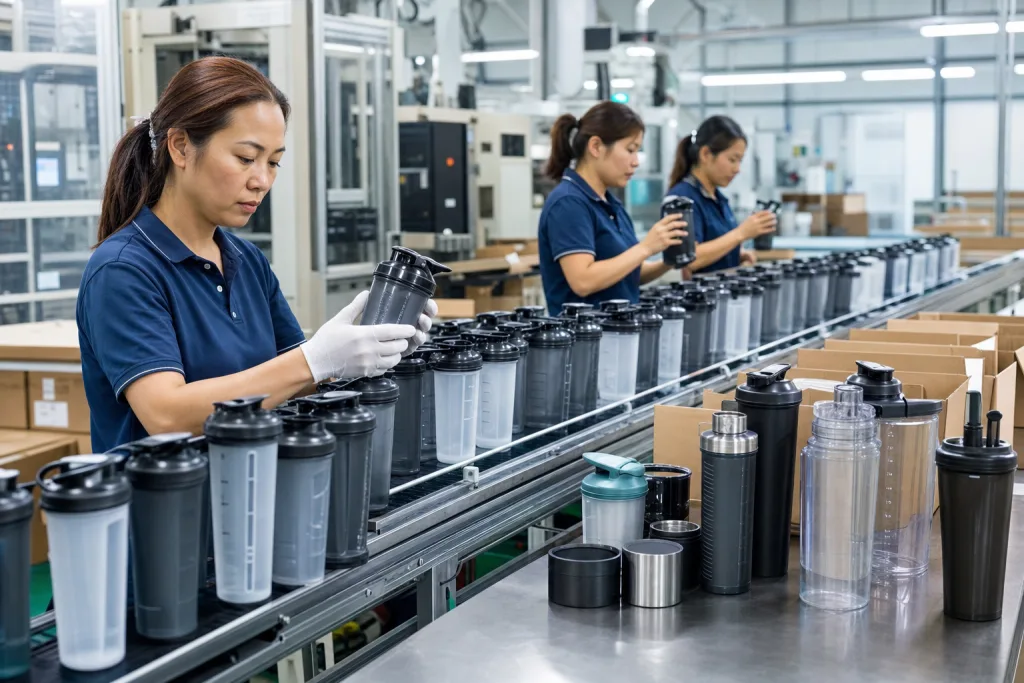
A blender bottle customized order looks easy on paper. Then the buyer flags the lid as 2 mm too loose, the logo starts rubbing after a few washes, or the signed sample fails a 1.2 m drop test in QC. We have seen this go sideways on the packing table. Unit price is only part of the bill; late launch, carton rejections, and a bottle that feels light and cheap in the hand cost more.
From Zhejiang, China, we run custom drinkware for brand owners, gyms, supplement companies, and distributor programs. On our line, the usual starter order is 3,000, 10,000, or 50,000 units, and the buyer often sends a PO with one wrong lid code or a logo typo that changes the whole quote. This is the wrong question to ask first: before you push for a serious FOB price, use the checks below to brief your canteen supplier properly.
What are you actually buying?
For a blender bottle customized quote, capacity and logo file are not enough. Tell the factory how the bottle will be used. A protein shaker for a gym chain needs different lid torque, graduation marks, and drop-test expectations than a university canteen giveaway. A stainless travel bottle for a distributor canteen channel is another job again. We run into this weekly: the PO says “700 ml shaker,” then the buyer flags leakage after sampling because nobody specified an inverted test.
Start with body material. Common plastic shaker bottles use PP, Tritan, or PE. PP keeps the price down and survives daily gym use, but the hand feel is basic. Tritan gives clearer walls and better impact resistance, usually adding USD 0.25-0.70 per unit depending on size and wall thickness; on our line, a 700 ml Tritan body with 2.3 mm wall thickness also needs slower cooling to avoid sink marks near the scale print. Stainless steel works for insulated custom drinkware, but the math changes: vacuum insulation, extra weight, and tighter welding control turn it into a higher-ticket bottle, not a cheap shaker.
Define the mixing system before artwork. A stainless wire ball is cheap and familiar, while a plastic mixing grid reduces noise in the carton and avoids buyers complaining about “metal parts” in supplement promos. An internal whisk insert needs tighter lid clearance. No mixer makes sense if the bottle is closer to a custom canteen. Lids cause most trouble. Flip caps, carry loops, leak-resistant silicone rings, powder compartments, and pill boxes add tooling, assembly labor, and tolerance risk; QC pulled one sample last month where a 0.4 mm oversized silicone ring made the cap hard to close after 200 cycles.
Buyer checklist:
- Capacity: 500 ml for compact gym bags, 600 ml or 700 ml for standard supplement use, 800 ml for longer workouts, or 1,000 ml when the buyer accepts the larger carton size.
- Material: PP for budget orders, Tritan for clear retail display, stainless steel 304 for insulated positioning, or mixed construction with plastic lid and metal body.
- Function: protein shaker with mixer, sports hydration bottle with fast-flow spout, promotional canteen customized item with simple branding, or retail bottle with barcode and color box.
- Leak target: basic splash resistance for giveaways or inverted leak test for 24 hours if the bottle will ship through Amazon FBA or sit inside a gym bag.
- Retail channel: gym with repeat member use, supplement brand with powder residue concerns, Amazon FBA with carton-drop risk, supermarket with shelf-facing artwork, or distributor growler program with mixed SKU cartons.
MOQ, pricing, and tooling reality
A serious canteen factory should not quote one flat MOQ for every customized drinkware project. MOQ depends on resin color, logo process, mold condition, and packing style. At our Zhejiang facility in China, standard shaker models usually start at 3,000 units per color for plastic and 1,000 units for stainless steel stock shapes. We check the color chip against a Pantone book on the line, because a “black lid” PO once arrived as matte black in the artwork and glossy black in the sample notes. If you need a new lid mold, a custom mixing insert, or a proprietary body shape, MOQ can move to 10,000-20,000 units because tooling and machine setup must be spread across enough pieces.
As a working benchmark, a 700 ml PP shaker with one-color silk screen logo may fall around USD 1.20-2.10 FOB Ningbo or Shanghai, depending on lid structure and packaging. Tritan versions often sit around USD 2.20-3.80. Stainless insulated shaker bottles can range from USD 5.50-9.50 when using 304 inner steel, 201 or 304 outer steel, powder coating, and retail box packing. These are quote boundaries, not promises. We run the costing sheet with cap weight, carton size, and logo film charge listed out; if another supplier is 30% lower, the math usually means thinner wall, cheaper steel, or a carton that fails the drop test.
Tooling deserves a direct question. A new plastic lid mold can cost USD 2,000-8,000. A full new body plus lid set may exceed USD 12,000. For stainless, custom molds are often lower than complex plastic injection molds, but MOQ still rises because polishing, welding jigs, and powder coating fixtures must be controlled. QC pulled one pre-production stainless sample last year because the welding jig left a 0.6 mm step at the shoulder; small on paper, ugly in the buyer’s hand.
Ask for the quote to separate bottle cost, logo cost, packaging cost, tooling cost, and inland China freight. If everything is hidden in one number, you cannot compare canteen manufacturers fairly.
For canteen distributors buying seasonal programs, the better route is often a stock mold with custom color, logo, and carton plan. This is the wrong question to ask: “Can you make my own mold for 2,000 pcs?” Ask whether a stock 700 ml or 800 ml body can carry your brand cleanly and ship 12 days vs 18 days after sample approval. We ship more repeat orders that way, and launch timing stays under control.
Which logo process survives use?
Logo decoration is where about 30% of blender bottle customized projects get over-promised. A clean render does not prove the mark will survive dishwashing, hand sweat, friction inside a gym bag, or a retailer's 3M tape pull. Match the process to the bottle material and target shelf price. We have had QC pull samples after one night in the drying rack because the ink edge lifted by 1 mm.
Silk screen printing is the standard low-cost choice for PP and stainless. It fits simple one- to three-color logos on curved bodies, especially when the artwork line width stays above 0.3 mm. For large wrap graphics, registration tolerance matters; a small shift at the seam is normal, and the buyer will see it if the design has a straight border. Heat transfer gives wider color range and gradients, but the adhesion test decides whether it passes. Laser engraving holds well on stainless steel, especially powder coated surfaces, but it is the wrong process for clear plastic branding. UV printing can look sharp, but we test it on the exact coating or plastic resin before the line runs 5,000 pcs.
For a canteen promotional order, one-color printing is often enough. For retail customized drinkware, ask for a physical pre-production sample and a logo durability test. We run a 3M tape pull test, 50-cycle hand rub test with a wet cloth, and dishwasher testing only when the product will be sold as dishwasher safe. Do not claim dishwasher safety because a catalog page says so. Test the exact logo ink and material. We have seen this go sideways when a PO said “dishwasher safe” but the approved sample only passed hand-wash labeling.
Logo decision checklist: Use this before we open the film positive or set the laser fixture.
- One-color gym giveaway: silk screen is most efficient, with MOQ and color count checked before plate making.
- Premium stainless shaker: laser engraving, or powder coat plus print after checking coating thickness in microns.
- Full-color lifestyle design: heat transfer or UV after adhesion test on the exact resin or coating.
- Retail barcode and warnings: print on the label or box, not only on the bottle, because scanners fail on curved glossy bodies.
- EU and North America sales: confirm ink compliance with REACH, LFGB, or applicable FDA food-contact expectations before bulk printing.
A dependable canteen vendor will push back if your artwork is too fine for the bottle curve. That is not negativity. It is production experience, and the math does not work when a 0.2 mm logo stroke has to print cleanly across a tapered shaker wall.
Safety documents buyers should request
For custom drinkware, the buyer carries the market risk even when the canteen manufacturer makes the goods. Ask for material and compliance files before PP sample approval, not after the vessel is already on the water. For Europe, buyers usually request LFGB food-contact testing, EU 10/2011 for plastics where relevant, REACH statements, and packaging heavy-metal compliance. For the United States, FDA food-contact suitability, California Proposition 65 review, and ASTM-related physical safety testing may apply by product and age group. We have seen this go sideways: QC pulled a lid sample after printing, and the buyer then asked for a test report covering the exact ink, not the plain lid.
If the bottle is for children, the requirements get stricter. A kids' shaker or customized canteen with small detachable parts needs choking hazard review and age grading. Do not treat it like a general adult sports bottle. Wrong question. The issue is not only “is the plastic food safe”; it is whether a 6 mm valve plug, carry loop pin, or loose logo badge can come off during normal use. If the product includes a metal mixing ball, inspect wire end finishing and corrosion resistance. If it includes silicone seals, confirm the silicone grade and odor control; on the line we usually open 20 seals from the incoming carton and check smell before assembly starts.
Factory audits are also part of procurement. BSCI, Sedex, ISO 9001, or a customer-specific audit can matter for retail chains. BottleForge Industrial operates from Zhejiang, China, and our standard line capacity is about 450,000 drinkware units per month across stainless bottles, tumblers, and plastic hydration products. Capacity looks good on a supplier profile, but audit readiness, document control, and traceability keep orders moving when a retailer asks for proof. We run lot cards by material batch, and one PO typo in a resin grade can cost 3 days while the merchandiser, lab, and buyer confirm which document is valid.
Document checklist:
- Material declaration for body, lid, seal, and mixer, with grade names matching the BOM.
- Food-contact test report matching the material family and the actual model or closest approved construction.
- Ink or coating compliance declaration, including logo print, powder coat, spray paint, or heat-transfer film.
- BSCI, ISO 9001, or social audit file if required by your customer, with the audit date still inside the buyer’s allowed window.
- Product warning text and country-of-origin marking plan, checked against the artwork file before tooling or pad-print plates are made.
Good canteen suppliers will tell you when a fresh third-party test is needed. Old reports from a different model are reference files, not automatic approval. The math does not work if a buyer saves 250 dollars on testing and then holds a 12,000-piece shipment because the report name does not match the blender bottle customized on the PO.
How should quality be checked?
Quality control for a blender bottle customized order cannot mean opening 5 cartons at the warehouse door and calling it done. We run checks at incoming material, first article, in-line assembly, and final inspection. Lid complexity changes the risk fast. Last quarter QC pulled a 0.04 USD silicone ring, checked it with a Shore A durometer and a digital caliper, and found the groove fit was 0.3 mm loose. That small ring would have made the whole container leak.
About 8 out of 10 export buyers we work with use AQL inspection. A common setting is AQL 2.5 for major defects and 4.0 for minor defects, with critical defects not accepted. Major defects include leaking, broken cap hinges, wrong logo color, strong odor, sharp edges, or missing accessories. Minor defects include small print variation within the approved Pantone tolerance, light shade difference inside the signed sample range, or scuffing that will not hurt retail sale. For premium retail custom drinkware, buyers often tighten the level or ask for 100% leak testing; the math does not work if a USD 6.50 retail bottle comes back because 12 lids in 1,000 were not seated right.
Testing has to copy real use, not just pass a clean table check. We recommend inverted leak testing with water filled to the marked line, lid open-close cycle testing on the hinge, drop testing at 1.0-1.2 m, torque checks for threaded caps using a torque meter, coating cross-hatch testing for powder coat, and carton drop testing under ISTA-style logic. For Amazon FBA or e-commerce, individual box strength matters more because parcels get tossed harder than palletized wholesale; we have seen a 350 gsm color box pass the line and still fail after courier handling.
Pre-shipment checklist:
- Approved golden sample on the inspection table.
- Carton count, SKU, barcode, FNSKU if needed, and country mark checked.
- Random leak test from packed goods, not only line samples.
- Logo position measured against approved artwork.
- Carton weight and dimensions confirmed for freight booking.
A canteen distributor should also keep 20-50 retained samples from each PO. Label them with PO number, production date, cavity number if molded parts are involved, and the inspector’s stamp. When a retailer reports a defect three months later, retained samples help separate factory issue from freight damage or customer misuse. We have seen this go sideways when the buyer’s PO had one digit wrong in the SKU, and nobody kept a sealed sample to prove what was shipped.
Packing and logistics choices
Packing is not an afterthought. It affects breakage, warehouse labor, freight cost, and the first 5 seconds when the buyer opens the carton. A bulk-packed gym shaker may need only a 0.03 mm polybag and 5-layer export carton. A retail customizable growler or premium shaker usually needs a color box, instruction sheet, barcode label, and sometimes a molded pulp tray. For North America, 7 out of 10 buyers we quote now ask us to remove plastic bags unless the bottle surface scratches during the rub test. QC pulled one matte black sample last month with lid scuff marks after a 1.2 m drop test. Bag removed, claim created.
Ask for carton specifications early. A typical 700 ml plastic shaker might pack 50 units per master carton, while stainless insulated bottles may pack 24 units or less because of weight and box volume. Cartons above 15-18 kg can trigger handling complaints from warehouses; one US 3PL rejected a 19.6 kg carton and charged repacking fees. If you are shipping to FBA, carton dimensions, FNSKU labels, suffocation warnings, and case-pack consistency must follow the receiving rules. A canteen vendor who ignores this can save USD 0.03 on packing and cost you 12 days in warehouse delays. The math doesn't work.
FOB Ningbo and FOB Shanghai are common for Zhejiang drinkware factories. Ningbo fits our Hangzhou line well because trucking is usually 2.5-3.5 hours, not the 5-6 hours we see for some Shanghai terminals during peak weeks. For smaller trial orders, LCL can work, but check palletization and moisture protection; we run 12 g desiccant packs per carton when the route sits in Ningbo warehouse over a rainy weekend. For large distributor canteen orders, full container load cuts handling risk. A 40HQ can hold roughly 35,000-60,000 plastic shakers depending on nesting and box size; stainless bottles take far less because each unit is boxed and heavier.
Logistics checklist:
- Confirm Incoterm: EXW, FOB, CIF, DDP, or FCA. We once saw “FOB Hangzhou” typed on a PO, which stopped booking for 2 days.
- Ask for packed carton size before issuing PO, including gross weight in kg and carton wall strength.
- Decide bulk pack, white box, color box, or retail display box based on the channel, not just unit price.
- Confirm pallet requirement for EU or North America warehouses, including pallet height and whether ISPM 15 wood is allowed.
- Include spare parts or replacement lids if your channel needs after-sales support; 1%-2% extra lids is common for shaker programs.
The cheapest packing is rarely cheapest after freight, retailer compliance, and damage claims are counted. We've seen this go sideways over a USD 0.08 color box.
Choosing the right supplier
The right blender bottle supplier is not the one with the lowest first quote. The cheap quote often misses the spring ball, carton drop-test packing, or FDA/LFGB file. You need a factory or trading partner that understands engineering, compliance, export packing, and daily communication with buyers. We have seen promo drinkware vendors quote a shaker cup well, then fail on lid thread fit because they never checked the 0.25 mm tolerance on the injection mold. Some stainless suppliers are solid on 304 stainless bodies but weak on PP lids and silicone seals. Some are good at custom growler programs but have no experience with shaker lid leak testing.
Start by asking what is made in-house and what is sent outside. Plastic injection, stainless forming, powder coating, printing, laser engraving, and assembly may sit in different workshops. That is normal in China. The key is control. Your main supplier must own the inspection plan, not just forward photos from a subcontractor. Ask for production photos, mold list, monthly capacity, and a lead time that matches the line schedule. For standard models, 25-35 days after sample approval is common. For custom tooling, plan 45-75 days including mold trial, revisions, and production. On our floor, QC checks the lid with a torque gauge and runs a 30-minute inverted leak test before packing.
Communication speed matters. A capable blender bottle manufacturer should answer technical questions directly: resin grade, steel gauge, wall thickness, seal material, AQL level, sample timing, and payment terms. If every reply is “yes, no problem,” slow down. Real factories know the weak points. The buyer flagged it last month: the PO said “clear black lid,” while the approved sample was smoke gray. One typo can stop a 12,000 pcs run.
For a first order, keep the product controlled. Use one body, one lid, and one proven logo process such as screen print or laser engraving. Add two colors only if the MOQ and carton split still make sense. After you validate sell-through, expand into canteen custom ranges, canteen customizable gift sets, customizable drinkware, or a distributor growler line. Launching six untested SKUs at once looks bold on a spreadsheet, but the math does not work when each color needs its own setup, QC pull, and spare lid stock.
Your best supplier will help you reject bad specifications before production starts. That is where margin is protected. We have seen this go sideways when buyers push for a softer silicone ring without retesting the leak rate.
Send your blender bottle specification for a factory quote
Share capacity, material, logo file, quantity, packing, and destination. We will return a practical FOB quote with MOQ and lead time.
Frequently asked questions
What MOQ should I expect for a blender bottle customized order?
For a standard plastic shaker bottle, expect 3,000 units per color as a practical MOQ. Some canteen suppliers may quote 1,000 units, but color options, logo method, and price will be limited. Stainless steel stock models can often start at 1,000 units because the body is already formed and decoration is easier to change. New plastic tooling, custom lids, or proprietary mixing parts usually push MOQ to 10,000-20,000 units. If your launch budget is tight, choose an existing mold and customize color, print, and packaging first.
How long does production take after I approve the sample?
For standard blender bottle customized production, plan 25-35 days after sample approval and deposit. Add 5-10 days for logo sampling if you need several print trials. For new tooling, allow 45-75 days because the mold must be designed, cut, tested, corrected, and approved before mass production. Peak season in China, especially before summer fitness promotions or Q4 retail programs, can add another 7-14 days. Ocean freight is separate: roughly 25-40 days to many North America ports and 30-45 days to many European destinations.
Can one supplier handle blender bottles, canteens, and growlers?
Yes, but verify the production base. A canteen factory strong in stainless vacuum bottles may also handle custom growler and customizable growler projects, but plastic shaker lids require injection molding knowledge and tighter cap tolerance control. Ask whether the supplier produces stainless forming, plastic injection, coating, printing, and assembly in-house or through approved partners. For distributor drinkware programs, using one coordinated supplier can reduce communication work and keep cartons, barcodes, and inspection standards consistent across blender bottles, canteen customized items, and growler SKUs.
Which logo method is best for gym or supplement brands?
For most gym and supplement blender bottles, one- or two-color silk screen printing is the best balance of cost and durability. On a 3,000-unit order, it is usually cheaper and faster than full-color processes. If you sell a premium stainless shaker, laser engraving or powder coating plus print gives a stronger retail feel. Full-color heat transfer is useful for lifestyle graphics, but you should test adhesion before approving mass production. Always approve a physical sample, not only a digital mockup, and ask for tape pull and wet rub test results.
What payment terms are normal for China drinkware orders?
A common term is 30% deposit with the purchase order and 70% balance before shipment after inspection. For new tooling, the mold fee is usually paid upfront or 50/50 before and after first mold trial. Larger repeat buyers may negotiate better terms after several clean orders, but new buyers should not expect open account terms. Use a proforma invoice showing item number, quantity, unit price, Incoterm, lead time, packing, and bank details. For higher-value orders, tie the balance payment to passed AQL inspection and approved shipping documents.