Key Takeaways
- A practical blender bottle custom MOQ starts at 1,000 units per color for factory-direct orders
- 304 stainless steel, Tritan, PP, and PE all change price, compliance, and perceived value
- Laser engraving is durable, while silk screen usually wins on 1-color promotional budgets
- Use AQL 2.5/4.0 inspection and carton drop testing before releasing balance payment
A blender bottle custom order looks clean on paper, then the quotes hit your inbox. One canteen supplier shows a low FOB price and a 0.8 mm bottle wall. Another canteen factory bundles a mixing ball, carton drop test, and cleaner print registration, then asks for a higher MOQ. We run this comparison all the time, and the unit price is the wrong question to ask. QC pulled the sample from the line last week and found a lid torque issue before shipment; that saved a buyer from a bad PO.
Before you send RFQs, lock four points: bottle structure, material compliance, decoration method, and packing route. BottleForge Industrial in Hangzhou, Zhejiang handles custom drinkware for distributor buyers, promotion agencies, and retail brands. Our Zhejiang production network can support 80,000 to 120,000 drinkware units per month, with typical MOQ from 1,000 units per color for shaker-style projects. On the shop floor, we check cap fit with a 72-hour leak test, because a 2 mm mismatch turns into returns fast.
Start With The Bottle Job
Before you ask any canteen manufacturer for a quotation, write down the job of the bottle. A gym shaker, a camping canteen custom order, and a distributor growler are not the same item with a new name on the carton. One buyer flagged this last month: their PO said “sports bottle,” but the artwork showed protein powder, so QC asked whether the lid needed a shaker seal or a standard flip cap. Different job, different lid. Different leak risk.
For a blender bottle custom project, choose the mixing system first. We run three common options: a stainless mixing ball, a fixed plastic whisk insert, or a mesh grid under the lid. A 304 stainless ball adds about USD 0.08 to 0.18 depending on diameter and order quantity. On the line, QC checks ball diameter with a digital caliper because a 1 mm mismatch can make the rattle sound cheap. A molded grid can cost less at 30,000 pcs, but it needs a matching lid structure and a proper tooling review, not a quick “same as sample” note.
Next, fix capacity and hand feel. Common shaker sizes are 500 ml, 600 ml, 700 ml, and 800 ml. North American fitness buyers often ask for 20 oz or 28 oz. European promotional buyers usually specify metric capacity and may require REACH documentation for plastic contact parts. If you are also planning a custom canteen or customizable growler range, keep diameter and carton size consistent; for example, 74 mm body diameter across two SKUs saves a new inner tray and makes pallet loading cleaner. The math does not work if every item needs its own carton.
The trade-off is simple: a custom lid or new body shape gives stronger brand ownership, but it slows the first order. An existing mold with custom logo, color, and packaging ships faster. For most first-time B2B buyers, I recommend a proven mold first, then custom color, scale markings, logo, and retail box. We’ve seen this go sideways when a buyer spends 60 to 90 days on a new mold, then changes the cap after the first leak test. With a proven mold, you can get market feedback in 35 to 50 days before paying for heavier tooling work.
Choose Material Without Guessing
Material choice sets your unit cost, test risk, and after-sale noise. For customized drinkware, do not accept loose wording like “food grade plastic” or “premium stainless.” Ask for the resin or steel grade on the PI and sample tag: PP, PE, Tritan, AS, 304 stainless steel, or 316 stainless steel. Ask for the test standard too. We have seen a buyer approve “plastic shaker” on a PO, then reject the first carton because the lab report said AS instead of Tritan. That mistake costs more than one email at sample stage.
For plastic shaker bottles, PP is the usual choice for promo runs because it is light and the molding cost stays sane at 3,000 to 10,000 pcs. Tritan costs more, but the clarity looks closer to retail shelf quality and buyers complain less about cloudy walls. PE fits squeeze-style sports bottles better than rigid blender bottles. For stainless versions, 304 is the normal choice for inner contact surfaces. If you are buying a custom growler or customized growler for beer, coffee, or outdoor use, double-wall 304 stainless steel with vacuum insulation is usually expected. The buyer flagged this last month: the sample passed appearance, but the vacuum test dropped from 95°C to 58°C after 6 hours. Not acceptable.
Wall thickness matters. For stainless drinkware, 0.4 mm to 0.5 mm sheet covers most mainstream tumblers and bottles we run on the line. Heavier builds may use 0.6 mm, but the math does not work for every order because the carton weight, sea freight, and dent rate all move. For plastic shaker bottles, check drop resistance and lid thread strength before arguing over gram weight. QC pulled one lid after a 1.2 m drop test and found a white stress mark at the hinge. A cheap lid that cracks after 300 openings is not cheap for a canteen distributor handling warranty claims.
If you sell in Europe, ask for LFGB or EU food contact testing and REACH checks for relevant components before tooling starts. For the United States, FDA food contact expectations and California Proposition 65 screening may apply, depending on coating, colorant, and packaging. If the product is for children, ASTM or CPSIA-related questions can appear. Zhejiang and wider China supply chains can handle this, but say the sales market before sampling. We ship different documents for Germany and California, and changing the test route after the gold sample can add 7 to 14 days.
Decoration Drives The Real Quote
Logo method changes the look and the real factory cost. Buyers ask for “customizable drinkware,” then send a JPG logo and leave the decoration column blank on the PO. We see this 6 or 7 times a month. Silk screen, heat transfer, laser engraving, UV print, powder coating, and full-wrap artwork all run through different stations, different jigs, and different QC checks. A canteen vendor cannot quote cleanly until the line knows the print area, color count, and artwork file type.
For blender bottle custom orders, 1-color silk screen is still the practical choice for promotional runs. Clean. Fast. Cheap enough. On a flat or slightly curved surface, the screen frame setup is manageable, and the unit cost can stay below USD 0.10 to 0.25 for roughly 80% of simple logo jobs we run. Multi-color logos need tighter registration and extra screens, so the operator checks alignment with a 0.5 mm tolerance before bulk print. If your artwork uses gradients or photo effects, heat transfer or UV printing usually makes more sense.
Laser engraving works well for stainless steel bottles, custom canteen projects, and premium distributor canteen orders. It will not peel, and the mark is permanent. The tradeoff is color. You get an etched effect, not a bright printed logo, so asking for “laser in red” is the wrong question to ask. For powder-coated stainless drinkware, laser engraving exposes the metal below; QC pulled one sample last week where uneven coating made the logo edge look dirty, so coating quality matters before the laser head even starts.
Color matching is another hidden issue. If you need a brand color, provide Pantone references. For plastic parts, molded color MOQ may start at 1,000 to 3,000 pieces per color depending on resin and factory schedule. For stainless bottles, powder coating can usually follow Pantone direction, but gloss level and texture change the final look. Always approve a pre-production sample under normal office light, not only a phone photo from the factory floor; we use a D65 light box because one buyer flagged a blue lid that looked correct on WeChat and wrong on their shelf.
My practical rule: if the bottle will be used as a low-cost giveaway, choose simple print and protect the delivery date. If it will sit on a retail shelf, spend the time on coating, logo durability, and packaging structure, because the math doesn't work when 500 cartons need rework after arrival.
Price The Whole Landed Order
A low FOB Ningbo or FOB Shanghai price is one line on the cost sheet, not the order cost. For B2B custom drinkware, price the bottle, logo process, retail box, lab test, AQL 2.5 inspection, China inland truck, sea or air freight, duty, and local warehouse handling. We run landed-cost sheets in RMB and USD because one missed line can kill the margin. Last month a buyer flagged a USD 0.18 gap per bottle after we added FBA labels and a 9.5 kg master carton limit. For canteen distributors selling to retailers with fixed margin targets, this is the wrong question to ask: “What is the cheapest FOB?” Ask what the whole shipped order costs.
As a rough China factory range, a plastic shaker-style bottle with basic logo may sit around USD 1.20 to 2.80 FOB depending on capacity, material, lid complexity, and order quantity. A stainless insulated bottle or customizable canteen can range from USD 3.50 to 8.50 FOB for mainstream specifications. A customized growler or customizable growler with larger capacity, handle, and premium coating can go higher, especially if the coating needs a second spray pass on the line. These are not promises; they are working ranges to help you judge whether a quote is realistic. QC pulled one 32 oz sample with a 0.6 mm lid gap, and that small fit issue changed the gasket choice and the quote.
MOQ changes the math fast. At 500 units, the factory still has setup, Pantone color change, artwork checking, and packing labor, so the unit price rises. At 1,000 to 3,000 units, canteen manufacturers usually get cleaner pricing and a steadier production slot. At 10,000 units, resin purchase, printing setup, and carton planning become more efficient, but you need accurate forecasts and space for inventory. We have seen this go sideways when a PO said “matte black” but the approved sample tag read “BK-02 rubber oil”; 12 cartons were packed before the buyer caught the typo.
Check carton dimensions and weight early. A bulky 800 ml bottle can make sea freight inefficient if the carton design is poor; a 54 x 42 x 38 cm carton at 11 kg ships differently from a tighter 48 x 36 x 34 cm carton. For Amazon or retail distribution, ask early about barcode labels, FNSKU, carton marks, and master carton strength. A USD 0.05 stronger carton is often cheaper than crushed packaging claims. If your canteen vendor does not discuss packing, they are not thinking like an export partner. Simple test: ask for the drop-test method and carton ECT value before you approve the PI.
Verify Factory Capability Early
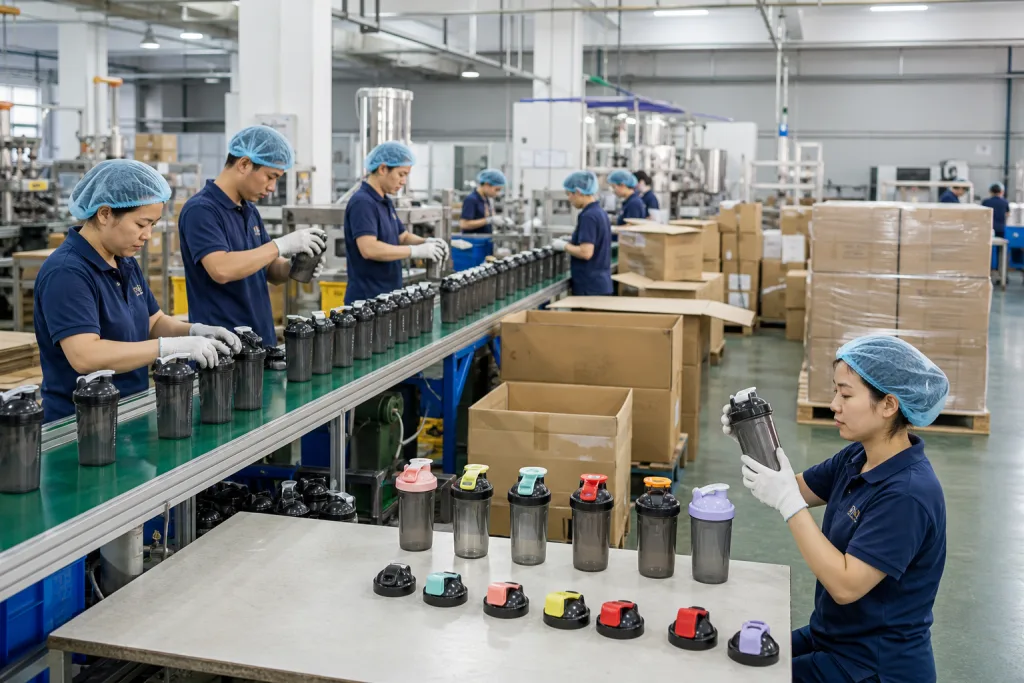
Buyers often search for canteen suppliers, canteen vendors, or a canteen factory and get 20 look-alike PDFs by Friday afternoon. The wrong question is “Can you make this?” Ask, “Which steps do you run yourself, and where can defects slip in?” A trading company still has a place, but you need clear answers on molding, coating, assembly, printing, and inspection. Last month a buyer flagged three suppliers using the same catalog photo; only one could show the actual 16-cavity lid mold on the line.
For a blender bottle custom order, ask for production photos of the exact mold family, not catalog renderings. Confirm whether the factory runs in-house assembly and leak testing. For stainless custom canteen and custom growler orders, ask about vacuum testing, salt spray testing for coating, and lid torque checks with a torque meter, not “worker hand feel.” For plastic bottles, ask about injection machine capacity, lid hinge testing, and random drop testing from 1 meter. We have seen a 0.3 mm mismatch on a flip cap turn into carton-wide leakage after hot water testing.
Audit documents matter, but they are not magic paper. BSCI, ISO 9001, or Sedex-type documentation can support your supplier approval process, but they do not replace product inspection. A certified factory can still ship bad printing if nobody checks print adhesion with 3M tape after curing. Use AQL inspection, commonly 2.5 for major defects and 4.0 for minor defects, unless your retailer has stricter rules. QC pulled one sample where the logo passed color review but failed after 10 rubs; the certificate did not catch that.
At BottleForge Industrial in Hangzhou, Zhejiang, we normally split approval into three gates: sample approval, pre-production confirmation with sealed PPS, and final random inspection. For a new customized canteen or distributor drinkware project, we prefer to freeze artwork and packaging at least 7 days before mass production. Strict? Yes. The math does not work when a PO has a Pantone typo on Monday, the line starts Wednesday, and the buyer still expects the original vessel date. Late artwork changes are one of the most common causes of shipment delay in China.
Plan Sampling And Lead Time
Sampling is where a smart buyer saves money. Do not approve a blender bottle custom order from a catalog image. Ask for a physical sample using the target resin, lid structure, logo method, and inner bag or color box direction. On our line, QC checks the shaker ball fit with a 0.2 mm feeler gauge and does a leak test before we let the sample leave Hangzhou. If the exact Pantone color or final logo tool is not ready, approve the mold, closure, drinking mouth, and mixing performance first.
Typical sample timing is 5 to 10 days for an existing mold with a simple logo mockup, and 12 to 20 days if you need custom color, new printing screens, or special packaging. New mold development can add 25 to 45 days before production sampling, sometimes longer for a flip lid with spring parts or a silicone seal that needs two rounds of fitting. Three days? Be careful. If a canteen manufacturer promises everything in 3 days, ask whether they are sending a real material sample, a blank bottle from stock, or just a UV logo proof.
Mass production lead time usually runs 25 to 40 days after deposit and sample approval for standard custom drinkware. Peak seasons before summer promotions and Q4 retail can push the line out by 7 to 12 days, especially when buyers ask for matte finish plus individual color boxes. Sea freight to Europe or North America may add 25 to 45 days port to port, plus inland handling. Air freight is possible for urgent promotional launches, but the math does not work on bulky drinkware; one buyer flagged a quote after the freight cost beat the bottle cost per carton.
Give your supplier a real deadline: event date, warehouse delivery date, or retailer routing deadline. Then work backward. If you need goods in a Chicago warehouse by May 1, a China production finish date in late March may already be tight. We ship better when the PO shows the warehouse cut-off date, carton mark rules, and barcode file in the same email; last month QC pulled samples while sales was still chasing a one-digit typo in the item code. Good canteen distributors build a 10 to 14 day buffer for inspection, customs documents, and vessel changes. Bad timelines assume nothing goes wrong.
Protect The Order Before Deposit
Before you pay the deposit, make the purchase order painfully clear. Spell out capacity, material, color, logo size, logo position, packaging, carton marks, testing requirements, inspection level, delivery term, and approved sample reference. A short PO saying “blender bottle custom, 5,000 pcs, black” leaves too much open. We have seen this go sideways over a 6 mm logo shift and a missing “matte finish” note on the PO.
Use photos and drawings. Mark the logo location in millimeters from a fixed point, such as the bottom edge or center seam. If the shaker has a molded measurement scale, tell the supplier whether the print can cross it. State whether small color variation is acceptable, for example within Delta E 1.5 or only “close by eye.” For canteen promotional orders, confirm if individual polybags are allowed in your market; 3 buyers last quarter changed to paper sleeves after their retail team flagged plastic packaging. If sustainability claims are used, ask for evidence, not just wording.
Payment terms for first orders commonly use 30% deposit and 70% balance before shipment after inspection. Established buyers sometimes negotiate better terms after 3 or 4 clean shipments. If you are working with a new canteen supplier, do not release final payment before receiving inspection photos, defect report, packing list, and commercial invoice draft. Simple rule. No report, no balance. For larger orders, consider a third-party inspection company in China, and set the inspection level in the PO; QC pulled one sample here with loose mixing ball welds after a 500-cycle shake test, and the buyer was glad they waited.
The best supplier relationship is not built on the cheapest quote. It is built on fewer surprises. A reliable canteen vendor will push back when your timeline is unrealistic, when your artwork line is too thin for screen printing, or when your requested material does not match the compliance target. That pushback matters. We run the line in Zhejiang, and if a 0.18 mm logo stroke will fill in during printing, the honest answer is to say so before cartons are sealed.
Send Your Blender Bottle Spec For Review
Share capacity, material, logo, quantity, and target market. We will check feasibility, MOQ, lead time, and factory-direct pricing.
Frequently asked questions
What MOQ should I expect for a blender bottle custom order?
For factory-direct production in China, a realistic MOQ is usually 1,000 units per color for an existing mold with custom logo. Some canteen vendors accept 500 units, but the unit price is higher because printing setup, color handling, and packing labor do not shrink much. For custom molded colors, 1,000 to 3,000 units per color is more common. If you need a new lid, special mixing insert, or private mold, the first order may need 5,000 units or tooling fees. For a first test order, I usually suggest 1,000 to 2,000 units using a proven mold, then scaling after you confirm sell-through and customer feedback.
Which material is best for customized blender bottles?
There is no single best material. PP is practical for canteen promotional and gym giveaway bottles because it is light and cost-effective. Tritan is better when you need a clearer, more retail-looking bottle and can accept a higher FOB price. Stainless steel is better for premium custom canteen or insulated customized drinkware projects, but it is heavier and more expensive. For European sales, ask for food contact test support such as LFGB or EU 10/2011 where relevant. For the U.S., confirm FDA food contact expectations and any Prop 65 screening requested by your customer. Choose material based on market, price point, and compliance burden.
How long does production take after sample approval?
For an existing mold blender bottle custom order, mass production commonly takes 25 to 40 days after deposit and final sample approval. Sampling usually takes 5 to 10 days for simple logo work, or 12 to 20 days for molded color, packaging, and more complex decoration. If you add new tooling, plan another 25 to 45 days before production sampling. Freight is separate. Sea freight from China to North America or Europe can add 25 to 45 days port to port. If you have a fixed event date, give the canteen factory your required warehouse delivery date, not only your preferred ship date.
Should I use silk screen, UV print, or laser engraving?
Use silk screen for simple 1-color or 2-color logos on promotional plastic bottles when cost and speed matter. It is usually the best value for distributor canteen orders. UV print works better for multi-color artwork, gradients, or more detailed branding, but it needs careful adhesion checks on curved surfaces. Laser engraving is best on stainless steel custom drinkware, especially powder-coated bottles and custom growler projects. It is durable and premium-looking, but it does not give bright printed color. Ask for a decorated pre-production sample and do a tape test or rub test before approving mass production.
How do I compare quotes from canteen manufacturers fairly?
Put every quote into the same format: capacity, material, lid type, mixing ball or insert, logo method, number of colors, packaging, carton quantity, FOB port, MOQ, sample cost, lead time, and testing included. A USD 1.60 bottle without logo setup, carton testing, or compliance support may be more expensive than a USD 1.85 bottle that includes those items. Ask each canteen manufacturer for carton size and gross weight so you can estimate freight. Also confirm AQL inspection standards, usually AQL 2.5 for major defects and 4.0 for minor defects. Compare landed cost and risk, not only FOB unit price.