Key Takeaways
- Start with a written spec: 600-800 ml capacity, PP or Tritan body, 304 stainless ball, leak test standard, and carton drop requirement
- For blender bottle custom made orders, 5,000 units usually gives better tooling flexibility and decoration cost than 1,000 units
- QC should include AQL 2.5/4.0 inspection, 100% leak testing, torque checks, barcode scans, and dishwasher simulation
- FOB Ningbo lead time is commonly 25-35 days after sample approval, plus 3-7 days for packaging and export booking
You are not buying a logo on a shaker. You are buying a drinking system that has to survive whey powder clumps, 65°C dishwasher cycles, retail complaints, and the trip from China to your warehouse. A blender bottle custom made order looks simple until QC pulled the sample and found a 0.4 mm lid gap, the mixing ball rusts, or the logo scratches off after 30 washes.
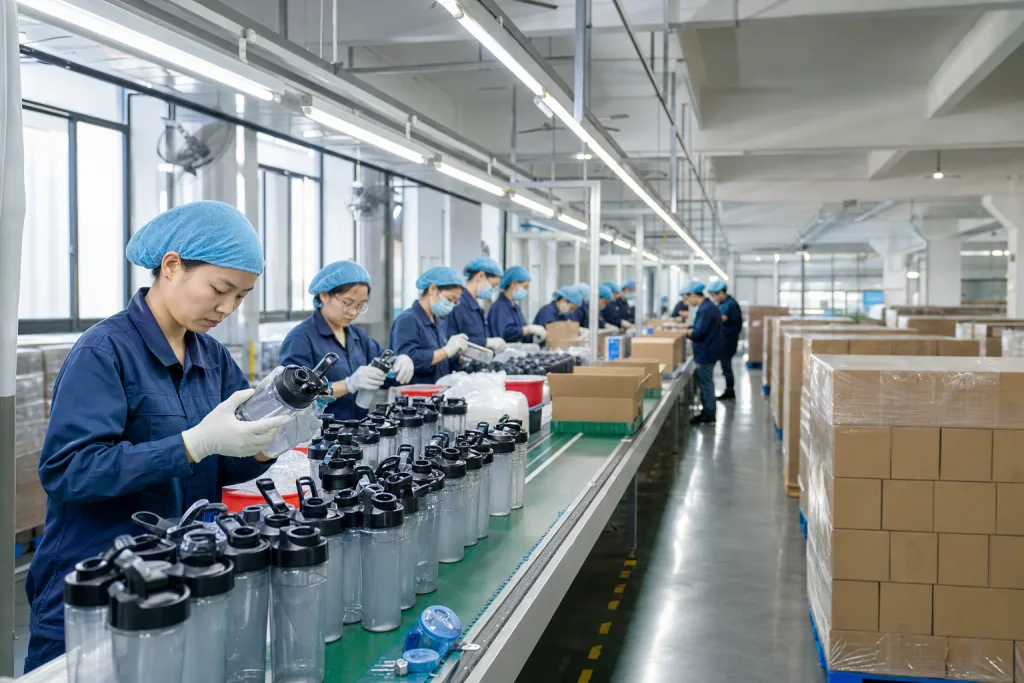
Here is a practical walkthrough of one B2B order: 5,000 custom drinkware units for a sports nutrition brand, shipped FOB Ningbo from Zhejiang. The same thinking applies if you source a custom canteen, customizable growler, or distributor drinkware line. BottleForge Industrial runs stainless and plastic drinkware programs from Hangzhou, Zhejiang, with typical MOQ from 1,000 units and 25-35 day production after artwork approval. We run the line with a torque gauge on the flip cap and a 24-hour upside-down leak test, because “looks fine” is the wrong question to ask on shaker bottles.
Start with the actual buying scenario
Assume you are launching a private-label shaker bottle for a protein powder bundle. Your retail price target is USD 14.99-19.99. You need 5,000 units, matte black body, side ml/oz scale, screw lid, flip cap, carry loop, 304 stainless mixing ball, and an individual color box. You also want the same supplier to quote a canteen custom project next quarter, so this is not a one-shot trade. We run these programs for repeat distributors, and the first question is whether the factory can hold the spec on the line without drifting on lid fit or print color.
The first mistake is sending only a photo and asking, “How much?” That is the wrong question to ask. A canteen factory in China can quote almost anything from USD 1.20 to USD 5.80, depending on resin, wall thickness, lid sealing design, decoration method, and test requirement. For a blender bottle custom made order, the quote should be built from a controlled specification sheet, not from a screenshot. The buyer flagged it on one job last month: the photo showed a ribbed body, but the PO never said whether the wall was 0.8 mm or 1.2 mm, and the price gap came straight from that miss.
A useful RFQ includes capacity measured to brim and usable fill line, body material, lid material, gasket material, odor requirement, decoration position, packaging, target market, compliance documents, and inspection standard. If you sell in Europe, ask about LFGB, REACH, and food-contact migration testing. If you sell in North America, ask for FDA food-contact material declarations and, where relevant, Prop 65 assessment. If the bottle is for children, you need a different risk review than an adult gym bottle. On our side, QC pulled the sample and caught a cap-torque drift before shipment; the leak tester showed 3 drips in 100 units at 80 kPa, and that saves a chargeback later.
At BottleForge Industrial in Zhejiang, we normally push buyers to confirm three numbers before tooling or sampling: target landed cost, acceptable defect rate, and next 12-month forecast. These numbers decide whether you should use an existing mold, adjust an existing mold, or pay for a private mold. We ship faster when the math is clear, and the line can plan it; for a new color box, our MOQ is 5,000 pcs, not 500, so a buyer once had to fix a PO typo after quoting the wrong carton count.
Lock the bottle specification first
For blender bottle custom made sourcing, body material sets the price and the complaint rate. PP keeps the unit cost down and survives daily gym use; on our line, a 700 ml PP shaker is often the quote buyers ask for when the target shelf price is tight. The downside is appearance and odor risk. If the mold polish is weak or the texture is too rough, protein smell stays after 3 washes. Tritan looks clearer on a retail shelf and passes the “premium feel” check faster, but the resin cost pushes the quote up. Stainless steel works for a premium shaker, but the math does not always work: the 304 ball is louder, powder can clump against the wall, and freight weight jumps from roughly 145 g for PP to 260 g or more for stainless.
A practical mid-market spec is a 700 ml PP or Tritan body, 2.2-2.8 mm body wall depending on mold geometry, PP lid, silicone gasket, 304 stainless mixing ball, and a threaded lid with at least 1.5 full turns of engagement. The flip cap should open smoothly but stay shut in a gym bag. Simple request. Hard part is repeatability. We run flip cap pull force with a digital force gauge and cycle the hinge 3,000 times before we trust a new lid mold. QC pulled one sample last season where the cap passed the first leak test, then popped open after the hinge pin wore 0.3 mm. This is where cheap shaker bottles fail first.
If your catalog also includes canteen customizable products, do not copy the same lid logic across all items. A customized canteen used outdoors often needs a tethered cap and wider temperature tolerance, especially when the buyer wants it clipped to a backpack. A customized growler may need thicker stainless steel, commonly 0.5-0.6 mm for the outer wall on vacuum styles, and better pressure awareness if customers use it for carbonated drinks. We have seen this go sideways when a buyer used one “universal lid” drawing for 4 SKUs. A blender bottle is different: powder mixing, cleaning access, gasket retention, and leak resistance matter more than insulation.
Write down the inspection dimensions before the PO is signed. For example: capacity tolerance ±3%, weight tolerance ±5%, logo position tolerance ±1.5 mm, color tolerance within approved Pantone chip under D65 light, and no sharp edges above 0.2 mm burr height. We also add thread go/no-go checks and gasket seating depth in mm, because a small mismatch there becomes a carton-level leak claim. One buyer once sent a PO with “Pantone 286C” in the artwork file and “Pantone 268C” in the order sheet; QC flagged it before mass printing. A canteen supplier that accepts these details early is easier to manage than a canteen vendor who only says “no problem.”
Choose decoration without overpromising durability
Brand owners often sign off from a glossy mockup, then the gym bottle gets hit by dishwashers, backpack abrasion, and sweaty hands. For custom drinkware, the decoration has to match the surface and the cleaning routine. On our line, a one-color silk screen still makes sense for a flat panel or a gentle curve; the mesh count, squeegee pressure, and cure time stay straightforward. Heat transfer gives finer color detail, but the film can lift if the plastic surface energy is low or the oven setting is off by a few degrees. Laser marking is fine on coated stainless parts. On a clear shaker body, it is the wrong process.
For 5,000 units, a one-color logo on one side may add about USD 0.08-0.18 per unit, depending on size and setup. A full-wrap heat transfer can move the decoration cost to USD 0.35-0.80 per unit. Individual color box artwork can add USD 0.15-0.45 per unit depending on paper weight, finish, insert, and carton packing rate. These are factory-level numbers from China, not landed cost. The math does not work if someone promises retail-grade decoration at plain silk-screen pricing. On one recent job, QC pulled the sample after the second print pass because the edge registration drifted 1.2 mm.
Ask for artwork files in AI or PDF vector format, Pantone references, logo size in millimeters, and exact placement from a physical reference point, such as 42 mm below the lid shoulder. For retail and online channels, include UPC, FNSKU, warning text, recycling marks, and country-of-origin text on the packaging proof. If you are a distributor canteen buyer selling into corporate gifts, your end client may change logo files late. We see this go sideways all the time when the PO says one thing and the file name says another. Build at least 3-5 working days for artwork confirmation. Our art table keeps a steel ruler and a 0.01 mm caliper on it for a reason.
Durability should be tested, not assumed. A reasonable pre-production check includes 3M tape adhesion after curing, 30 dishwasher cycles for dishwasher-safe claims, alcohol rub for printed areas, and scratch testing using a defined load. If you cannot afford formal lab tests for every customized drinkware SKU, at least demand a retained golden sample and a written decoration standard approved before mass production. We ship fewer surprises that way. The buyer flagged it once on a 2,000-piece shaker order, and the fix was a new cure profile, not a prettier mockup.
Price the order like a factory
A blender bottle custom made quote is not one price. It is a stack of factory choices: PP or Tritan grade, 304 stainless parts if used, whether we have the mold on the rack, lid thread count, flip-cap spring, silicone gasket section, mixing ball or grid, logo process, inner bag, color box, AQL 2.5 inspection, and payment terms. A serious canteen manufacturer should break out mold cost, unit cost, decoration cost, packaging cost, and testing cost. Ask for the split. Last month a buyer flagged a USD 0.18 jump after changing from bulk pack to color box; the unit price looked fine, but the 5-ply export carton and divider tray were buried in one line.
For an existing 700 ml shaker mold, a realistic MOQ may be 1,000-3,000 units per color. For a custom color matched to Pantone, resin suppliers may require a color masterbatch MOQ, so 3,000-5,000 units is easier. QC will also check the first injection shot against a D65 light box, not just a phone photo. For private mold development, expect tooling from roughly USD 2,500 to USD 12,000 depending on body and lid complexity. A simple adjustment to an existing mold costs less, but this is where buyers ask the wrong question. Cheap tooling does not give you exclusive shape control.
Our Hangzhou, Zhejiang production planning team typically quotes 25-35 days for mass production after pre-production sample approval, with monthly capacity around 300,000 drinkware units across stainless, plastic, and hybrid programs. In a normal week we run shaker lids on one injection line and bottle bodies on another, then move finished parts to pad printing after the surface wipes clean. Peak season before summer promotions and Q4 gift sets can add 7-14 days, especially for color box printing and carton scheduling. We have seen 25 days become 38 days because the PO listed matte black while the approved sample card said Pantone Black 6 C.
Payment terms also change your real risk. Around 8 out of 10 canteen suppliers in China ask for 30% deposit and 70% before shipment. For repeat buyers with stable forecasts, staged payment or credit insurance-backed terms may be possible. If you are dealing with several canteen vendors for one program, compare total landed cost, not only FOB. The math does not work when a USD 0.12 cheaper bottle needs a carton 20 mm taller, fails drop testing at the handle, or makes you miss a retail launch window.
Sample before you issue the PO
Sampling should answer engineering questions, not produce a nice photo for the buyer meeting. For a blender bottle custom made program, we ask for 1 reference sample first, then 2 pre-production samples made with the final resin, Pantone color, gasket, logo process, and retail box. If the supplier says the final color is available only during mass production, push back. The math doesn’t work. We’ve seen a 1.5 mm gasket change turn a passable desk sample into a leaking shipment.
A good sample review takes 30 minutes and a checklist. Fill the bottle to the marked line, close the lid with normal hand force, invert it for 10 minutes, shake it hard for 30 seconds, place it on its side, and check leakage around the thread, flip cap, and gasket. Use a digital scale if needed; 1 g lost after the leak test is already a warning. Put protein powder and water inside, shake, then clean it with a bottle brush. Smell the bottle after 24 hours. Cheap resin and poor molding settings often show up as odor before a lab report says anything.
Check the mixing ball. It should be 304 stainless steel, not a vague “stainless” grade. Ask for a material declaration and, for higher-risk retail channels, third-party testing. QC should pull the sample, compress the ball by hand, and check whether it springs back without a bent wire tip. The wire ends must feel smooth. No burrs. If you specify a plastic mixer insert instead, check sink marks near the ribs, warpage over 1 mm, and powder trapped after washing.
The same sample discipline applies to a custom growler, customizable canteen, or canteen promotional order. With a growler, we run handle pull checks and cap sealing checks, not just a quick visual review. With a canteen customized for outdoor use, test strap attachment and drop behavior from 1 meter on a rubber mat. For a shaker, focus on leaks, odor, cleaning, logo adhesion, and cap fatigue after 100 open-close cycles. Approve one golden sample, sign across the label, and keep one unit with you and one unit at the factory.
QC the shipment before it leaves
Do not wait until the container reaches your 3PL to find the problem. A normal final random inspection should follow ISO 2859-1 sampling, with AQL levels agreed before the line starts mass production. For consumer drinkware, 8 of our last 10 US and EU buyers used Critical 0, Major 2.5, Minor 4.0. Critical defects include unsafe sharp edges, wrong material, contamination, or severe leakage. Major defects include incorrect logo, functional leak, broken cap, missing gasket, wrong barcode, or carton shortage. Minor defects include small cosmetic marks within the approved limit, such as a 1 mm black dot on the back side. QC pulled the sample. No guessing.
For shaker bottles, we recommend 100% factory leak testing before packing, plus random verification by the inspector. The leak test should state water volume, inversion time, shake action, and pass/fail condition. For example, we run 700 ml water, invert for 30 seconds, then shake 10 times over white tissue paper. If a canteen factory only says “we test leaking” without a method, ask for the method in writing. This is the wrong question to leave loose. Torque checks on threaded lids with a torque meter, 500 hinge open-close cycles, and gasket retention checks with tweezers are simple and worth doing.
Packaging QC matters for distributor growler and distributor canteen programs as much as it matters for shaker bottles. Run barcode scans on retail boxes, verify FNSKU labels if shipping to fulfillment warehouses, check master carton markings, and perform a carton drop test, commonly 1 corner, 3 edges, and 6 faces from 60-80 cm depending on carton weight. Last month a buyer flagged one PO typo where the carton mark said 24 pcs but the packing list said 48 pcs. That stops a warehouse. If the bottle has a matte coating, add abrasion protection between units, such as PE bags or thin paper sleeves, because matte black shows rub marks fast.
Ask the inspector to photograph the production line, packed cartons, carton dimensions, gross weight, inner packing, approved sample comparison, and any defect clusters. Get the tape measure in the photo for carton size, and put the scale reading in the gross weight shot. If defects exceed AQL, do not negotiate by emotion. Require sorting, rework, replacement, or a commercial allowance tied to actual defect numbers. A professional canteen supplier will understand this. A weak canteen vendor will try to ship first and discuss later. We have seen this go sideways when 312 leaking lids became a “small issue” after the vessel sailed.
Plan freight, documents, and repeats
Once QC passes, the job shifts to freight and repeat orders. For FOB Ningbo or FOB Shanghai, lock down carton count, CBM, gross weight, HS code, commercial invoice, packing list, bill of lading instructions, and any test reports your importer asks for. We had a buyer flag a PO where the carton count was typed as 1,200 instead of 12,000, and that one typo would have broken the booking. A 5,000-unit plastic shaker order can go LCL if the launch date is loose, but air freight usually kills the margin. The math does not work.
If you sell online, the box data has to be right before the cargo leaves China. Measure the retail box, master carton, and unit weight after final packing, not from a CAD drawing on a laptop. On the packing bench, we use a 30 kg scale and a steel ruler, not guesses. If you need FNSKU labels, spell out label size, placement, scan grade, and whether our line or your prep center applies them. Wrong barcode placement costs more than the print run.
For the next order, keep a change log. Did buyers complain about odor, cap stiffness, powder clumps, or logo wear? Did the warehouse report crushed cartons, or did one color move faster than the rest? QC pulled the sample from the line and checked the cap torque at 18 N·m after one complaint about a loose lid. That feedback has to go back into the factory spec. Reorders run smoother when both sides protect the approved standard.
If you plan to move from shaker bottles into customized growler, canteen promotional, or canteen distributor assortments, keep the materials, coatings, and packaging rules aligned. You do not need every SKU to share the same shape. You do need one set of quality terms: AQL, approved sample, test method, carton standard, artwork control, and lead time. We ship better when those rules are written before the first PO, not after the buyer starts asking for a revision. That is how a one-off custom drinkware buy turns into a controlled sourcing program.
Send your shaker bottle spec for a factory quote
Share capacity, material, logo, MOQ, packaging, and destination. BottleForge will reply with FOB pricing, lead time, and QC recommendations.
Frequently asked questions
What MOQ should I expect for a blender bottle custom made order?
For an existing mold, expect 1,000-3,000 units per color as a practical MOQ. If you need a Pantone-matched body, custom lid color, retail box, and logo decoration, 3,000-5,000 units is much easier for factory scheduling and material purchasing. Private mold work usually starts around 5,000 units for a first run, although the tooling fee is separate. At BottleForge Industrial in Zhejiang, we often quote from 1,000 units for standard models, but the best FOB pricing normally appears at 5,000 or 10,000 units. If a canteen supplier offers 200 units with full customization, check whether it is using stock goods, digital decoration, or trading inventory rather than true mass production.
Which material is better for a custom shaker bottle: PP, Tritan, or stainless steel?
PP is the cost-effective choice for gym promotions and can work well if the resin is food-grade and molding is controlled. Tritan looks clearer, feels more premium, and is often preferred for retail custom drinkware, but it costs more. Stainless steel is durable and premium, but it changes the user experience because you cannot see the fill level, the mixing ball makes more noise, and freight weight increases. For a 700 ml blender bottle custom made order, many B2B buyers choose PP for promotional programs and Tritan for retail bundles. If your future range includes a custom canteen or customized growler, stainless steel may make more sense there than on a protein shaker.
How long does production take after I approve the sample?
For an existing mold with standard packaging, plan 25-35 days after pre-production sample and artwork approval. Add 5-10 days if you need third-party testing, special color box printing, or multiple logo versions for different distributors. Private mold development can add 30-60 days before mass production, depending on the number of mold trials. China holidays matter; orders placed near Chinese New Year can be delayed by 3-5 weeks if not planned early. For FOB Ningbo shipments from Zhejiang, export booking and warehouse loading usually need another 3-7 days after final QC passes. Do not schedule a retail launch based only on the factory production date.
What quality tests should I require before shipment?
At minimum, require 100% factory leak testing, final random inspection to ISO 2859-1, and agreed AQL levels such as Critical 0, Major 2.5, Minor 4.0. For a blender bottle, add cap torque checks, flip-cap fatigue checks, gasket retention, logo adhesion, odor review, barcode scan, and carton drop testing. If you claim dishwasher-safe performance, test samples through repeated dishwasher cycles; 30 cycles is a practical internal benchmark. For Europe, request food-contact migration documents such as LFGB or relevant EU testing. For North America, ask for FDA food-contact material declarations and Prop 65 review if applicable. The test method should be written before production, not debated after defects appear.
Can one supplier handle shaker bottles, custom canteens, and growlers?
Yes, but check whether the supplier is truly a canteen manufacturer with production control or mainly a canteen vendor sourcing from several workshops. A broader drinkware factory can manage shaker bottles, customizable canteen projects, and customizable growler programs if it has stable molding, stainless forming, decoration, and QC systems. Ask for factory audit documents such as BSCI if needed, production capacity, inspection records, and photos of similar lines. The advantage of one qualified canteen supplier is consistent artwork control, packaging rules, and export documentation. The risk is assuming one factory is strong in every material. Review each product category separately before consolidating your distributor drinkware program.