Key Takeaways
- Typical MOQ starts at 500 pcs for stock colors and 3,000 pcs for custom powder coating
- FOB China pricing often ranges from USD 1.20 to USD 8.80 depending on material, insulation and lid complexity
- Standard production lead time is 25-45 days after deposit and artwork approval
- AQL inspection, REACH/LFGB testing and carton drop tests should be budgeted before purchase order release
If you are comparing the best wholesale water bottles, finding a supplier is the easy part. The harder part is checking whether a USD 2.40 quote matches the steel thickness, whether 3,000 pcs covers a custom Pantone color, and whether a 35-day lead time still holds after logo approval, carton artwork, LFGB/FDA testing, and vessel booking. We had one buyer flag this last March after QC pulled the pre-production sample: the lid gasket was 0.8 mm thinner than the approved sample. Cheap quote. Bad math.
From our factory network in Zhejiang, China, we see the same sourcing mistake at least 20 times a season: buyers ask for “best price” before locking capacity, material, lid structure, decoration method, and inspection level. Those details drive landed cost more than negotiation. A 600 ml single-wall sports bottle, a 1.2 L vacuum growler, and an alcohol flask bulk order are not the same job on the line; they need different molds, polishing steps, leak tests, and carton drop-test settings. Ask for price too early and we ship confusion.
Start with the bottle cost stack
For best wholesale water bottles, unit price comes from five cost blocks: body material with grade and wall thickness, forming process with tooling and scrap rate, lid system with gasket choice, surface finish with curing loss, and packaging with carton strength. A quote that only says “304 stainless steel bottle, custom logo” is not a comparison. Too thin. We need wall thickness in mm, capacity tolerance, insulation target, cap material, seal type, coating method and carton specification. Last month QC pulled a 750 ml sample that looked fine, but the caliper showed 0.38 mm body wall against 0.45 mm on the approved sample.
A basic single-wall stainless bottle in 500-750 ml may sit around USD 1.20-2.10 FOB Ningbo or Shanghai at 5,000 pcs. A double-wall vacuum bottle of the same capacity usually moves to USD 3.20-5.50 because the line has to run inner shell forming, outer shell forming, vacuum sealing and leak testing; some models also add copper coating. Production time is not the same either: single-wall can run in about 12 days after logo approval, while vacuum bottles often need 18 days if the vacuum furnace is booked. A heavy 1.9 L beer growler wholesale item can reach USD 7.20-8.80 before premium packaging. The math does not work if a buyer asks for vacuum performance at single-wall pricing.
Plastic sports bottles can be cheaper, but they are not always the best wholesale drink bottle for your channel. Tritan, PP and PE carry different mold costs, clarity limits and compliance paperwork. Tritan bottles for drinkware wholesale often need Eastman material declaration, BPA-free statement and sometimes EU food-contact migration testing. On one PO, the buyer wrote “Tritan look” instead of Tritan material, and our merchandiser flagged it before tooling because that wording would have changed both price and test risk. Aluminum canteen wholesale programs need internal coating control, since acidic drinks can attack bare aluminum.
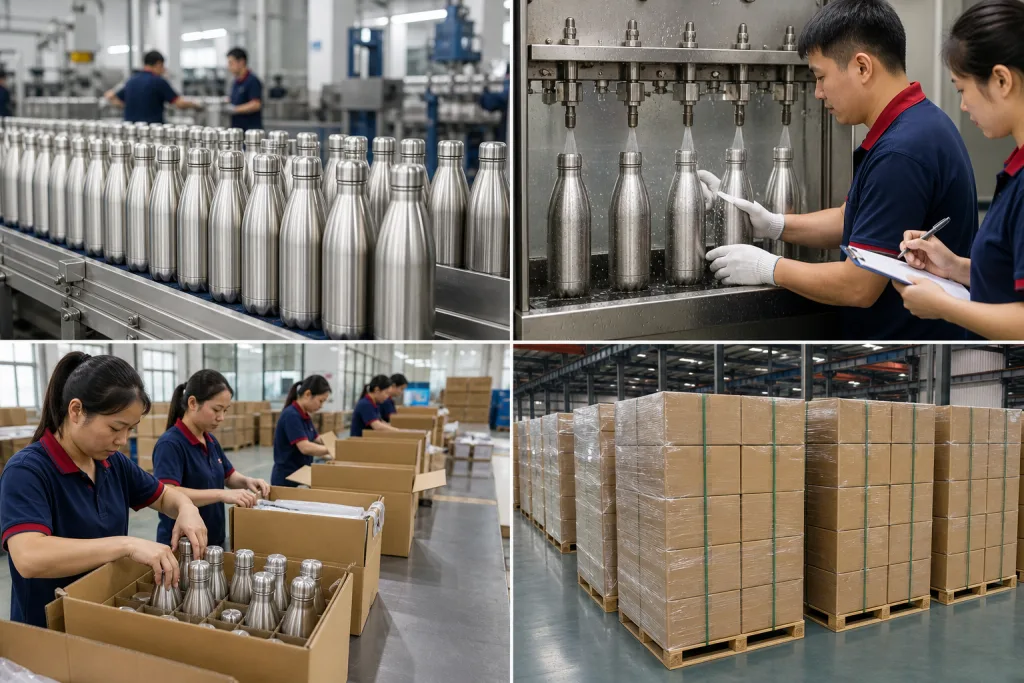
Packaging is the quiet cost driver buyers notice too late. A plain polybag and export carton may add USD 0.06-0.12 per unit. A printed color box can add USD 0.18-0.45. A kraft gift tube for a bulk growler or beer tumbler wholesale bulk line can add USD 0.60 or more. We check carton drop risk with a 12 kg packed carton on the floor before mass shipment, because crushed corners get charged back fast by retail accounts. If your retail price depends on shelf presentation, packaging belongs in the RFQ, not after price approval.
MOQ tiers buyers actually face
MOQ is not just a sales rule. It comes from paint line changeover, mold setup, printing fixture time, material purchase, and carton MOQ. At BottleForge Industrial in Hangzhou, Zhejiang, we run about 450,000 stainless drinkware units per month, but a 300 pc trial order still hits the same powder booth cleaning, jig setup, and incoming carton limits as a bigger run.
For stock models in running colors, 500-1,000 pcs can work, especially with simple laser engraving or one-color silkscreen. Good for testing. You can check wholesale drinkware demand without tying up cash in a full container. For custom powder coating, expect 3,000 pcs per color. The coating line needs a clean hopper, Pantone matching under a D65 light box, and sample approval before mass production; running 300 pcs in a unique Pantone makes the math ugly.
For new molds, the numbers change fast. A custom lid can require USD 1,200-4,500 tooling and 30-45 days just for mold build and trial. A custom bottle body for a bulk canteen or wholesale growler can run much higher, depending on shape, thread structure, and tooling cavities. We’ve seen this go sideways when a buyer wanted a new body at 800 pcs, then flagged the mold cost after the PO was typed. Most buyers start with an existing body and customize the cap, logo, color, and packaging. Less exciting, yes. Faster and safer.
- 500-1,000 pcs: stock color, stock lid, laser logo, plain carton; QC checks logo position with a 0.5 mm tolerance gauge.
- 3,000 pcs: custom color with one or two logo positions; retail box possible if the box supplier accepts the paperboard MOQ.
- 5,000-10,000 pcs: better FOB pricing, steadier 304 stainless buying, and cleaner FBA carton planning by SKU.
- 20,000 pcs and above: dedicated production slot, negotiated component pricing, and tighter QC control beside the line, not just at final inspection.
If you are sourcing canteen bulk, growler bulk, or beer tumbler in bulk across several SKUs, ask whether the factory can combine color batches or share carton components. This is the right question. We ship mixed-SKU programs more smoothly when the buyer accepts one master carton size, for example 58 x 39 x 32 cm, instead of forcing four small custom cartons that each miss the supplier MOQ.
Logo and finish change the math
Decoration is where 7 out of 10 messy purchase orders lose margin. Laser engraving stays durable and clean on 304 stainless steel, so we run it for corporate programs and premium drinkware bulk orders. Cost is often USD 0.08-0.25 per unit depending on logo size and position. No ink. The catch is fixture stability: if the curved cup jig shifts 0.5 mm on the rotary engraving machine, the logo looks drunk and QC pulls the sample.
Silkscreen printing is cheaper for simple one-color logos at volume, often USD 0.05-0.12 per position, but the math doesn't work for rough outdoor handling if the coating and curing are loose. Our line checks adhesion with 3M tape after oven curing, and weak ink shows up fast on matte powder coat. Heat transfer and water transfer work for full-wrap graphics, but buyers should expect higher reject rates, 12 days vs 18 days for sampling in some artwork cases, and a cost range of USD 0.35-1.20 per unit. For stainless vacuum bottles, powder coating usually beats spray paint on durability, but it adds cost and color-MOQ pressure.
For canteen wholesale and wholesale canteen projects, pay attention to strap rivets and screw-cap torque, not just the bottle body. A cheap strap connector can fail before the bottle body does; we have seen 18 kg pull tests snap the plastic loop while the canteen still looked perfect. For alcohol flask wholesale or alcohol flask wholesale bulk orders, the engraving area is small, so artwork must be simplified. Fine text below 1.2 mm height can fill in or look weak after polishing, and the buyer flagged this last month when a PO logo had a tiny “EST. 1998” line nobody could read.
Growlers and beer products need another check. A beer growler in bulk may use a swing-top, or it may use a screw cap with a silicone gasket measured at 2.5 mm. The lid decides leak risk and replacement cost. A beer tumbler bulk program may require a sliding lid, but sliding lids are not always leakproof. If your sales page says “leakproof,” your test standard should match that claim: filled bottle, inverted for 30 minutes, then side-drop testing from 80-100 cm.
Lead time from sample to vessel
A realistic timeline keeps your launch date honest. For existing models in China, sampling runs 5-10 days when you choose a standard color and laser logo. Custom color samples need 10-15 days because the coating team has to match the Pantone chip, cure the powder coating or spray finish, then check it again in a D65 light box. If you request new packaging, add 3-7 days for dieline, print proof and carton structure review; we have seen a 0.5 mm tuck-flap error stop a color box approval.
Mass production normally takes 25-45 days after deposit, final artwork and sample approval. Stock color wholesale drinkware or simple drinkware bulk orders during calm months sit closer to 25-30 days. Custom coating, 6 or more SKUs, retail packaging, bulk growler sets and orders near Chinese New Year move closer to 40-45 days. In Zhejiang and other China manufacturing regions, capacity tightens from late December through February. A buyer who confirms a PO on January 10 may not ship before March. We run into this every year: the buyer says “same as sample,” but the PO has one logo size typo, and the line waits while everyone rechecks the artwork.
Inspection and logistics need calendar space too. A third-party AQL inspection usually needs booking 3-5 days before completion, and the inspector will not wait if final cartons are still open on the packing table. If the order requires REACH, LFGB, FDA food-contact documentation or ASTM-related child product checks, testing can take 7-15 working days depending on the lab and test scope. Ocean freight booking may add 5-10 days before sailing, especially for LCL cargo. QC pulled one sample last month for a leaking lid gasket, and that single finding cost the buyer 4 extra days.
For a normal 5,000 pcs stainless bottle order with custom color and logo, plan 7-10 days for samples, 30-40 days for mass production, 2-3 days for inspection and 3-7 days for export handling before the container leaves port.
Air freight saves calendar days, but the math often does not work. A 750 ml vacuum bottle packed in color box may weigh 420-520 g. Sending 2,000 pcs by air can cost more than the product margin you were trying to protect, especially after dimensional weight is checked at the forwarder’s scale. Ask for the chargeable weight first.
Compliance is not optional paperwork
Procurement teams in Europe and North America should treat compliance as a cost line, not a favor from the supplier. The math is simple: if the lab report is missing, the shipment gets stuck. For stainless steel water bottles, we usually ask for food-contact material confirmation for 304 or 316 stainless steel, silicone seals, and plastic lid components. On our line, QC pulls the sealing-ring spec with a 0.2 mm gauge before packing starts. For EU markets, buyers often request LFGB or EU 1935/2004 related migration testing, plus REACH screening for coatings and accessories. For the US, FDA food-contact compliance is commonly requested.
Kids bottles need stricter handling. If the product is marketed to children, CPSIA, lead, and phthalate testing may apply. If the bottle includes a straw, small silicone plug, or decorative charm, check small-parts risk. We had a buyer flag a 4 mm charm hole on proof photos, and the sample was reworked the same day. ASTM standards can become relevant depending on category and claim. Calling it “general drinkware” when the carton says kids is the wrong question to ask.
For alcohol flask in bulk, beer growler wholesale, and beer tumbler wholesale programs, compliance is still about food contact, but the use case changes. Alcohol can react with some coatings, adhesives, and internal linings. If you sell a hip flask for spirits, ask for testing with alcohol simulants, not water only. QC pulled the sample off the leak rack after a 24-hour soak, and the coating haze showed up fast. For beer growler wholesale bulk, pressure is another concern. Most stainless growlers are not built for long-term carbonation pressure unless the design was made for that job.
Factory audits matter too. BSCI, Sedex, ISO 9001, or internal audit reports do not guarantee perfect goods, but they cut blind risk. Ask for the business license, export records, product test reports from the last 12 months, and photos or video of the actual production line in Zhejiang or another China facility. We run a 10-minute check at the packing bench and still ask for the machine number, because one PO typo can turn 304 into 316 on paper while the line is running the other grade. A trading office with no production access will struggle when defects appear at 18,000 pcs.
Inspection levels that catch real defects
Write AQL inspection into the purchase order before deposit. Do it early. We run common settings at AQL 2.5 for major defects and 4.0 for minor defects, while premium retail programs sometimes ask for 1.5/2.5. For drinkware, major defects are the ones that stop sale or trigger returns: leakage in the inverted water test, broken lid buttons, wrong material, poor vacuum performance, unsafe burrs, coating peel larger than the approved limit, incorrect logo placement, and barcode failure. Minor defects cover small dust spots under the clear coat, light scratches visible at 30 cm, slight color variation inside the signed color tolerance, and carton scuffing. Last month QC pulled the sample with a 0.4 mm burr on the mouth rim; the buyer was right to reject it.
Vacuum insulation testing needs its own line on the inspection sheet. A factory can test samples beside the line, but ask for random finished-goods testing after packing too. One practical method is filling the bottle with hot water at 95°C, measuring after 6 hours, then comparing the result with the signed standard. For a 500 ml mid-range vacuum bottle, a 6-hour temperature above 55-60°C is usually acceptable; premium programs often write a higher number into the spec. Put the number in writing. “Good insulation” is the wrong wording, because the math doesn't work when claims start.
For wholesale growler and beer growler bulk orders, test lid torque with a torque meter, check thread engagement by full turns, and run leakage after repeated opening. For beer tumbler in bulk, check lid fit across production lots, because a 0.2 mm shrinkage shift in plastic lids can make assemblies loose or too tight. For alcohol flask bulk orders, inspect welding seams under a light box, polishing marks around the shoulder, cap chain pull strength, and internal cleanliness with a white wipe test. A flask may look clean outside but fail because metallic dust or oil residue stays inside after polishing. We've seen this go sideways.
Carton testing is not glamorous, but it saves claims. Export cartons for North America often need to survive 5-ply corrugated handling, 12-18 kg gross weight and at least a basic drop test from 76 cm. If you are shipping to Amazon FBA, each carton needs the correct FNSKU or carton labels, readable barcodes and weight under the platform limit. Fix this at packing stage, not at the warehouse. One buyer flagged a PO typo where the carton mark said “24 pcs” but the approved packing was 25 pcs; that mistake costs 12 days vs 1 hour if QC catches it on the line.
How to compare supplier quotes
When three quotes arrive for the best wholesale water bottles, do not sort the file by FOB price and call it done. We run a comparison sheet line by line: capacity; net weight; steel grade; wall thickness; lid material; seal type; finish; logo method; packaging; MOQ; sample time; mass lead time; payment terms; testing included; inspection acceptance level. Small gaps matter. Last month a buyer picked the quote USD 0.18 lower, then QC pulled crushed inner boxes after the 1.2 m carton drop test. The “cheap” quote lost money once repacking and delay were counted.
Ask for the actual bottle weight. A 750 ml vacuum bottle at 260 g and another at 340 g are not the same product, even if the photos look close. We check this on a 0.1 g bench scale, then confirm wall thickness with a digital caliper. Thinner steel cuts cost, but it dents faster and feels light in hand. For mainstream stainless bottles, outer wall thickness sits around 0.4-0.5 mm, while inner wall sits around 0.3-0.4 mm depending on model. Do not over-specify thickness blindly; ask what the design needs to pass drop and vacuum tests. This is where we have seen quotes go sideways.
For mixed programs such as wholesale drinkware, wholesale canteen, wholesale growler, beer tumbler wholesale and alcohol flask wholesale in one shipment, confirm which items the supplier makes on its own line and which items come from a partner workshop. Subcontracting is normal in China. Uncontrolled subcontracting is the problem. We have seen one PO with “matte black” typed correctly for bottles, then “gloss black” typed on the flask line sheet. The buyer flagged it at pre-shipment. You need one signed quality standard and one accountable exporter.
The cleanest RFQ is short but specific: product type, capacity, material, target FOB price, order quantity, logo method, packaging, destination market, required certificates and target ship date. If you have a reference sample, send it. If not, ask for 2-3 existing models that fit your price band, then request photos of the lid seal, bottom weld and carton mark before samples are packed. Our sample room can usually prepare stock-color pieces in 3-5 days, while custom powder coating often needs 7-10 days. Good sourcing is not squeezing every cent; it is buying a bottle your customer reorders without complaints.
Send your bottle spec and target landed cost
We will check MOQ, FOB price, lead time and compliance route before you issue a purchase order.
Frequently asked questions
What is a realistic MOQ for custom wholesale water bottles?
For existing bottle models, 500-1,000 pcs is realistic if you accept stock color, stock lid and simple laser engraving. For custom powder coating, most factories in Zhejiang or elsewhere in China need about 3,000 pcs per color because coating line setup and color matching cost money. For new lid tooling, expect 3,000-5,000 pcs plus tooling fees. For a fully custom body, 10,000 pcs is a more practical starting point. If a supplier accepts 200 pcs with custom Pantone color at a very low price, check whether they are repainting stock goods or skipping proper curing.
How much should best wholesale water bottles cost FOB China?
A simple single-wall stainless bottle may cost USD 1.20-2.10 FOB at 5,000 pcs. A double-wall vacuum bottle usually ranges from USD 3.20-5.50 depending on capacity, lid and finish. A larger insulated growler or beer growler wholesale item can run USD 7.20-8.80, sometimes more with premium packaging. Plastic Tritan sports bottles may fall between USD 1.00-2.80. These ranges assume normal export cartons and standard logo work. Retail boxes, full-wrap printing, special coatings, replacement parts and lab testing all add cost.
Can I combine canteen bulk, growler bulk and tumblers in one order?
Yes, but treat it as a mixed production program, not one simple SKU. You can often combine canteen bulk, wholesale growler and beer tumbler bulk items in one shipment to save freight and simplify customs paperwork. MOQ still applies by model, color and decoration method. For example, one factory may accept 1,000 pcs per stock tumbler color but need 3,000 pcs for a custom coated growler. You also need a shared inspection plan, carton marks and packing list. Mixed LCL shipments are possible, but FCL becomes cleaner once volume reaches roughly 20-28 cbm.
How long does production take after I approve samples?
For stock models with standard colors, mass production can take 25-30 days after deposit and artwork approval. For custom color drinkware wholesale, plan 30-45 days. Add 7-10 days for sampling before that, or 10-15 days if you need color matching and retail packaging proof. Lab testing can add 7-15 working days, depending on REACH, LFGB, FDA or CPSIA scope. Around Chinese New Year, lead time can stretch by 20-35 days because China factories, subcontractors and logistics providers close at different times.
What quality checks matter most for drinkware bulk orders?
Leakage, vacuum performance, coating adhesion, logo accuracy, lid function and carton strength are the main checks. Use AQL 2.5 for major defects and 4.0 for minor defects unless your retail channel requires stricter levels. For vacuum bottles, test hot-water retention on random finished goods, such as 95°C water measured after 6 hours. For alcohol flask wholesale bulk, check internal cleanliness and cap sealing. For beer growler in bulk, verify lid torque and leakage after repeated opening. Barcode scanning and carton drop tests are also important if you ship to retail warehouses or Amazon FBA.