Key Takeaways
- For custom stainless orders, a practical MOQ is usually 1,000-3,000 units per color and 25-35 days production after sample approval
- Ask for 304 or 316 stainless steel, PP food-grade lids, REACH/LFGB/FDA documents, and AQL inspection terms before paying deposit
- Laser engraving is durable but slower; silk screen is cheaper for 1-3 colors and better for large front logos
- FOB Ningbo or Shanghai pricing should include carton specs, spare parts ratio, packing method, and defect standard, not only unit price
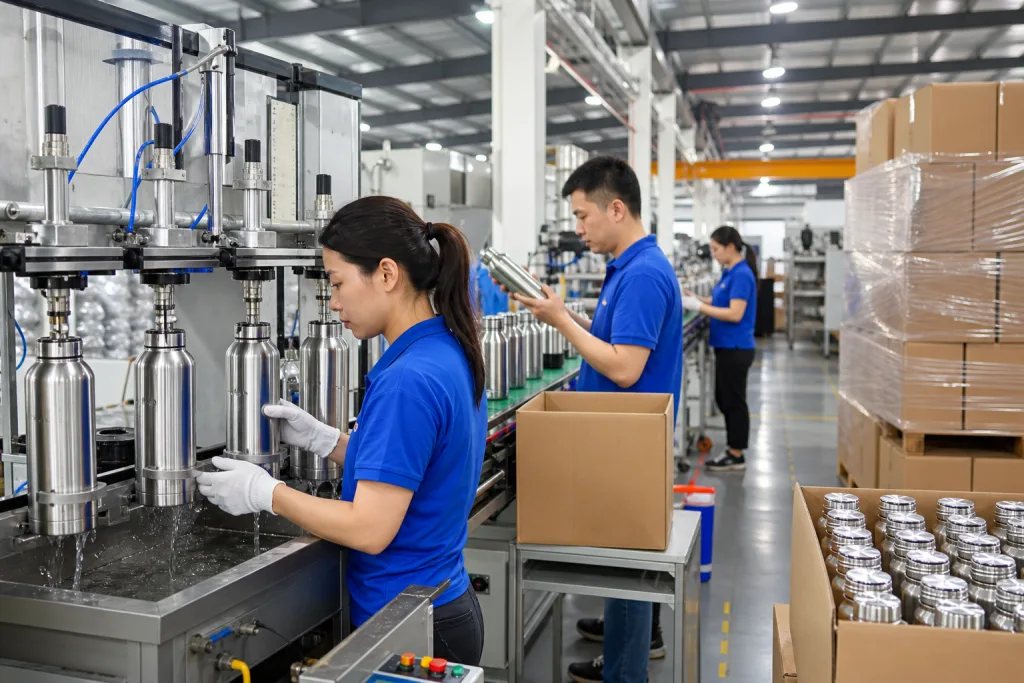
The cheapest bottle on a supplier page is usually the wrong question. The bottle you want is the one that clears your compliance file, holds a clean logo, and stays under 2.5% major defects when QC pulls the sample. On our line, we check cap torque at 0.6 N·m, and the buyer still asks why a USD 2.80 bottle can create chargebacks. Because it can. One weak print job, one leaky lid, and stock starts moving backward.
From our Zhejiang factory, we see the same pattern on stainless steel bottles, wholesale canteen orders, beer growler bulk runs, and alcohol flask wholesale quotes. Buyers want to know if 1,000, 5,000, or 20,000 units is safe to place. Fair question. The math changes with print method, lid style, and carton pack; a PO typo on "304" versus "201" has burned more time than any sales deck. Start with a sourcing checklist, not a slogan.
What makes a bottle worth buying?
A good buy starts with the use case. A gym brand, an outdoor canteen program, and a beer tumbler promotion should not be built from the same mold spec. Before asking for prices, write down the sales channel, target retail price, liquid type, expected service life, and decoration method; last month a buyer flagged a PO because “matte black” in the artwork file became “black powder” on the order sheet. Small typo. Big argument.
For stainless vacuum bottles, we normally suggest 304 stainless inside and outside for mainstream drinkware wholesale. If your customer base is premium outdoor or marine, 316 inner steel can be considered, but it often adds USD 0.20-0.60 per unit depending on size and wall thickness. The math does not work for every retail shelf. On the line, QC checks inner wall thickness with a digital caliper, and a 0.28 mm body will not feel the same as a 0.35 mm body after coating and vacuum testing. For plastic contact parts, ask for food-grade PP, silicone seals, and BPA-free test reports. For Europe, request LFGB or EU food contact documentation; for North America, FDA food contact and Prop 65 review may be needed.
The best wholesale drink bottle also needs predictable packing. A 32 oz stainless bottle may look profitable at USD 4.20 FOB, but an oversized color box can push the carton CBM up by 8-12%, which quietly kills margin after freight. We ship heavier drinkware bulk orders in 5-ply corrugated export cartons, and we run a carton drop test before mass packing. We have seen this go sideways: 1,200 cartons passed visual inspection, then corner crush showed up after the forwarder restacked the pallets.
Do not approve a bottle from photos. Approve it from a sealed sample, weight, wall thickness, lid torque, coating test, and carton specification.
MOQ, pricing, and lead time checks
Buyers asking for the best wholesale water bottle usually mean the safest mix of MOQ, unit price, and delivery risk. In Zhejiang, China, a realistic custom MOQ for stainless steel bottles is usually 1,000 pieces per design for simple logo work, 3,000 pieces per color for custom powder coating, and 5,000-10,000 pieces for private mold changes. At BottleForge Industrial, our regular output is about 450,000 units per month across bottles, tumblers, canteens, and growlers, but capacity still needs booking before peak season. We run coating lines on batch schedules; last April, one buyer wanted 6 matte colors at 1,000 pcs each, and the line changeover loss alone made the quote look wrong.
Indicative FOB China prices can range from USD 2.20-3.80 for basic single-wall sports bottles, USD 3.50-6.80 for 500-1,000 ml vacuum bottles, and USD 6.50-12.00 for larger bulk growler or beer growler wholesale styles. Alcohol flask bulk orders may sit around USD 1.20-3.50 depending on capacity, finish, and gift box. These numbers move with steel price, exchange rate, coating, lid complexity, and packaging. Small changes matter. A 0.5 mm thicker carton, a flip lid with silicone plug, or a PU leather gift box can shift the landed cost more than a buyer expects.
For repeat programs, negotiate price by annual volume instead of squeezing one trial PO until the math doesn't work. A supplier can protect quality better when you forecast 20,000 units over four shipments instead of demanding the lowest price on 2,000 units. Standard lead time is 7-10 days for pre-production samples and 25-35 days for mass production after deposit and artwork approval. Add 5-7 days if you need custom color matching, barcode labels, FNSKU labeling, or retailer carton marks. QC pulled one sample last season because the Pantone chip was marked 186C on the artwork but 185C on the PO; that typo cost 2 days before bulk powder approval.
Which product type fits your channel?
No single wholesale bottle wins across every channel. Segment the line before you compare FOB quotes. For corporate gift projects, we usually run a 500 ml or 750 ml vacuum bottle with powder coating and laser logo; on our line, a 0.18 mm logo depth is enough for a clean mark without cutting through the coating. For outdoor retailers, canteen wholesale styles with carry handles, wide mouths, and 2-coat powder coating move better because buyers can feel the grip and weight. For breweries and taprooms, beer growler in bulk or beer tumbler in bulk programs need different caps, insulation claims, and pressure warnings. The buyer once flagged “keeps beer fresh for 24 hours” on a carton proof, and he was right. That claim can go sideways.
- Bulk canteen and canteen bulk orders: fit outdoor, military-inspired, school, and camping channels. Check strap pull strength at 12 kg, cap tether thickness, and mouth diameter; QC pulled one sample last May where the strap rivet opened after 3 pulls.
- Growler wholesale and growler bulk orders: fit breweries, gift shops, and outdoor beverage brands. Ask whether the lid is for still drinks only or short-term carbonated beverage carry; the math does not work if a buyer expects a standard screw lid to act like a pressure-rated cap.
- Beer tumbler wholesale: usually 12 oz, 16 oz, or 20 oz with slide lids. For beer tumbler wholesale bulk, verify lid fit after 50 open-close cycles and test coating resistance after dishwasher-style washing, even if the final care label says hand wash.
- Alcohol flask wholesale bulk: usually smaller capacity and higher finish sensitivity. Mirror polish, matte coating, and leather wrap need separate QC checks; one PO typo changed matte black to “mate black,” and the line stopped until sales confirmed the finish code.
If you sell through online marketplaces, choose shapes that photograph well and pack tight. Simple sells. Tall bottles with fragile handles can create 18 complaint photos per 1,000 units, while a straight-wall bottle with a standard loop cap often stays under 6. If you supply retailers, confirm shelf height, hang tag hole size, inner carton quantity, and barcode placement before tooling or artwork starts; we usually ask for the planogram photo and a 30 mm barcode quiet zone before making the first sample.
Branding choices that do not fail
Decoration turns a good bottle into a bad purchase order fast. On our six-head screen line, silk screen is still the cleanest choice for 1-3 color logos and usually lands at USD 0.05-0.20 per position. Laser engraving holds up better through dishwashing and truck use, and it often adds USD 0.10-0.35 per unit, but the math changes with logo size, curve radius, and line speed.
If your artwork has gradients or photo detail, do not force it onto a curved bottle with basic screen printing. Use UV or heat transfer, then approve a physical decorated sample from the line. For custom Pantone coating, agree a tolerance before the spray booth runs. On 304 stainless, the same color can read 1-2 shades off under different light, and a powder coat is never as flat as a paper proof.
For canteen wholesale and beer growler wholesale bulk programs, watch logo position around curves, seams, and handles. A mark centered on a flat mockup can land 6-8 mm off once the body rolls under the jig. We want a pre-production sample with final logo size, final coating, final lid, and final packaging. A PDF proof helps, but it is not enough for alcohol flask wholesale or premium gift lines where the buyer flags every scratch.
Your purchase order should state decoration method, Pantone code, logo size in millimeters, acceptable placement tolerance, and whether minor pinholes or dust marks are accepted. If those points are missing, the argument starts after shipment. We have seen a PO say “logo as per artwork” and nothing else, then the buyer comes back over a 2 mm shift. Write it down. No guesswork.
Compliance and inspection questions to ask
Check compliance before you wire the deposit. Not later. For drinkware sold in Europe, ask for current REACH, LFGB, EU food contact, and packaging files, including the test report number and sample description. For the United States and Canada, ask for FDA food contact, ASTM where relevant for kids items, Prop 65 if selling into California, and CPSIA if the bottle is clearly for children. A China supplier should tell you which reports are still valid, which cover raw 304 stainless sheet or PP lid material only, and which must be renewed for your exact bottle, lid, straw, paint, and logo method. We have seen a buyer flag a report because the tested color was “black powder coating” while the PO said “Pantone 186C spray paint.” Fair pushback. The math doesn't work if you discover that gap after 3,000 pcs are packed.
Factory audits matter too. BSCI, Sedex, ISO 9001, or retailer-specific audits do not prove every bottle on the line is good, but they cut blind risk before you spend money on tooling and samples. If you are buying drinkware bulk for a national retailer, confirm audit status before sampling and ask for the audit expiry date, not just a logo on the profile page. Audit scheduling can take 2-6 weeks, and corrective actions can delay shipment; we have had a missing fire-extinguisher tag hold an order for 12 days. That feels small until the vessel cutoff is Friday. For retailer programs, we run this check before opening the color sample request.
Put inspection terms in the PO using AQL language. A common setup is AQL 2.5 for major defects and 4.0 for minor defects, with critical defects at 0. Critical defects include sharp edges, contamination, unsafe material, serious leakage, or wrong logo. Major defects may include poor vacuum performance, obvious dents over the agreed mm limit, coating peel after tape test, cap mismatch, or incorrect barcode. Minor defects include small cosmetic marks within agreed limits, such as one light scratch under 5 mm on the non-logo side. QC pulled the sample, not the salesperson. If the PO only says “good quality,” we’ve seen this go sideways because nobody knows whether a 2 mm paint dot is acceptable.
For vacuum bottles and beer growler bulk orders, request a leak test, vacuum retention test, coating adhesion test, and carton drop test. For alcohol flask in bulk, add smell check and inner cleanliness check, since oil residue near the welded seam is easier to catch before packing than after delivery. We usually keep one approved golden sample at the factory and one in the buyer’s office, both signed across the body and cap with date, order number, and color code. Simple control. During final inspection, match the production unit against that sample under the same light box, not under a random warehouse lamp.
Shipment planning and landed cost
FOB is only the first line. For a best wholesale water bottle order, we price unit cost, inner box, master carton, inland trucking, ocean or air freight, duty, customs clearance, warehouse handling, and a defect allowance. On our packing line, a 750 ml vacuum bottle often runs 24 pcs per master carton; a 64 oz wholesale growler may fit only 12. That gap hurts fast. The buyer who skips carton count is asking for trouble.
For North America and Europe, sea freight usually makes sense above 1,000-2,000 units unless the launch date is fixed. Air freight can cost more than the bottle itself on heavy stainless items. If you need seeding stock, split shipment works: 300-500 units by air, the balance by sea. Lock that plan before mass production, because carton marks and documents can change. We had one carton at 28 kg on the scale, and the forwarder pushed it back.
If you sell online, ask for FNSKU labeling, suffocation warnings on polybags where required, carton weight below warehouse limits, and no mixed SKUs unless your warehouse takes them. For distributors, ask for neutral export cartons and inner cartons sorted by color or SKU. For retail, confirm the color box, hang tag, instruction sheet, and country-of-origin mark. Products made in Zhejiang should show the destination-required origin mark, usually “Made in China” on the product or packaging. QC pulled the sample, and the buyer flagged a label that sat 3 mm over the seam.
Do not let the supplier pick packing just to shave the quote. Stronger cartons, foam for premium flasks, and clean SKU labels can add USD 0.08-0.40 per unit, and that is still cheaper than a crushed return. We switched one order to 5-ply cartons at 7.2 mm after a corner drop test split the box twice. This is the wrong question to ask: the quote looks lower, but the landed cost is higher.
Buyer checklist before paying deposit
Before you transfer the 30% deposit, the order file should be clear enough for another colleague to take over without calling you 6 times. That is the standard we use with experienced procurement teams. A product photo, unit price, and logo file is not enough. We’ve seen this go sideways when the PO says “blue bottle” but the approved sample is Pantone 299C with a matte powder coat, 0.3 mm logo tolerance, and a different lid gasket.
- Final product size, capacity, material grade, lid type, and finish confirmed, with drawings or sample notes if the shape is custom.
- MOQ, unit price, Incoterm, payment term, and production lead time written on the PI, not only in WhatsApp.
- Approved physical sample or clear sample plan with cost and timing, including who pays courier freight.
- Artwork file, logo method, Pantone color, and placement tolerance confirmed; AI, PDF, or CDR files should match the approved mockup.
- Compliance documents listed by market: REACH, LFGB, FDA, Prop 65, ASTM, or CPSIA as needed.
- AQL inspection level, defect definitions, and testing method agreed, including leak test, drop test, coating adhesion, or carton drop test where needed.
- Packaging structure, carton dimensions, gross weight, barcode, FNSKU, and shipping marks confirmed, with master carton layout checked before mass packing.
- Spare parts policy agreed, especially for lids, straws, seals, and handles; this is where small claims become expensive.
This checklist applies whether you are buying a simple wholesale canteen, beer growler wholesale, beer tumbler bulk, or alcohol flask wholesale line. The categories differ, but the risk pattern is the same: loose specs create mixed goods on the line. A reliable China supplier will not be offended by detailed questions. Good factories prefer them because they cut rework, claims, and awkward video calls after QC pulled the sample and the buyer flagged a logo 2 mm off center.
Send your bottle brief for a practical quote
Share capacity, material, logo, market, and target quantity. We will reply with MOQ, FOB price, lead time, and compliance notes.
Frequently asked questions
What MOQ should I expect for the best wholesale water bottle?
For standard stainless steel water bottles with your logo, expect 1,000 units as a practical starting MOQ. If you need custom powder coating by Pantone color, 3,000 units per color is more realistic. For private mold changes, custom lids, or unique bottle shapes, MOQ often moves to 5,000-10,000 units because tooling, setup, and line change costs are higher. Stock color drinkware wholesale orders can sometimes start lower, but you have less control over color consistency and long-term availability.
How do I compare quotes from different China suppliers?
Compare the full specification, not only FOB unit price. Ask each supplier for steel grade, capacity tolerance, wall thickness or weight, lid material, coating type, logo method, carton size, units per carton, compliance documents, sample lead time, and AQL standard. A USD 0.25 cheaper bottle can become more expensive if it uses lighter steel, weak cartons, or untested paint. For bulk drinkware, also compare production lead time and whether the quoted price includes color box, barcode, FNSKU labeling, or spare parts.
Can I use the same supplier for water bottles, growlers, and flasks?
Yes, but check category experience. A factory strong in vacuum bottles may also handle wholesale growler and beer tumbler wholesale orders, but alcohol flask bulk production has different polishing and cleanliness expectations. Ask for recent samples from each category, not just catalog images. If you plan one mixed program, confirm MOQ by SKU. A supplier may accept 1,000 water bottles but require 2,000-3,000 units for a special beer growler in bulk or alcohol flask wholesale bulk order.
What inspection tests should I require before shipment?
Use AQL inspection with critical defects at 0, major defects at 2.5, and minor defects at 4.0 unless your retailer requires stricter terms. For vacuum bottles, test leakage, heat retention, coating adhesion, logo position, cap fit, odor, and carton drop performance. For canteen bulk or growler wholesale orders, add handle strength and lid thread checks. For kids products, check sharp edges and applicable ASTM or CPSIA requirements. Inspection should happen when goods are 100% produced and at least 80% packed.
How long does a custom wholesale drinkware order take?
Plan 7-10 days for sample preparation after artwork confirmation, then 25-35 days for mass production after deposit and sample approval. Custom mold work can add 30-60 days depending on complexity. Sea freight to North America or Europe may add 25-45 days port-to-port, plus customs and inland delivery. If you have a fixed retail launch, build a schedule backward and leave at least 10 days for inspection, repacking, or document correction. Rushing drinkware bulk orders usually increases defect risk.