Key Takeaways
- Choose 304 stainless steel at 0.4-0.6 mm wall thickness for most retail and promotional thermos orders
- A realistic MOQ for a customized thermos is 1,000-3,000 pieces per color or logo design
- Plan 25-40 days for mass production after artwork and pre-production sample approval
- Use AQL 2.5/4.0 inspection plus 100% leak testing for vacuum flask orders
Buying the best wholesale vacuum flask is the wrong question if it starts with the shiniest trade show sample. For outdoor retailers and promotional brands, the real test is a 1.0 m drop on the QC bench, a logo that passes the 3M tape test, a ship date that holds at 12 days instead of slipping to 18, and landed cost that still leaves margin after freight, duty, and packaging.
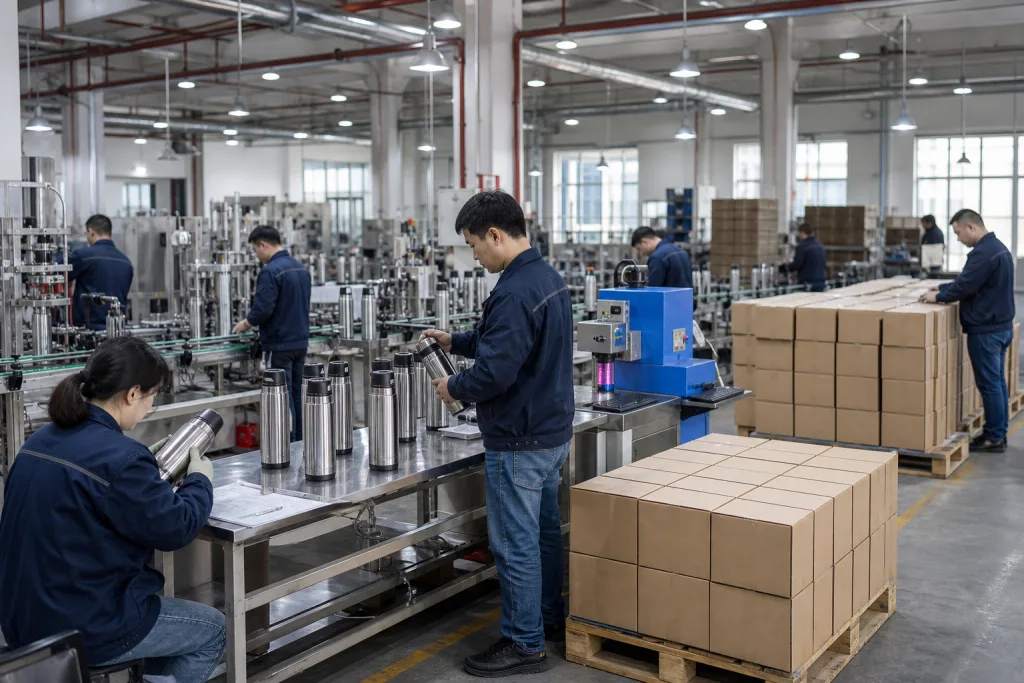
You need a custom thermos program that is boring in the right places: 304 stainless steel we can trace by coil batch, vacuum loss checked after 24 hours, logo position held within ±0.5 mm, and lead times from China we will put on the PI. BottleForge Industrial is based in Hangzhou, Zhejiang, and we run a bulk thermos order like an engineering job. Not a catalog sale. When the buyer flagged a 2 mm height difference on a pre-production sample, the line stopped before mass production, because the math does not work if 5,000 flasks need rework after packing.
Start With Four Buying Decisions
A clean buying spec starts before you ask for a quote. On the line, we see four choices decide the whole job: capacity, insulation target, branding method, and carton style. If those are loose, every thermos supplier will send a different FOB, and the cheapest one usually hides a thinner shell, a weaker vacuum, or a plain box nobody wants.
For outdoor retail, 500 ml, 750 ml, and 1,000 ml are the usual picks. A 500 ml flask fits a commute or a short hike. A 750 ml bottle feels bigger on shelf without getting awkward in the hand. A 1,000 ml factory thermos works for camping, job sites, and winter sports, but the carton weight jumps fast. We shipped a 1,000 ml sample at 1.08 kg packed, and the buyer flagged the freight quote the same day.
For promotion runs, 350 ml and 500 ml usually make more sense. They fit event handouts, gift boxes, and a lower unit budget. This is the wrong question to ask if you only chase insulation numbers. A corporate gifting order often cares more about logo space and box presentation than about keeping tea hot for a full shift. We had a PO with “5000 pcs” typed as “500 pcs”; QC pulled the sample count before the line started.
Next is insulation versus cost. A normal double-wall stainless vacuum flask should hold hot water above 60°C after 6 hours, tested from 95°C at room temperature. That is a fair target. Higher numbers are possible, but they need tighter vacuum control, copper lining or inner-wall treatment, and a lower reject rate. We run a vacuum leak check on each batch, and if the reading drifts, the whole lot gets held. Ask for the use case first. Don’t ask for “best performance” and call it a spec.
Packaging comes earlier than most buyers expect. A plain white box, retail color box, kraft gift box, and Amazon-ready carton are four different jobs. For Zhejiang export orders, the packaging file can delay production more than the bottle body. One buyer sent a die line with the flap size off by 3 mm, and the packing team had to stop the line for a day. Confirm the channel first, then send the correct artwork and carton spec to your thermos manufacturer.
Material Specs That Actually Matter
Most wholesale stainless thermos quotations say “304 stainless steel” and stop there. Too thin. For the inner liner, 304 stainless steel is the normal choice because it holds up better against tea, coffee, electrolyte drinks, and weak acidic liquids than cheaper 201 steel. For the outer shell, a few thermos factories switch to 201 to cut USD 0.20-0.45 per bottle, but we do not recommend it for outdoor retailers selling in Europe or North America. We have seen 201 outer shells show orange rust dots after a 24-hour salt spray check. Rust complaints kill repeat orders.
Ask your thermos factory for material declarations and, when needed, LFGB, FDA, or REACH supporting documents. For children’s or food-contact promotional channels, buyers may also request CPSIA-related documentation in the US. Not every order needs full lab testing, and this is where some buyers ask the wrong question: “Can you send all certificates?” is less useful than “Which certificate matches this market and this lid material?” On our side, QC pulled the sample file last month and found one PO typed “LFGB” while the artwork brief said “FDA,” which would have delayed shipment by 6 days if nobody caught it.
Wall thickness is another practical detail. For most customized thermos designs, 0.4 mm to 0.6 mm stainless steel is a good range. Below 0.4 mm, the bottle can dent during transit or retail handling, especially after a 90 cm carton drop test. Above 0.6 mm, the bottle feels premium but becomes heavier and costs more. If you are selling to outdoor retailers, a 30 g weight increase per piece may pass. If you are shipping a 10,000-piece promotional thermos order by air for a campaign deadline, the math hurts fast.
The lid is where cheap flasks fail. PP is common, but the gasket should be food-grade silicone and fitted with consistent compression. A lid that passes one hand-tight leak test in the sample room can still fail if the mold tolerance is loose by 0.2 mm. We run leak checks with warm water, inversion, and a 3-minute shake test because cold-water testing alone misses problems. For a manufacturer thermos project, ask whether the lid is from an existing tested mold or a new custom mold. Existing molds are safer for timelines; new molds give differentiation but add 20-35 days and tooling cost.
Surface finish also changes durability. Powder coating gives better grip and more color options, but it must pass cross-hatch adhesion and abrasion checks. Brushed stainless is durable and safe for conservative retail programs. Gloss painting looks bright on a shelf but shows scratches faster, and the buyer usually flags it after the first display sample rubs against a metal hook. A good supplier thermos quote should state finish, steel grade, capacity tolerance, carton size, and estimated gross weight. If those five lines are missing, we ask before sampling.
Insulation, Leakage, And Real Testing
The best wholesale vacuum flask should be judged by test data, not sales adjectives. “Keeps hot for 12 hours” is weak unless the test sheet shows starting temperature, room temperature, fill level, and pass point. We run a practical factory check with 95°C water, filled to the rated line, capped for 6 hours at 20°C to 25°C ambient temperature, then measured with a calibrated probe thermometer. For retail-grade flasks, we usually want above 60°C after 6 hours. For premium outdoor lines, 70°C or higher is possible, but the math does not work unless you accept a tighter vacuum process, slower output, and more rejected pieces on the line.
Cold retention is easier to print on a gift box than to standardize. Ice retention changes fast if the test uses 30% ice versus 70% ice, or if the cap is opened every 30 minutes for a “real use” check. For retailer packaging, avoid big claims unless you have lab data with the ice weight, water volume, ambient temperature, and opening cycle written down. Promotional brands should be stricter. We have seen this go sideways when an end user ignored the fine print and the buyer flagged the claim after delivery.
Leakage testing should be routine, not optional. At BottleForge Industrial in Hangzhou, Zhejiang, our normal stainless thermos production includes 100% leak testing before packing and AQL inspection before shipment. The line flips each filled bottle upside down for a set hold time, then QC checks the lid thread and silicone ring by hand before it enters the polybag. A common inspection plan is AQL 2.5 for major defects and 4.0 for minor defects, with critical defects set to zero. Critical defects include leaking, sharp edges, foreign material inside the bottle, and wrong food-contact material.
Vacuum failure is harder to see than a scratch. A failed vacuum flask may look perfect but lose heat fast. Factories use insulation tests, vacuum detection, or batch sampling depending on product class; for higher-value SKUs, QC pulled the sample from the finished carton, not from the repair table. If you are building a distributor thermos line that will sit in warehouses for months, ask for a retained sample from each production batch. It gives you evidence if complaints appear after delivery, especially when one carton number or one PO line has the problem.
For thermos bulk orders, also request transit testing on packaging. A 1,000 ml bottle in a retail box is heavy enough to crush weak dividers, and we have opened cartons where the top layer looked fine but the bottom tray had split corners. Drop tests from 60-80 cm on master cartons are common. If you ship to North America via ocean freight, humidity resistance matters too. Cartons should use export-grade corrugated board, usually 5-ply for heavier flasks, with the gross weight and carton size checked against the packing list before we ship.
Branding Choices And Their Limits
A custom thermos is bought for the logo first in 8 out of 10 RFQs we see, and the lid drawing comes later. Fair enough. But the branding method has to match the finish, MOQ, and how the bottle will be used after delivery. We run laser engraving, silk screen printing, heat transfer, water transfer, UV printing, and full powder coat color matching on the line, but not every logo belongs on every surface.
Laser engraving is the safest choice for outdoor retailers because it will not peel. On powder-coated bottles, the laser burns through the coating and shows the stainless base or a lighter underlayer. QC usually checks the edge with a 10x loupe because weak laser power leaves a brown shadow. The trade-off is simple: no fine gradients and no multi-color artwork. For a rugged manufacturer thermos line, laser is usually the cleanest answer.
Silk screen printing is cost-effective for one or two colors and works well for promotional thermos campaigns. It needs a flat or mildly curved print area; tapered bodies make registration drift, and the buyer flagged this on a 750 ml flask sample last month. For 1,000 pieces, screen setup is manageable. For 300 pieces, the math does not work because the screen charge makes the unit price look silly.
UV printing and heat transfer support richer color for lifestyle graphics, event artwork, or private-label retail packs. The risk is abrasion. If the flask will rub against rocks, tools, or bike cages, test the print with tape pull, alcohol wipe, and abrasion cycles before mass production. We had QC pulled the sample after 50 alcohol wipes once, and the red logo edge softened. A thermos custom project should always include artwork size, Pantone number, logo position, and tolerance. A normal logo placement tolerance is plus or minus 1.5-2.0 mm, depending on the surface.
Color matching has limits too. Powder coat colors can be matched to Pantone, but stainless substrate, coating thickness, and curing temperature change the final shade. For a customized thermos order over 3,000 pieces, a pre-production color chip is worth the extra few days; our coating room checks it under a D65 light box, not just office lighting. For small promotional runs, stock colors often save 7-10 days and reduce MOQ pressure.
MOQ, Pricing, And Production Reality
For most wholesale vacuum flask projects from China, MOQ comes down to how much you change from our running line. Stock shape, stock color, and a one-color logo can usually start at 1,000 pieces; we run these with a standard laser jig or silk-screen plate. If you ask for custom powder coating, printed retail box, and a new lid color, plan on 2,000-3,000 pieces per SKU. New body mold or lid mold is a different job, and MOQ can move above 5,000 pieces because the mold shop needs trial shots, fit checks, and at least one leak-test round before mass production.
Typical FOB Ningbo or Shanghai pricing for a 500 ml stainless vacuum flask sits around USD 3.20 to USD 6.50, depending on steel thickness, lid structure, surface finish, packaging, and testing requirements. For a 750 ml or 1,000 ml model, USD 5.50 to USD 9.50 is a normal planning range. Not a promise. Use these numbers to screen quotes that look too clean. If one thermos supplier is 25% cheaper than the other 4 factories you asked, the math does not work unless something changed: steel grade, wall thickness, coating powder, carton burst strength, or inspection level. QC pulled samples before where the buyer saved USD 0.18 per unit, then found thin cartons crushed at 13 kg gross weight.
BottleForge Industrial’s stainless drinkware capacity is about 450,000 units per month across thermos, tumbler, and bottle lines, with standard production lead time of 25-40 days after sample approval. Before Q4, peak season can add 10-15 days because coating booths and lid assembly stations get booked first. We ship faster when artwork, Pantone number, barcode, and carton mark are approved in one clean round; a typo on a PO for “matte balck” once held a retail order for 3 days. Outdoor retailers should lock specs earlier than promotional buyers because retail packaging, barcodes, and compliance files take time.
Payment terms change how a factory treats risk. The common setup is 30% deposit and 70% balance before shipment, or against copy of bill of lading for approved customers. For new thermos distributors, factories in Zhejiang and other China manufacturing regions usually ask for balance before release because custom goods are hard to resell. A flask printed with a German club logo and a custom RAL color is not going back into stock; we have seen this go sideways when the buyer changed the launch plan after final inspection.
When comparing thermos suppliers, ask for a quote sheet that separates product cost, logo cost, packaging cost, mold cost, sample cost, and inland freight. Bundled pricing hides choices. A serious thermos manufacturer will itemize it because it prevents arguments later, especially when the buyer flagged a 0.5 mm lid gap or asked why the retail box cost rose after adding a hang tag. This is the wrong question to ask: “What is your best price?” Ask what is included.
Packaging For Retail And Promotion
Packaging is not decoration; it is part of the product system. For outdoor retailers, the box has to protect the flask, explain the insulation claim, carry barcode data, and sit straight on the shelf. For promotional brands, we often build gift packs, event kits, or tight bulk cartons for lower freight. We have seen this go sideways: the bottle passed AQL 2.5, but QC pulled the sample because the E-flute color box crushed at the bottom corner after a 10 kg stack test.
Common options start with a plain white box for low-cost programs. A kraft box gives an outdoor look and avoids the glossy retail feel some buyers dislike. A printed color box works for retail, but the artwork needs CMYK control, barcode scanning, coating choice, and a 3 mm bleed checked before plate making. For premium customized thermos lines, magnetic gift boxes exist, but they add volume and shipping cost. Use them only when the retail price can carry the freight penalty; for a 500 ml flask, we have seen the carton cube jump by 22%.
Carton planning should happen before the final purchase order. A 500 ml flask may pack 24 pieces per master carton. A 1,000 ml flask may only pack 12 pieces due to weight and volume. Gross weight above 15-18 kg per carton can bring handling complaints in some distribution centers. This is not paperwork. If you sell online, inner box strength matters because single units go through parcel networks, and one buyer flagged dented lids after a 76 cm drop test with only a thin paper insert.
For North American e-commerce, you may need FNSKU labels, suffocation warnings on polybags, master carton labels, and drop-test packaging. For European retail, check language panels, recycling symbols, importer information, and country of origin marking before printing. “Made in China” is standard, but placement and size should be confirmed with your compliance team. We run barcode checks with a handheld scanner on the pre-production sample because one PO typo, a missing digit in the EAN, can delay packing by 2 days.
If sustainability is part of your brand, be precise. Recycled paper packaging, plastic-free inserts, and water-based inks are realistic. Claiming the entire vacuum flask is “eco-friendly” without material proof is risky. The math does not work if the lid uses PP, the gasket uses silicone, and the coating has no test report. Stainless steel is durable and recyclable, but coatings, lids, gaskets, and mixed materials still need honest description on the box copy and spec sheet.
How To Choose The Right Partner
The right thermos vendor is not always the factory quoting the lowest unit price. For outdoor retailers and promotional brands, the sharper question is: who can hold your spec on the third repeat order? One hand-polished sample proves little. A 20,000-piece run shows whether the line controls mouth diameter, powder coating thickness, carton strength, and vacuum retention without daily firefighting.
Ask whether the supplier is a trading company, a thermos factory, or a hybrid manufacturer using partner workshops. None of these is automatically bad. A trading company may fit a 6-SKU mixed gift set. A direct factory usually controls welding and vacuum testing better, but small mixed SKUs can slow the line. Transparency is the point. If you are buying a manufacturer thermos program, ask where the laser welding is done, which plant runs the vacuum ovens, who handles powder coating, and whether printing and packing stay under the same QC team.
Request photos or video of production steps, but do not treat a 30-second clip as proof. Ask better questions: What is your standard AQL 2.5 inspection plan? In a normal 10,000-piece batch, how many units fail the hot-water vacuum test? Do you keep 2 retained samples per color? Can you provide current BSCI audit status? Which port do you ship from, Ningbo or Shanghai? How many months do spare lids and silicone rings stay available? A capable thermos suppliers team answers with numbers, batch records, and test sheets, not brochure language.
Test communication before you place the order. Send a logo file with one unclear detail, such as a 0.25 mm line gap or a Pantone code missing from the artwork, and see whether the sales engineer catches it. Good China suppliers thermos teams stop the file before mass printing. Weak teams say yes in 6 minutes, then offer a discount after 3,000 crooked logos are already on the table. We have seen this go sideways.
For a first order, keep the design controlled: one capacity, one or two colors, one branding method, and standard packaging. Start with 1,000 to 3,000 pcs if your channel allows it, then add sizes, lids, or seasonal colors after sell-through data comes back. This protects cash flow and gives your thermos manufacturer a clean benchmark for leak rate, color difference, and carton drop-test results. The best wholesale vacuum flask program is built through controlled decisions, not one heroic purchase order.
Send Your Thermos Spec For A Practical Quote
Share capacity, logo method, quantity, and target market. Our Zhejiang team will return options with MOQ, FOB pricing, and lead time.
Frequently asked questions
What MOQ should I expect for a custom stainless thermos?
For a stock stainless thermos with one logo, expect 1,000 pieces as a practical MOQ. If you need custom powder coating, printed retail boxes, or a special lid color, 2,000-3,000 pieces per SKU is more realistic. New molds can require 5,000 pieces or more because tooling, trial runs, and material setup must be recovered. Some China factories will accept 500 pieces, but the unit price and logo setup cost are usually high. For outdoor retailers, we suggest starting with one 500 ml or 750 ml model, then expanding after sell-through data.
How long does a wholesale vacuum flask order take?
A normal customized thermos order takes 25-40 days for mass production after artwork, sample, and packaging approval. Pre-production samples usually need 7-12 days if using stock molds and colors. Custom coating, new color matching, or complex retail packaging can add another 7-15 days. Ocean freight to North America or Europe often takes 25-40 days port to port, not including customs and inland delivery. If your promotional campaign has a fixed event date, build the schedule backward and leave at least 10 days for inspection and shipping paperwork.
Is 304 stainless steel enough for outdoor retail products?
Yes, 304 stainless steel is the standard choice for most outdoor retail vacuum flasks, especially for the inner liner. It has good corrosion resistance for coffee, tea, water, and sports drinks when cleaned properly. For the outer shell, we still recommend 304 rather than 201 if the product will face wet outdoor use or long retail warranty expectations. Ask your supplier for material declarations and food-contact test reports such as FDA, LFGB, or REACH documentation when required. Also confirm wall thickness; 0.4-0.6 mm is a sensible range for durability and weight.
Which logo method is best for a promotional thermos?
For a promotional thermos, silk screen printing is usually the best balance of cost and appearance for one or two colors. It works well at 1,000 pieces and above. Laser engraving costs more in some cases, but it lasts longer and is excellent for powder-coated bottles used outdoors. UV printing or heat transfer is better for full-color artwork, but you should request abrasion and tape-pull tests before approving mass production. If the product is for a rugged outdoor retailer, choose durability first. If it is a short campaign giveaway, visual impact may matter more.
What quality checks should I require before shipment?
Require 100% leak testing, insulation sampling, visual inspection, logo placement checks, carton drop testing, and AQL inspection before shipment. A common AQL plan is 2.5 for major defects and 4.0 for minor defects, with critical defects set to zero. Critical defects include leaking, sharp metal edges, contamination inside the flask, wrong material, and unsafe lids. For large thermos bulk orders, ask the factory to retain samples from each batch and provide inspection photos. Third-party inspection is worthwhile for first orders above USD 10,000 or any retail launch with strict delivery penalties.