Key Takeaways
- A practical custom thermos MOQ is usually 1,000 pieces per size and color, with lower trial runs costing 12-25% more
- FOB China pricing for a 500-750 ml stainless thermos commonly ranges from USD 3.20-8.50 before premium packaging
- Laser engraving is slower but durable; silkscreen is cheaper for 1-color promotional thermos runs above 2,000 pieces
- Normal lead time is 25-45 days after sample approval, plus 25-38 days ocean freight to North America or Europe
The best wholesale thermos bottle is not the cheapest vacuum flask on a quote sheet. Cheap is expensive. For an outdoor retailer or promotional brand, the real question is total landed cost after decoration, carton drop testing, AQL inspection, freight, and a delivery date you can actually sell against. We run this check with a caliper and a drop tester, and the buyer usually flags the same issue: the unit price looked fine, the packed carton did not.
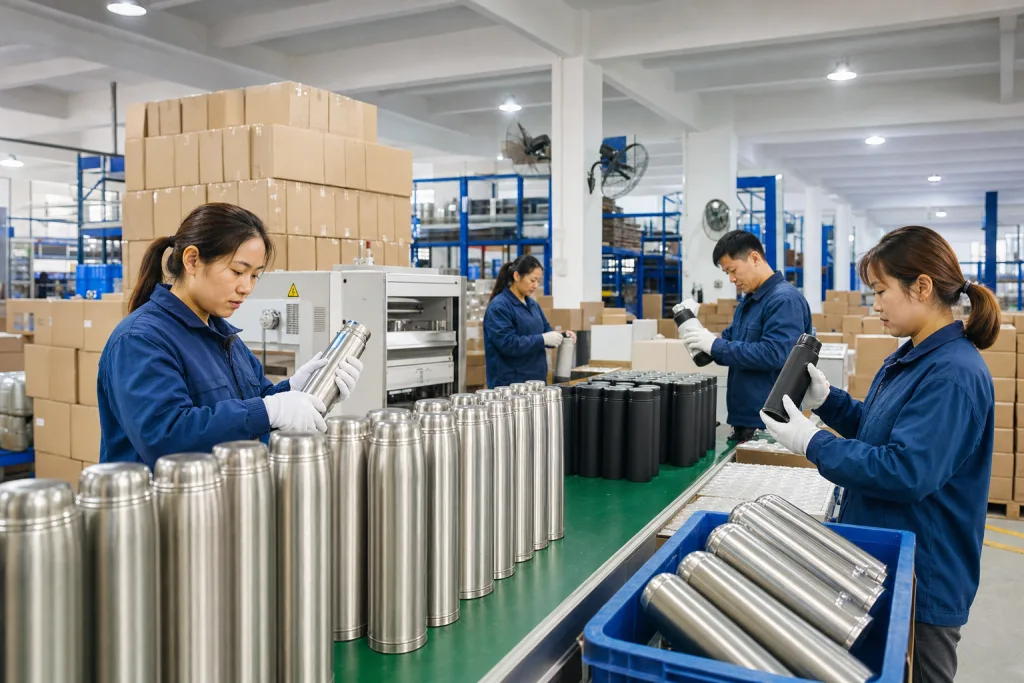
From our thermos line in Zhejiang, China, we see the same mistake every season. Buyers compare FOB only and skip tooling, packaging, logo method, sample rounds, and the production queue. On one PO, the carton mark was typed one line off, and QC pulled the sample before it reached packing. A realistic stainless thermos program usually starts at 1,000 pieces per SKU, with 25-45 days for mass production after artwork approval. The math does not work any other way.
What Wholesale Price Really Includes
Ask for the best wholesale thermos bottle and the quote should break out the bottle body, decoration, packaging, testing, and shipping terms. “All included” is where trouble starts; last month a buyer flagged a USD 0.18 barcode sticker charge because it was missing from the first PI.
For a standard 500 ml or 750 ml double-wall stainless thermos, the base FOB Ningbo or Shanghai price from a China thermos manufacturer often sits around USD 3.20-5.80 for simple models at 3,000 pieces. Premium models with copper lining, powder coating, carry handle lids, tea filters, or retail gift boxes can move into USD 6.00-8.50. Small 500-piece trial orders may add 12-25% because line setup, coating changeover, and carton printing are spread across fewer units; we run the same spray jig and heat-transfer fixture whether the order is 500 pieces or 5,000 pieces.
The metal matters. Common bodies use 304 stainless steel inside and 201 or 304 outside. For outdoor retail, we usually recommend 304 inner and 304 outer if the product will face dents, cold weather, and long shelf life expectations. Wall thickness typically runs 0.4-0.5 mm on the inner wall and 0.5-0.6 mm on the outer shell, checked with a digital thickness gauge before polishing. Going thinner saves cents, not reputations. We’ve seen this go sideways after drop tests left flat spots on a “cost-down” sample.
Ask whether the quote covers vacuum performance testing, lid leak testing, barcode labels, polybag, master carton, and spare parts. A serious thermos supplier will state these line by line, including AQL 2.5 inspection if that is your standard. Before comparing thermos suppliers, normalize every quote to the same specification; otherwise the math doesn’t work. QC pulled the sample, the PO said “white box,” and the buyer expected a 350 gsm color gift box. That gap is not free.
MOQ Tiers That Change Your Cost
MOQ is where custom thermos plans get real, or get expensive. We can run fewer units on a factory thermos line, but the math does not work below 1,000 pieces once powder booth cleaning, logo setup, and carton packing are counted. For most stainless vacuum bottles from Zhejiang, China, a sensible MOQ is 1,000 pieces per size, per color, per lid type. If you need three colors, expect 3,000 pieces, unless the thermos factory charges a color-change fee; last month QC pulled a sample batch because 0.3 mm of black overspray showed near the bottom seam.
Here is a realistic cost pattern for a 750 ml customized thermos with powder coating and one logo:
- 500 pieces: possible for a paid pilot, usually USD 5.80-7.20 FOB, limited color options, manual packaging; the line often packs these by hand with a tape gun and printed SKU labels.
- 1,000 pieces: normal entry MOQ, around USD 4.90-6.40 FOB depending on lid and finish; one lid mold change can add half a day if the silicone ring size is different.
- 3,000 pieces: better coating efficiency, around USD 4.40-5.90 FOB, easier to negotiate carton and insert printing; buyers start asking for drop-test photos from the 76 cm carton test here.
- 10,000 pieces: stronger material purchasing, around USD 4.05-5.50 FOB, better for distributor thermos programs; we ship this level in full pallet plans, not loose cartons stacked at the container door.
For promotional thermos buyers, thermos bulk orders are often split across 3 or 4 end clients. That can work, but do not cut the order into too many small logo runs. Ten logo versions across 2,000 units can slow production more than one 5,000-piece retail run, because each artwork change needs film, laser file setup, print alignment, and inspection. We have seen this go sideways when the buyer sent one PO with “navy blue” in the file name and “royal blue” in the logo sheet.
If a thermos vendor claims 100-piece MOQ at full custom color, retail box, and low price, read the quote twice. It is often stock goods with logo only, not a true customized thermos made to your specification. Ask for the Pantone code, box dieline, and pre-production sample photo beside a ruler; the buyer flagged it fast when a “custom” 750 ml bottle measured 72 mm in diameter while their shelf tray needed 68 mm.
Decoration Costs And Practical Limits
A custom thermos gets judged by the logo before anyone checks heat retention. On the line, a curved 500 ml body with a 58 mm shoulder and a powder coat always adds setup time. We had one PO where the buyer typed 56 mm, then sent artwork sized for 58 mm; QC pulled the sample and the badge sat off-center by 2 mm. That is how a cheap print turns into a rework fee.
For a one-color logo, silkscreen printing is the lowest-cost thermos custom method. We run 120T mesh on simple straight runs, and the math is clean: USD 0.08-0.20 per unit for a plain mark, plus a screen fee of USD 30-60 per color. It fits promotional thermos orders above 2,000 pieces when the logo stays small and the artwork has clean edges. The weak point is abrasion. This is the wrong question to ask if the bottle lives in a truck; a printed logo can scuff faster than the bottle body when it rides in backpacks, delivery vans, or trade-show crates.
Laser engraving usually costs USD 0.15-0.45 per unit, based on logo size and placement. Our 20W fiber laser handles side walls and lids, and on powder coating it cuts through the paint cleanly so the stainless shows through. QC likes it because there is no ink to flake, and the buyer stops pushing back after the first salt-spray test. For distributor thermos orders, the extra spend is easier to defend than a warranty claim later.
Full-wrap heat transfer, water decal, or UV printing turns a thermos customizable with complex artwork. These methods can add USD 0.50-1.50 per unit and usually need a higher MOQ, often 2,000-3,000 pieces. We also add 3-7 days for sample confirmation, because a wrap that looks fine on a flat PDF can drift 3 mm at the shoulder once it hits the rotary jig. We have seen this go sideways when the buyer skips final art checks and expects the line to fix the curve.
A good rule: if the bottle is for retail, pick the finish that survives handling. If it is a campaign giveaway, take the logo that prints fast and ships on time.
Sample, Tooling, And Approval Timeline
Lead time starts before mass production. We see 6 or 7 new buyers each month count only the production run, then ask why the shipment missed a trade show or launch date. For a manufacturer thermos project with logo, coating color, and retail box, we run 7-15 days for pre-production samples after artwork confirmation; QC pulled one sample last week because the logo was 1.8 mm lower than the approved AI file.
If you use an existing mold, tooling is not required. A custom lid, special handle, silicone boot, or new capacity shape means mold work. Simple plastic lid tooling may cost USD 800-2,500 and take 20-30 days. More complex stainless or multi-part molds can reach USD 3,000-8,000 and take 35-50 days. For a first order under 5,000 pieces, the math doesn't work unless the product will run as a steady SKU for at least 12-18 months; one buyer flagged this after paying for a handle mold, then reordered only 1,200 pieces.
Color approval takes its own slot on the line. Powder coating can be matched to Pantone, but metal surface, gloss level, and oven temperature change the final shade; our coating oven log showed 182°C on a matte black batch that looked different from the 190°C approved sample. A lab dip or coated sample takes 5-7 days. For strict retail brands, approve a physical sample, not only a photo. Camera lighting lies.
Packaging approval causes more delay than buyers expect. If you need an EAN, UPC, FNSKU, suffocation warning, French or German text, recycling marks, or country-of-origin statement, send them before sample packing. Our Zhejiang facility can output about 450,000 stainless drinkware units per month, but even that capacity cannot fix missing artwork two days before the planned production slot; we once held 36 cartons because the PO had “Made in Chine” on the color box file.
Mass Production And Inspection Windows
Once the pre-production sample is signed, mass production for a bulk thermos order usually runs 25-45 days. Existing molds, standard colors, one-position laser logo, and stocked 304 stainless steel sit near 25 days. Peak season, 4 colorways, flip lids with silicone parts, retail boxes, or thermos customized artwork push the schedule toward 45 days. We check this at the line-planning board before taking the deposit, because “same as last order” on the PO has gone sideways when the buyer meant a different lid.
A typical production flow is stainless tube cutting, forming, welding, vacuuming, copper coating if specified, polishing, powder coating or painting, logo decoration, assembly, leak testing, packing, and final inspection. The vacuum station is where the risk hides. You cannot see vacuum failure from the outside, so every bottle should pass hot water or vacuum performance checks, and QC should pull random samples for heat retention testing. A common performance target for a 500 ml bottle is 60°C or above after 12 hours, depending on starting temperature and room conditions. On our floor, QC uses a calibrated thermometer and records the room temperature; if the test starts at 95°C in a 23°C room, the result means something.
For inspection, most North American and European buyers use AQL. A common setting is AQL 2.5 for major defects and 4.0 for minor defects, with critical defects at 0. Critical defects include leakage, sharp edges, contaminated interior, broken lid function, or incorrect material contact surface. Minor defects include small paint specks, light scratches, or carton scuffs within agreed limits. Be careful with “minor.” The buyer may accept a 0.3 mm paint dot on the base, but not on the front face beside a printed logo.
If your thermos distributor order is time-sensitive, book inspection 3-5 days before the cargo-ready date. Do not inspect after the container is waiting at the warehouse gate. That is the wrong question to ask the factory. At that point the loading team, warehouse space, and truck booking are already tied up, and the math does not work if QC pulls 80 cartons for rework while storage charges start ticking.
Freight, Duties, And Landed Cost
FOB price is only half the cost story. The best wholesale thermos bottle for your margin is the one with a landed cost you can quote without guessing. Stainless thermos bottles are bulky, not heavy for their size, so carton CBM and pallet height move the freight bill more than 6-8 kg of steel ever will. We check this on the line with a tape measure before we issue the packing data.
A 500 ml bottle in a color box may pack 24 pieces per master carton, with a carton around 52 x 35 x 28 cm and gross weight around 9-12 kg. A 40HQ container may carry roughly 45,000-65,000 units depending on bottle shape and packaging. For smaller orders, LCL freight can look cheap on the first quote, then CFS, document, and truck charges at destination eat the saving. We saw one buyer flag a USD 380 local charge on a 12-carton trial order; the math did not work. Ask your forwarder for total DDP, or at least a port-to-door estimate with destination fees shown line by line.
Ocean freight from China to the US West Coast commonly takes 18-25 days port to port, then 5-12 days for clearance and inland delivery. To the US East Coast, allow 30-40 days. To major European ports, 28-38 days is common. Air freight works for an urgent promotional thermos launch, but it can add USD 1.50-4.00 per bottle, sometimes more than your logo print and color box combined. We've seen this go sideways when the PO says “must arrive before 6/10” but the artwork approval lands 9 days late. Rush freight does not fix late decisions.
Duties depend on destination HS code classification and trade rules at the time of import. Your thermos supplier should provide HS code, material declaration, packing list, commercial invoice, and test reports when needed. For EU buyers, check LFGB, REACH, and food-contact requirements. For US buyers, check FDA food-contact expectations and any applicable state rules. QC pulled a sample last month because the outer carton mark showed the wrong country abbreviation; small typo, big customs headache.
Choosing A Factory Partner
A good thermos manufacturer is not just the lowest quote on Monday morning. You need a factory that controls 304 stainless material, vacuum performance, coating adhesion, logo registration, and export paperwork without guessing. For outdoor retail and promotional brands, the safer choice is often a specialist manufacturers thermos partner, not a trading desk that cannot explain why one 500 ml sample holds 78°C after 6 hours and another drops to 63°C.
Ask for BSCI or social audit status if your retailers require it. Ask whether the factory has ISO 9001 process control, whether the bottle can pass LFGB or FDA food-contact testing, and whether coatings can meet REACH limits. Then ask for recent production photos from a similar customized thermos order, not catalog renderings. We run this check because buyers have flagged the same issue before: the sample looked fine, but bulk powder coating failed the 3M tape test around the logo edge.
The wording matters when you source. “Thermos manufacturers,” “thermos suppliers,” “thermos distributor,” and “thermos vendor” get mixed together online. Some are real factories, some are exporters, and some are brokers. Working through an export company is fine if they solve problems; the wrong question is whether they have the cheapest PDF quote. Ask who controls the line, who signs the pre-shipment report, and who pays if 3% of lids leak during AQL 2.5 inspection.
From our base in Hangzhou, Zhejiang, we prefer to quote with a written specification sheet: capacity, steel grade, wall thickness, lid material, coating, logo process, packaging, carton drop-test requirement, AQL level, MOQ, lead time, and FOB port. It takes 1 extra day at the start and often saves 7 days of argument before mass production. We ship cleaner this way. That is usually how you get the best wholesale thermos bottle, not by squeezing another USD 0.06 from an offer that forgot carton size, inner box paper weight, or the typo on the PO.
Get a thermos quote built for your timeline
Send capacity, color, logo, packaging, MOQ, and delivery country. We will return a practical FOB quote with lead-time risks flagged.
Frequently asked questions
What is a realistic MOQ for a custom stainless thermos?
For a true custom thermos with your color, logo, and retail packaging, 1,000 pieces per SKU is the practical starting point. Below that, many factories can only offer stock colors with logo decoration. At 500 pieces, expect a 12-25% higher unit price because powder coating, logo setup, carton printing, and inspection costs are spread across fewer bottles. For better pricing, 3,000 pieces per size and color is a more efficient MOQ. If you need three colors, plan around 3,000 total only if the factory agrees to split the coating run; otherwise it may be 1,000 pieces per color.
How long does a bulk thermos order take from artwork to delivery?
For an existing stainless thermos model, allow 7-15 days for sampling and 25-45 days for mass production after sample approval. Ocean freight then adds about 18-25 days to the US West Coast, 30-40 days to the US East Coast, and 28-38 days to major European ports. A safe calendar for a retail launch is 75-105 days from final artwork to warehouse receipt. If you need custom tooling, add 20-50 days before sampling. Air freight can save time but may add USD 1.50-4.00 per bottle.
Which logo method is best for outdoor retail thermos bottles?
For outdoor retail, laser engraving is usually the safest choice because it is permanent and resists scratching better than ink. Expect USD 0.15-0.45 per unit depending on logo size and placement. Silkscreen printing is cheaper, often USD 0.08-0.20 per unit plus screen fees, and works well for one-color promotional thermos orders. If your artwork needs full color or a wraparound design, heat transfer or UV printing can work, but budget USD 0.50-1.50 per unit and add 3-7 days for approval samples.
What tests should I require before shipping?
At minimum, require leak testing, vacuum performance checks, visual inspection, lid function testing, and carton drop testing. For formal inspection, many buyers use AQL 2.5 for major defects and 4.0 for minor defects, with critical defects at 0. Critical defects include leakage, sharp metal edges, dirty interiors, wrong material, or broken lids. For Europe, request LFGB and REACH-related documentation when applicable. For the United States, ask for food-contact material declarations. Always confirm inspection criteria before production starts, not after goods are packed.
How do I compare thermos supplier quotes fairly?
Put every quote into the same format: capacity, steel grade, inner and outer wall thickness, coating, lid material, logo method, packaging, MOQ, sample time, production lead time, FOB port, and testing included. A USD 4.60 quote may be more expensive than a USD 4.90 quote if it excludes color box printing, laser engraving, or inspection. Also check whether the supplier is quoting 201 outer steel or full 304 stainless. For outdoor retailers, saving USD 0.20 on a lower-grade body can create warranty problems later.