Key Takeaways
- 304 stainless is the default sweet spot; 316 usually adds 12-20% to unit cost
- A 500ml double-wall bottle often lands at USD 2.20-4.80 FOB at 3,000 pcs depending on finish and lid
- Typical MOQ for custom stainless bottles starts at 1,000-3,000 pcs per SKU in Zhejiang
- Expect 25-35 days production after sample approval, with AQL 2.5 as the practical QC baseline
Buying the best wholesale stainless steel water bottle is not about choosing the prettiest sample. It is a spec stack: steel grade, wall build, cap design, coating, compliance, carton pack, and how many units you can move before the season flips. If you source from China or Zhejiang, the gap between a clean run and an expensive one usually sits in the small print, not the catalog photo.
For procurement managers and brand owners, the right call depends on use case. A 500ml sports bottle for retail, a 750ml commuter bottle for corporate gifting, and a 64oz growler-style bottle for hospitality each hit price, freight, and margin differently. At BottleForge Industrial in Hangzhou, Zhejiang, we run a 120,000 units/month line, and the numbers drive the deal: MOQ, 25-35 day lead time, FOB control, and whether the bottle clears REACH, food-contact, and AQL 2.5 without QC pulling the sample twice.
Compare specs before you compare prices
If you want the best wholesale stainless steel water bottle, start with a side-by-side spec table. We run quotes that way because buyers who chase the lowest unit price first usually pay later in freight, rejects, or customer complaints. The comparison is not bottle vs bottle; it is wall construction, steel grade, capacity, lid type, and coating method. That is what decides whether the bottle fits retail, corporate gifting, outdoor use, or a subscription box.
Here is the kind of table you should ask your supplier to build during sourcing:
- 304 single-wall: lighter, lower cost, good for casual hydration and better carton density on the line
- 304 double-wall vacuum: the workhorse for premium wholesale drinkware and temperature retention; QC pulled the sample at 12 hours and it still held the spec
- 316 double-wall vacuum: stronger corrosion resistance for salty, acidic, or marine environments
- Powder coat: better grip, better branding durability, usually adds USD 0.18-0.45; we have seen buyers flag a gloss finish as too slippery
- Lid options: screw lid, sport lid, straw lid, chug lid, or stainless cap with silicone seal
When you compare these options properly, the cheapest bottle is often the wrong one. A gym chain order might need a matte powder-coated 750ml bottle with a leakproof sports lid. A promo giveaway might work better as a lightweight 500ml single-wall item. If a buyer wants wholesale drinkware that feels premium and still hits margin, vacuum insulation is the safer bet than decorative extras; the math does not work otherwise.
Use-case fit beats one-size-fits-all
The best wholesale stainless steel water bottle is the one that fits the channel. You are not buying a generic cylinder; you are buying a sales tool. A DTC brand, a supermarket program, and a corporate gift order all run on different math. In Zhejiang, we see buyers spec a 1L giveaway like a retail hero piece, then wonder why the margin disappears. The line tells the truth fast.
Retail outdoor bottle: 750ml to 1L, double-wall vacuum, 304 steel, laser logo or one-color silk print, target FOB USD 2.80-5.60 at 3,000 pcs.
Corporate bottle: 500ml to 750ml, clean silhouette, matte coating, gift box, lower decoration risk, target FOB USD 2.40-4.90.
Fitness bottle: 650ml to 800ml, sport lid or carry loop, sweat-free exterior, easy one-hand use.
Travel bottle: slimmer body for cup holders, tighter lid tolerance, more focus on leak performance than decoration.
That is why terms like best wholesale drink bottle or wholesale drinkware only mean something after you name the channel. A school canteen, a camp order, and a premium merch bottle are different jobs. If you need canteen wholesale or wholesale canteen supply, ask whether the factory can hold neck finish within 0.2 mm, keep cap torque stable, and keep coating thickness even across multiple SKUs. We’ve seen this go sideways when the PO says “matte black” and nothing else. China has enough factories. Spec control is the real issue.
Stainless grades and wall build
Steel grade is where buyers waste time. For most bulk drinkware programs, 304 stainless is the baseline. It gives solid corrosion resistance, broad food-contact acceptance, and a cost structure that still leaves room for margin. We have seen buyers push for 201 on the first sample, then the line starts showing rust spots after salt-spray testing. If the bottle will sit in salty air, acidic drinks, or harsher wash cycles, 316 earns its keep, but only when the end customer will pay for that upgrade.
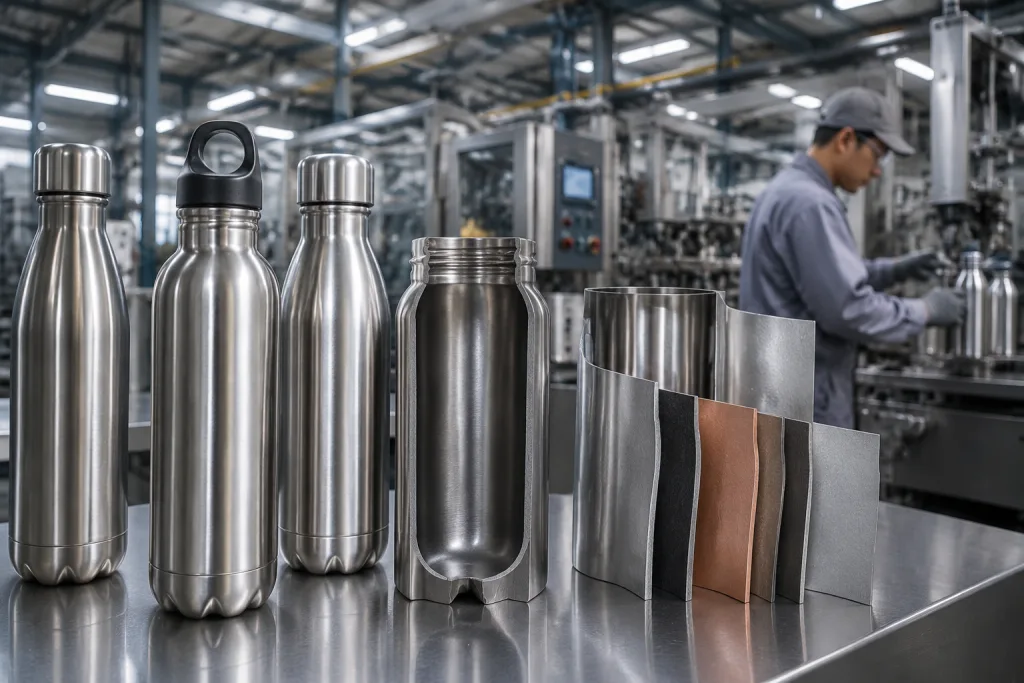
Wall build matters just as much. Single-wall bottles are cheaper and lighter, but they do not hold temperature and they feel thin in hand. Double-wall vacuum construction is the common pick for wholesale drinkware in Europe and North America because it lifts perceived value and protects margin. A typical vacuum bottle uses inner and outer 304 shells with a 0.4-0.5 mm wall thickness per shell, then a sealed vacuum gap. That spec keeps weight under control for shipping. We run a gauge check on the line; if the wall drifts by 0.05 mm, QC pulls the sample and rechecks the tube lot.
Ask your supplier for material declarations, coating specs, and a cross-section photo of the weld and vacuum seam. If they cannot answer cleanly, you are not comparing factories; you are comparing guesses.
For brand owners, the question is not “stainless or not.” It is whether the steel, weld quality, and finish can survive 12 months of returns and reviews. We have seen this go sideways when a PO typo called for a matte powder coat on a mirror-polished bottle, and the buyer flagged it only after first cartons landed. That is the line between a one-time order and repeat wholesale canteen or growler wholesale business.
Closures, lids, and leak risk
The lid decides whether a bottle ships clean or comes back as complaints. Two bottles can share the same body and still behave differently once you change the cap shape, gasket groove, or torque window. For B2B sourcing, the lid is part of the spec sheet, not an add-on.
Common options include:
- Screw cap: lower risk, simpler tooling, good for general wholesale drinkware
- Sport cap: easier for retail shelves, but test the straw path and flip hinge
- Chug lid: common in outdoor and fitness channels, leak risk rises when tolerances drift by 0.2 mm
- Stainless lid with silicone seal: premium look, often chosen for higher-margin programs
If you are sourcing beer growler bulk, beer growler in bulk, or beer growler wholesale bulk, sealing matters more because carbonation, pressure, and cold storage change the failure point. Same story for bulk growler programs in hospitality. We run inversion checks, drop tests, and 50 open-close cycles on the line; if QC pulled the sample and it leaked on cycle 30, the math does not work.
Alcohol flask bulk and alcohol flask wholesale bulk orders follow a different logic. These are slimmer, style-led, and often sold as lifestyle pieces rather than utility stock. They still need a tight closure and a clean internal finish, or the buyer flags it before the first carton leaves the dock.
Decoration changes your margin
Decoration is where sourcing teams lose margin fast. The bottle looks simple on paper, but the branding method changes scrap rate, cycle time, and how many colorways we can run on one line. For stainless steel bottles, the usual picks are silk screen printing, laser engraving, heat transfer, and full-body powder coat with logo knockouts.
Laser engraving stays clean and holds up well on premium wholesale drinkware. Silk screen costs less and works for one-color or two-color art. Powder coating gives a stronger retail shelf look, but the reject rate climbs if coating thickness drifts. We keep powder coat at 60-90 microns; below that the finish looks thin, and above that the edges and threads chip faster. QC pulled the sample on a 2 mm thread lip before, and the buyer flagged it the same day.
For buyers comparing bulk drinkware across more than one channel, decoration has to match sell-through speed. A simple logo often beats a busy print. If you need beer tumbler bulk or beer tumbler wholesale bulk for events and tapside programs, keep the mark readable at 1 meter, not just under studio lights. The same goes for growler bulk orders: one bold mark on a clean body sells better than a crowded layout. That is the right question to ask.
In Zhejiang, we run multi-process branding all the time, but every extra step adds clock time. Spot color print, gradient coating, and retail gift packaging in one order can push a ship date by 5-7 days if the PO changes mid-run. One PO typo on carton count once turned a 3,000-piece job into a hold at packing. If you want a fast program, choose one finish, one logo method, one carton spec.
Compliance and QC are not optional
For Europe and North America, compliance is a PO condition, not a selling point. We ship into those markets with food-contact declarations, REACH files, and test reports that map to FDA-style requirements where they apply. If the buyer sells on Amazon, through retail chains, or via distributors, ask for batch traceability and carton marks, not a PDF with no lot number.
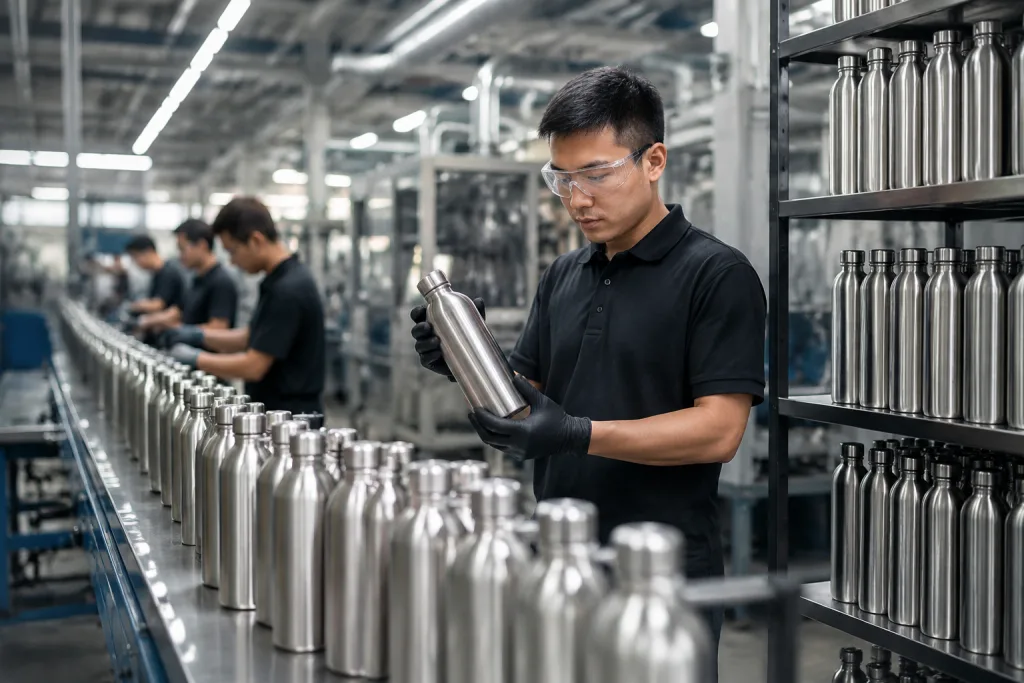
QC on a stainless bottle line starts with AQL 2.5 for major defects and AQL 4.0 for minor defects. That is the baseline we run. Check the samples for:
- Vacuum retention and temperature hold
- Leakage under inversion and pressure
- Coating adhesion and scratch resistance
- Thread smoothness and cap torque consistency
- Odor, residue, and surface contamination
When buyers ask for alcohol flask wholesale or alcohol flask wholesale bulk, the compliance file gets stricter fast because the product often lands in gift, travel, or lifestyle channels. We’ve seen this go sideways when a PO typo changed the carton mark and the buyer flagged it at receiving. The safe play is pre-shipment inspection, carton drop tests, and a signed golden sample. If a factory in China or Zhejiang pushes back on those three items, the order math does not work.
Send your spec, get a real quote fast
We price by material, lid, coating, and packing. If you want a clean wholesale offer from Zhejiang, send your target channel and quantity.
Frequently asked questions
What is a realistic MOQ for a custom stainless steel bottle order?
For most custom stainless steel water bottle programs, realistic MOQ starts at 1,000 to 3,000 pieces per SKU. If you want multiple colors, engraved logos, or mixed lids, expect the MOQ to rise because each variation eats production time. For standard 500ml or 750ml vacuum bottles from Zhejiang, many factories can quote a 2,000-piece base with a 25-35 day lead time after sample approval. Smaller trial runs are possible, but unit cost usually rises 10-25%.
How much should I budget for FOB pricing?
For a standard 304 stainless vacuum bottle, budget roughly USD 2.20-4.80 FOB at 3,000 pieces, depending on size, coating, lid type, and logo method. A 316 upgrade, premium gift box, or complex decoration can add USD 0.30-1.20 per unit. If you are comparing drinkware wholesale quotes, make sure the quote includes inner packaging, master carton details, and the same testing standard. Otherwise you are not comparing real landed costs.
Which is better: 304 or 316 stainless steel?
For most wholesale drinkware, 304 is the right choice because it balances cost, food safety, and availability. Choose 316 only if the bottle will face acidic drinks, salty environments, or higher corrosion risk, and if your target price can absorb the 12-20% cost increase. For bulk canteen and canteen wholesale programs, 304 is usually enough. For marine, camping, or premium lifestyle lines, 316 can be justified if the customer sees value in the upgrade.
How do I reduce leak complaints on bulk orders?
Start with a lid spec that has a proven seal design, then require cap torque testing, inversion testing, and repeated open-close cycle testing. Ask the factory to submit a golden sample and lock the gasket material, because changing the silicone can change leak behavior. For beer growler wholesale bulk or growler bulk programs, add pressure and cold-chain checks. AQL inspection alone does not replace functional testing; you need both.
Can one factory handle stainless bottles and other drinkware types?
Yes, many Zhejiang factories run multiple drinkware categories, but you should verify separate tooling, process control, and packing lines. A factory that produces canteen bulk, bulk growler, beer tumbler bulk, and stainless bottles may still be strong if it has clear line separation and monthly output above 100,000 units. The key is not product variety; it is whether the plant can hold the same finish quality across different molds and lids without mixing specs.