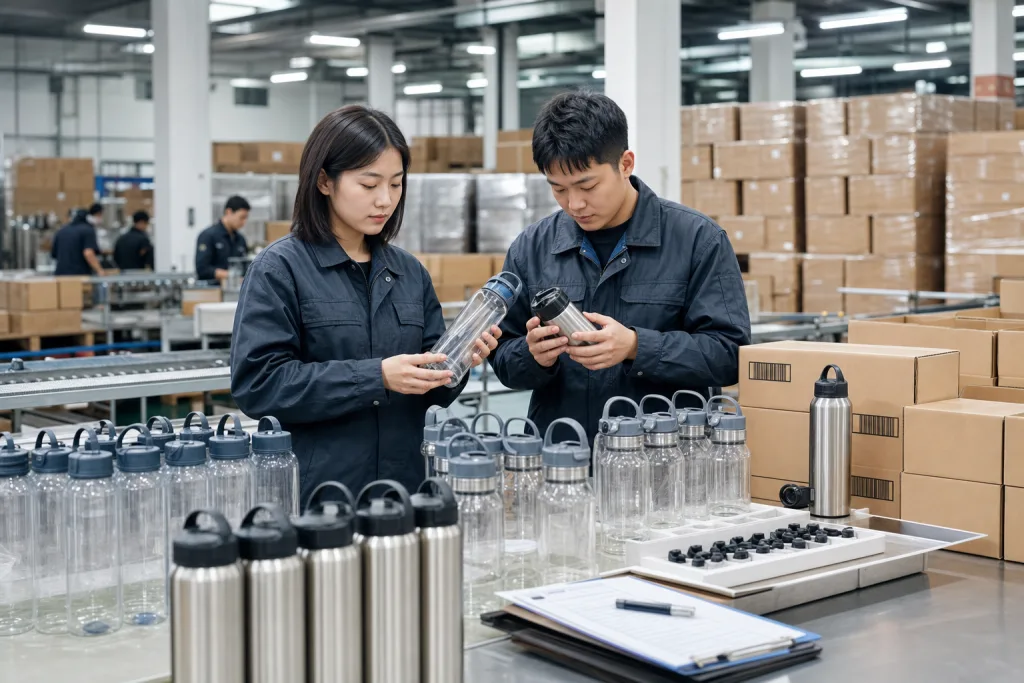
Key Takeaways
- A reliable custom sport bottle project usually starts at 1,000-3,000 pcs MOQ, not 100 pcs
- Normal FOB China pricing ranges from USD 1.20 for PP bottles to USD 6.80 for insulated stainless steel models
- A realistic custom order lead time is 30-55 days after deposit and artwork approval
- Logo, lid complexity, packaging, and third-party testing can change unit cost by 8-25%
The best wholesale sport bottle is rarely the cheapest 750 ml bottle on a catalog page. For a procurement manager, the right question is sharper: which bottle can your brand reorder safely, decorate without ink bleed, pass testing, and ship on time without a second invoice for mold tweaks, insert cards, or carton upgrades? Cheap samples fool people. We have seen a buyer approve a USD 1.18 bottle, then lose 12 days because QC pulled the sample and found the flip lid leaking at the silicone plug.
From our factory network in Zhejiang, China, most sourcing problems start with loose specs. “Tritan bottle with logo” or “stainless sport bottle wholesale” gives the line too much room to guess. Wall thickness in mm, lid structure, carton drop test, MOQ, print method, and inspection level all change your landed cost and launch date. A 0.6 mm stainless body and a 0.8 mm body do not quote the same, and the math does not work if the buyer expects retail-grade powder coating at giveaway pricing. If you buy bulk drinkware for retail, events, Amazon, or distributor inventory, use the numbers below to push suppliers before the PO is signed, not after the first carton fails a 76 cm drop test.
Start with the bottle platform
Before you ask for the best wholesale sport bottle, pin down the platform you are buying. “Sport bottle” is too loose. We see buyers use the same word for a low-cost PP squeeze bottle, a Tritan gym bottle with flip straw, a single-wall stainless canteen, or a double-wall vacuum bottle for outdoor retail. On the line, those are four different jobs: different mold sets, different leak tests, different scrap points. Last month QC pulled a straw-lid sample because the silicone vent was 0.4 mm off-center, and that small miss became a leak claim.
For promotional programs, PP or PE bottles usually make sense at USD 0.65-1.40 FOB China. They are light and cheap, and we run custom colors faster because the pigment is mixed before injection. The trade-off is lower perceived value and weaker heat resistance; the math does not work if your buyer expects a premium gym bottle at a giveaway price. Tritan bottles sit around USD 1.80-3.80 depending on lid, capacity, and silicone parts. They work well for fitness brands and school channels because they are transparent, BPA-free, and look better on shelf than basic plastic. A real factory detail: a Tritan flip-straw lid can add 2 extra assembly checks per piece, so a 10,000 pcs order is not just “plastic bottle plus logo.”
Stainless steel sport bottles move the project into higher QA requirements. A single-wall 304 stainless model can land around USD 2.20-4.20 FOB. A double-wall vacuum bottle, using 304 inner and 201 or 304 outer steel, usually runs USD 3.80-6.80 for common 500-750 ml sizes. If you are also sourcing wholesale canteen, bulk canteen, or canteen wholesale programs, the same material decision applies. A military-style canteen bulk order may need stronger dent resistance and nylon pouch compatibility, while a retail sport bottle needs shelf appeal. We check vacuum bottles with a hot-water hold test, and dents over 1.0 mm near the shoulder get flagged fast because the buyer will see them before reading any spec sheet.
Do not treat bulk growler, beer growler bulk, or wholesale growler as the same category. A 64 oz beer growler in bulk needs better sealing, larger body forming, and food-contact testing for acidic liquids in most buyer files. Beer tumbler wholesale and beer tumbler bulk programs need different lid choices and insulation targets. We have seen this go sideways when a PO says “sport bottle” but the artwork file shows a beer growler; production planning loses 12 days instead of the normal 18-day new-sample cycle because the tooling quote has to be restarted. The best wholesale drink bottle is the one that matches the selling channel, not the one that looks clean in a supplier PDF.
FOB cost drivers buyers miss
Most Zhejiang factories quote FOB Ningbo or FOB Shanghai. The FOB number comes from material, forming loss, lid components, decoration, packaging, labor, testing, and factory overhead. We run the cost sheet by part: body, cap, gasket, carton, then inland trucking to port. If two suppliers quote 20% apart, the math usually points to a changed spec, such as a 6 mm thinner carton, a cheaper gasket, or no drop-test allowance.
For stainless bottles, steel grade and thickness matter. A common vacuum sport bottle may use 0.4-0.5 mm inner 304 stainless and 0.5 mm outer shell. Dropping the gauge saves money, but dent claims rise fast; QC pulled one 750 ml sample last month with a visible side dent after a 1.0 m carton drop. Powder coating can add USD 0.25-0.65 per piece depending on color, masking, and reject rate. A rubberized finish looks nice in the sample room, but we have seen it fail 3M tape and key-scratch checks. For Tritan, resin brand and lid mold quality drive cost more than the bottle body, especially when the gasket hardness is off by 5 Shore A and the straw starts leaking.
Decoration is a quiet cost driver. One-color silkscreen may be USD 0.05-0.12 per position. Laser engraving on stainless is usually USD 0.10-0.25. Full-wrap heat transfer or UV print can add USD 0.35-0.90, especially if the artwork needs tight registration around a curved 72 mm body. Small logos are not always cheaper. The line still needs jigs, film, color matching, and a first-article check. If you sell drinkware wholesale through retail accounts, do not underbudget packaging. A white box may add USD 0.12-0.25. A printed color box can add USD 0.25-0.70, plus plate or setup cost; the buyer flagged one PO because “matte black” on the box proof did not match the bottle finish.
For related categories such as alcohol flask wholesale, alcohol flask bulk, and alcohol flask wholesale bulk, polishing and welding quality affect rejects more than the logo. Alcohol flask in bulk orders often look simple, but leak testing every piece and keeping the cap thread clean add real labor. We usually run a water leak check at the bench, wipe the thread, then recheck caps after packing because stainless dust can sit in the groove. Ask for a costed quote line by line. A professional China supplier should explain the difference between the approved sample and the production unit you will receive, and if they refuse, this is the wrong quote to chase.
MOQ tiers and what they change
MOQ is not a factory playing hardball. It ties back to stainless coil purchasing, Tritan resin batches, coating line setup, carton printing plates, logo jigs, and how many times the line has to stop. At BottleForge Industrial in Hangzhou, Zhejiang, we run about 450,000 units per month across drinkware bulk programs, but a 600 pcs color split across 6 shades still burns coating-room time. Last month QC pulled a sample where the logo jig was fine, but the carton mark had the buyer’s item code typed one digit wrong on the PO.
For an existing mold with standard color and simple logo, 1,000 pcs is often workable for stainless or Tritan sport bottles. At 3,000 pcs, color control gets cleaner because one powder batch can cover the run, and the decoration charge drops because the laser or silk-screen setup is spread wider. At 5,000-10,000 pcs, custom lid color, PMS body color, retail box printing, and carton optimization start to make commercial sense. Fully private mold projects usually start from USD 3,000-18,000 tooling cost and 8,000-30,000 pcs annual volume expectation, depending on lid complexity. For a flip lid with silicone straw and lock ring, our mold engineer will check the 2D drawing against the 0.2 mm tolerance before anyone talks price.
Here is the practical difference. A 1,000 pcs order may carry a higher unit price by 8-15% because the coating line and logo setup are spread over fewer units. A 3,000 pcs order often gets a cleaner production slot and stronger inspection coverage; we can pull more AQL 2.5 samples without arguing over who pays for the extra opening cartons. A 10,000 pcs order gives you buying power on material and carton loading, but only if your forecast is real. We have seen this go sideways when a buyer asked for the 10,000 pcs price, released 1,200 pcs, then pushed back on the unit cost.
The same logic applies to wholesale drinkware beyond sport bottles. Bulk canteen, wholesale canteen, growler wholesale, beer growler wholesale bulk, and beer tumbler wholesale bulk projects all need MOQ planning before artwork starts. If your first order is only market testing, say it plainly. A good factory can recommend an open mold model first, then move you to custom tooling after sell-through data proves the volume; the math does not work if we cut a USD 9,000 mold for a 2,000 pcs annual guess. We ship open mold samples in 3-5 days when stock is ready, while a new lid tool can take 25-35 days before the first T1 sample hits the bench.
Lead time from sample to vessel
A normal custom sport bottle timeline is 30-55 days after deposit and approved artwork. If a supplier promises 12 days for custom color, logo, retail box, and inspection, check what they are skipping. We have seen this go sideways: the powder coating oven was rushed, QC pulled the sample after tape test, and the logo edge lifted near the 0.5 mm line gap.
Sampling normally takes 5-10 days for an existing bottle with logo mockup, or 12-20 days if you need a pre-production sample with correct coating and packaging. Artwork approval can finish the same day if you send vector AI or PDF files, Pantone numbers, logo size, and placement; one buyer once sent a 480 px JPG copied from a website, and the line waited 3 days just to rebuild the logo. Bad files cost time. Deposit confirmation and material booking usually take 2-4 days.
Mass production for 1,000-5,000 pcs is commonly 20-35 days. Larger drinkware wholesale orders of 10,000-30,000 pcs may take 35-50 days, especially during March-May and September-November, when coating rooms and laser machines are already booked by promotion orders. Final inspection should happen when 80-100% of goods are packed. A standard AQL inspection requires one day for most orders under 20,000 pcs, but booking a third-party inspector can take 3-5 days; we had one PO with the carton mark typed as “750ml” while the bottle was 700ml, and that single typo stopped packing for half a shift.
Shipping is separate. FOB Ningbo to a US West Coast port may be 16-25 days on water, while Europe is often 30-40 days depending on route. Air freight can move in 5-9 days, but the math doesn't work on bulk drinkware unless the launch date is worth the extra cost per carton. For Amazon FBA, add time for FNSKU labeling, carton size control, and appointment delivery; a 62 cm carton can get flagged before it even leaves our warehouse. Lead time is a chain. The slowest approved detail controls the whole order.
Testing, compliance, and inspection cost
Sport bottles touch the mouth, hold coffee, water, electrolyte drinks, and kids’ juice, so testing belongs in the first cost sheet, not after cartons are sealed. For Europe, buyers usually ask us for LFGB, REACH, and food-contact migration reports tied to the exact material list on the PO. For the US, FDA food-contact compliance and California Proposition 65 screening come up on Target-style and Amazon programs. Kids bottles may need CPSIA or ASTM-related review depending on age grading, spout design, paint, and small parts. Last month QC pulled a PP lid sample with a silicone gasket marked 58 Shore A; the lab still treated them as 2 separate contact materials.
Third-party testing is not free. A basic food-contact test package may cost USD 180-600 per material set. If your bottle has 304 stainless, silicone gasket, plastic lid, straw, powder coating, and printed ink, the lab may quote each contact surface separately. For a simple corporate gift order of 1,000 pcs, a lighter test plan can make sense if the buyer accepts it in writing. For retail chains, do not gamble. We have seen this go sideways: one failed ink migration report held 6,240 bottles in our warehouse for 18 days, while the lab retest alone took 7 working days. Rejected inventory costs more than a lab report.
Inspection needs a written standard before the line starts packing. We normally recommend AQL Level II with critical defects at 0, major at 2.5, and minor at 4.0 for export drinkware. Critical issues include leaks under 30-second inversion, burrs on the drinking rim, visible contamination, wrong material, and unsafe odor when QC opens the bottle. Major defects include logo shift over 2 mm, coating peel after 3M tape pull, dented bodies, failed vacuum performance, and cracked lids. Minor defects include small cosmetic scratches inside the signed limit sample. This is the wrong question to ask: “Can your factory inspect?” Ask for the defect board, the caliper reading, and the filled AQL sheet.
For beer growler wholesale, beer growler in bulk, alcohol flask wholesale bulk, and beer tumbler in bulk, leak testing deserves extra attention. A threaded cap that passes a quick upright test can still leak after vibration in a 12 kg export carton. Ask whether the factory runs 100% leak test, random vacuum test for insulated items, and carton drop test from 76 cm on corner, edge, and face. On our line, QC uses blue tissue around the cap after the shake test; one wet ring is enough to stop packing. In China, the better factories will show the actual test method, not just say “QC passed.”
How to compare supplier quotes
Procurement teams often collect five quotes and pick the middle price. That only works when all five suppliers quoted the same bottle. Build a quote sheet that locks the comparison line by line: capacity, material grade, wall thickness, lid material, gasket material, coating, logo method, packaging, carton quantity, MOQ, sample cost, lead time, payment term, FOB port, and validity date. We run quote checks in Excel with separate columns for 0.4 mm versus 0.5 mm body thickness because a two-cent material gap becomes real money on 10,000 pcs.
For example, a 750 ml double-wall stainless sport bottle may be quoted at USD 4.35, USD 4.80, and USD 5.20. The USD 4.35 version might use 201 outer steel, thinner body, generic lid, and one-color print. The USD 5.20 version might include 304 outer steel, powder coating, laser logo, retail box, and a spare straw. Both prices can be honest. The mistake is buying the cheap version while expecting the premium version. We have seen this go sideways when QC pulled the sample and found a 0.38 mm outer wall against a buyer spec that clearly said 0.50 mm.
Payment terms change risk. A standard China export term is 30% deposit and 70% balance before shipment. For established buyers with repeated wholesale drinkware orders, some factories may discuss balance after inspection or against bill copy. New buyers asking for 60-day credit on a first order of 1,000 pcs will not get the best production slot. The math does not work. If the line is already booked for 18 days and another buyer pays deposit today, the unpaid PO waits, even if the artwork file looks perfect.
If you are buying mixed categories such as best wholesale sport bottle, wholesale growler, beer tumbler wholesale, canteen bulk, and alcohol flask in bulk under one purchase order, separate the specifications by SKU. Mixed drinkware bulk orders are efficient for container loading, but QC standards must be written per product. A growler is not inspected like a plastic gym bottle, and a flask is not packed like a 32 oz straw bottle. Last month the buyer flagged a PO typo where the carton mark said “750 ml” for the flask line; small error, messy warehouse claim.
The clean buying brief
A clean buying brief saves more time than hard price negotiation. Send capacity, target FOB price, order quantity, sales market, compliance requirement, logo files, packaging style, delivery deadline, and reference photos. If you have a target retail price, include it. We can build the BOM faster when we know whether the bottle must sit at USD 9.99, USD 19.99, or USD 34.99 on shelf. Last month, QC pulled a 750 ml powder-coated sample with a 0.28 mm logo shift because the buyer sent only a mood board, not the final AI file.
For a first order, keep the structure simple. Use an existing mold. Pick one body color. Choose one logo method and standard carton unless packaging is part of the sale. Add custom parts after the reorder. We’ve seen 17 brand owners lose 20 days arguing about a custom lid color on a 1,000 pcs trial order; the line could have used that time to confirm sell-through and reorder timing. This is the wrong question to ask on a trial run. Ask whether the bottle sells, not whether the silicone strap matches Pantone 326C under the light box.
Ask for photos of similar production, not just showroom samples. Ask how many units per month the line can produce, what MOQ applies to replacement lids, and whether spare gaskets can be supplied at 1-2% of order quantity. If the product is for outdoor, school, or gym use, request a leak test video, coating adhesion test, and carton drop standard before deposit. On our side, we run a 45-minute inverted leak test and a 3M tape pull on coating; if a supplier cannot show the same basic check, the math does not work.
The best supplier will not always say yes. Sometimes the honest answer is simple: your target cost is too low for the material, your lead time is 12 days when custom packaging needs 18 days, or your MOQ is too small for a private mold. That direct answer helps. It lets you adjust the product before money is paid and before your launch date sits on guesses. We once caught a PO typo listing 10,000 pcs lids against 1,000 pcs bottles; better to flag that on day one than explain it after cartons are sealed.
Send your target cost and launch date
We will match bottle structure, MOQ, testing, and FOB pricing before you commit to samples.
Frequently asked questions
What is the MOQ for the best wholesale sport bottle with logo?
For an existing mold, expect 1,000 pcs MOQ for a simple one-color logo on stainless steel or Tritan sport bottles. At 3,000 pcs, factories can usually offer better decoration pricing and more body color options. Custom PMS coating often starts at 3,000-5,000 pcs because the coating line has setup loss. A private mold lid or unique bottle shape is different; tooling can cost USD 3,000-18,000 and the factory may expect 8,000-30,000 pcs annual volume. If you need only 300 pcs, choose stock drinkware wholesale inventory rather than custom production.
How much should I budget per unit FOB China?
For sport bottles, a realistic FOB China range is USD 0.65-1.40 for basic PP, USD 1.80-3.80 for Tritan, USD 2.20-4.20 for single-wall stainless, and USD 3.80-6.80 for double-wall vacuum stainless. Logo, coating, lid type, and packaging can add 8-25%. A retail color box may add USD 0.25-0.70, while laser engraving may add USD 0.10-0.25. Bulk growler, beer growler wholesale, and beer tumbler bulk items usually cost more because of larger steel usage and stricter leak or vacuum testing.
Can I combine sport bottles, canteens, growlers, and flasks in one order?
Yes, but treat each SKU separately for MOQ, inspection, and packing. A wholesale canteen order may have a 1,000 pcs MOQ, while beer growler in bulk may need 500-1,000 pcs depending on size and mold. Alcohol flask wholesale items may be packed in smaller inner boxes and require different leak testing. Combining bulk drinkware can improve container utilization and reduce logistics cost, but the purchase order should list material, capacity, decoration, carton quantity, and AQL criteria per SKU. Do not accept one vague QC standard for five different products.
What lead time should I give my sales team?
For a custom sport bottle, quote your internal team 30-55 days for production after deposit and artwork approval, plus ocean freight. Sampling usually takes 5-10 days for an existing mold and 12-20 days for a pre-production sample with correct coating. Mass production often takes 20-35 days for 1,000-5,000 pcs and 35-50 days for larger orders. Add 3-5 days to book third-party inspection. For North America, ocean transit may be 16-30 days depending on port; Europe is often 30-40 days from Ningbo or Shanghai.
What quality checks matter most for sport bottle sourcing?
Start with material verification, leak testing, coating adhesion, logo durability, odor check, capacity check, and carton drop test. For stainless vacuum bottles, add insulation testing and vacuum failure inspection. For plastic sport bottles, check lid hinge strength, straw fit, gasket hardness, and stress cracking. A practical inspection plan is AQL Level II, critical 0, major 2.5, minor 4.0. If you sell in Europe or North America, budget USD 180-600 for basic food-contact testing depending on materials. Retail buyers may also request REACH, LFGB, FDA, Prop 65, or ASTM-related documents.