Key Takeaways
- Set glass wall tolerance at ±0.3 mm and inspect with AQL 2.5/4.0 before shipment
- Confirm cap torque, silicone hardness, and 24-hour inverted leak testing before mass production
- Use 5-ply export cartons and drop-test packed cartons from 76 cm for e-commerce channels
- Plan 35-50 days production lead time after artwork approval for custom glass bottle orders
The best wholesale glass bottle is not the prettiest sample on your desk. It is the bottle that survives filling, capping, carton drop, and repeat use without leaking, cracking, smelling odd, or sending a label off the side after 14 days. We run a 90 cm drop test on the packing line for this reason. One bad neck finish and the math stops working fast.
From our Hangzhou, Zhejiang export desk, we see the same sourcing mistakes across glass bottles, bulk canteen programs, drinkware wholesale lines, and seasonal growler wholesale projects. A factory can ship 300,000 drinkware units per month, but that does not save a weak spec sheet. QC pulled the sample last week and found a PO typo: 250 ml on page one, 250ml on page two. Your purchase order has to tell China suppliers which defect is a hard stop, because this is the wrong question to ask after the deposit is paid.
Pretty samples hide weak production
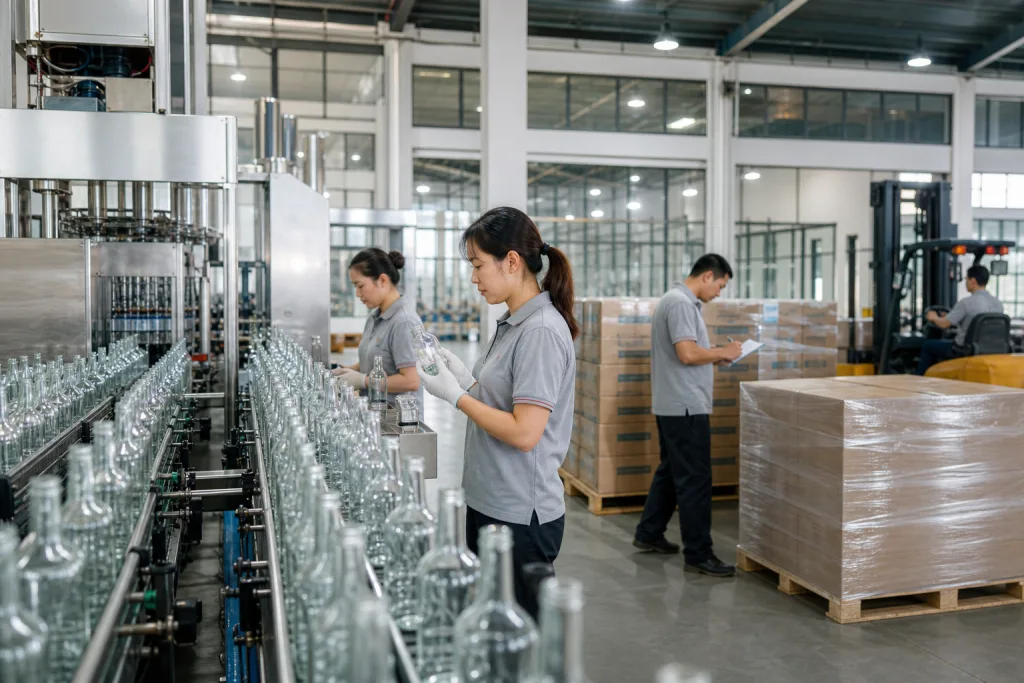
A showroom sample is often built slowly, checked by a senior merchandiser under a light box, and packed like jewelry. Bulk is not that. On a real wholesale drinkware order, 5,000-20,000 bottles run through forming, annealing, coating, printing, cap assembly, carton packing, then container loading. One weak station becomes a claim later. QC sees it first.
For the best wholesale glass bottle program, do not approve only by appearance. Ask for a production sample made from the same mold, same glass batch, same cap, same silicone seal, and the same decoration method planned for bulk production. If you are buying drinkware bulk for retail shelves, corporate gifting kits, or subscription boxes with barcode labels, this matters more than saving USD 0.05 per unit. We had one buyer push back on this; the math did not work after 312 leaking caps were pulled during AQL sorting.
Early failure signs are easy to miss: uneven bottle base thickness measured with a 0.01 mm caliper, seam lines you can feel with a fingernail, or a bottle that rocks on a flat stainless inspection table. Watch for cloudy glass, inner bubbles larger than 1.5 mm, and caps that feel different between samples. These findings do not mean the order is dead, but they tell you the line needs tighter process control before bulk release.
For standard borosilicate glass bottles, a realistic China MOQ is usually 1,000-3,000 pcs per color for stock shapes and 10,000 pcs or more for a private mold. At our Zhejiang facility network, normal lead time is 35-50 days after deposit and artwork approval. If a supplier promises 15 days for a decorated 20,000 pc order, ask which inspection steps they are cutting. We run annealing checks, print adhesion tape tests, and cap leak tests before packing; skipping one saves days, then costs cartons.
Glass breaks before customers see it
The costliest glass bottle defect is not a scratch. It is transit breakage. A bottle can pass the factory light-table check and still crack during truck loading, sea freight vibration, warehouse stacking, or parcel delivery. We have opened a master carton after a 1.2 m forklift bump and found 3 broken bottles, with glass dust scratching 18 saleable units in the same carton.
Spec the glass first. For reusable glass drink bottles, we usually recommend borosilicate glass with 2.0-2.5 mm wall thickness for 350-750 ml sizes, checked with a digital thickness gauge at the shoulder, body, and base. Soda-lime glass can work for some low-cost drinkware wholesale projects, but it is heavier and weaker against thermal shock. If the bottle may receive hot liquid, define the temperature difference test clearly, for example 20°C to 80°C without cracking. Do not let the supplier write only “heat resistant” on the invoice. That wording causes arguments later.
Packing needs the same discipline. A safe export pack normally uses individual polybag or paper wrap, divider or egg-crate protection, 5-ply corrugated master carton, and corner compression suitable for pallet stacking. For Amazon FBA or direct-to-consumer distribution, run a carton drop test from 76 cm on one corner, three edges, and six faces. QC pulled the sample carton last month after the buyer flagged loose dividers; the gap was 6 mm, enough for bottles to knock during vibration. Confirm gross carton weight too. Above 15 kg increases manual handling damage in many warehouses, and the math doesn't work if your warehouse team is re-taping crushed cartons at receiving.
Buyers sourcing beer growler wholesale, bulk growler, or beer growler bulk should be stricter. Large 1 L, 1.5 L, and 2 L glass formats create more leverage during impact, and their caps and handles add pressure points around the neck and shoulder. Ask the supplier for packed drop-test photos, carton dimensions, and historical breakage rate by shipment, not a clean showroom sample. We run a 2 L growler line with foam neck rings on export orders because plain dividers looked fine on the PO but failed after pallet stacking. Under 1% breakage on sea shipment is a reasonable target when cartons and pallets are correctly engineered.
Caps leak when specs are vague
Leakage is where 6 out of 10 glass bottle claims start. Buyers check the glass body first, but complaint photos usually show water around the cap, gasket, thread fit, or closure torque. We see the same issue on the best wholesale drink bottle, canteen wholesale, wholesale canteen, and alcohol flask wholesale projects; last month QC pulled 200 pcs from the line and found 7 caps weeping at the first thread.
A proper specification should name the cap material, liner material, gasket hardness, and leak test method. For food-contact drinkware, common cap materials include PP, stainless steel 304, bamboo with inner plastic liner, or aluminum; if the buyer just writes “bamboo cap,” the factory may quote the cheapest PE insert and the math looks better for the wrong reason. Silicone rings should be food-grade and typically 50-60 Shore A hardness, depending on the thread design. Too soft and the seal deforms. Too hard and the user cannot tighten the cap enough. We run this check with a Shore A durometer before pilot production, not after 30 cartons are packed.
Do not accept “no leak” as a test standard. It means nothing. Write the test into your purchase order: fill bottle with room-temperature water to 90% capacity, tighten cap to agreed torque, invert for 24 hours, and check for visible leakage. For sport caps or flip lids, add a shaking test of 30 seconds and a side-rest test. For canteen bulk and canteen wholesale orders with straps or metal loops, check that the cap remains sealed after 500 open-close cycles; we had one PO typo say 50 cycles, and the buyer flagged loose caps only after the retail drop test.
Alcohol flask bulk, alcohol flask in bulk, and alcohol flask wholesale bulk orders need another check: odor. Some low-grade gaskets carry a rubber smell that becomes obvious with alcohol, and we have seen this go sideways when the sample used LFGB silicone but bulk used a cheaper ring to save USD 0.018 per pc. Ask for LFGB or FDA food-contact declarations for silicone and plastic parts, and run a 4-hour soak test before approving mass production. In China, about 8 out of 10 suppliers can source compliant components, but only if you specify them before pricing is locked.
Decoration fails after the invoice
Logo failures hurt because the bottle can pass pressure, drop, and leak checks, then still sit in our warehouse with a rejected carton label. We see this on glass bottle orders around 3–5 times a month during peak season. The common decoration choices are silk screen printing, heat transfer, decal, spray coating, electroplating, frosting, and laser marking on metal or bamboo caps. Each one has a hard limit. QC pulled one 500 ml sample last April where the body was fine, but the logo sat 6 mm off-center.
Silk screen works best for one-color logos and large wholesale drinkware runs, usually from 3,000 pcs upward if you want the setup cost to make sense. It is the wrong method for fine gradients or photographic artwork. Decal can hold more detail, but it costs more and needs controlled firing or curing; one rushed kiln batch at 560°C gave us yellowish whites on a customer’s café logo. Spray coating gives a clean matte or glossy finish, but it scratches fast when pretreatment or curing is weak. Frosting looks clean, yet fingerprints and cloudy patches show up when the acid strength or sandblasting time drifts. The line has no mercy.
Your artwork file should spell out Pantone color, logo size in millimeters, print position from base or shoulder, acceptable color tolerance, and whether the logo must pass a tape test, rub test, or dishwasher test. Do not send only a JPG pulled from a website; the math does not work when a 38 mm logo is rebuilt from a 72 dpi image. For retail drinkware bulk, we normally use a 3M tape pull test and 50-cycle wet rub test for basic screening. If the product is sold as dishwasher-safe, that claim needs stronger validation, not a casual factory promise. We ask buyers to approve one signed golden sample before mass print, because a PO typo like “white logo” instead of “warm gray PMS 428C” can burn 12 days vs 18 days in rework and re-approval.
Buyers ordering beer tumbler wholesale, beer tumbler bulk, or beer tumbler in bulk often pick coated glass for a barware look. Fair choice. Be careful with metallic coatings and colored lacquers if you sell into the EU, especially on 300 ml and 500 ml bar sets packed for retail shelves. Ask for REACH-related documentation and heavy metal screening where applicable. We have seen this go sideways: the buyer loved the champagne-gold coating, then flagged the compliance file two days before booking space with the forwarder. A beautiful coating that fails compliance is not a bargain; it is inventory you cannot legally sell.
Compliance cannot be added later
Compliance is not decoration. You cannot bolt it on after production because a retailer asks for documents 3 days before booking. For glass bottles sold in Europe or North America, we check food contact safety, heavy metals, labeling, and packaging marks first; social compliance comes up when the buyer is a chain account. Kids bottles are a different lane. Last month QC pulled 12 samples from the annealing line and the buyer flagged the silicone straw as a child-use component, not an adult accessory.
For EU buyers, ask for food-contact declarations and migration testing aligned with EU framework requirements, plus REACH screening for coatings, inks, plastics, and silicone components. For the US, FDA food-contact expectations apply, and children’s products may need CPSIA-related review. If the bottle is a kids format, talk through ASTM mechanical risk checks for small parts, straws, and caps before tooling starts. We run a 0.05 mm feeler gauge check on cap gaps when the design has a flip lid, because one loose plug can turn into a failed report.
Factory audits matter when your customer is a chain store or licensed brand. BSCI, ISO 9001, and Sedex are common requests, and 2 out of 10 new buyers still send the audit request after price confirmation. That is the wrong order. An audit certificate does not guarantee perfect quality, but it shows whether the Zhejiang or wider China factory has written systems for corrective action, training, traceability, and worker safety. Ask if the certificate belongs to the actual production site, not only a trading company office; we have seen POs list the Hangzhou sales office while the glass forming line was 180 km away.
For wholesale growler, growler bulk, beer growler in bulk, and beer growler wholesale bulk programs, labeling creates extra trouble. If the product is marketed for beer, kombucha, or carbonated drinks, you must state whether it is pressure-rated. Most ordinary glass growlers are not designed for uncontrolled carbonation. Put the intended use on the spec sheet, carton mark, and instruction insert to reduce misuse claims. The math does not work if the buyer wants “beer safe” printed on a 2 L soda-lime growler without pressure testing; our carton mark proof catches this before the line prints 5,000 boxes.
Inspection must match real risk
AQL inspection is not paperwork for show. It is cheaper than air-freighting 3,000 replacement caps or refunding a retailer after shelf complaints. For most best wholesale glass bottle orders, we run ANSI/ASQ Z1.4 or ISO 2859 sampling with Critical 0, Major 2.5, Minor 4.0. If the bottle touches food or liquid, leakage, sharp edges, broken glass, contamination, and wrong material should be critical or major defects. QC should test with water, a torque meter, and a clean white cloth, not just look at the carton stack.
Build the defect list before production starts. Do it early. Major defects can include leaking cap, unstable base, wrong capacity beyond tolerance, wrong logo position over ±2 mm, color mismatch beyond approved limit, visible coating peeling, and carton under-strength. Minor defects may include tiny bubbles below your defined limit, light scuffing outside the logo area, or small carton print imperfections. Last year a buyer flagged “minor bubbles” after packing because the PO only said “clear glass”; the line had already sealed 186 cartons, and the math did not work for re-sorting.
Capacity checking is often missed. A 500 ml bottle should not randomly hold 465 ml or 535 ml unless you approve that range in writing. Define capacity at fill line or brimful capacity. For commercial orders, we usually control usable capacity within ±5%, while tighter tolerances may require better molds and higher unit cost. QC pulled the sample with a digital scale and 20°C water; that simple check catches more trouble than a glossy pre-shipment photo.
If you are mixing glass bottles with stainless items such as beer tumbler wholesale bulk, wholesale growler accessories, or alcohol flask wholesale, inspect each category separately. Different materials fail in different ways. Stainless steel needs vacuum or corrosion checks; glass needs annealing, impact, and leak checks. A single general “drinkware inspection” report is too broad for serious procurement. We have seen this go sideways when one inspector used the same checklist for a 304 stainless tumbler and a soda-lime glass bottle, then missed a cracked inner thread under the cap.
Landed cost beats cheap FOB
The lowest FOB price can still give you the highest landed cost. A glass bottle quoted at USD 1.25 FOB Ningbo can lose to a USD 1.42 bottle once you count breakage, carton cube, rework, and complaint rate. We see this on the line: QC pulled 80 pcs from a trial pack last month, and 3 bottles had shoulder chips after a 60 cm drop test. Glass is heavy. It punishes loose costing.
Ask for carton size, pcs per carton, gross weight, CBM, pallet loading plan, and estimated container quantity before approving the order. A 750 ml glass bottle may ship 24 pcs per carton, while a 1 L growler may need 12 pcs per carton because the gross weight jumps and the divider needs more room. Tell the supplier to mark the carton drawing with mm, not just “standard export carton.” If you ship mixed bulk drinkware, do not place 18 kg glass cartons above lightweight plastic cups or paper display packs. We have seen this go sideways.
Payment terms also affect risk. A common China arrangement is 30% deposit and 70% balance before shipment, with inspection before final payment. For repeat buyers, we run staged quality gates: pre-production sample approval, inline check at 20-30% completion, final random inspection, then balance payment. One buyer once pushed for balance after arrival, but the math did not work for a USD 8,000 glass run with custom caps already molded. Keep it practical.
When you compare wholesale drinkware suppliers, compare the complete offer: glass type and wall thickness, cap material and liner, compliance documents, decoration durability after tape test or dishwasher test, packing, inspection support, lead time, and after-sales responsibility. The best wholesale glass bottle is the one with fewer hidden assumptions. If you make those assumptions visible before the deposit, the factory has a fair target and you have a sourcing decision you can defend to your boss.
Send your bottle spec before you pay a deposit
We will review glass type, cap design, decoration, MOQ, packing, and inspection points before your China production order starts.
Frequently asked questions
What MOQ should I expect for a custom wholesale glass bottle?
For stock glass bottle shapes from China, a practical MOQ is usually 1,000-3,000 pcs per color or logo design. If you need a custom mold, expect 10,000-30,000 pcs depending on size, mold complexity, and cap design. Decoration also changes MOQ. One-color silk screen may start lower, while spray coating or decal printing often needs 3,000 pcs or more to control setup cost. For mixed wholesale drinkware programs, you can sometimes combine glass bottles, canteen bulk items, and growler wholesale products in one shipment, but each SKU still needs its own production minimum.
How long does glass bottle production take after I approve samples?
A normal decorated glass bottle order takes 35-50 days after deposit, artwork confirmation, and final sample approval. Plain stock bottles can be faster, sometimes 20-30 days if inventory is available. Custom molds add 20-35 days for mold opening and trial production before mass production starts. Zhejiang and other China factory clusters are efficient, but kiln schedules, coating capacity, and packaging material lead time still matter. If you need pre-shipment inspection, reserve 2-3 extra days for booking, reporting, and corrective action if defects are found.
Which glass type is best for reusable drink bottles?
Borosilicate glass is usually the safer choice for reusable drink bottles because it handles temperature change better than regular soda-lime glass. For 350-750 ml bottles, a 2.0-2.5 mm wall thickness is common. Soda-lime glass can be acceptable for low-cost promotional drinkware wholesale projects, cold-fill bottles, or decorative packaging, but you should not market it for hot liquids unless tested. Always confirm thermal shock testing, lead and cadmium limits for decoration, and cap food-contact compliance. The glass body is only one part of the safety equation.
Can I source beer growlers and glass bottles from the same supplier?
Yes, but treat them as different risk categories. A 500 ml glass water bottle and a 2 L beer growler bulk order have different weight, impact, cap, and pressure concerns. If the growler is for beer or kombucha, state whether it is decorative, cold-fill only, or suitable for controlled carbonation. Most standard glass growlers are not pressure-rated for uncontrolled fermentation. For beer growler wholesale or beer tumbler wholesale bulk, ask for stronger cartons, 76 cm drop testing, cap leak testing, and clear user instructions in the retail pack.
What should be checked during final inspection?
Final inspection should cover appearance, dimensions, capacity, glass defects, sharp edges, cap fit, leakage, logo position, color, coating adhesion, odor, carton strength, barcode, and shipping marks. Use AQL Critical 0, Major 2.5, Minor 4.0 as a practical starting point. For leakage, test filled bottles inverted for 24 hours or use an agreed accelerated method if the inspection window is short. For alcohol flask wholesale bulk or canteen wholesale orders, add gasket odor and open-close cycle checks. The report should include photos, defect counts, and carton drop-test results if required.