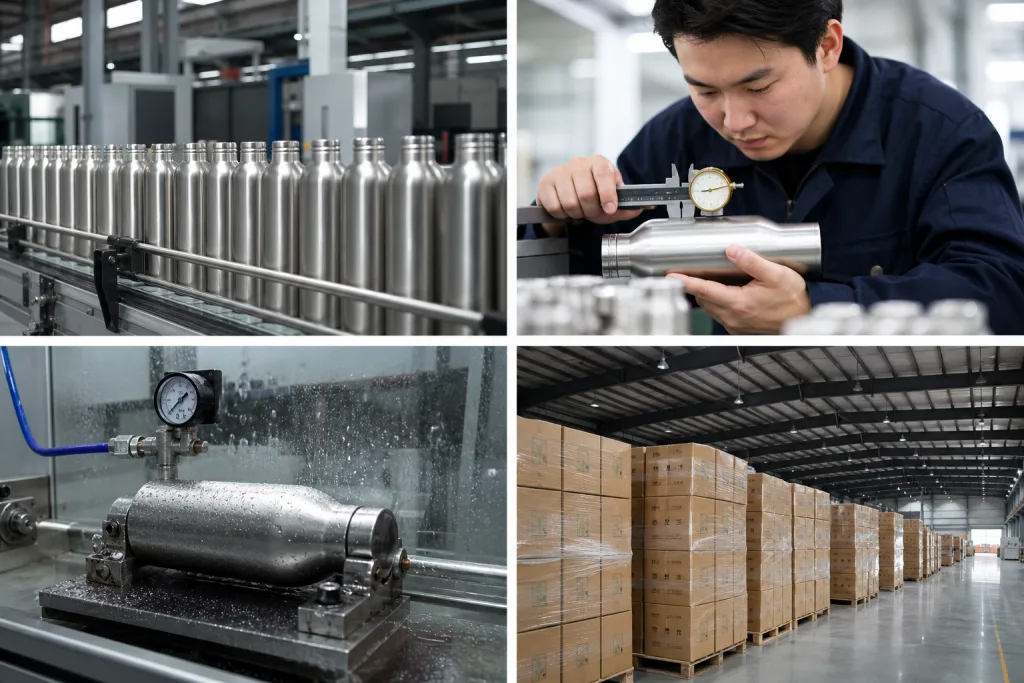
Key Takeaways
- Set AQL 2.5 for major defects and 4.0 for minor defects on production lots above 3,000 units
- For stainless bottles, specify SUS304 inner wall and at least 0.4 mm body wall thickness
- Confirm MOQ by decoration method: laser engraving can start at 500 pcs, custom color usually starts at 1,000-3,000 pcs
- Plan 30-45 days production lead time after artwork approval for most China wholesale drinkware orders
The best wholesale drink bottle is not the prettiest sample on your desk. It is the bottle that still looks clean after 90 days in a warehouse, does not leak in a courier bag, passes your market’s compliance check, and lands within the cost you approved. We see this weekly. QC pulled one 600 ml sample last month that looked perfect, but the lid seeped after a 45-minute inverted leak test.
From our factory network in Zhejiang, China, we see the same 5 problems repeat: steel grades written as “stainless” instead of 304 stainless, lid gaps over 0.3 mm, coating baked too fast, cartons under 5-ply strength, and inspection plans sent after the line has already packed. If you buy drinkware wholesale for retail, corporate gifting, Amazon FBA, or distributor stock, your spec sheet needs to block failures before the first purchase order. Asking for “best price” first is the wrong question; once the buyer flagged a missing LFGB line on the PO, the math already stopped working.
The sample passed, the order failed
A good sample can hide a bad production setup. For the best wholesale drink bottle project, treat the sample as a reference, not a promise. The sample may come from a senior worker, get polished twice, and pass hand check one by one. Your 10,000-piece order runs on normal line speed, shift changes, new material batches, and line-balancing pressure. On one run, QC pulled a lid with a torque tester at 2 N·m and the mass order still came back with 6% loose caps. We've seen this go sideways fast.
The failure usually starts with an incomplete golden sample record. Buyers approve “matte black 750 ml bottle with logo” and think that is enough. It is not. Freeze the exact body height, capacity tolerance, lid structure, Pantone color, logo size, logo position, carton packing, barcode label, and defect limits. On our packing table, a PO once missed “logo under handle,” and the printer ran 4,800 pcs on the wrong side. For a Zhejiang, China factory, a clear bilingual spec sheet removes 80% of the argument later.
For drinkware bulk orders, ask for a pre-production sample made with mass-production tools and the actual decoration process. If the final order uses powder coating, do not approve a spray-painted sample. If you need canteen wholesale goods with a strap, approve the real strap width, buckle material, and pull strength. If you are ordering growler wholesale for outdoor retail, approve the handle weld and cap gasket, not only the body shape. We run a 24-head powder line, and a 0.2 mm hanger mark shows up fast on dark finishes.
Practical spec: allow ±3% capacity tolerance for most bottles, ±2 mm height tolerance, and ±1 mm logo placement tolerance unless your packaging insert requires tighter control. Our Hangzhou team usually recommends a signed golden sample plus 6 production reference photos before deposit. QC keeps the signed piece next to the go/no-go gauge, and that saves time when the buyer flags a small color shift. It sounds boring. The math doesn't work without it.
Leaks are not random accidents
Leak complaints are almost never random. We usually trace them to a loose lid design, weak gasket material, sloppy thread matching, or an operator seating the silicone ring half a millimeter off in the groove. QC pulled one 600 ml sports bottle sample last month where the gasket had a 0.4 mm height difference after assembly. That was enough. If you sell a wholesale canteen, sports bottle, travel tumbler, or alcohol flask wholesale item, one leak in a customer’s laptop bag can cost more than the bottle itself.
Your purchase order should state the lid test method. Do not just write “leakproof.” We run a standard test by filling the bottle to 80% capacity, tightening the lid to normal torque, laying it horizontally for 30 minutes, then inverting for 10 minutes. For higher-risk products, we use a shake test: 20 vertical shakes after hot water filling, then horizontal placement. For vacuum bottles, pressure change after hot filling can expose weak seals. The buyer once flagged a PO that said “no water out” with no test time; the math does not work when inspection uses one standard and the factory uses another.
The gasket material matters. Food-grade silicone should be specified, not simply “rubber.” For EU and North American buyers, ask for LFGB or FDA food-contact documentation where relevant, and make sure the gasket color is tested if it is not natural translucent silicone. Black and colored seals can contain additives that create compliance headaches. On the line, we check gasket hardness with a Shore A durometer; a seal that is too soft can deform after hot water filling, while a stiff one may not compress enough against the lid seat.
Bulk canteen and canteen bulk projects often fail at the cap hinge or carrying loop. If the bottle is 1 L or larger, request a 5 kg static pull test for the handle or strap connection. For alcohol flask in bulk, pay attention to cap alignment and hinge pin tightness; small flasks are cheap, but the cap tolerance is unforgiving. We have seen 8 oz flask caps look fine on the table, then rub against the shoulder after plating adds thickness. For beer growler wholesale bulk, the cap must handle carbonation expectations clearly. Most stainless growlers are for short-term transport, not long-term pressurized storage. Put that in your product claim and instruction sheet.
Steel grade mistakes cost trust
We hear this every week: a buyer asks for the best wholesale drinkware, then writes “stainless steel” on the spec sheet and calls it done. That is too loose. On our line, the safe build for a drink bottle is SUS304 for the inner wall and SUS201 or SUS304 for the outer wall, based on target price. If the bottle is for premium retail or hot drinks, SUS304 inner wall is the line we do not cross.
Wall thickness is where a lot of orders go sideways. A bottle can look clean in photos and still dent on the first decent drop if the shell is too thin. For common vacuum bottles, 0.4 mm inner wall and 0.5 mm outer wall is the baseline we run. We have seen quotes trim wall thickness to win by USD 0.10-0.20 per unit, and the buyer ends up paying that back in dents, returns, and ugly reviews. The math does not work.
For bulk growler, growler bulk, and beer growler bulk orders, body strength matters more because the bottle is larger and gets dragged outdoors. A 1.9 L stainless growler should sit steady in the hand and stay rigid around the neck when the cap is torqued down. For beer tumbler wholesale and beer tumbler in bulk, rim finishing is a real check. On our bench, anything with a sharp edge or uneven lip gets flagged before packing. That is not cosmetic. It is a defect.
Ask for material certificates, but do not treat paper like proof by itself. Certificates should line up with the production batch where possible. A pre-shipment inspection can include random magnet checks, wall thickness readings, appearance checks, and capacity checks with a filling jig. Magnet testing is not a perfect stainless test, but it will catch a suspicious substitution fast. For higher-value programs, third-party lab testing under FDA, LFGB, REACH, or California Proposition 65 requirements is worth the spend before you scale. We have seen this go sideways when a buyer missed a PO typo on the heat number and the goods landed with the wrong batch file.
Coating failure shows up late
Powder coating, spray painting, and plating all look fine on day one. The real test starts after abrasion, hand sweat, dish soap, carton rubbing, and 38°C warehouse heat. Coating failure usually lands on your desk after the bottles are sold. Bad timing. We once had QC pull 32 matte black samples from a packed carton, and the shoulder area already showed rub marks from the kraft divider.
If you want a matte finish on bulk drinkware, specify powder coating when the target price can carry it. Powder coating costs more than basic spray painting, often by USD 0.20-0.50 per bottle depending on size and color, but scratch resistance is usually better. For promotional canteen wholesale orders with a 30-day campaign life, spray painting can pass if the buyer accepts the risk. For retail wholesale drinkware, I push back. The math does not work when a USD 0.30 saving turns into 2% customer returns.
Your artwork process changes the risk too. Laser engraving holds up well and can support lower MOQ, often 500 pcs for a standard bottle in our Zhejiang facility. Silk screen printing works for simple logos, but the ink must match the coating and the curing oven cannot be rushed; our line checks this with a 3M tape pull after cooling. Heat transfer can show complex graphics, but edge lifting and color shift need checking before bulk packing. For custom powder color, MOQ often starts at 1,000-3,000 pcs per color, and production lead time is usually 30-45 days after artwork approval.
Put test requirements in writing. A simple cross-hatch adhesion test, 3M tape pull, 50-cycle rub test with a dry cloth, and carton abrasion simulation can catch weak coating before shipment. For dark matte bottles, request visual inspection under consistent lighting, such as a 6500K light box, because fingerprints, dust points, and orange peel texture become common arguments. If you buy alcohol flask wholesale bulk with mirror polish, define acceptable hairline scratches by length and position, for example under 5 mm outside the logo area. “No scratches” is not a production standard; a measurable defect limit is.
Packaging fails before the bottle
A bottle can pass production and still land at the buyer’s warehouse with dents, broken lids, or scratched powder coating because nobody priced the carton properly. Export packaging is not retail packaging. It has to survive the packing table, forklift moves, container loading, sea freight vibration, destination trucking, and FBA receiving if that is your channel. If you buy drinkware bulk from China, put packaging as a separate line in the quotation; we have seen a USD 0.06 cheaper carton turn into a 3% damage claim.
For a standard stainless bottle, we run a white box or kraft box with a 5-layer export carton. For heavier bulk growler and beer growler in bulk shipments, use stronger cartons with tighter internal dividers, not loose paperboard that collapses after the first drop. Small detail, big problem. If the product has a handle, lid loop, straw, or accessory brush, QC should shake the packed sample and check whether any part rubs against the coated surface. On one 40 oz order, QC pulled the sample after a 10-minute vibration test and found black marks from the lid loop on the matte paint. Polybags reduce scuffing, but EU buyers often push back on plastic, so tissue wrap or paper sleeves may be the better call.
Carton drop testing should match your sales channel. A distributor pallet order may pass with normal export carton strength. E-commerce and Amazon FBA drinkware need tougher packaging because single cartons get thrown, stacked, and re-labeled more often. For FBA, confirm FNSKU labels, suffocation warnings on polybags where applicable, carton weight below 22.5 kg unless clearly marked, and barcode scannability; we scan with a handheld barcode reader before sealing the master carton. A carton that looks fine in Hangzhou can still become a receiving problem in Germany, Canada, or the United States.
Do not ignore palletization. If you ship wholesale growler or beer tumbler wholesale bulk by sea, ask for carton dimensions and loading quantity before you approve the order. This is where the math goes bad. A bottle design that wastes container space can add USD 0.15-0.40 per unit in freight during tight shipping seasons, especially when a 52 x 38 x 34 cm carton leaves dead space on a 1,100 x 1,100 mm pallet. Good sourcing is not just FOB price; it is landed cost and damage rate together.
Inspection plans written too late
The worst time to talk QC is after the factory says the goods are finished. At that point, rework takes 12 days instead of 3, the forwarder is chasing the SI cut-off, and everyone is arguing over photos on WeChat. For the best wholesale drink bottle sourcing plan, lock the inspection rules before deposit. We have seen this go sideways when a PO only said “good quality” and QC pulled the sample with a 0.4 mm logo shift the buyer would not accept.
Use AQL. For most wholesale drinkware orders, AQL 2.5 for major defects and 4.0 for minor defects is a practical starting point. Critical defects should be 0. Major defects include leakage, wrong material, wrong logo, serious coating peel, unsafe sharp edges, broken lids, or capacity far outside tolerance. Minor defects include small dust points, slight color variation within the approved range, tiny carton marks, or minor print position deviation. Be specific. Our line uses a vacuum leak tester and a 3M tape pull on coated samples; if the checklist does not name the test, the math does not work during the claim.
For an order of 5,000 pcs, a normal Level II inspection often checks 200 pcs under ISO 2859-1 sampling. You do not need to inspect every unit, but you do need a written checklist. Include capacity, weight, lid fit, leak test, coating appearance, logo, barcode, carton marking, packing quantity, and accessories. For beer tumbler bulk or beer tumbler wholesale orders, add rim smoothness and stackability checks if applicable. For alcohol flask bulk, add cap hinge and internal odor checks. One buyer flagged a 12 pcs/carton packing mistake after cartons were sealed; opening 417 cartons cost more time than writing “12 pcs/ctn, inner bag required” on the QC sheet.
BSCI, ISO 9001, and Sedex-style audits are useful, but they do not replace product inspection. A clean audit means the factory system is organized; it does not guarantee your matte blue 650 ml bottle is correct. Our Zhejiang, China production lines can run about 600,000 stainless drinkware units per month across standard bottles, tumblers, canteens, and growlers, but capacity only helps if the quality gate is defined. Fast production without clear QC is fast risk. We ship better when the inspector has the golden sample, Pantone chip, caliper, barcode scanner, and carton mark file before the first master carton comes off the line.
Send your bottle spec before you place the PO
We will review material, MOQ, decoration, packing, and QC risks before your next wholesale drinkware order moves into production.
Frequently asked questions
What MOQ should I expect for the best wholesale drink bottle?
For existing stainless bottle shapes, a practical MOQ is 500 pcs with laser engraving or one-color silk screen logo. Custom powder coating usually starts at 1,000-3,000 pcs per color because the coating line needs setup time and color change cleaning. Fully custom molds can require 5,000-10,000 pcs depending on size and complexity. For canteen bulk, growler wholesale, and beer tumbler in bulk orders, MOQ also depends on lid type and accessories. If a supplier offers 100 pcs with custom color at a very low price, check whether it is stock repainting, mixed inventory, or a trading order with weak QC control.
How do I compare FOB prices for wholesale drinkware fairly?
Compare the same spec, not just the same capacity. A 750 ml bottle can be quoted with SUS304 inner/SUS201 outer steel, thinner walls, spray paint, no individual box, and basic lid; another quote may include SUS304 inner and outer steel, powder coating, retail box, leak testing, and stronger carton. The price gap may be USD 0.40-1.20 per unit for good reasons. Ask each China supplier to list steel grade, wall thickness, coating type, lid material, packing method, MOQ, lead time, and inspection standard. FOB Ningbo or FOB Shanghai should also be stated clearly so your freight forwarder can calculate landed cost.
Are beer growler wholesale orders different from normal bottles?
Yes. Beer growler bulk orders need more attention to cap sealing, body strength, internal cleaning, and product claims. Many stainless beer growlers are suitable for short-term beer transport, but they are not designed as long-term pressurized kegs. If you sell beer growler wholesale bulk, avoid marketing language that implies indefinite carbonation storage unless the design has been tested for it. For 1.9 L growlers, check handle weld strength, cap gasket compression, mouth diameter, and internal polishing. MOQ is often 500-1,000 pcs for standard designs, with 35-45 days production after logo and packaging approval.
Which decoration method is safest for alcohol flask wholesale bulk?
Laser engraving is usually the safest for alcohol flask wholesale orders because it does not peel, has clean edges, and works well on brushed or polished stainless steel. Silk screen printing can be cheaper for larger logos, but curved flask bodies make registration more difficult. For alcohol flask in bulk with gift boxes, inspect both the flask and the packaging insert because scratches often happen during packing. A reasonable MOQ is 500 pcs for standard flasks with engraving and 1,000 pcs for custom color or printed gift packaging. Always specify food-contact compliance for the internal surface.
Should I order pre-shipment inspection for every drinkware bulk order?
For repeat orders under USD 3,000 with a trusted factory, you may rely on internal QC plus production photos. For new suppliers, new molds, new coating colors, or orders above 3,000 pcs, pre-shipment inspection is worth it. A third-party inspection in China often costs USD 200-350 per man-day, which is small compared with rejected retail inventory. Use AQL 2.5/4.0, require leak tests, capacity checks, logo checks, carton drop review, and barcode scanning. For Amazon FBA or major retailer orders, inspection should happen before final balance payment and before the vessel booking becomes urgent.