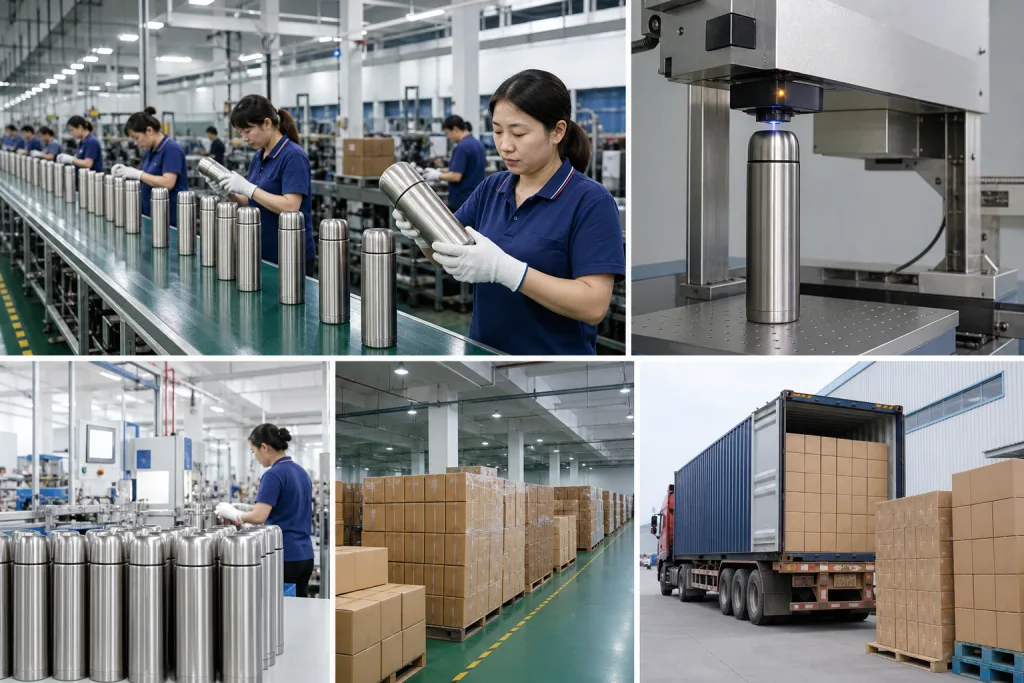
Key Takeaways
- A realistic MOQ for custom stainless thermos orders is 1,000-3,000 units per color or logo
- 304 stainless steel, 0.4-0.5 mm wall thickness, and copper-plated vacuum insulation are the normal starting specs
- Production usually takes 30-45 days after artwork, deposit, and pre-production sample approval
- AQL 2.5/4.0 inspection should include leakage, vacuum retention, coating adhesion, barcode, and carton drop checks
You are not just buying a bottle with a logo. You are buying a promotional thermos that has to survive 6-sided carton drop tests, pallet stacking, retail handling, outdoor use, and a client who will complain if the lid leaks inside a backpack. Cheap FOB looks nice on a spreadsheet. Then QC pulls a sample, finds 0.38 mm body steel instead of 0.45 mm, the silk print fails a 3M tape test, or the export carton crushes at the corner.
Here is a real buyer case we see often: an outdoor retailer needs 5,000 customized thermos units for a winter membership campaign. The wrong question is “what is your lowest price?” The better question is what spec will hold insulation, keep the logo clean, pass AQL 2.5 inspection, and ship before the promotion date. From our line in Zhejiang, China, we would lock the capacity, lid structure, powder coating, logo method, carton strength, sample approval, production schedule, inspection points, and ETD so the order moves without guesswork.
Start With The Use Case
The buyer brief says “best promotional thermos,” but that wording is too loose for a factory order. For an outdoor retailer, start with where the bottle will be used. Car cup holder? Hiking pack side pocket? Gift bundle with a winter jacket? A 500 ml slim thermos looks clean on a conference table, but a 750 ml wide-mouth model usually moves better for camping, fishing, and cold-weather staff kits. We had one buyer flag this after the first PP sample: the bottle looked premium, but it would not fit their standard 78 mm backpack pocket.
For this order, we would start with a 750 ml double-wall stainless thermos. The body uses inner 304 stainless steel and outer 201 or 304 stainless depending on budget. If the product will hold coffee, lemon tea, or sports drinks, full 304 is the safer call. A practical wall thickness is 0.4-0.5 mm before forming. Go thinner and you might save USD 0.15-0.30 per unit, but dents show up faster during retail handling and carton drop tests. The math doesn't work if QC pulls 180 dented pieces from a 5,000 pcs run.
The target FOB China price for a 750 ml manufacturer thermos with powder coating, screw lid, and one-color logo is usually around USD 4.20-6.80 depending on steel grade, lid structure, gift box spec, and order quantity. For 5,000 units, do not expect the same price as a 50,000-unit program. Still, 5,000 pcs is enough for proper custom thermos production, not just trading-stock decoration. On our line, that usually means a dedicated color batch, logo fixture, and a pre-production sample checked with a 3M tape test before mass printing.
Define the purchase brief in numbers: capacity, lid type, mouth diameter, packed carton quantity, target FOB, required certifications, country of sale, and must-arrive date. A thermos supplier in Zhejiang can quote faster and cleaner when those points are clear. “Send your best price for bulk thermos” is the wrong question to ask. It often leads to an overbuilt sample or a cheap quote that changes after the buyer adds LFGB, a 72 mm mouth, 24 pcs carton packing, and a delivery date that is 18 days away instead of the normal 30-35 days.
Lock The Stainless Specification
The mistake we see most in a thermos promotional project is simple: the buyer treats every stainless grade as the same. Bad start. For drink-contact surfaces, 304 stainless steel is the normal expectation for Europe and North America, and QC should verify it with a material report, not a sales note. Some thermos manufacturers use 201 stainless for the outer shell to cut cost by about USD 0.18-0.35 per piece on a 750 ml bottle; that can pass for a budget giveaway if the powder coating covers well and the campaign is not sold as premium. For a higher-end outdoor campaign, 304 inner and 304 outer gives the sales team a cleaner claim and better corrosion resistance. We have seen this go sideways when a buyer flagged rust spots around the bottom seam after a 48-hour salt-spray check.
For the best promotional thermos order in this scenario, we would lock this working specification: 750 ml capacity, 304 inner wall, 304 outer wall, double-wall vacuum construction, copper plating between walls, powder-coated exterior with 60-80 μm coating thickness, silicone sealing ring, and PP or stainless-accent lid. The vacuum layer is invisible. Test it. On our line, QC fills the sample with 95°C water, leaves it at room temperature, then checks with a probe thermometer after 12 hours; a good factory thermos should still read above 55-60°C, although the result changes with bottle shape, lid structure, and test setup. The math does not work if a supplier promises 24-hour heat retention on a slim 750 ml bottle with a cheap flip lid and no test report.
Ask the supplier thermos team for the following before you approve the sample:
- Material declaration: 304 stainless steel for all food-contact metal parts, with the heat number or mill certificate matching the sample batch.
- Food-contact compliance: LFGB or EU food-grade testing for Europe; FDA food-contact expectation for the U.S., especially for the lid, gasket, and any coating near the mouth.
- Chemical control: REACH documentation for coating and plastic components when selling into the EU; buyers often ask this after artwork approval, which wastes 3-5 days.
- Factory system: ISO 9001 is useful; BSCI may matter if your retailer requires social compliance, and some retailer portals will block shipment booking without it.
Do not rely only on a polished sample. Ask for a cut sample or production material confirmation if the order matters; for a 3,000 pcs MOQ promotional run, that is a fair request. A real thermos manufacturer in China should be able to discuss steel grade, vacuum yield rate, welding quality, and coating thickness, down to whether the mouth weld is laser welded or argon arc welded. If the answer is only “good quality, no problem,” keep asking. We ship these every month, and vague answers before deposit usually become bigger problems during AQL 2.5 inspection.
Choose Branding That Survives Use
Branding is where a customizable thermos turns into either a retail-grade gift or a giveaway that feels cheap in hand. For outdoor retailers, the logo method has to survive abrasion, moisture, and cold-weather handling. One-color silk screen is economical, often USD 0.05-0.15 per position at volume, but the result depends on ink quality and curing. On our line, we run a quick rub check after the oven, because a print that looks fine on day one can start lifting after a week in a backpack. The wrong question is “what is the lowest print cost?” The real question is whether the mark still looks clean after use.
For this 5,000-unit custom thermos order, I would point you to laser engraving for a premium outdoor brand mark, or one-color screen print only if the budget is tight and the artwork is simple. Full-wrap heat transfer can look strong on a shelf, but it adds cost, sample time, and QC risk. The buyer flagged this on a past job when the wrap seam missed by 2 mm, and we had to rework the pilot. It works better for lifestyle retail designs than a promotional thermos campaign on a tight schedule.
The artwork file should be vector AI, EPS, or PDF. Set a maximum logo height and width in millimeters, not “make it big.” On a 750 ml bottle, a front logo around 45-60 mm wide is usually readable without looking cheap. I once saw a PO that said 60cm instead of 60mm, and that cost a day of back-and-forth. For a distributor thermos program with multiple regional customers, we often stick to one body color and swap logo files by market. That keeps the line moving and still gives each buyer a customized thermos.
Branding approval should include a pre-production sample, not just a digital mockup. Check logo position tolerance, color match, edge sharpness, and scratch resistance. A simple 3M tape test and 50-cycle dry rub test can catch weak printing before mass production. If the project uses Pantone-matched powder coating, allow 7-10 extra days for coating sample approval. On a recent job, QC pulled the sample beside the spray booth because the first chip read half a shade off under natural light. Zhejiang factories can move fast, but color chemistry still needs real sampling.
Price The Order Without Fantasy
A buyer often sends the same RFQ to three thermos suppliers, gets three FOB prices, then picks the middle one. Fair enough. But compare the same bottle. One thermos vendor may quote 201 outer steel, 0.38 mm wall, a plain white box, and no third-party inspection. Another may include 304 outer steel, color box, stronger powder coating, and AQL inspection support. QC pulled a 750 ml sample last month where the quote said “stainless thermos,” but the magnet test showed the outer shell was not the grade the buyer expected. The price gap can be USD 0.60-1.20 per unit, and both quotes may look like “750 ml stainless thermos” on a spreadsheet.
For our scenario, a workable price structure for 5,000 units might look like this: base bottle USD 4.50-5.40 FOB Ningbo or Shanghai, laser logo USD 0.10-0.25 depending on logo size and position, individual kraft or color box USD 0.18-0.45 based on paper weight and print, master carton USD 0.12-0.20 per unit equivalent, plus spare parts allowance if required. The math gets ugly if every line item is guessed. Tooling is usually not needed if you use an existing mold; we run the same body with different caps on the line all the time. A fully custom lid or body shape changes the project completely, often requiring USD 3,000-12,000 tooling and 60-90 days before mass production.
MOQ depends on the customization. For a standard thermos custom order with one logo and one stock body color, 1,000 units may be workable. For Pantone powder coating, 8 out of 10 thermos lines we deal with prefer 3,000 units per color because the spray booth setup and powder loss do not work at small volume. For thermos bulk programs with mixed SKUs, you can sometimes combine colors across a production run, but do not assume it. Ask clearly: MOQ per item, per color, per logo, and per carton configuration. We have seen this go sideways when a PO says 5,000 units total, then the buyer splits it into 10 colors of 500 after artwork approval.
BottleForge Industrial in Hangzhou, Zhejiang produces drinkware for export programs with monthly capacity around 300,000 units across stainless bottles, travel tumblers, and thermos lines. For a normal 5,000-unit thermos manufacturer order, we would quote 7-10 days for sampling and 30-45 days for mass production after deposit and approved pre-production sample. If your event date is fixed, work backward from vessel departure, customs clearance, and inland delivery, not just factory completion. We ship from Ningbo or Shanghai most weeks, and a 2-day delay on carton marks or a typo in the consignee name on the PO can still push the booking into the next sailing.
Build Packaging For Retail Reality
Packaging is not decoration. It keeps the bottle clean after coating, carries compliance marks, and decides whether your warehouse receives 800 cartons in 2 hours or spends half a day cutting tape and checking loose labels. For an outdoor retailer, a plain white box can make a decent 304 stainless thermos look like a giveaway item unless it sits inside a larger kit. A kraft box with one-color print is the safer middle option; we run this often for 1,000-3,000 pcs programs because artwork approval is faster. A full-color retail box lifts shelf value, but it needs tighter artwork control, a 300 dpi print file, and usually adds USD 0.25-0.60 per unit depending on board weight and finish. The math doesn't work if the buyer wants premium box print for a one-week event handout.
For North America, your customized thermos packaging may need UPC or FNSKU labels if it goes through marketplace or third-party fulfillment channels. For European retail, plan for importer details, material symbols, country of origin, and language-specific warnings before the box die-line is locked. Small mistakes hurt. QC once pulled a pre-production box where “Made in China” was squeezed into a 4 mm side panel and scanned poorly under warehouse lighting. Print “Made in China” correctly on the product label or packaging; hiding origin is not worth the customs risk.
Carton strength matters. A typical 750 ml stainless thermos might pack 24 units per master carton, around 15-18 kg gross weight depending on packaging. Use 5-ply export cartons if the goods will pass through more than one warehouse or be split by a 3PL. Ask for a carton drop test from 76 cm on one corner, three edges, and six faces for retail packaging validation. We ship samples with the same insert style as bulk, not a hand-cut foam pad from the sample room. If the bottle has a handle lid, add internal protection so lids do not rub during vibration testing and leave coating marks.
Distributors thermos programs often fail at barcode and carton label control, not bottle production. Create a label layout showing SKU, color, quantity, PO number, carton number, gross/net weight, and destination. If you are shipping to multiple stores or DCs, send the routing file before mass packing starts; 12 days before ETD is workable, 2 days before ETD is where this goes sideways. A good thermos factory can apply labels, but the buyer must define the data. Last-minute relabeling in China delays shipment and creates avoidable errors, especially when one PO typo turns “navy” into “nany” across 326 cartons.
Inspect Before The Balance Payment
Inspection is where you protect your margin. On a 5,000-unit promotional thermos order, do not wait for end users to send photos of leaking lids. We run AQL inspection before balance payment and before the container leaves China. A common setting is AQL 2.5 for major defects and 4.0 for minor defects, with critical defects not accepted. If your retailer has its own inspection manual, use that file, even if our normal checklist is stricter in some points. Last month one buyer flagged a 2 mm logo shift after we had already packed 312 cartons, so this check needs to happen before the final invoice is paid.
The QC checklist should be specific. For function, test leakage by filling the bottle, closing the lid, shaking it hard, then placing it upside down for at least 30 minutes on white tissue paper. Test vacuum performance with hot water retention on selected samples; our QC team usually reads the temperature with a probe thermometer after 6 hours. Check lid thread fit, silicone ring placement, odor, mouth smoothness, internal polishing, and welding marks. For appearance, check coating dust, scratches, dents, color consistency, logo position, and print adhesion with 3M tape, not just a quick finger rub. For packaging, scan barcodes, confirm carton labels, count accessories, and inspect drop-tested cartons. Small mistake, big delay.
For a thermos distributors shipment, I would also pull samples from different production times, not just the top cartons. This is the wrong place to save 40 minutes. Vacuum failure can cluster by welding batch, especially when the line changes operators after lunch. Coating defects can cluster by color line; we have seen matte black cups pass in the morning and show dust points after the spray booth filter was changed. If the inspection only checks one pallet, it gives false comfort. Random sampling across finished cartons is basic, but it catches the problems buyers actually complain about.
Typical defect tolerances should be agreed before production. A tiny black dot under 0.5 mm on the bottom may be minor. A leaking lid is major or critical. A wrong logo color is major. A missing importer label can become critical if customs or the retailer rejects the goods. Put these definitions into the purchase order, including the logo Pantone number, carton mark wording, and any retailer label size in mm. We once had a PO typo that said “matte blue” while the approved sample was “navy blue,” and the math does not work after 5,000 units are coated. A serious thermos supplier will accept written standards because it cuts arguments later.
Ship With Dates You Can Defend
After QC passes, shipping turns into calendar math. For 5,000 units of 750 ml bulk thermos, the order can move as LCL or a partial container; last month our 750 ml gift-box set ran 0.028 CBM per carton, so the carton drawing decided it, not guesswork. Sea freight from Ningbo or Shanghai to the U.S. West Coast is usually 18-28 days port to port, while Europe is often 30-40 days. Then add 3-5 days for trucking, 1-3 days for customs if documents are clean, and receiving time at the buyer’s warehouse. Air freight works for urgent replenishment, but stainless drinkware is heavy. The math often breaks.
Choose Incoterms on purpose. FOB China is clean if your forwarder already runs Ningbo or Shanghai lanes. CIF looks easy on a quote sheet, but we have seen buyers get hit with destination charges they did not budget for, especially on smaller LCL thermos shipments. DDP can work for smaller distributor thermos orders, but confirm duties, importer responsibility, and product compliance before the PI is signed. For larger retailer programs, FOB Ningbo or FOB Shanghai is usually the clearest option; the buyer controls the forwarder, and we hand over cartons after the line releases the shipment.
Before shipment, request final documents: commercial invoice, packing list, bill of lading draft, certificate of origin if needed, test reports, and inspection report. Check the details line by line. We once had QC pull the sample, approve the cartons, then the buyer flagged a one-letter typo in the consignee name on the BL draft, which cost 2 days before vessel cut-off. If the order ships direct to a promotional brand’s client, confirm blind shipping or neutral documents before cartons leave the factory gate. China export paperwork is routine, but wrong HS code, carton count, or consignee name can waste days.
The best promotional thermos is not just the one with the coldest lab result or the lowest unit price. It is the one where the spec, logo, packaging, inspection, and shipping plan match the campaign date. We track this on a simple shipment sheet: PO number, ETD, ETA, carton count, CBM, and document status. If those details are controlled from the first RFQ, a manufacturer thermos program feels predictable instead of painful.
Send Your Thermos Brief For A Factory Quote
Share capacity, quantity, logo file, target market, and delivery date. We will return practical specs, MOQ, pricing, and sampling timing.
Frequently asked questions
What MOQ should I expect for a custom stainless thermos?
For a standard custom thermos using an existing mold and stock color, 1,000 units is often possible, especially with laser engraving or one-color printing. For Pantone powder coating, expect 3,000 units per color because the coating line has setup loss and color-cleaning time. If you need multiple logos, ask whether MOQ is per logo or total order. A 5,000-unit thermos bulk order gives better pricing and more control over packaging, but it is still not large enough for free tooling on a new body shape.
How long does a customized thermos order take from China?
A normal schedule is 7-10 days for sample preparation, 2-5 days for buyer review, and 30-45 days for mass production after deposit and sample approval. Add 18-40 days for sea freight depending on destination. If you need custom color coating or retail packaging, allow another 7-14 days for approvals. From Zhejiang, China, we tell buyers to plan 70-90 calendar days from RFQ confirmation to warehouse arrival for a controlled promotional thermos campaign.
Which logo method is best for an outdoor promotional thermos?
Laser engraving is the safest choice for outdoor use because it does not peel, especially on powder-coated stainless steel. It usually costs around USD 0.10-0.25 per unit depending on logo size and quantity. Silk screen printing is cheaper, often USD 0.05-0.15, but it needs proper ink and curing to pass rub testing. For a premium retail or membership gift, I would choose laser. For a budget event giveaway with simple artwork, screen print can still work if QC includes tape and rub tests.
What tests should I require before shipping bulk thermos orders?
At minimum, require leakage testing, vacuum heat-retention testing, coating adhesion, logo rub testing, barcode scanning, carton label checks, and carton drop testing. Use AQL 2.5 for major defects and 4.0 for minor defects unless your retailer specifies another standard. Pull samples across cartons, colors, and production batches. For Europe, confirm LFGB or relevant food-contact testing and REACH control for coating and plastic parts. For the U.S., confirm food-contact material suitability and any retailer-specific packaging rules.
Can I use one thermos supplier for retail and promotional channels?
Yes, but the specification must be separated by channel. Retail may need color box packaging, UPC labels, stronger carton specs, and tighter cosmetic standards. Promotional orders may prioritize logo cost, delivery date, and mixed carton shipping. A capable thermos manufacturer can run both, but the purchase order should define each SKU clearly. Do not let the factory assume one packing method for all channels. For distributors, the cleanest setup is one shared bottle platform with different logo and packaging files per customer.