Key Takeaways
- A practical promotional stainless thermos MOQ is usually 1,000-3,000 units per color for custom production
- For outdoor use, 304 stainless steel with 0.4-0.5 mm inner wall thickness is a safer baseline than ultra-light promotional shells
- Laser engraving is durable for 3-7 day sampling, while full-color printing often needs 7-12 days for approval samples
- AQL inspection, leak testing, and packaging drop tests matter more than chasing a USD 0.20 lower FOB price
A promotional thermos looks simple until you own 5,000 units that must land on time, hold heat for 12 hours, hit the Pantone color, pass compliance review, and survive a retailer’s carton drop test from 76 cm. Outdoor retailers and promo brands should not buy it like a giveaway pen. One loose silicone gasket, or a powder coat that measures 35 μm instead of the agreed 55 μm, turns into return emails fast.
From our line in Zhejiang, China, the best promotional thermos flask is usually not the shiny catalog hero. It is the bottle that matches your retail price, decoration method, MOQ, packaging, and delivery window without hidden risk. Ask the factory thermos questions before artwork approval and deposit. We’ve seen this go sideways: QC pulled the sample after the buyer flagged a one-letter typo on the PO, but the cartons were already booked for a 18-day sea schedule.
What makes a thermos promotional-ready?
A good retail thermos and a good promotional thermos are not always the same product. Retail buyers care about shelf presentation and repeat purchase. Promotional brands care about logo size, delivery dates, event deadlines, and a landed cost that still leaves margin. The best promotional thermos flask has to pass both checks. Last month a buyer flagged a 28 mm logo as “too small for a trade-show giveaway,” even though the bottle looked fine on the shelf.
Start with the basic construction. For outdoor retailers, we run double-wall vacuum insulated 304 stainless steel for the inner and outer shell in most quotes. A common reliable build is 0.4 mm inner wall and 0.5 mm outer wall, with a 201 or 304 outer shell depending on price target. If your brand position is premium, use 304 stainless for both. If the item is for a short campaign, 304 inside and 201 outside can reduce FOB cost by roughly 5-10%, but do not sell it like a top-tier outdoor flask. The math doesn’t work. QC checks wall thickness with a digital caliper, and a 0.1 mm shortcut shows up fast when the sample is cut open.
The lid is where promotional thermos projects fail. A supplier thermos quote may look attractive, but check whether the lid uses food-grade PP, a silicone gasket, and thread depth that survives repeated opening. We usually test 50 open-close cycles before the pre-production sample is signed. A 500 ml customized thermos with a weak lid will bring more complaints than a bottle that is 18 g heavier with a cleaner seal. We have seen this go sideways: the buyer approved the body color, then rejected the shipment because QC pulled the sample and found water marks inside the cap after a 10-minute inverted leak test.
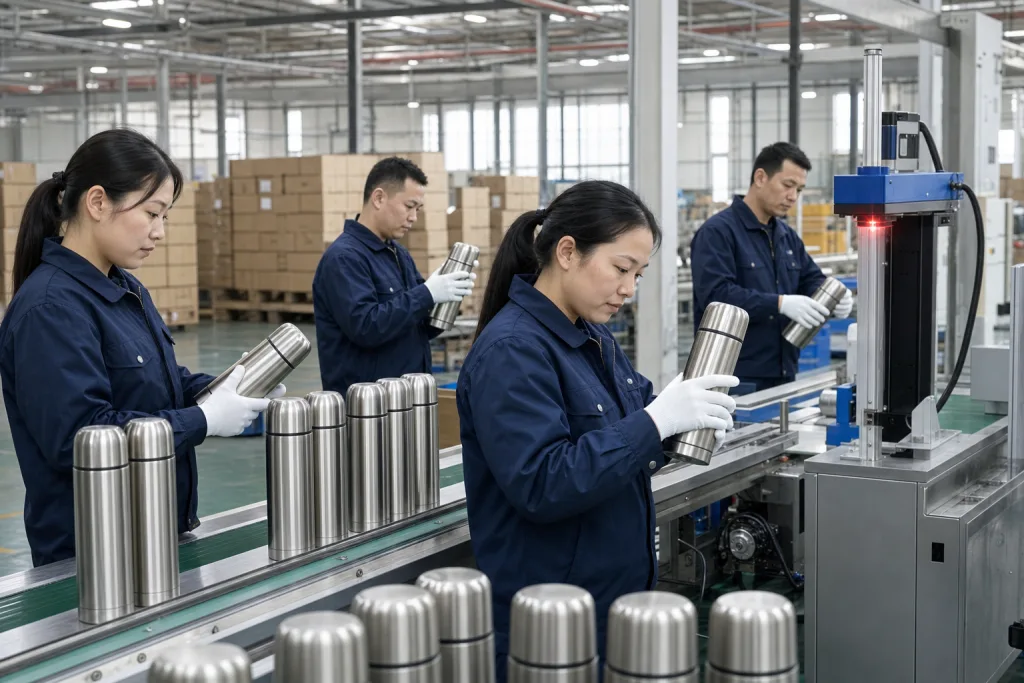
For a normal Zhejiang, China production line, a monthly capacity of 300,000-500,000 stainless bottles is realistic when tooling and decoration are already confirmed. That does not mean your 8,000-unit bulk thermos order can ship tomorrow. Production planning, powder coating, logo setup, inspection, and export packing usually need 30-45 days after sample approval. We ship faster only when the color, carton mark, and PO details are clean; one typo in a Pantone code can cost 3 days on the line.
Checklist before asking for price
Price requests that only say “quote 500 ml thermos custom logo” waste time. A manufacturer thermos quote can move by USD 1.20 per unit once coating, lid structure, carton spec, insert card, and testing requirement are fixed. Before you ask thermos suppliers for FOB pricing, send a short buying checklist; we had one PO last month with “metel bottle” typed in the item line, and QC pulled the sample twice before the buyer confirmed it meant matte black powder coat.
- Capacity: 350 ml, 500 ml, 750 ml, and 1,000 ml are the common promotional sizes. Outdoor retailers usually move 500 ml and 750 ml best, especially when the carton stays under 15 kg for warehouse handling.
- Material: 304 stainless steel inner wall should be your default. Ask for LFGB, FDA, or REACH-related material documents if selling into Europe or North America, and make sure the steel grade is written on the PI, not buried in chat history.
- Insulation target: a practical claim is 6-12 hours hot and 12-24 hours cold, depending on capacity and test method. Do not approve exaggerated claims without lab data; we’ve seen this go sideways when a gift buyer printed “24 hours hot” on 8,000 sleeves.
- Surface finish: powder coating, spray painting, brushed steel, or matte stainless. Powder coat usually costs more but handles outdoor use better; on the line we check adhesion with a cross-hatch cutter and 3M tape before bulk packing.
- Logo method: laser engraving, silk screen, heat transfer, water decal, UV print, or full-wrap print. For curved bodies, send the logo size in mm, because “make it big” is not a production spec.
- Packaging: white box, kraft box, color box, gift tube, retail hangtag, barcode, FNSKU label, or master carton marks. If Amazon is involved, give the FNSKU file early so the line does not stop for a missing sticker.
- Compliance: BSCI factory audit, ISO 9001 process control, FDA food-contact declaration, LFGB migration test, and Prop 65 review where needed. This is the wrong place to cut cost if the goods go to chain retail.
If you are comparing five thermos manufacturers, force them to quote the same specification. Otherwise the lowest thermos vendor may be quoting 0.4 mm thinner steel, cheaper paint, no individual box, or no pre-shipment inspection. The math doesn't work. We ship cleaner when the buyer locks the spec sheet before sampling, not after the first carton photo lands in their inbox.
Which branding method should you choose?
Decoration choice changes durability, lead time, MOQ, and the buyer’s first impression of the promotional thermos. There is no single best method. The right choice depends on order quantity, artwork, and sales channel, and this is where we see projects go sideways if the logo file is approved before the bottle shape is checked with a real jig.
Laser engraving is the safe choice for outdoor brands that want a clean, permanent logo. The laser burns through the coating and shows the stainless surface under it. It will not peel. Sample lead time is usually 3-7 days, and on our line a 20W fiber laser can finish a 45 mm logo in about 18-25 seconds per bottle. Color is the limit. Laser is not for full-color artwork. It works best on powder-coated bottles, brushed steel, and simple logos with no tiny 0.3 mm text.
Silk screen printing fits one-color or two-color logos when cost matters. For a 3,000-unit promotional thermos order, it is often the best balance of price and shelf visibility. Curved bottles still need proper jigging. Bad jigs give oval logos, and buyers notice. Ink adhesion also needs testing after coating; QC pulled one sample last month where the black ink lifted at the edge after the 3M tape test. Ask for a 3M tape test and rub test before mass production.
Heat transfer and water decal work better for gradients and larger artwork. Use them when your customizable thermos needs a full campaign graphic instead of a small chest-logo style mark. Cost is higher, and sample approval can take 7-12 days because film output, alignment, and curing must be checked. We run the first pieces slowly, usually 30-50 units, because a 2 mm shift near the seam looks cheap even when the artwork file is correct.
Full-wrap printing looks strong for retail, but it needs tighter color control and higher MOQ. If your artwork has PMS colors, send Pantone references and allow a practical tolerance. Stainless coating is not paper. This is the wrong question to ask: “Will it match my PDF?” Ask whether the signed physical sample matches under D65 light and whether the wrap seam is acceptable at arm’s length. A Delta E target can be discussed for large retail programs, but for normal thermos promotional orders, a signed physical sample is more reliable than a screen image.
How much should bulk thermos orders cost?
For a 500 ml stainless custom thermos, a workable FOB China price is often USD 3.20-6.80 per unit, depending on steel grade, coating, lid, logo, and packaging. A matte powder-coated bottle with a laser logo and white box usually lands around the lower-middle of that range when we run it on an existing body. A 750 ml bottle with 304 inner and outer walls, carry handle lid, full-color artwork, and retail color box will price higher, especially if the buyer asks for a thicker 0.5 mm outer shell or a molded insert tray. QC pulled one sample last month because the coating thickness was 58 μm instead of the approved 70 μm. That gap affects both cost and scratch resistance.
MOQ is not a sales trick. It comes from coating line setup, logo fixtures, material purchase, and carton production. For standard models, we often support 1,000 units with one logo and one color. For custom PMS coating, 3,000 units per color is more practical because the powder booth cleaning, color matching card, and first-piece approval eat time before the line is stable. For a fully customized thermos with private mold lid or unique body shape, tooling can run from USD 1,500 to over USD 8,000, with MOQ usually starting at 5,000-10,000 units. The math does not work at 800 units if the lid mold alone needs CNC cutting and two rounds of fitting.
When you compare thermos bulk quotes, ask what is included. Does the price include inner bag, desiccant, individual box, carton, barcode sticker, instruction leaflet, and export pallet option? Does it include logo setup charge? Is the price FOB Ningbo, FOB Shanghai, or EXW Zhejiang? The difference between EXW and FOB can easily be USD 0.15-0.40 per unit after local handling, export documents, and trucking. We once had a PO typo that said “FOB Hangzhou” for a Ningbo sailing; the buyer flagged it after the carton marks were printed, and the correction cost 2 days in booking time. Small terms move money.
Chasing the cheapest manufacturer thermos price makes sense only if the specification and inspection level are locked. Otherwise you are not negotiating; you are removing parts you may need later.
Factory questions buyers should ask
If you are choosing a thermos factory in China, do not stop at catalog photos. Ask factory questions. Good suppliers answer with test methods, tolerances, and who signs the QC report. Weak thermos teams hide behind “no problem”; on our line, that phrase usually means nobody checked the torque gauge on the lid or the welding record for the inner tank.
Ask whether the factory performs 100% leak testing after assembly. Ask how vacuum insulation is checked: by temperature decay test, vacuum detection, or both. For mass production, we run spot temperature testing from each batch, then 100% visual and leak checks at the packing table; QC pulled one 500 ml sample last month because the silicone ring sat 0.8 mm proud and failed the tilt test. For a retail distributor thermos program, add third-party inspection using AQL 2.5 for major defects and AQL 4.0 for minor defects, or stricter if your retailer requires it.
Ask for the real production schedule, not the sales answer. A normal timeline is 5-10 days for pre-production sample, 30-45 days for mass production, and 3-7 days for inspection, booking, and export loading. Sea freight to North America may add 25-40 days port to port; Europe is commonly 30-40 days depending on route and season. If your event date is fixed, count backwards and keep at least 10 days as buffer. We have seen this go sideways when a buyer approved artwork 6 days late, then asked us to ship 18 cartons by air because the PO had the wrong delivery week.
Ask what happens when defects are found. A serious thermos supplier should define rework, replacement, credit, or shipment hold terms before production. For Zhejiang factories, our practical rule is simple: if a problem is visible before shipment, fix it in China. The math does not work after arrival. Repairing promotional drinkware in a distributor warehouse means repacking, labor, missing spare lids, and arguments over photos; one black powder-coated batch we ship would cost more to sort overseas than to rework at the factory before loading.
Packaging, cartons, and retail handling
Packaging is not an afterthought decoration. It decides whether your promotional flask arrives clean, scans at receiving, and goes straight to retail shelf or campaign packing. Outdoor retailers often ask for color boxes with UPC labels, inner cartons, and master carton marks printed to their routing guide. Promotional buyers usually push for kraft boxes or plain white boxes to save USD 0.08-0.22 per unit; fair enough, but the buyer flagged crushed corners on a 3,000 pcs order last April, and the cheap box was the reason.
For e-commerce or Amazon-style fulfillment, packaging needs extra attention. A 500 ml thermos in a thin 300 gsm color box can pass our packing table check and still crush during courier handling. It happens. For direct-to-consumer fulfillment, we run stronger 350-400 gsm paperboard, internal paper support, or a corrugated mailer when each bottle ships alone. If FNSKU labels are required, confirm label size, position, barcode grade, and who applies them: the thermos manufacturer or your forwarder. QC checks barcode readability with a handheld scanner before carton sealing, because one 38 mm label placed 12 mm too low can slow the whole Amazon inbound appointment.
Carton strength matters for thermos distributors moving mixed pallets. A typical master carton for 500 ml bottles might hold 24 units, with a gross weight around 10-13 kg depending on model and packaging. Ask for carton dimensions before final order because freight cost is calculated by weight and volume. A beautiful gift box that increases carton CBM by 18% can erase the margin you saved on product cost. The math does not work if your 40HQ loading drops from 28,000 pcs to 23,500 pcs just because the insert tray is 6 mm too tall.
Drop testing should match your channel. For normal wholesale, an internal carton drop test is often enough. For retailer programs, think close to ISTA even when full ISTA certification is not required: run corner and edge drops first, then face drops from practical heights, and check dents, cap cracks, and box deformation. On the line, QC pulled the sample after a 76 cm corner drop and found the powder coating fine but the PP lid scuffed; that is the kind of small finding you want before we ship, not after 12 pallets reach the retailer DC.
Choosing a long-term thermos partner
A one-time thermos customized order is easy to place. A repeat program is where buyers get exposed. If you are an outdoor retailer, promotional agency, or distributors thermos buyer, choose a partner that can hold the same model, Pantone color, logo file, carton mark, and inspection records across 2 or 3 seasons. We run this through an approved sample shelf, caliper checks on lid fit, and a saved carton drawing, because a 2 mm shift on a logo position is enough for the buyer to flag it.
Look for a thermos manufacturers team that understands export documents, not just welding, polishing, and packing. You may need commercial invoice, packing list, bill of lading, certificate of origin, food-contact declaration, test reports, and retailer-specific vendor forms. Paperwork matters. Last year QC passed 5,000 bottles, but the shipment still waited 4 days because the PO had “matte balck” while the carton mark said “matte black.” If your supplier cannot manage documents cleanly, your shipment can sit at customs or fail retailer onboarding even if the bottles are good.
Model continuity deserves a hard check. Some trading-style thermos suppliers change factories each order to save USD 0.08 per piece, and the math does not work when the repeat order looks different on the shelf. We have seen this go sideways: lid thread feels tighter, powder coating has more orange peel, color shade shifts half a tone, and carton size changes from 48×36×28 cm to 50×38×30 cm. For a brand program, those details look unprofessional. A stable factory thermos source in China should keep a BOM, approved sample, artwork file, and batch records for your repeat orders.
The best promotional thermos flask for your brand is the one your customers still use after 12 months, not the one that looked cheap on the quotation sheet. It should feel solid in the hand, keep coffee hot on a cold trail morning, survive being thrown into a truck, and carry your logo without looking like a disposable giveaway. Specify the wall thickness, coating type, logo method, lid material, and drop test target before deposit. We ship better orders that way, and it saves far more than the small time spent before the line starts.
Send your thermos brief for a factory quote
Share capacity, logo method, packaging, target price, and delivery market. We will reply with MOQ, FOB cost, sample timing, and practical risks.
Frequently asked questions
What MOQ should I expect for a custom stainless thermos?
For standard stainless thermos models, a realistic MOQ is 1,000 units with one logo and one stock color. If you need custom PMS powder coating, plan for 3,000 units per color because coating line setup and color matching waste must be absorbed. For a private mold lid, special body shape, or fully customized thermos, MOQ usually starts at 5,000-10,000 units and tooling may cost USD 1,500-8,000. Some suppliers advertise 100 units, but those are often existing stock with limited decoration and higher unit cost.
How long does a promotional thermos order take from China?
A normal timeline is 5-10 days for artwork and pre-production sample, 30-45 days for mass production after approval, and 3-7 days for inspection and export loading. Add sea freight time separately: roughly 25-40 days to North America and 30-40 days to Europe, depending on port and season. Air freight is possible for urgent distributor thermos orders, but it can add USD 2.00-5.00 per unit or more for stainless bottles because they are bulky and heavy.
Is laser engraving better than printing for outdoor promotional flasks?
For rugged outdoor use, laser engraving is usually the most durable choice because it cannot peel or scratch off like surface ink. It works especially well on powder-coated black, navy, olive, and white bottles. The tradeoff is that laser is normally single-tone, showing the stainless steel underneath. If you need full-color logos or campaign artwork, silk screen, UV print, heat transfer, or water decal may be better. For printed logos, ask for tape adhesion testing, alcohol rub testing, and a signed physical sample before approving thermos bulk production.
What tests should I require before shipment?
At minimum, require 100% leak testing at the factory, visual inspection, coating adhesion checks, and random insulation performance checks. For third-party inspection, AQL 2.5 for major defects and AQL 4.0 for minor defects is a common starting point. If selling in Europe, ask about LFGB and REACH-related compliance. For the U.S., FDA food-contact documentation and Prop 65 review may be needed depending on materials and decoration. Packaging drop tests are also useful, especially for e-commerce or retailer distribution.
Can one thermos supplier handle retail packaging and barcodes?
Yes, a capable thermos manufacturer can apply UPC, EAN, FNSKU, carton labels, hangtags, inserts, and retail color boxes during production. You should provide barcode files, label placement drawings, carton mark requirements, and retailer routing instructions before sample approval. For a 5,000-unit order, label mistakes are expensive because relabeling after export can cost more than the original packaging work. Ask the factory to send photos of the first packed unit, inner carton, master carton, and pallet layout before mass packing continues.