Key Takeaways
- For outdoor retail, 304 stainless steel inner wall, 0.4-0.5 mm gauge, and 12-24 hour insulation are the practical baseline
- Most custom thermos projects start at 1,000-3,000 pcs MOQ, with 30-45 days production after sample approval
- Laser engraving is cleaner for long-term retail use, while silk screen works better for low-cost promotional thermos runs
- AQL 2.5/4.0 inspection, leak testing, and carton drop testing matter more than a 3% lower FOB price
A promotional thermos looks simple until you buy 5,000 pieces, print a logo, book the vessel, and still need goods in the warehouse before the campaign date. Then QC pulls 32 samples and the small problems show up: one lid seeps after the inverted leak test, the powder coating chips at the cup bottom, or heat retention drops after 6 hours. Outdoor retailers and promotional brands usually do not lose money because of the wrong color. They lose money because wall thickness, lid structure, coating, carton drop test, or logo process does not match how the bottle will be used.
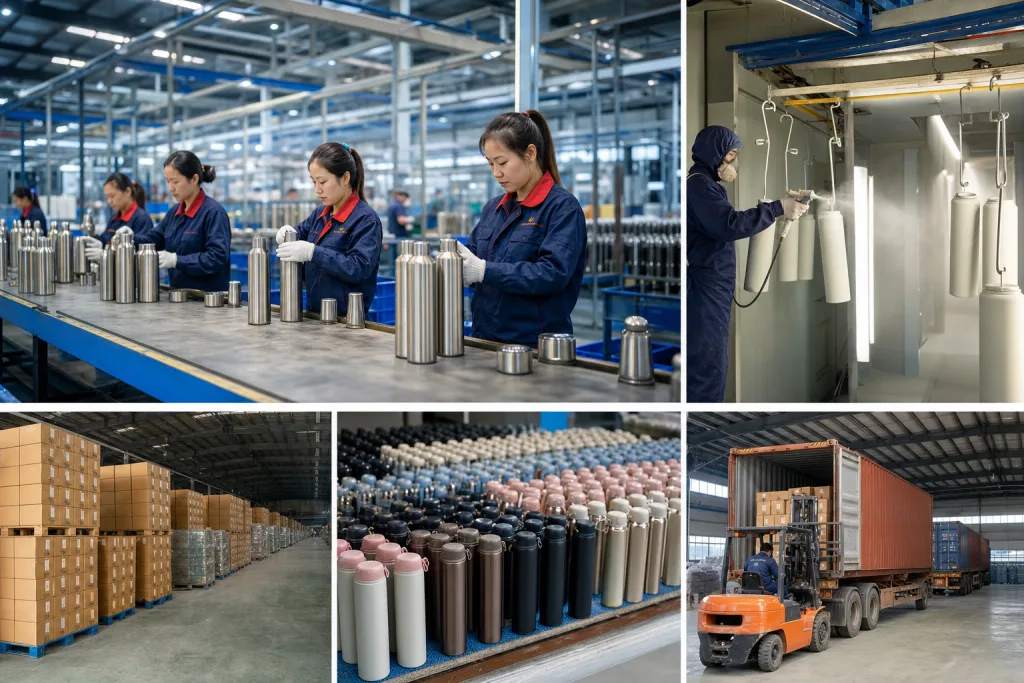
From our factory floor in Zhejiang, China, we hear the same question almost every week: what is the best promotional thermos bottle for real buyers, not showroom photos? This is the wrong question to ask first. A premium retail thermos, a distributor thermos for 10,000 event giveaways, and a rugged custom thermos for outdoor kits should not share the same lid, paint, or carton spec. We run different samples on the line for each case, and the buyer often flags the same thing on the PO: “logo must not scratch off.” The right comparison starts with specs, not slogans.
The spec table that matters
Read the spec table before you look at the photo. That is where the real job starts. Two bottles can both say “500 ml vacuum insulated stainless steel” and still act differently after 6 months in a warehouse, a trail bag, or a distributor sample kit. On our line, QC pulled a sample and checked 0.4 mm wall thickness with a caliper; the numbers matched the drawing, but the lid still needed a gasket change.
| Spec | Event giveaway | Outdoor retail | Premium brand gift |
|---|---|---|---|
| Capacity | 350-500 ml | 500-750 ml | 500-600 ml |
| Steel | 304 inner / 201 outer acceptable | 304 inner / 304 outer preferred | 304 inner / 304 outer |
| Wall thickness | 0.35-0.4 mm | 0.4-0.5 mm | 0.45-0.5 mm |
| Insulation target | 6-12 hours | 12-24 hours | 12-24 hours |
| Logo | Silk screen | Laser or powder-coated print | Laser, emboss, gift box |
| MOQ | 1,000-3,000 pcs | 2,000-5,000 pcs | 3,000-5,000 pcs |
The cheapest column is not always the wrong one. If you are shipping 2,000 bottles for a one-day dealer meeting, a 350 ml model with silk screen branding is enough, and we run that job all the time. If the bottle will sit on a retail wall at USD 18-28, the math changes fast: coating adhesion needs to hold, the carton has to survive transit, and heat retention has to stay steady. One buyer once flagged a PO typo that mixed up 304 outer and 201 outer, and that single line changed the whole cost sheet. A factory quote should show material grade, capacity tolerance, lid material, gasket material, finish, packing method, and test standard. If a thermos supplier only sends a photo and a unit price, you are still missing half the cost.
Event giveaway versus retail shelf
The best promotional thermos bottle for an outdoor retailer is rarely the same bottle a bank hands out at a conference. Outdoor buyers abuse it. They stuff the bottle in a backpack side pocket with keys, drop it on gravel, leave it overnight in a cold car, then complain if the lid seeps after 200 openings. On our line in Hangzhou, QC pulled samples last month with 0.35 mm body dents after a 1 m drop test, and that is where a loose bill of materials starts costing money.
For event use, a lighter body, standard PP lid, and single-color logo can pass if the brief is built around price. FOB China prices often sit around USD 3.20-4.80 for a 500 ml stainless thermos at 3,000 pcs, depending on coating and lid. For retail or outdoor bundle programs, expect USD 5.20-8.50 for a stronger 500-750 ml customized thermos with 304/304 steel, better powder coating, and individual color box. That extra USD 1.50-3.00 is not decoration. It pays for thicker steel, longer powder curing, tighter lid fit, and fewer returns after the buyer’s warehouse team starts opening cartons with a box cutter.
Here is the split we run in Zhejiang: event-grade thermos bulk orders for a 30-90 day campaign, retail-grade thermos custom orders when your brand name stays on the bottle for years. A distributor thermos program can sit between both: 304 inner wall with a checked wall thickness, a simple lid that passes leak testing upside down for 30 minutes, neutral matte coating, and laser logo. One outdoor distributor once pushed back on USD 0.42 for coating upgrade; six weeks later the buyer flagged scratches around the cup holder contact area. The math does not work when a cheap bottle carries a serious outdoor logo.
Do not ask a factory to make a retail bottle at giveaway pricing. It puts pressure on steel gauge, coating time, lid resin quality, and inspection hours, and we have seen this go sideways before shipment.
Steel, vacuum, and heat retention
Most buyers write “304 stainless steel” on the RFQ, then forget to say where. Big difference. The inner wall touches coffee, tea, and juice, so 304 stainless steel is the baseline for food contact. Some thermos manufacturers switch the outer wall to 201 stainless steel to save cost; for a dry office giveaway, that can pass. For outdoor retail, the math doesn’t work. We’ve seen 201 outer shells come back with rust spots after salt-spray feedback from a coastal buyer, even though the liner passed the magnet check and material report. A 304 outer wall holds up better when bottles sit in rain, salt air, sweat, or a wet backpack pocket.
Vacuum performance comes down to weld quality, vacuum draw, copper lining if used, and neck design. A 500 ml vacuum bottle with a narrow mouth usually holds heat better than a wide-mouth bottle made from the same steel grade. On the line, QC checks the mouth weld with a water bath and then pulls samples for heat testing after the vacuum furnace cycle. A fair claim is 12 hours hot above 50-55°C when filled with 95°C water and tested at 20°C room temperature. Cold retention may reach 18-24 hours with ice water, but the test condition needs to be written on the spec sheet. Do not print “24 hours hot” unless your supplier thermos factory has test data to back it up.
For outdoor retail, ask for three numbers before approving the sample: empty bottle weight, inner and outer wall thickness, and the heat retention curve with time stamps. A 500 ml bottle around 280-340 g is common, but mold shape, lid structure, and paint thickness all move the number. We once had a buyer flag a 38 g drop between golden sample and bulk sample; QC pulled the sample, cut the body, and found the outer wall had been thinned by 0.08 mm. If a thermos vendor quotes a suspiciously low price and the weight drops by 40 g, the saving likely came from thinner steel or a lighter lid. Across 10,000 pcs in China production, that saving looks tempting, but it shows up later as denting and weak insulation.
At BottleForge Industrial in Hangzhou, Zhejiang, our stainless thermos lines can produce about 600,000 units per month across standard and custom molds, with normal custom color lead time at 30-45 days after approved pre-production sample. We run color checks with a Pantone book under D65 light, and if the buyer’s PO says matte black but the artwork file says satin black, we stop and confirm before spraying 10,000 pcs.
Logo methods compared honestly
A customizable thermos earns its place only when the branding survives daily handling, carton rubbing, and a few drops on a trade-show floor. Match the logo method to the surface finish, budget, and sales channel. We see this mistake about 6 times a month: a buyer pays for expensive decoration on a thin low-cost body, or a retail brand saves USD 0.12 on the logo and then gets shelf samples that look cheap. The math doesn't work. On our line, QC pulled a powder-coated 500 ml sample last week after the printed logo failed at the rim curve during a 3M tape test.
Silk screen printing
Silk screen is the steady option for thermos promotional orders. It suits one- or two-color logos on smooth powder-coated or painted bodies, and the print edge stays sharp if the artwork is not too thin. Setup cost is low, usually USD 40-80 per color, and unit cost can be USD 0.08-0.25 depending on coverage. Abrasion is the weak point. If the bottle will sit in a hiking pack with keys, ask for adhesion testing and keep line width above 0.3 mm; we had one buyer flag a 0.18 mm slogan because half the letters closed up after printing.
Laser engraving
Laser looks cleaner and lasts better. It cuts through the coating and exposes the stainless steel underneath, so there is no ink layer to peel off. For a customized thermos sold in outdoor retail, laser usually gives a more solid retail feel and handles repeated use. Color is the limit: most jobs finish as silver on coating or a dark mark on bare steel, not full color. Unit cost commonly sits around USD 0.15-0.45 depending on logo size and placement. We run a fiber laser for most bottle bodies, and if the logo wraps too close to the weld line, the mark can look uneven by 1-2 mm.
Powder coating with custom color
For a thermos manufacturer, custom powder coating brings more variables than buyers expect. Pantone matching is possible, but matte black, navy, olive, sand, and white do not behave the same in production. White shows dirt and scratches. Matte finishes can burnish during sea freight if the polybag is thin or the carton divider rubs the shoulder. Ask for cross-cut adhesion testing, color tolerance, and a packed sample before mass production. For larger thermos bulk programs above 5,000 pcs, custom color is usually worth the extra control because the shelf impact is stronger; below that, stock powder colors often ship 12 days faster than a new matched color.
Lids decide the complaint rate
If you compare only the stainless body price, you miss the part the customer touches 30 times a day. Lids drive most after-sales cases we see: leaks, odor, weak hinges, missing gaskets, cross-threading, and rough drinking flow. The quote should state lid material, gasket material, spare gasket option, and leak test method; if it just says “standard lid,” the buyer should push back. On our line, QC checks the PP lid thread with a go/no-go gauge before packing, because a 0.3 mm mismatch can turn into a leaking carton.
For outdoor retailers, we usually run simple screw lids or push-button lids with replaceable silicone seals. Fewer parts win. Complicated flip lids look good in catalogs, but every spring, hinge, and button adds another place for failure after 2,000 open-close cycles. For hot drinks, pressure release and drinking safety matter. A lid that pops open after holding hot tea creates a real customer complaint, not just a bad review; we have seen one buyer flag this after steam pressure lifted the button during a pre-shipment sample check.
Food contact compliance should be on paper, not promised in a chat message. For Europe, ask for LFGB or EU food contact declarations where applicable, plus REACH for coatings. For North America, BPA-free PP and silicone documentation is a common request, and some programs ask for FDA food contact statements. If your promotional thermos is for kids, schools, or national retail chains, requirements can get stricter, including CPSIA or ASTM-related review depending on the product design. We once had a PO typo listing “ABS lid” instead of PP, and the lab report would not match until the buyer corrected it.
Before mass production, run a simple buyer-side test: fill 10 samples with colored water, invert for 30 minutes, shake each bottle 20 times, then leave them sideways overnight. Do it on a white towel. A thermos factory should also perform 100% leak testing on finished goods; we ship only after the line checks each lid under the leak-test jig. At AQL inspection, we usually treat leakage as a critical defect, not a minor issue. One leaking bottle can make the whole carton smell like failure, and the math does not work if a 5,000 pcs promo order needs repacking because one gasket batch was too soft.
MOQ, pricing, and lead time
MOQ is not a punishment. It is the point where 304 stainless coil ordering, powder coating line setup, logo jig making, carton printing, and AQL 2.5 inspection hours stop fighting the cost sheet. For standard color custom logo orders, a realistic MOQ from China is often 1,000 pcs per model. For custom powder color, 3,000 pcs is more common because the coating booth needs cleaning and color changeover; we measured 42 minutes last week just to switch from matte black to Pantone 5425C. For a new mold or unusual lid, 10,000 pcs may be needed because tooling, testing, and component sourcing take 18 days vs 12 days on regular lids.
A basic 500 ml bulk thermos with one-color silk screen may quote at USD 3.20-4.80 FOB Ningbo or Shanghai at 3,000 pcs. A 304/304 outdoor retail bottle with laser logo, powder coating, and individual box may sit at USD 5.20-8.50. Gift packaging and carabiner lids add cost; tea infusers, copper lining, handle lids, and extra gaskets push it again. Small parts matter. Last quarter QC pulled the sample because a buyer approved a handle lid but forgot the spare gasket line on the PO, and the rework cost more than the gasket itself. Air freight can destroy the economics of low-cost drinkware, so plan ocean freight unless the campaign deadline is locked and margins can carry it.
Normal timing is predictable if you approve details quickly. A stock sample takes 3-7 days. A custom logo sample takes 7-12 days. Mass production usually takes 30-45 days after sample approval and deposit. Sea freight to the US West Coast may add 18-28 days port-to-port; Europe often needs 30-40 days depending on routing. Add buffer for customs, delivery appointment, and retailer compliance checks; we have seen a delivery appointment slip 5 days because one carton mark used “500ML” while the buyer’s routing guide showed “500 ml.”
Distributor thermos programs should also plan reorder logic. If you launch with five colors but only reorder one, your MOQ per color becomes the problem. For first orders, two colors are easier to control than six. The line runs cleaner, QC checks shade difference faster with a D65 light box, and your warehouse does not sit on 1,200 pcs of the slow color. You can expand once sell-through data proves demand.
Inspection before the container closes
The final choice between thermos suppliers should include quality control, not only FOB price. For stainless thermos, we run pre-production sample approval, inline checks at the coating line and lid assembly, and final random inspection under AQL. A common setting is AQL 2.5 for major defects and 4.0 for minor defects, with critical defects such as leakage set at zero tolerance. QC pulled the sample with a 0.02 mm feeler gauge at the lid seat, and that kind of check catches trouble before the container is locked.
Check the things your customer will notice first: coating scratches, color mismatch, logo position, lid fit, odor, sharp edges, dents, and dirty interiors. Then check export issues: barcode readability, FNSKU placement if you sell through marketplace fulfillment, carton strength, master carton weight, polybag warnings if required, and pallet configuration. We scan cartons with a handheld barcode gun and catch PO typos on FNSKU lines before they turn into warehouse charges. A beautiful customized thermos that arrives with crushed color boxes is not retail-ready.
For outdoor retailers and promotional brands, packaging needs a use-case decision too. Bulk packed bottles reduce cost and waste for event distribution. Individual kraft boxes work for distributor thermos sales kits. Printed retail boxes help shelf presentation but add artwork approval and carton testing time. If you sell in Europe, keep packaging material and recycling marks consistent with local expectations. We run a 76 cm drop test on packed cartons, and the buyer who wants retail graphics on a giveaway order is asking the wrong question.
A good thermos manufacturer in Zhejiang, China should be willing to show inspection photos, production videos, compliance files, and packed carton details before balance payment. You do not need drama at shipment time. You need a factory thermos partner that tells you early if a matte coating is scratching, a gasket batch is late, or a carton needs a stronger K=K board. On the line, we ship when the photos match the pallet spec, not after. That honesty is worth more than another USD 0.10 discount on paper.
Send your thermos brief for a factory quote
Share capacity, logo method, target price, and market. We will return practical specs, MOQ, lead time, and FOB options.
Frequently asked questions
What is the best promotional thermos bottle size for outdoor retail?
For outdoor retail, 500 ml and 750 ml are the safest sizes. A 500 ml bottle fits most cup holders and daypacks, while 750 ml feels more serious for hiking, camping, and winter sports. For distributor giveaways, 350 ml can work, but it often feels too small for outdoor customers. If you want one SKU for both promotional and retail use, choose a 500 ml 304 stainless steel vacuum bottle with screw lid, powder coating, and laser logo. It balances unit cost, freight weight, and perceived value. At 3,000 pcs, expect a practical FOB China range of USD 5.20-7.50 for a stronger retail-grade build.
What MOQ should I expect for a custom thermos order?
For a standard factory thermos model with your logo, MOQ is usually 1,000 pcs. If you need a custom powder-coated Pantone color, plan for 3,000 pcs per color because the coating line setup and material loss must be covered. For a customized thermos with a new lid, new mold, or unusual shape, MOQ can move to 10,000 pcs or more. A sensible first order for an outdoor retailer is often 3,000-5,000 pcs across two colors. That gives you enough volume for stable pricing without creating too much inventory risk.
Is laser engraving better than printing on stainless thermos bottles?
Laser engraving is usually better for long-life outdoor products because it will not peel or rub off. It works especially well on powder-coated stainless steel, creating a clean metal mark. The trade-off is that laser is not full color. Silk screen printing is cheaper and better for bright multi-color promotional logos, but it needs good coating adhesion and abrasion testing. For a promotional thermos used at an event, silk screen is often enough. For a retail custom thermos sold under your outdoor brand, laser is normally the safer choice. Typical laser cost is USD 0.15-0.45 per unit depending on logo size.
How long does production take for bulk thermos orders from China?
For a regular thermos bulk order from China, plan 30-45 days for mass production after sample approval and deposit. Add 7-12 days for a custom logo sample if you do not already have an approved sample. Ocean freight adds roughly 18-28 days to the US West Coast and often 30-40 days to Europe, depending on port and season. If you need retail packaging, compliance review, or special carton testing, add another week of buffer. For a fixed campaign date, start the sourcing process at least 90 days before delivery.
What quality tests should a thermos supplier perform before shipment?
A reliable thermos supplier should perform 100% leak testing, visual checks for coating and logo defects, capacity checks, lid fit checks, and random heat retention testing. For final inspection, use AQL 2.5 for major defects and 4.0 for minor defects, with leakage treated as critical. For retail orders, add carton drop testing, barcode checks, color box inspection, and odor checks. If you sell in Europe or North America, ask for food contact documentation, BPA-free statements for plastic parts, and REACH information for coatings. Do not release balance payment based only on finished product photos.