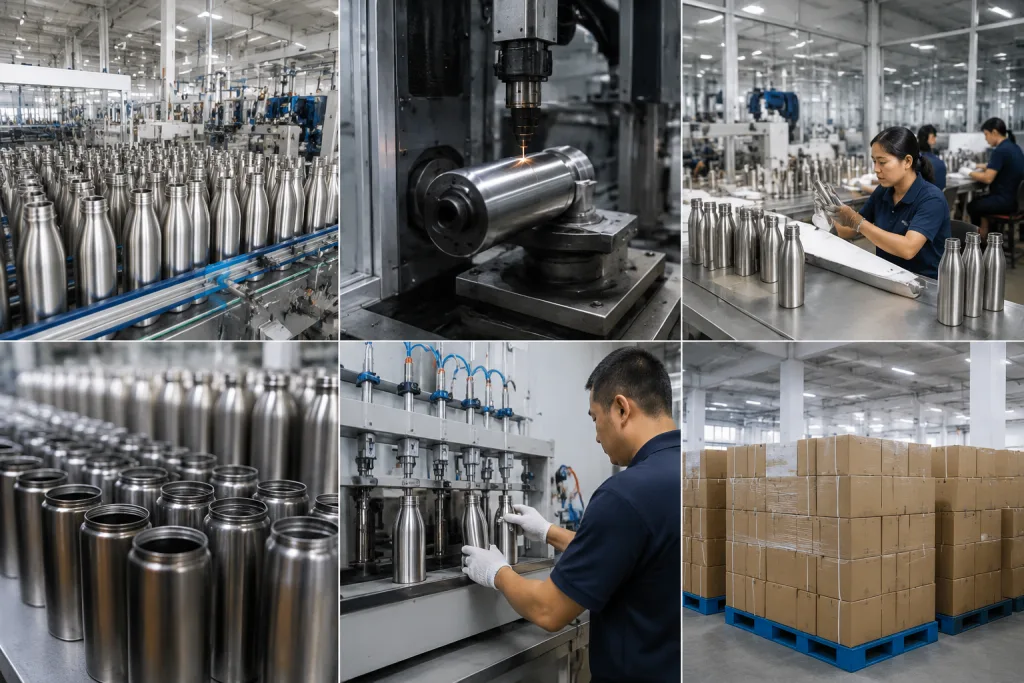
Key Takeaways
- 304 stainless steel is the practical baseline; 316 only pays off for higher corrosion risk and premium positioning.
- A 500 ml bottle with double-wall vacuum insulation should hold heat for 6-12 hours and cold for 18-24 hours, depending on lid design.
- For bulk thermos orders, expect MOQ from 500 to 3,000 units and a normal lead time of 25-40 days in China.
- Laser engraving usually lasts longer than color print on a promotional thermos, especially for outdoor use.
If you are buying the best promotional stainless steel bottle for outdoor retail or brand campaigns, shopping by looks alone is the wrong call. We’ve seen a glossy sample hide weak insulation, 0.4 mm walls, or a logo that starts peeling after two washes. Start with the basics: steel grade, lid style, decoration method, and order math.
That is how seasoned buyers work with a thermos manufacturer in Zhejiang or a thermos supplier in China. They check wall thickness, lid seal performance, AQL 2.5, and lead time before they talk about Pantone colors. A solid factory thermos has to protect margin, pass EU and North American compliance checks, and still look premium at 5,000 or 20,000 units.
Start with the end use
The best promotional stainless steel bottle for a trail campaign is not the same bottle you pick for a golf club gift set or a national outdoor chain shelf. Start with the end use. If the bottle rides in backpacks, car cup holders, and jobsite kits, we run a rugged cap, a powder-coated body, and a shape that survives a 1.2 m drop test. If it is a premium promotional thermos for executives, the finish, the box, and the unboxing sequence matter more than scratch resistance.
Ask three questions before you quote anything: how often will it be washed, how long must it hold temperature, and who carries it? QC pulled the sample on a 500 ml bottle after a 12-hour heat test, and that told us more than a long spec sheet. The answer decides whether you need a 500 ml single-wall bottle, a 750 ml vacuum bottle, or a 1 L stainless thermos with a tea infuser. A distributor thermos for retail has to balance shelf appeal and repeat use. A thermos promotional item for an event can take simpler decoration if the logo still reads cleanly from 2 meters away.
- Retail outdoor use: prioritize grip, dent resistance, and lid durability.
- Corporate gifting: prioritize appearance, packaging, and engraving quality.
- Field teams: prioritize leak resistance and one-hand opening.
In China, the better factories push you to define the use case first because it avoids rework later. The buyer flagged a PO typo once, and the whole carton mark had to be redone before ship-out. A Zhejiang manufacturer with real export experience will not say yes to every spec; that is the right filter, not a problem.
Choose steel and insulation
Material choice is where a lot of buyers overspend or miss the spec. For most custom thermos programs, 304 stainless steel is the right starting point. It gives solid corrosion resistance, broad food-contact acceptance, and cleaner cost control. We run enough bottles to know the math: if the order is for coffee, tea, or plain water, 304 usually wins. If the bottle will hold acidic drinks, salty sports mixes, or sit in humid storage for 30 days, 316 is worth the extra cost. QC pulled the sample after an acid soak, and that is where the gap shows up.
Wall construction matters just as much. A double-wall vacuum bottle usually runs 0.4-0.5 mm inner and outer wall thickness, sometimes a touch higher on larger sizes. If the seller cannot tell you the gauge, stop there. Vacuum performance should be written in hours, not slogans. A 500 ml customizable thermos should normally deliver 6-12 hours hot and 18-24 hours cold, but only when the lid seal and vacuum pull are right. We have seen a buyer flag a PO typo on the capacity and then wonder why the heat test missed target. The numbers have to match the line.
Do not assume thicker is better. Extra metal can make the bottle heavier without lifting performance if the vacuum gap is off. A well-made 18/8 stainless body with a proper vacuum draw and copper plating on the outer wall can outperform a heavier bottle with poor processing. That is not theory. On one run, the weight went up by 38 g and the insulation got worse. The wrong question to ask is, “Which one feels tougher?” Ask for the process sheet instead.
“If a supplier cannot explain wall thickness, vacuum process, and leak testing in plain numbers, you are not buying engineering; you are buying hope.”
For B2B sourcing, ask for material declarations, food-contact compliance, and, if needed, REACH-aligned documentation for the coatings and packaging. Buyers in Europe and North America care about that more than a glossy brochure. We ship plenty of sample sets with a 24-hour leak test report and still get pushback on paperwork first. That is normal.
Pick a lid that survives abuse
The lid is usually the failure point, not the bottle body. We’ve seen a custom thermos with clean insulation still trigger complaints because the cap leaked in a commuter bag. For outdoor retail, I prefer lids with fewer moving parts unless the drink use case truly needs them. A screw cap with a silicone gasket is simple, durable, and easier to clean. A flip lid gives convenience, but it also brings hinges, springs, and more ways to fail.
For a promotional thermos, judge the lid on four points: leak resistance, opening force, washability, and spare-part availability. If the lid threads feel rough on a sample, that points to tooling or QC that is not set up right. If the gasket sits loose or the stopper wobbles, do not expect mass production to fix it. We’ve seen that go sideways when a factory thermos order is rushed, and the line just keeps moving.
Some buyers ask for straw lids for sports use. That can work, but only when the target audience accepts the extra cleaning. Straw systems suit cold drinks, they cut into heat retention, and they are usually the wrong answer for a thermos customized for winter use. If you need a one-hand, car-cup-friendly format, lock the drinking profile early so the thermos manufacturer can match the lid geometry to the body diameter. The buyer flagged it late on one PO, and the lid no longer fit the 74 mm cup holder.
- Simple screw cap: best for durability and low complaint rates.
- Flip top: best when convenience matters more than service life.
- Straw lid: best for cold-use promotions, not hot-drink insulation.
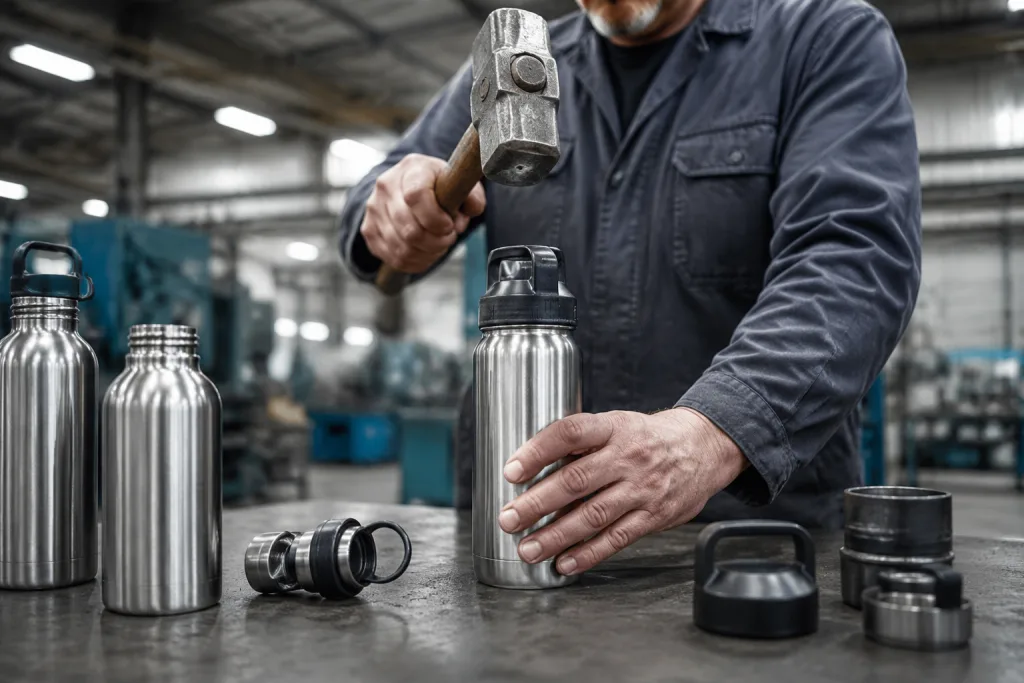
Decoration should match the channel
Logo choice changes sell-through more than most buyers admit. We have seen the line go sideways on this exact point. A promotional thermos sold through outdoor retailers should stay restrained, not overloaded with print. Laser engraving is usually the safest custom logo for a premium bottle because it holds up through abrasion, dishwasher cycles, and UV better than most inks. If you need color branding, screen print and heat transfer can work, but QC should check rub resistance and color shift on coated bodies.
For thermos custom programs, ask the supplier to quote two decoration methods, not one. A polished stainless body with a single laser logo looks clean and expensive. A powder-coated body with one-color print fits mass promotion, especially when the target is 5,000 units or 20,000 units and every cent matters. Do not push a full wrap graphic onto a curved surface unless you are ready to inspect alignment closely. We once saw a buyer flag a 2 mm shift on a 20,000-unit PO, and the math did not work.
If you sell to distributors or run private-label retail, packaging is part of decoration. Gift boxes, sleeves, insert cards, and barcode application need to be locked before sampling. For Amazon or other e-commerce channels, you may need FNSKU labeling, carton marks, and packaging that survives a 1.2 m drop test. A thermos supplier that handles that in-house saves rework, and it cuts the “who missed the label” back-and-forth we all know too well.
When the brief is unclear, choose the simplest decoration that fits the brand channel. The best promotional stainless steel bottle is usually the one that looks premium on day one and still looks acceptable after 100 cycles of use.
Treat MOQ and price like a system
Price only makes sense when you tie it to MOQ, lead time, and service level. In China, a normal bulk thermos run starts at 500 to 3,000 pieces per SKU, and the number shifts with color count, lid structure, and gift box spec. A 500 ml 304 stainless bottle usually sits at USD 3.20-5.80 FOB China on larger buys, while laser engraving or premium cartons push it up fast. That spread is normal.
Do not ask for unit price alone. Ask for tooling fees, sample fees, decoration setup, carton spec, and spare parts. We have seen buyers get a low bottle price and then lose it in packing or prep charges, and the math stops working. A proper thermos quote should split each cost line so you can compare the offer cleanly, not chase a fake low number.
Lead time matters as much as cost. A realistic mass-production window is 25-40 days after sample approval and deposit, with extra time for new molds, special lids, or custom packaging. If someone promises 12 days on a fresh stainless thermos project, ask what got cut. Usually it is inspection, curing, or proper packing, and QC pulled the sample because the line skipped a step.
For large orders, set your tolerance plan around AQL 2.5 for major defects and 4.0 for minor defects, then match that to your market risk. A retail distributor order can live with a small visual mark if the insulation holds and the lid seals at 90 degrees. A premium corporate gift cannot, and we ship those with tighter checks at the 1 mm gap level.
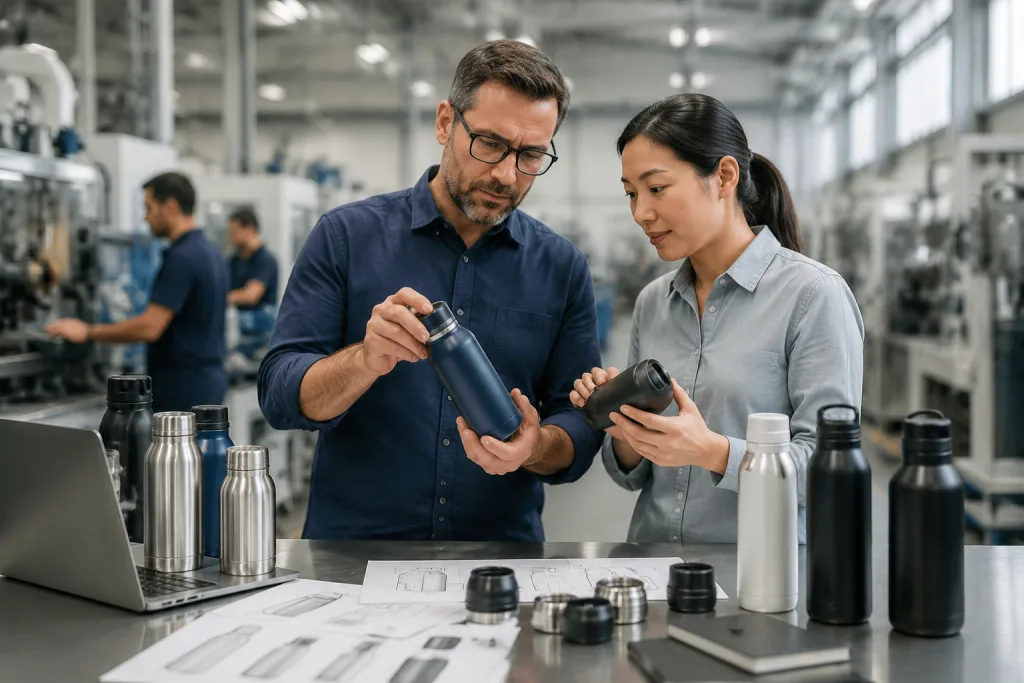
Audit the factory, not the sample
A perfect sample proves almost nothing unless the factory can repeat it at scale. We’ve seen buyers approve one good piece, then the line slips on the second carton. Ask straight away who owns shell forming, vacuum sealing, polishing, coating, printing, and final leak testing. If those steps bounce between subcontractors, traceability turns muddy and defect control gets weak fast.
Ask for monthly output, not a glossy “capacity” number. A Zhejiang plant we know can run 300,000 to 800,000 units a month across multiple lines, with QC pulling samples at each stage. That matters when your promo launch has a 12-day window, not 18. If your channel needs social compliance, ask for BSCI, then ask for batch records, incoming material checks, and the actual inspection log, not a PDF cover page.
QC should be practical, not theatrical. Leak test, thermal retention check, coating adhesion check, carton drop test. That’s the list. If the supplier throws out ISO, ask how it shows up on the line, with the pressure tester, the oven, and the rework station. Paper certificates do not ship goods. You also need a clear answer on defects: who reworks, who replaces, and what happens if the first carton fails arrival inspection.
When a manufacturer in China knows export work, they talk process control in plain terms. That is the thermos manufacturer you want, whether you call them a supplier, vendor, or factory partner.
Build your order around channel risk
Outdoor retailers and promotional brands do not buy the same way, even when the bottle is identical. Retail buyers want stable replenishment, barcode accuracy, and shipment-to-shipment variance that stays inside spec. Promo buyers care about artwork sign-off, campaign dates, and a clean handoff to the marketing team. We run those jobs differently for a reason.
If you are building a long-term program, pick one core body and one or two lid variants. That keeps thermos bulk planning under control and cuts the risk of dead stock. If this is a campaign test, keep it tight: one color, one logo, one carton spec. We’ve seen the math go sideways when buyers try to launch six SKUs at once. A custom thermos program gets easier when you stop pretending every channel needs the same setup.
Use simple governance: approved sample, approved artwork, approved carton, then pre-production check. Do not skip the pre-production sample because the first one looked fine. QC pulled the sample on a 500 ml bottle and found a 1.2 mm gap at the lid seat; that is the kind of miss that turns into a claim later. Ask for live photos or video from the line if you cannot visit China. A supplier thermos that shares process details early is usually easier to handle after shipment too.
The best promotional stainless steel bottle is the one that fits the channel without creating noise on your side. That is the right order of decisions: use case first, material second, lid third, decoration fourth, then factory control from start to finish.
Source your next bottle with less risk
Send your target size, logo method, and monthly volume. We will help you spec a promotional thermos that fits retail, gifting, or bulk campaigns in China.
Frequently asked questions
What is a realistic MOQ for a custom stainless thermos?
For most thermos custom projects, MOQ is 500 to 3,000 units per SKU. Simple colors and standard lids can start near 500 units, while special finishes, molded lids, or premium packaging often push you toward 1,000 or 3,000. If a thermos factory offers 100 units on a fully customized body, check whether they are using stock inventory or charging heavily for setup. MOQ changes with decoration too: laser engraving is easier than multi-color print. For outdoor retail, I would rather place a 1,000-unit order with stable quality than chase a tiny MOQ with weak process control.
How do I compare insulation claims from different suppliers?
Use the same test conditions every time. Ask each thermos supplier to test a 500 ml bottle filled at the same starting temperature, sealed with the same lid, and held in the same room. A credible promotional thermos should usually show 6-12 hours hot retention and 18-24 hours cold retention, depending on the design. Watch for vague claims like “all-day hot”; that tells you almost nothing. Ask for the test method, room temperature, fill volume, and lid type. If the manufacturer cannot provide those details, the number is marketing, not engineering.
What decoration lasts longest on a stainless bottle?
Laser engraving is the most durable choice for most promotional thermos programs. It does not chip like some coatings and holds up better than print under abrasion and repeated washing. For a powder-coated body, one-color screen print can still work if the finish is tested properly. If you need full-color branding, be prepared to validate rub resistance, dishwasher exposure, and UV stability. For outdoor retailers, a restrained engraved logo often sells better than a loud printed design because it looks more premium and ages more cleanly.
Can I import custom thermos products into Europe or North America?
Yes, but you need the right documents and packaging. Ask for food-contact declarations, REACH-related material support for coatings and inks where relevant, and any required test reports tied to your exact SKU. For North America, carton markings, barcode accuracy, and retail labeling matter as much as the bottle itself. If you are selling through Amazon, you may also need FNSKU labels and carton compliance. A good supplier thermos partner in China should support these basics without making them feel optional. That saves delays at customs and at the warehouse.
What should I inspect before paying the balance?
Check leak tests, logo placement, color consistency, carton condition, and random sample function from the finished batch. For a larger thermos bulk order, inspect against AQL 2.5 for major defects and 4.0 for minor defects if that fits your risk profile. Make sure the lids screw smoothly, gaskets seat correctly, and the vacuum performance matches the approved sample. If possible, open random master cartons and test 2-3 units per carton. The balance payment should follow the same discipline as the sample approval, not hope.