Key Takeaways
- For most promotional sport bottle orders, 3,000 pcs is a realistic MOQ for custom color and logo
- Single-wall bottles are cheaper, but double-wall vacuum bottles usually deliver better perceived value
- Logo method should match the surface: laser for stainless steel, screen print for large color artwork
- Ask for AQL 2.5/4.0 inspection, REACH/LFGB or FDA documents, and a 5-carton drop test before shipment
The best promotional sport bottle is not the one with the nicest catalog render. It is the bottle your customer still uses after 6 months, the lid that does not leak in a backpack, the carton that survives a 76 cm drop test, and the shipment that reaches the warehouse before the campaign date. At 3,000 to 50,000 units, one weak gasket or the wrong logo process can turn a clean promotion into chargebacks. We have seen this go sideways.
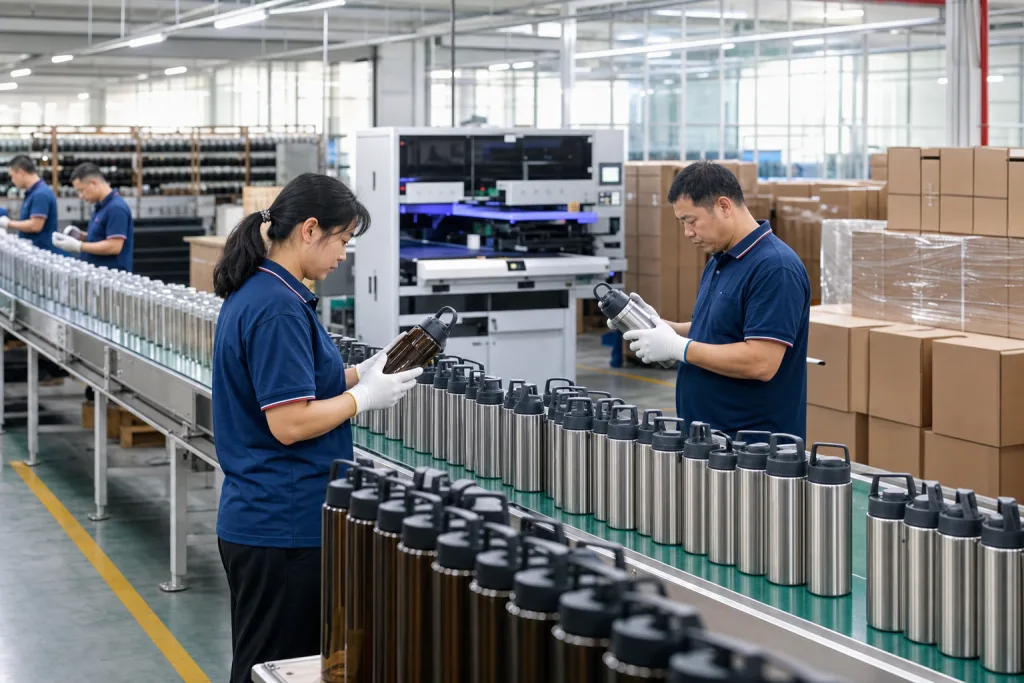
We manufacture custom drinkware in Zhejiang, China, and the same mistakes show up on the line every month. Buyers compare FOB prices, then skip the checks that decide whether the order passes: steel grade, carton drop test, AQL level, and spare gasket policy. Last month QC pulled the sample on a canteen custom order because the PO said “304 stainless,” but the approved sample sheet missed the lid gasket material. Small typo. Big delay. This guide covers the practical questions a procurement manager should ask before placing a sport bottle order.
What counts as best?
For a B2B buyer, the best promotional sport bottle is not the highest-spec product. It is the bottle that fits the campaign budget, user habit, logo process, and delivery risk. A gym giveaway and a school sports day order should not share the same spec. Last month we had a PO that said “blue” only; our QC team stopped it at the Pantone card stage because the buyer meant 2925C, not navy.
If the user will carry the bottle while running or cycling, weight and one-hand opening matter. A 650 ml single-wall stainless bottle around 150-190 g is easy to carry and keeps the FOB price under control. Good fit. For a premium employee gift, a 500-750 ml double-wall vacuum bottle feels more substantial, usually 260-380 g depending on body diameter and lid type. A plastic Tritan sport bottle makes sense for kids or fitness clubs because it is lighter and transparent, but ask for BPA-free documentation before deposit. We check lid torque with a simple torque meter on the line; if the flip cap feels loose at sampling, mass production will not fix it.
Promotional buying uses different math than retail buying. You may not need a thick retail box, foam insert, or hang tag, but you do need logo consistency, clean printing, and a low defect rate. A bottle that costs USD 0.18 less but shows 4% lid leakage is not cheaper after replacements, credit notes, and angry distributor emails. We have seen this go sideways. At our Zhejiang facility, a normal promotional sport bottle line can produce about 350,000 units/month, but that capacity only helps if the spec is locked early, including logo size in mm and carton mark wording.
Good procurement starts by defining failure: leaking, late delivery, logo peeling, color mismatch, or non-compliance. Then choose the bottle that avoids those failures. QC pulled the sample, not the brochure.
Which material should you choose?
The common choices are stainless steel, Tritan, PP, and aluminum. For long-term brand value, stainless steel is the safest bet 8 times out of 10. For food contact, buyers commonly specify 18/8 stainless steel, also called 304 stainless steel. For a promotional bottle, a wall thickness of 0.4-0.5 mm is common for single-wall construction; our incoming QC checks it with a digital thickness gauge before the sheet goes to deep drawing. Vacuum bottles usually use inner and outer walls around 0.3-0.5 mm depending on size and forming process. Cheap steel is tempting. The math doesn't work if the logo dents before the second campaign.
Tritan works when you need a clear, lightweight bottle, especially for 600 ml and 750 ml sports bottles where the buyer wants to see the water level. It is often used for sports teams, fitness challenges, and school promotions, but we still ask for BPA-free and food-contact test reports before mass production. PP is lower cost, and a 10,000 pcs order can save real money, but it looks more budget and can deform under high heat if the formulation and wall design are weak; we once had QC pull a PP sample after a 70°C hot-water test because the shoulder went oval. Aluminum is light, but most aluminum bottles need an internal coating. That coating is the real risk point, so ask what coating is used and whether it passes relevant food-contact testing.
For buyers searching canteen custom, custom canteen, or customizable canteen options, stainless steel is the usual starting point. The word canteen can mean a round military-style bottle, a camping flask, or a basic sport bottle depending on the market. Send a drawing or reference size in mm. We have seen this go sideways when a PO said “canteen 1L” but the buyer meant a flat army-style bottle, while the line quoted a straight 1 L sport bottle. A canteen factory in China may read the term differently from a North American distributor canteen buyer.
- Budget event: PP or single-wall stainless steel, 500-750 ml, usually for short campaigns where unit price beats insulation performance.
- Fitness promotion: Tritan or stainless steel with flip lid, 600-1,000 ml, with a leak test on the lid before carton packing.
- Premium corporate gift: double-wall vacuum stainless, powder coating, 500-750 ml, with logo position checked against the artwork proof.
- Outdoor campaign: stainless bottle or customized growler, 1 L to 1.9 L, where handle strength and cap sealing matter more than saving a few cents.
What should the quote include?
A good quote is not just a unit price. It should show what we run, what we pack, and what is excluded. When comparing canteen suppliers or canteen manufacturers, ask for a quote table with material, capacity, finish, logo method, packaging, MOQ, sample time, mass production lead time, FOB port, and validity period. Ask for the drawing number too; last month QC pulled two “750 ml” samples and one measured 735 ml to the brim with a lab cylinder. Without this detail, you may be comparing three different bottles under one item name.
For a standard customized drinkware order, the MOQ is often 1,000 pcs for an existing color with a simple logo, and 3,000 pcs for a custom powder-coated color. New mold or customized lid work can push MOQ to 5,000-10,000 pcs. Normal sample lead time is 7-10 days for existing bottle molds with logo, while mass production is commonly 30-45 days after artwork and deposit approval. Peak season before summer and Q4 gifting can add 10-15 days. The line gets tight fast. We have seen buyers ask for “same price, new lid, 18 days production”; the math does not work if the lid needs a new silicone gasket tool.
FOB Ningbo or FOB Shanghai is common for Zhejiang and nearby China factories. If you are a distributor drinkware buyer in Europe or North America, request carton dimensions and gross weight early. Freight can change the real landed cost by USD 0.20-0.80 per unit depending on bottle size and packaging. A 24 pcs carton with 62 x 42 x 28 cm measurements ships differently from a 12 pcs color-box carton, even when the bottle cost looks the same on the PI.
Checklist for a comparable RFQ
- Capacity in ml and oz, with clear wording on brim capacity versus practical fill line; we usually check with a graduated cylinder.
- Material grade, such as 304 stainless steel inner wall, plus outer wall grade if your market asks for it.
- Finish: powder coating with Pantone reference, spray paint with coating thickness, polish level, matte texture, or raw stainless.
- Logo size, position, Pantone colors, and artwork file format; AI, PDF, or CDR prevents the usual “logo shifted 3 mm” argument.
- Packaging: polybag, white box, color box, kraft box, or bulk pack, with carton pcs count and drop-test requirement if needed.
- Inspection standard: AQL 2.5 major / 4.0 minor or your internal standard, including leak test, logo rub test, and coating scratch check.
- Incoterm: FOB, CIF, DDP, or EXW, with port named clearly; do not let “China port” sit on the PO as a blank trap.
How do logos hold up?
Logo durability comes down to the bottle surface and the process we run on the line. For stainless steel, laser engraving lasts best because it cuts or marks the surface instead of sitting on top as ink. We usually set the fiber laser on powder-coated 304 stainless so the logo opens up to the steel base, clean and sharp at around 0.1-0.2 mm visual depth. Good for one-color logos and premium orders. Bad for big multi-color campaign art; the math doesn't work.
Silkscreen printing fits simple one- to three-color logos. It is low-cost and fast, but ink adhesion depends on surface treatment, mesh setup, and curing time. On powder coating, a good factory should run a 3M tape test after curing; QC pulled one sample last month where the edge lifted after cross-hatch cutting, so we stopped the print run before 3,000 bottles went into cartons. Heat transfer can reproduce full-color artwork, but the curve must be controlled on cylindrical bottles or the seam will drift 2-3 mm. UV printing works for smaller batches and complex artwork, though it is usually not the best price for large orders.
If you are ordering canteen promotional products through a canteen vendor, ask for the logo process by name, not just “custom logo.” A canteen customizable project with a 25 mm chest-style logo is a different job from a 360-degree wrap. Also check whether the logo is included in the quoted price. Some canteen vendors quote bottle only, then add USD 0.08-0.35 per unit for logo, depending on size and color count. We have seen this go sideways when a PO said “logo included” but the artwork file showed four colors on both sides.
For color matching, give Pantone C codes and accept a tolerance. Powder coating has batch variation, and exact color match is harder on textured finishes; even two approved panels can read differently under a D65 light box versus factory LED lamps. A realistic Delta E tolerance or signed color sample prevents arguments later. For customized canteen and customizable drinkware projects, we recommend approving a physical pre-production sample, not only a photo under factory lighting. Photos hide too much.
What compliance documents matter?
Compliance changes by destination market and material. For the EU, buyers usually ask for LFGB, REACH, and sometimes BPA-free reports for PP, Tritan, or PE plastic parts. For the US, FDA food-contact compliance is the normal request, and some buyers add California Proposition 65 review. For children’s drinkware, expect stricter testing such as CPSIA and ASTM-related requirements based on age grading and product design. We had one 550 ml sport bottle order held for 6 days because the pull-up spout was tested, but the silicone gasket was not listed on the lab report.
Do not accept a random old test report without checking the model, material, and date. This is where buyers get caught. A report for a stainless tumbler does not cover a plastic sport lid, and a report from 2021 may fail against a retailer’s current vendor manual. Ask your canteen supplier to map each food-contact component: bottle body, lid, straw, gasket, coating, and printing ink if applicable. On our line, QC marks these against the BOM and material card before sampling; if the lid says PP but the PO says AS, the buyer will flag it later.
Factory audits are separate from product compliance. BSCI, Sedex, ISO 9001, and social compliance audits say something about factory management, but they do not prove the bottle is safe for food contact. A good canteen manufacturer should provide factory-level documents and product-level reports. In Zhejiang, China, about 8 out of 10 export drinkware factories we compete with know the basic EU and US paperwork, but the buyer still needs to name the required standard before production. If you ask after mass production, the math does not work; retesting can take 7 to 12 working days, and the packed cartons are already sitting on pallets.
Documents to request before deposit
- Food-contact test report for the same material family, with the correct model name or matching material code.
- Material declaration for stainless steel, plastic resin, silicone, and coating; check it against the BOM, not just the catalog page.
- Factory audit or ISO 9001 certificate if your customer requires it, especially for chain-store or distributor programs.
- Artwork approval sheet with logo position and size, including print area in mm and Pantone number.
- Pre-shipment inspection plan with AQL level and defect definitions, so QC knows what counts as a minor scratch, leak, or color mismatch.
How much quality control is enough?
For promotional bottles, QC should chase the defects a user spots in the first 30 seconds: leakage, bad lid action, sharp edges, dents, color scratches, smell, unstable base, and logo shift. If an inspection report skips the leak test, the report is mostly decoration. Last month QC pulled 32 samples from a 10,000 pcs run and found 3 lids seeping at the silicone gasket, even though the logo and carton marks looked clean.
We run three checkpoints on the line. Incoming material inspection checks stainless thickness with a micrometer, plastic resin grade, silicone gasket hardness on a Shore A tester, and coating powder batch against the PO. In-process inspection catches welding marks, spinning defects, color contamination, and lid assembly problems before 2,000 pcs become bad inventory. Final random inspection before shipment should use AQL 2.5 for major defects and AQL 4.0 for minor defects unless your retailer requires a tighter level.
A practical leak test is simple: fill samples to normal capacity, close the lid, invert for 10 minutes, and shake for 30 seconds. No shortcut here. For flip lids or straw lids, test open-close cycles; we usually run 300 cycles on a bench fixture when the buyer is sending the bottle to gyms or schools. For vacuum bottles, a hot water test screens insulation failure: fill with water around 95°C, wait 3-5 minutes, and check whether the outer wall heats abnormally. Carton drop testing also deserves space in the QC plan. A 5-carton drop test from 60-80 cm, depending on carton weight, can expose weak retail boxes, loose dividers, or a 0.5 mm gap that lets bottles rub during sea freight.
For distributor growler or custom growler orders, tighten QC because the bottle is heavier and the claim cost is higher. Check handle strength, cap thread smoothness, internal polishing, and pressure behavior if the product is used for carbonated beverages. We have seen this go sideways: one buyer flagged “beer growler” on artwork, but the PO only said “stainless bottle,” and the cap design was not rated for carbonation. Not every growler is suitable for carbonation. Ask the canteen factory to state intended use in writing.
When should you customize deeper?
Go deeper on customization only when the numbers justify it: repeat volume, retailer exclusivity, or a planned product line. For a one-time 1,000 pc promo run, the math doesn't work. A new lid mold, special body profile, or custom grip texture can require USD 1,500-8,000 in tooling depending on complexity. Development can add 25-45 days before mass production even starts, and the CNC shop will still ask for a signed 2D drawing with wall thickness marked in mm before cutting steel.
For most buyers, we run a safer route: customize an existing proven mold. Pick the body capacity, color, finish, lid, logo, and packaging from parts the line already knows. You still get a canteen with enough brand impact, but you avoid fresh leakage risk. Existing molds already have confirmed carton packing, leakage performance, and production jigs; QC pulled the sample last month on a 40 oz bottle and the fixture position was already locked, so the order moved faster and the defect rate stayed easier to control.
Packaging is the better place to spend money when you want brand value without changing the bottle itself. A kraft box with one-color print may add USD 0.12-0.25 per unit. A full-color retail box can add USD 0.25-0.60 depending on size and paper spec. If you sell through online marketplaces, ask about barcode labels, FNSKU labels, carton marks, and drop-test strength; we have seen this go sideways when a PO said “Amazon label” but the buyer meant FNSKU on each unit, not only on the master carton. Distributor canteen and distributor drinkware buyers should also request master carton labels that match warehouse receiving rules.
If you need a customizable growler or distributor growler range, start with two or three capacities rather than six. For example, 32 oz, 40 oz, and 64 oz cover most retail and promotional uses. Six SKUs look nice on a catalog page, but they split volume, slow color changeover, and push unit prices up. China manufacturing is efficient, but it is still driven by line setup, color changeover, and packing complexity; one extra powder-coat color can mean washing the spray booth and losing 2-3 hours on the line.
Send your sport bottle RFQ for factory review
Share capacity, quantity, logo artwork, market, and delivery date. We will reply with practical options, MOQ, lead time, and FOB pricing.
Frequently asked questions
What is a realistic MOQ for the best promotional sport bottle?
For an existing sport bottle with one logo, 1,000 pcs is often possible, especially if you accept stock color. For custom powder coating or Pantone-matched color, 3,000 pcs is more realistic because the coating line needs batch efficiency. If you need a new lid, new body shape, or exclusive mold, expect 5,000-10,000 pcs plus tooling. Some canteen suppliers will accept lower MOQ, but the unit price may rise by 10-30% and color consistency can be harder. For B2B planning, ask your canteen manufacturer to quote 1,000, 3,000, and 5,000 pcs so you can see the price break clearly.
How long does a custom drinkware order take from China?
For a standard customized drinkware project using an existing mold, plan 7-10 days for logo sample and 30-45 days for mass production after sample approval and deposit. Sea freight to North America or Europe can add roughly 25-40 days depending on port and routing. Air freight is faster but often too expensive for bottles because cartons are bulky. If you need retail packaging, barcode labels, or third-party inspection, add 3-7 days to the schedule. Zhejiang and other China drinkware production areas move quickly, but late artwork approval is still the most common reason orders miss campaign dates.
Is stainless steel better than plastic for promotional sport bottles?
Stainless steel usually gives better perceived value and longer use life. A 304 stainless sport bottle feels more durable and works well with laser engraving or powder coating. Plastic, especially Tritan, is useful when transparency, low weight, and lower cost matter. For gym campaigns or youth sports, Tritan can be a good choice if you have BPA-free and food-contact reports. PP is cheaper but feels less premium. If your campaign budget is under USD 2.00 FOB per unit, plastic or single-wall stainless may fit. If you can spend USD 3.00-6.00 FOB, double-wall stainless is usually stronger for brand impression.
What defects should we define before inspection?
Define leakage, lid malfunction, dents, scratches, wrong color, poor logo, odor, dirty interior, sharp edges, unstable base, and carton damage. For leakage, specify the method: filled bottle inverted for 10 minutes and shaken for 30 seconds. For logo, define acceptable position tolerance, such as plus or minus 2 mm, and color tolerance against an approved sample. Use AQL 2.5 for major defects and 4.0 for minor defects unless your retailer requires tighter limits. If ordering customized growler products, add handle strength, cap thread smoothness, and inner wall polishing to the checklist because heavier bottles create different failure points.
How do I compare multiple canteen vendors fairly?
Give every canteen vendor the same RFQ sheet. Include capacity, material grade, finish, lid type, logo size, packaging, compliance requirements, Incoterm, inspection level, and target delivery date. Ask them to quote FOB Ningbo or FOB Shanghai, plus carton size and gross weight. A low unit price may exclude logo, individual box, or test reports. Also ask whether they are a trading company, canteen factory, or integrated canteen supplier. None of those is automatically bad, but you need to know who controls production. The fairest comparison is landed cost plus risk, not just FOB price.