Key Takeaways
- Set a 0.2-0.5 mm tolerance on cap fit and sealing surfaces to reduce leaks.
- Ask for AQL 2.5 or tighter on appearance, with 100% leak testing on lids.
- Typical MOQ is 3,000-5,000 units and lead time is 25-40 days from sample approval.
- A good custom canteen spec includes wall thickness, coating type, drop test height, and carton compression strength.
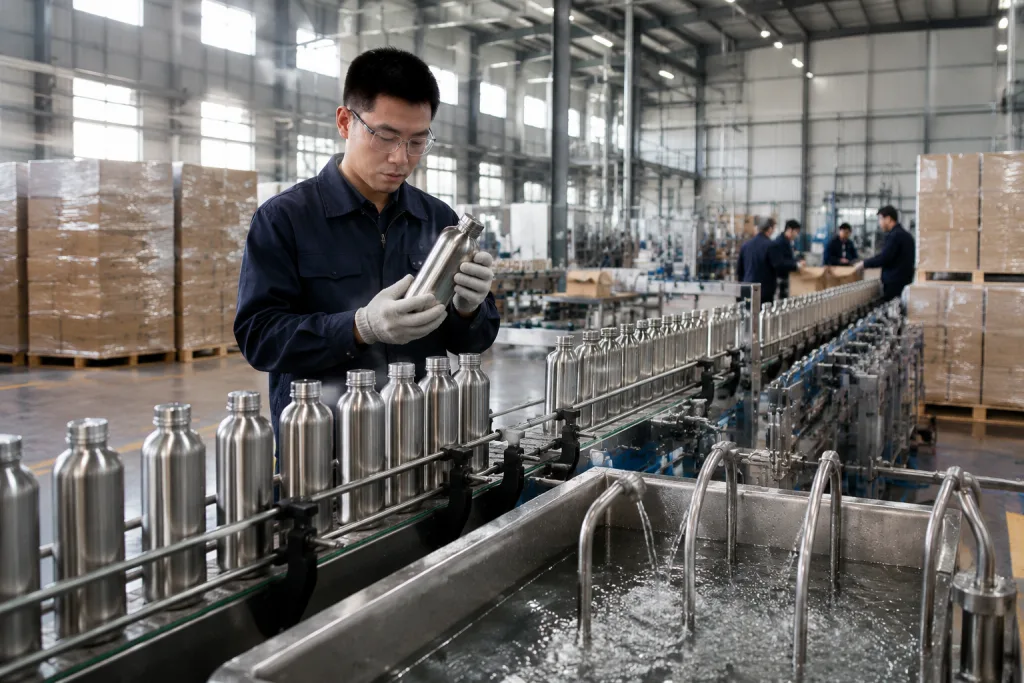
Buying the best promotional reusable water bottle is easy until the first carton shows up with crushed corners, a lid that weeps in transit, a logo that sits 3 mm off center, or a cap that cracks after three opens. We see this on the line. That is where margin disappears. The bottle is rarely the only issue; the break starts earlier, in the spec, in the mold, or in how QC pulled the sample in Zhejiang or another China plant.
If you buy custom drinkware for retail, events, or corporate gifting, you need a failure-mode mindset. This is the wrong question to ask: “Does it look good in the render?” A canteen maker can ship something that passes photos and still fails in transit, at pack-out, or in the end customer’s hand. The factory you want talks tolerances, coating adhesion, leak testing, AQL, and packing method before decoration. That is the real order.
Where bottle programs usually break
The first failure is usually not the logo. It is the hidden geometry. We have seen a bottle pass a clean pre-production sample and still leak because the seal groove is 0.3 mm shallow, the cap thread pitch drifts, or the gasket is cut too hard. On a canteen customized program, that mistake shows up after mass production starts. Then the line is already booked.
Another break point is finish quality. Powder coat that looks even under shop lights can show burn marks on matte colors, especially on dark canteen promotional SKUs. For vacuum insulated steel bodies, we check weld seam visibility, neck concentricity, and dent sensitivity during packing. China makes good custom drinkware, and China also makes cheap mistakes when the spec is vague. A Zhejiang factory that runs serious programs will ask for CAD drawings, sealing notes, and decoration position before it quotes.
- Leak risk: cap thread mismatch, weak gasket, poor torque control.
- Appearance risk: uneven coating, print misregistration, scratches from packing.
- Durability risk: thin wall sections, weak hinge points, coating flake.
If you want the best promotional reusable water bottle, ask what can fail in production first. The render is the wrong question.
Specify the body before the print
Buyers often spend all their energy on branding and leave the body vague. That is the wrong order. A clean logo on a bottle that dents at 0.4 mm impact, sweats on the shelf, or feels flimsy because the wall is too thin still loses the order. For stainless steel, 18/8 or 304 is the baseline we run. If the item is a budget canteen, some suppliers will try lower-grade steel, and the first place it shows up is corrosion resistance and hand feel. For a custom growler or a large-volume customizable growler, ask for material certs and thickness by zone, not one headline number on the PO.
A usable spec covers wall thickness, neck finish, capacity tolerance, and coating system. On a 500 ml bottle, +/- 3% is usually workable. On a 750 ml canteen distributor program, we still define the minimum fill line, because the buyer flags it when two units from the same carton feel different. If the bottle has a carabiner cap, handle, or flip-top, ask for cycle testing. A 5,000-cycle hinge test is a fair ask for promotional reuse. If the vendor cannot name the test method, the math does not work.
Do not approve a sample just because the logo is clean. Approve it because the body, lid, and coating all survive abuse.
Leak testing is not optional
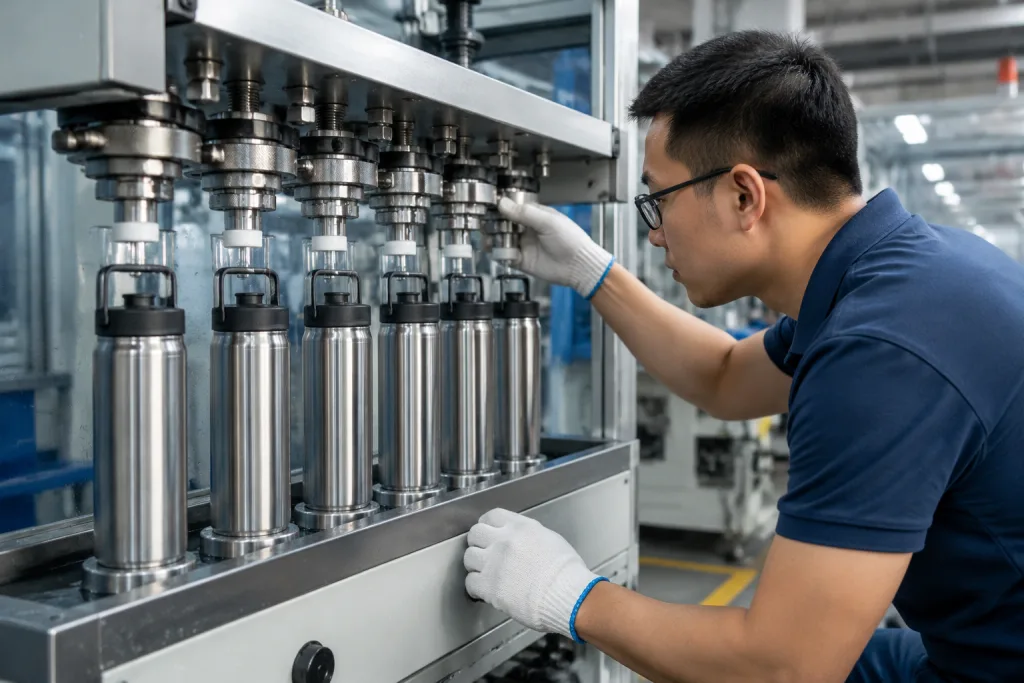
Leakage is the fastest way to turn a canteen custom project into a warranty line item. You need a test plan, not a promise. Ask the canteen manufacturer to define leak test orientation: upside down, horizontal, and after thermal cycling if the bottle is insulated. A proper factory in Zhejiang will usually run pressure tests or water-invert tests on caps in production, then spot-check torque values with a torque wrench. If they only say “passed QC,” that tells you nothing.
For screw lids and sports tops, specify gasket material and hardness. Silicone is common, but durometer matters. Too soft and it deforms; too hard and sealing drops off. For a customized drinkware line sold through distributors, we like a 24-hour inverted test at room temperature, plus a post-drop leak check from 1 meter. The buyer flagged a cap that seeped after a pallet shift, and the whole math changed. If the bottle is for hot fill, add a hot-water hold test and make sure the cap does not warp. A canteen vendor that knows export work will also tell you how to pack cartons so the seal is not crushed in transit.
- Ask for 100% leak testing on all finished lids.
- Define torque range for threaded caps.
- Require post-drop leak confirmation at 1 meter.
Decoration fails when the prep is weak
Most decoration failures are prep failures. The line was clean, but the bottle came in with oil on the shell, the coating was still soft, or the laser depth wandered by 0.05 mm, and the logo started to chip, smear, or look off after one wash. That is the wrong question to ask if you only stare at the print file. For retail or giveaway canteen promotional items, the buyer reads the decoration as part of the product, and QC pulled the sample if the surface was not ready.
For silkscreen, ask the custom canteen factory for mesh count, ink type, cure temperature, and cross-hatch adhesion results. For laser, ask for depth range and whether the mark sits on raw steel or through coating. On coated stainless bottles, an adhesion test beats a glossy photo every time. We run a simple rub check with a cotton pad and 500 cycles on the bench, because the math does not work if the print looks good for a day and fails in the field. If you want a premium feel, matte powder coat with tight print coverage is safer than full-wrap art that hides defects and pushes reject rates up. A good canteen suppliers network in China should show test panels, not just hero shots.
When buyers compare canteen manufacturers, I ask one thing: can you repeat the same logo 5,000 times without drift? If the answer stays vague, we have seen it go sideways. A PO typo on the logo size or a missing Pantone code is enough to create a 2 mm shift across the run, and then the buyer flags it on the first carton.
Packaging decides transit damage
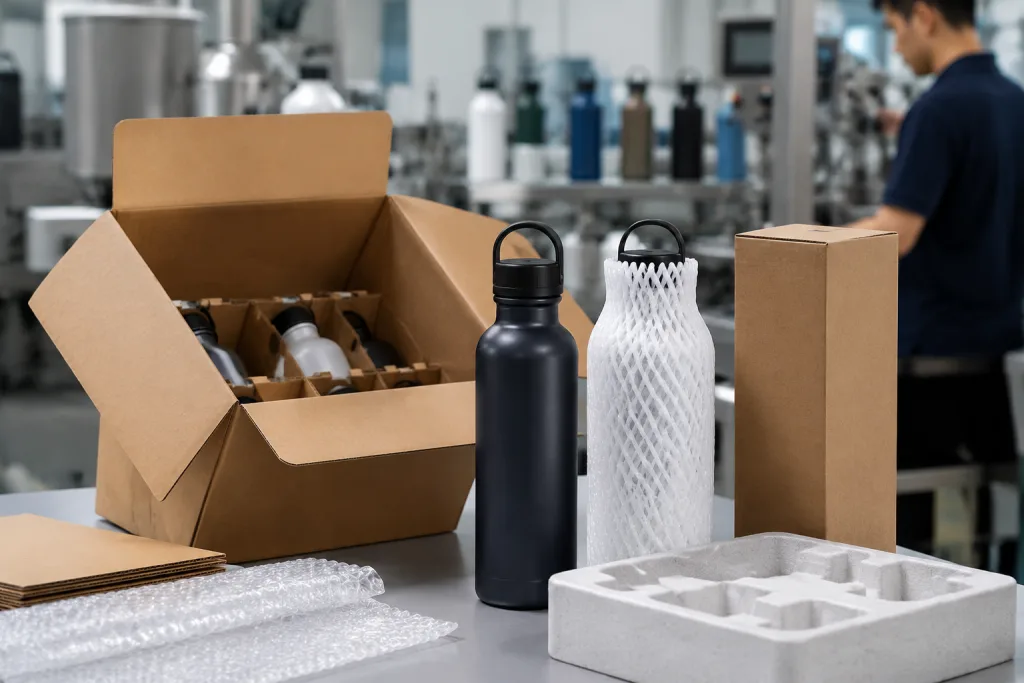
Transit damage usually gets blamed on the shipper, but the packaging was the weak link. We see it on the line all the time: a bottle with a clean powder coat still shows rub marks because the carton partitions flex, the inner polybag is 18 microns instead of 25, or the unit can slide 4 mm inside the box. For a distributor drinkware program, that is the wrong question to ask. Damage eats margin faster than a bad print run.
Ask for carton drop testing, not bottle-only testing. Check the full route: factory pallet, truck to port, container vibration, warehouse handling, then final fulfillment. We had one buyer flag an FNSKU typo on the outer carton, and the rework cost more than the freight difference. If you sell on Amazon or through a 3PL, have the factory label the master carton correctly and confirm FNSKU placement before shipment. For export to Europe or North America, verify REACH-related material paperwork and the packaging compliance your market requires. A solid canteen factory in Zhejiang will tune the shipper carton so the product survives 30 to 40 days at sea and still lands retail-ready.
- Use molded pulp or stiff dividers for coated steel bottles.
- Target no more than 2-3 mm movement inside each retail box.
- Specify outer carton compression and drop standards.
How to compare suppliers without guessing
When you compare canteen distributor options, ask for the process first and leave the price for later. A real canteen supplier gives you MOQ, sample time, lead time, and QC checkpoints without dragging their feet. A weak vendor jumps to a low unit price and dodges the details. For custom drinkware, the usual MOQ is 3,000 to 5,000 units per color, with 25-40 days production after sample approval. If someone promises 800 units and says tooling is free, we ask which cost got buried on the line.
Use numbers and shop-floor facts. Check factory audit status, BSCI or a similar social compliance file, testing capability, response time, and whether they can keep the design stable across repeat runs. If you need a customizable canteen or a custom growler for a distributor network, ask how they hold ink color within the same Pantone spec from one run to the next. Ask for sample lead time in days, not “soon.” Ask for defect rate targets and the agreed AQL. A serious canteen manufacturers team in Zhejiang should explain appearance defects separately from functional defects; those are not priced the same, and we’ve seen buyers get burned when that gets mixed up.
If a canteen vendor cannot explain repeat-order control, they are not ready for a branded program. They are only ready for a one-off sale.
What a useful spec sheet includes
I’ll rewrite the section in place, keeping the HTML tags and the original technical specifics intact while making the voice sound like a seasoned factory sales engineer.Spec your next bottle like a QC engineer
Send the product type, target market, and decoration method. We will help you build a production-safe custom drinkware spec that actually ships cleanly.
Frequently asked questions
What MOQ should I expect for a custom promotional bottle?
For most custom drinkware programs, expect an MOQ of 3,000 to 5,000 units per color or finish. Some canteen manufacturers can do 1,000-2,000 units, but the price usually rises fast because decoration setup and packing labor stay fixed. If you need multiple SKUs, ask whether the MOQ is per design, per color, or per lid style. That detail matters more than the headline number.
How do I know if a bottle will leak in production?
You do not know from photos. You need a defined test. Ask for 100% lid leak testing, then add a 24-hour inversion test and a post-drop leak check from 1 meter. For hot-fill or insulated items, request a thermal cycle test too. A canteen supplier that can state torque range, gasket material, and test method is far more reliable than one that just says the sample passed.
What finish holds up best for canteen promotional orders?
Matte powder coat is usually the safest option when you want a premium look and decent scratch resistance. It is not perfect, but it hides handling marks better than high-gloss paint. For printed artwork, a clean silkscreen with proper curing can work well on flat areas. If the art is complex or wraps around curves, ask for adhesion testing and a sample made on the actual production line, not a hand-finished mockup.
Should I choose laser engraving or print?
Use laser when you want permanence and a cleaner industrial look. Use print when you need color, branding flexibility, or larger coverage. For coated stainless canteens, laser can expose raw steel and look sharp, but depth control matters. For custom canteen orders in bulk, print can be cheaper, yet it is more sensitive to surface prep and cure. The right choice depends on use case, not taste.
What documentation should a canteen factory provide?
At minimum, ask for material data, factory audit status, sample approval records, and QC checkpoints tied to the order. For Europe and North America, REACH-related statements and any relevant food-contact declarations are common asks. If the product is for Amazon or retail fulfillment, request barcode, carton, and FNSKU confirmation before mass production. Good canteen suppliers in China will share these without drama.