Key Takeaways
- A workable MOQ for a custom gym bottle is usually 3,000-5,000 pcs per style, with 30-45 day production from a China factory.
- For the best promotional gym water bottle, PP or Tritan bodies and silicone seals beat soft, cheap plastics on odor and leak control.
- Expect FOB China pricing around USD 0.85-2.60 depending on size, decoration, and cap complexity.
- Ask for AQL 2.5 inspection, REACH support, and drop-test data before you place a bulk fitness water bottle order.
If you are sourcing the best promotional gym water bottle, do not treat it like a freebie. That is the wrong question to ask. For fitness brands and gym chains, the bottle has to survive drops, dishwasher cycles, sweaty hands, and a logo that still looks clean after 3 months in a locker room. We run these orders in Zhejiang all the time, and the buyer usually flags the same issue first: low FOB looks good until you pay for reprints, leaks, and cartons that get rejected at the warehouse.
Buy it like a small industrial product. Resin choice, cap seal, wall thickness, print method, and carton spec all affect the result. A decent China factory should give you a 7-15 day sample lead time, 30-45 days production, and a clear MOQ such as 3,000-5,000 pieces per style. On our line, QC pulled the sample at 72 hours to check the seal ring and drop fit; if the supplier cannot answer those basics, the math does not work.
What makes a bottle worth buying?
Buyers often start with artwork and forget the hardware. That is backwards. The bottle has to survive 50 wash cycles, a tossed gym bag, and a few drops on the locker-room floor. If you are sourcing for a gym chain or a fitness brand, your customer judges it on hand feel, cap reliability, and whether the logo still looks sharp after daily use.
For a bulk sports water bottle, the practical baseline is simple: 500-750 ml capacity, 1.0-1.5 mm wall thickness for PP, 0.8-1.0 mm for Tritan where the design allows, and a cap with a proper silicone gasket. A cheap cap without a gasket leaks in transit, and leaked cartons turn into chargebacks fast. We run torque checks on the line, and if the sealing surface is off by even 0.2 mm, QC pulls the sample. In Zhejiang, serious factories talk about torque, sealing surfaces, and cavity consistency, not just colors.
You should also decide whether you need a straight drink bottle, a squeeze bottle, or a shaker format. A bulk shaker bottle is not a hydration bottle, and that is the wrong question to ask if the buyer wants protein use. Shaker bottles need better mixing geometry, secure lids, and ball or insert options. We’ve seen orders go sideways when the PO says “sports bottle” but the buyer really needs a shaker for 30 g powder.
- Best for clean branding: smooth sidewall, one or two print zones, matte finish.
- Best for retail feel: Tritan body, upgraded cap, laser or multi-color print.
- Best for giveaway volume: PP body, single-color silkscreen, simple sports cap.
Which material should you choose?
I’m rewriting the section in place, keeping the tag structure unchanged and tightening the sales-engineer tone. I’ll preserve the product keywords and the quoted callout, then hand back only the HTML.This is where orders slip. Material drives odor control, clarity, drop resistance, and unit cost. For a custom fitness water bottle, PP is the low-cost workhorse. It runs light on the line, molds cleanly, and fits a large bulk gym water bottle program without pushing the MOQ up.
If you are building a customizable fitness water bottle line for chain rollout, look at the numbers, not the brochure. A PP body usually sits around USD 0.85-1.35 FOB for 500-600 ml with a simple cap. Tritan often lands closer to USD 1.45-2.60 FOB, depending on mold detail and decoration. The gap is real. So is the drop in complaint rate when the bottle looks premium at shelf opening.
For shaker programs, a custom made shaker bottle needs food-contact safe resin, a lid that closes tight, and a mixer insert that stays quiet in transit. Buyers often push for a custom logo shaker bottle because the print helps sell it, but the shaker hardware decides repeat orders. We’ve seen this go sideways: the logo passed, the insert rattled, and the buyer flagged it on the first sample. If the powder stays lumpy, nobody comes back.
Ask the factory for the exact resin grade, food-contact declaration, and whether the bottle body is designed for hot-fill or cold-use only. Do not assume.
How do you spec the cap and lid?
The cap is where leak complaints start or stop. A solid custom gym water bottle needs a lid with a clear click or a firm thread stop, a silicone seal, and a mouth size that matches the use case. For gym users, we ship a flip-top cap or a push-pull spout. For retail hydration, a screw cap with a wide mouth usually makes more sense.
If you need a customizable shaker bottle, spec the lid separately from the body. List hinge strength, closure cycle target, and whether the cap is one-piece or two-piece. We run 50 open-close cycles before approval, then 500 cycles in production validation on larger orders. For a custom sports water bottle, the lid has to take squeeze pressure and bag compression without seepage; this is the wrong question to ask after the goods are packed.
- Flip-top: fast gym use, one-hand drinking, good for classes and treadmills.
- Push-pull: simple, low cost, and common for team sports or promo packs with 1,000 pcs MOQ.
- Wide-mouth screw cap: easier cleaning, better for premium retail programs, and safer for protein mix-ins.
Ask for cap drawings and seal placement photos. If the supplier refuses, the buyer should flag it. A serious China factory in Zhejiang will show tooling details, because QC pulled the sample before packing on our line after a 1.2 mm seal offset showed up in inspection.
What branding method actually lasts?
I’m rewriting the section in-place, keeping the HTML structure and link intact, and tightening the copy so it reads like a factory-side sales engineer wrote it.How do you control quality in China?
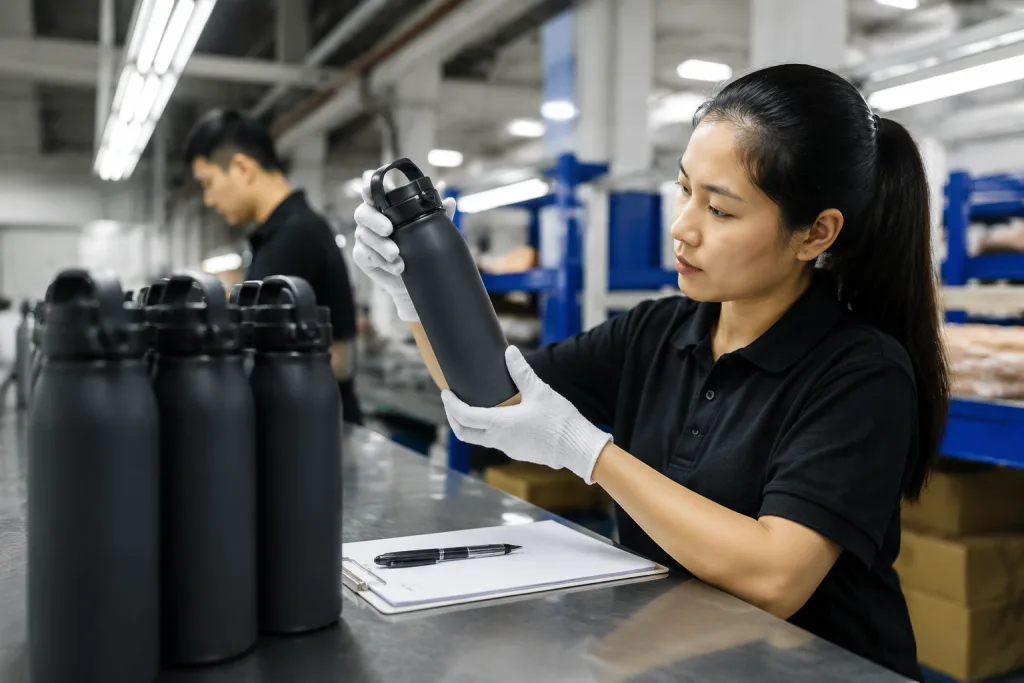
Quality control is not a slogan. It is a checklist with consequences. We set acceptance criteria before mass production starts. That means dimensional tolerances, a color delta target, print registration, sealing performance, and carton drop test requirements. On the line, we usually lock these in with an inspection sheet and AQL 2.5 for major defects, AQL 4.0 for minor defects.
For a customized gym water bottle order, ask for pre-production samples, then a sealed golden sample with a signed approval sheet. If your order is a distributor gym water bottle or distributor fitness water bottle program, this is where reorders get messy. QC pulled the sample, the buyer flagged it, and the next batch can drift if the factory changes resin blend, mold venting, or print ink.
- Check leakage: invert the bottle for 24 hours.
- Check impact: drop from 1.2 m onto carton and concrete target where relevant.
- Check odor: no strong plastic smell after washing.
- Check compliance: REACH for Europe, food-contact declarations for your market.
If you are sourcing from a China supplier for the first time, use a third-party inspection before balance payment. We have seen this go sideways on a 5,000-piece order, and the math does not work if one failed container wipes out the margin.
What should you ask before ordering?
Ask like a buyer, not like a showroom visitor. Start with output: how many units can the line ship per month, what is the real lead time, and how many days does export packing add. We run into this every week. A factory in Hangzhou, Zhejiang should answer packing structure, barcode placement, and master carton strength without guessing; if they cannot, the buyer should walk.
For a custom fitness water bottle or custom gym water bottle program, pin down the numbers before you talk color chips. Is the MOQ 3,000, 5,000, or 10,000 pieces? What is the sample fee, and does it come off the order? What is the FOB China price at 1-color print and at 2-color print? Can the supplier pass BSCI, REACH, and carton drop testing? We have seen this go sideways when the PO typo says 5,000 but the buyer meant 5,500. If you are a distributor shaker bottle buyer, ask whether the factory can pack inner boxes with your UPC or FNSKU labels.
Good suppliers answer in numbers. Weak suppliers hide behind adjectives. QC pulled the sample, measured the carton at 58 x 38 x 42 cm, and the issue showed up fast.
Use this pre-order checklist
Here is the pre-order checklist we run before we confirm a customized fitness water bottle or customizable gym water bottle order:
- Confirm body material, capacity, and wall thickness in mm.
- Confirm cap type, seal material, and the leak test spec.
- Approve artwork size, print position, and Pantone reference before the line starts.
- Confirm MOQ, unit price, sample cost, and tooling cost if there is a new mold.
- Confirm production lead time, packaging style, and carton dimensions for the shipping plan.
- Confirm compliance documents for EU or North America; the buyer flagged this on a 20,000 pcs PO.
- Confirm inspection standard, usually AQL 2.5 for major defects, and tell QC what to pull.
This checklist works for a bulk gym water bottle shipment and a bulk sports water bottle rollout across multiple clubs. We’ve seen this go sideways when a buyer changes the cap after sample approval. Keep one master spec sheet and one approved sample for all reorders. That is the only way to stop drift when a second or third purchase order lands months later.
For product range planning, browse custom sports bottle options and matching drinkware lines if you need a broader promotion set.
Send your bottle brief for a fast quote
Share capacity, target price, logo file, and delivery market. We will map the right custom gym water bottle spec without wasting your time.
Frequently asked questions
What is a realistic MOQ for a custom gym water bottle?
For most export factories in Zhejiang and wider China, a realistic MOQ is 3,000-5,000 pieces per style for a printed bottle. If you want a new mold, the number can move to 8,000-10,000 pieces because tooling cost has to be spread out. For simple logo runs on an existing shape, some factories will accept 1,000-2,000 pieces, but the unit price usually rises by 10-25%. Always ask whether the MOQ applies per color, per logo, or per carton pack. That detail changes your landed cost faster than most buyers expect.
How much does a promotional gym bottle cost FOB China?
A basic PP custom sports water bottle with one-color silkscreen often lands around USD 0.85-1.35 FOB China. A Tritan or premium custom shaker bottle can be USD 1.45-2.60 FOB depending on body thickness, lid complexity, and decoration. If you need a custom logo shaker bottle with multiple print positions, add roughly USD 0.08-0.25 per unit. These are ballpark export numbers, not retail numbers. Freight, duties, and destination labeling can add another 15-35% to your landed cost depending on market and shipment size.
Which material is best for a fitness brand order?
PP is the budget choice and works well for bulk fitness water bottle programs where price matters most. Tritan is the better premium choice if you want clearer appearance, better perceived value, and a stronger retail shelf look. For shaker bottles, use food-contact safe PP or Tritan with a reliable seal and a mixer insert that does not rattle. If your audience cares about odor or premium feel, Tritan usually wins. If your audience wants a low-cost giveaway, PP is the practical answer.
What compliance documents should I request?
For Europe, ask for REACH support and a food-contact declaration. For North America, ask for food-contact materials documentation and any state-level requirements that apply to your channel. If you sell through Amazon or big-box distribution, also request carton specs, barcode placement, and if needed FNSKU labeling support. A serious China supplier should also be able to show ISO-based quality procedures and, if applicable, BSCI audit status. Do not place a bulk gym water bottle order before you have the documents in hand.
How long does production usually take?
For an existing mold and standard print, sample lead time is often 7-15 days and mass production is usually 30-45 days after sample approval and deposit. If the project needs a new mold, add 15-25 days for tooling and trial runs. Shipping from China to Europe or North America adds more time depending on mode: sea freight is cheaper but slower, while air freight can cut transit to days but raises cost sharply. If you have a gym chain launch date, build at least a 2-week buffer for inspections and rework.