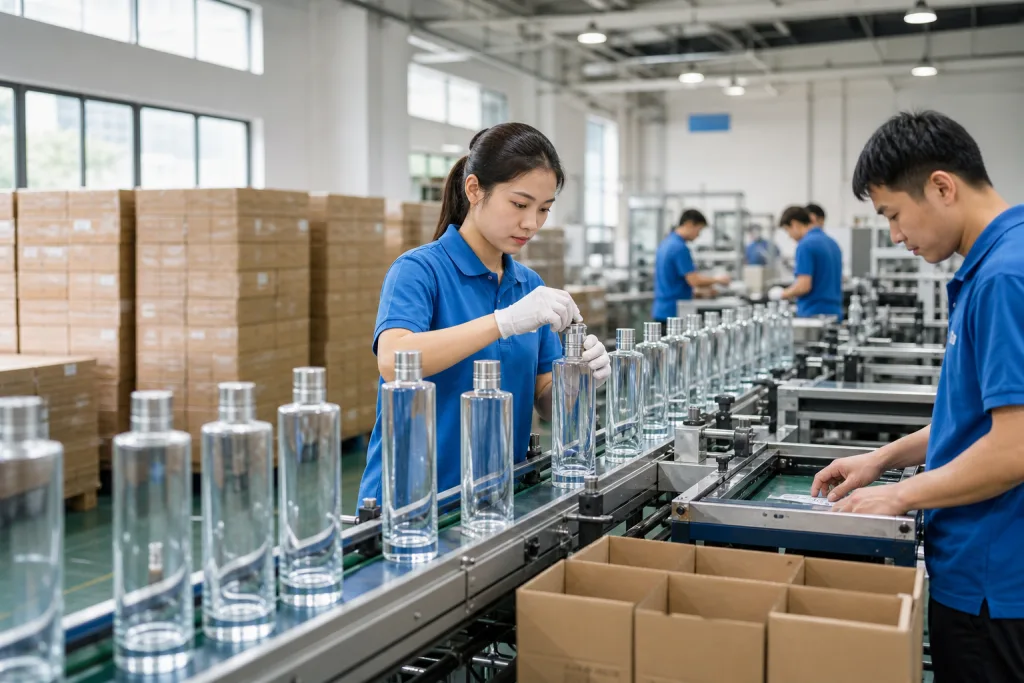
Key Takeaways
- MOQ normally starts at 1,000 pcs for logo glass bottles and 3,000 pcs for custom mold or color work
- Borosilicate glass suits higher perceived value, while soda-lime glass wins on cost-sensitive mass promotions
- AQL 2.5/4.0 inspection, carton drop testing, and REACH/LFGB checks should be agreed before deposit
- Typical production lead time is 25-35 days after sample approval for standard promotional glass bottles
The best promotional glass bottle is not the cheapest line on the quote sheet. It is the bottle that survives freight, passes your market tests, prints your logo without ghosting, and lands before the campaign date. For retail, events, corporate gifting, or distributor programs, the weak point is often hiding outside the product photo; last month QC pulled 32 samples from a 500 ml order and found 3 cartons with corner crush after the 80 cm drop test.
At our Zhejiang factory, we see buyers compare 350 ml, 500 ml, and 750 ml glass bottles as if capacity decides the order. Wrong question. Glass type, wall thickness in mm, cap material, decoration method, carton drop strength, and inspection level usually decide whether the shipment gets accepted. China can supply 60+ canteen customizable and glass bottle formats, but the spec has to be nailed first; we have seen a buyer flag a PO typo of “bamboo lid” versus “PP lid” only after the line had already packed 4,800 pcs.
Glass bottle types compared directly
Ask us for the best promotional glass bottle, and the sample cart usually lands on three picks: soda-lime glass, borosilicate glass, and glass bottles with a protective sleeve. They all ship well. They do not fit the same job. We had one buyer try to cover a campus giveaway and a retail gift set with one spec. The math did not work.
| Spec | Soda-lime glass | Borosilicate glass | Glass with sleeve |
|---|---|---|---|
| Common capacity | 300-750 ml | 350-1,000 ml | 350-750 ml |
| Typical wall thickness | 2.5-3.5 mm | 2.0-3.0 mm | 2.0-3.0 mm plus sleeve |
| FOB China range | USD 1.10-2.20 | USD 1.80-3.80 | USD 2.10-4.50 |
| Best use | Events, giveaways, gym programs | Retail, premium gifting, wellness brands | Travel, campus, corporate kits |
| Main risk | Heavier, lower heat shock resistance | Higher unit cost | Sleeve fit and odor issues |
Soda-lime glass is the workhorse for promo orders where price decides the deal. On our line, a 2.8 mm wall with a clean straight body prints well and packs fast. QC pulled the sample, checked the neck ring, and it passed water and juice use without drama. It is clear, easy to decorate, and fine for cold brew too. Borosilicate has stronger thermal shock resistance and a cleaner premium feel. If the buyer wants a retail shelf price, this is the right material; if the order is a giveaway, that is the wrong question to ask.
Sleeved bottles fix a grip problem and take some of the knock damage out of a busy shipment. A silicone or neoprene sleeve helps, but it adds one more checkpoint. We run sleeve fit after compression packing, because a 1 mm loose fit turns into a complaint in transit. The color has to stay inside Pantone tolerance, and the material needs an odor check before we ship. A good Zhejiang factory samples the bottle and sleeve together, then drops the packed carton at 80 cm. A sleeve that looks fine on the bench can still go sideways in the carton.
Match bottle specs to the campaign
The lowest-cost bottle works for a one-day trade show. For a retail gift set, subscription box, or distributor drinkware program, the math usually fails. Before you ask canteen vendors for pricing, write the use case in buyer language: who receives it, expected retention time, and whether the logo must survive daily desk use or only 6 hours in an event bag. We run different checks for each case; last month QC pulled 32 samples from a 2,000 pcs gift order because the screen print shifted 1.5 mm on the shoulder curve.
For mass giveaways, a 500 ml soda-lime glass bottle with bamboo-look PP cap, single-color silk screen logo, and standard kraft carton can hit a workable price. For a corporate onboarding kit, a 550 ml borosilicate bottle with stainless steel cap, silicone sleeve, and laser-marked metal disc matches the budget better. Retail needs barcode labeling, hangtag, retail box, and tighter cosmetic inspection than a normal promotional order; we usually add a separate light-table check for bubbles, black dots, and sleeve scratches over 0.8 mm.
- Trade show handout: 350-500 ml, soda-lime glass, 1-color logo, 1,000-3,000 pcs.
- Corporate gift: 500-750 ml, borosilicate glass, sleeve, gift box, 2,000-5,000 pcs.
- Retail wellness bottle: borosilicate, food-grade cap seal, barcode, user insert, 3,000 pcs and up.
- Distributor growler program: 1,000 ml or larger custom growler, thicker carton, regional compliance review.
If you are a canteen distributor serving 8 or 12 end customers, do not over-customize the first run. Pick one body shape, two safe colors, and one decoration method; this is the wrong place to prove every customer needs a private mold. It is easier to reorder 5,000 pcs of a proven customizable canteen than to sit on six slow-moving versions, especially when the warehouse team is already flagging mixed caps, carton marks, and one PO typo that says “matte black” while the artwork says “charcoal grey.”
Decoration methods are not equal
Logo method changes how the bottle looks and how often it comes back from QC. On glass bottles we run silk screen printing, heat transfer, decal, laser engraving on a metal cap, and paper or PP label. Each one has its own MOQ, setup cost, and wear result. Last month QC pulled a sample with a 1 mm shifted logo, and the buyer flagged it on the spot.
Silk screen printing is the default for most custom drinkware. A one-color mark on a smooth cylindrical glass body is the cleanest job we run. Setup runs USD 40-80 per color, and the decoration cost stays around USD 0.08-0.25 a piece depending on coverage. We run a 200-mesh screen on the line, and the buyer should accept about ±1.5 mm print tolerance. If your artwork has five colors, this is the wrong method to force.
Heat transfer and decal printing fit gradient art, full-color graphics, and wraparound designs. They look more retail-ready, and the price climbs with the artwork. We keep a 3M tape pull kit at the bench, then run a cross-hatch adhesion test and a 20-cycle hand-wash simulation before release. If the bottle gets used every day, skipping those checks is how the print starts lifting at the seam.
For ordinary glass promotional bottles, we do not push direct laser unless the buyer wants a frosted look and accepts slower processing. More often we engrave the stainless steel cap, tea infuser, or metal badge with a fiber laser. For canteen customized projects, that gives a clean premium touch without the inconsistency we see on large glass marking jobs. The math does not work if you need 5,000 pcs in 7 days.
Do not approve a logo from a PDF mockup. Ask for a physical pre-production sample built with the same glass, cap, sleeve, ink, and packing spec as mass production.
A good canteen vendor in China will also tell you when the art is too fine. Lines below 0.2 mm, tiny reversed text, and large solid ink panels on curved glass are where jobs go sideways. We had a 0.18 mm stroke disappear after firing in the kiln, so I would not promise that detail to a retail buyer.
Caps, seals, and leak testing
Buyers spend 8 weeks approving the glass body and then give the cap 2 lines on the PO. Wrong move. For the best promotional glass bottle, the cap and gasket are where user complaints start. We have seen a 500 ml sample pass carton drop testing, then leak from a 0.8 mm gasket mismatch after QC pulled the sample for an overnight desk test. Pretty bottle. Wet laptop bag.
We run PP plastic caps, stainless steel outer caps with PP inner threads, bamboo outer caps, aluminum caps, and flip-top mechanisms. Bamboo gives a natural look, but grain color can shift across 3 cartons, and caps can crack when moisture content is not controlled before assembly. Stainless steel caps feel stronger in hand, yet the inner plastic thread and silicone gasket still decide leak performance. For food-contact parts, ask your canteen suppliers for LFGB, FDA, or REACH documents based on the sales market; one buyer flagged this after their PO said “FDA” but the test report covered only the glass body.
Leak testing belongs in the purchase order, not in a WeChat message after production starts. Our normal check for screw-cap glass bottles is room-temperature water, approved torque range checked by torque meter, 30 minutes inverted, then 15 seconds of hand shaking. For sports-style lids, we add open-close cycle checks, usually 300-500 cycles for development validation. This still does not make glass suitable for rough sports use. The math does not work. It does catch weak hinge pins, thin silicone lips, and cap molds that are already wearing out on the line.
If you are sourcing a custom canteen or customizable growler with a wider mouth, check gasket seating after repeated washing as well. A gasket that drops out after the fifth wash will bring complaints even if the first inspection passed. Zhejiang and other China manufacturing regions have 20+ cap sub-suppliers within a short truck run, but the assembly factory must control incoming cap dimensions with a caliper and plug gauge, not just trust the catalog drawing. We have seen this go sideways when a 62 mm cap arrived at 61.6 mm and nobody checked until final packing.
Packing must survive real freight
Glass bottle projects usually fail in packing, not at the glass furnace. The courier sample lands on your desk clean, then the 40 ft container reaches your warehouse with crushed corners, loose glass dust, and a liability argument between buyer, forwarder, and factory. We have seen QC open a master carton with a box cutter and find the bottom corner split 42 mm after one hard pallet move. Packing specs look boring. They save claims.
For standard 500 ml glass promotional bottles, we run individual bubble bag or paper wrap, inner partition, 5-layer export carton, and gross weight under 14 kg per carton where practical. If the order uses retail gift boxes, the outer carton should still carry the stacking load. A pretty 350 gsm color box does not protect glass by itself; the math doesn't work once 6 cartons are stacked in a humid container. The line should check carton bursting strength, partition height, and whether the bottle shoulder touches the lid after taping.
Ask for a carton drop test before mass shipment. A common approach is ISTA-style handling simulation: one corner, three edges, and six faces from 60-80 cm depending on carton weight. It will not stop every courier abuse case, but it beats guessing. QC pulled the sample carton after a 75 cm edge drop last month, and the glass passed while the printed sleeve creased, so the buyer changed the sleeve paper before we packed 18,000 pcs. For Amazon FBA or marketplace programs, add FNSKU labeling, suffocation warning where needed, carton dimension limits, and master carton barcode rules before production starts.
Freight cost changes the bottle choice fast. Glass is heavy and bulky. A 500 ml soda-lime bottle may weigh 280-380 g before packing, while borosilicate can be lighter but costs more per unit. Air freight is painful for glass promotions; sea freight or rail to Europe is usually the cleaner quote. If your campaign date is fixed, work backward: 7 days for sample, 25-35 days production, 3-7 days inspection and booking, then the actual transit time from China. Also check the PO carefully; we once caught a buyer typo showing 12 kg carton limit on page 1 and 16 kg on page 3, and that kind of mismatch delays booking.
Factory checks before you pay
A professional canteen manufacturer should talk QC before you send a deposit. If a supplier answers with “quality is good,” push for the actual sheet: inspection standard, defect list, test items, carton drop requirement, and who pays when rework is needed. We ask buyers to sign the limit sample before mass production; last month QC pulled one sample with a 1.8 mm print shift, and the buyer flagged it before the line packed 96 cartons.
For promotional glass bottles, we usually run final inspection under AQL 2.5 for major defects and AQL 4.0 for minor defects. Major defects include leakage, cracked glass, sharp edges, wrong capacity, wrong logo color, loose cap, and contaminated packing. Minor defects include small bubbles, light scuffs, slight print position shift, or small color variation within the approved limit. Glass is not machined metal. Define bubble size, mold seam visibility, and logo tolerance in mm before production, or we’ve seen this go sideways at final inspection.
At BottleForge Industrial in Hangzhou, Zhejiang, our standard MOQ for stock-shape logo glass bottles is 1,000 pcs, with monthly drinkware output around 450,000 units across stainless steel, plastic, and glass lines. Custom mold glass bottles, customized growler projects, and special sleeve colors usually start at 3,000-5,000 pcs because tooling, color matching, and line setup need real machine time. A stock logo order might sample in 7 days; a new mold can push sampling to 18 days after the 3D drawing is confirmed. The math doesn’t work if the PO says 2,000 pcs but asks for a private mold and six Pantone sleeve colors.
Check the factory documents before payment. BSCI can matter for European retailers. ISO 9001 indicates a management system, not perfect product, but it still gives the factory a process to audit against. REACH, LFGB, FDA food-contact, and California Proposition 65 screening may be relevant depending on your sales channel. A good canteen factory or canteen vendor should not guess your compliance needs; state the destination market, contact material, lid type, and use case clearly on the PO. One typo matters. We once saw “EU warehouse” written on the order, while the final ship-to was California, and the buyer had to add California Proposition 65 screening after cartons were already sealed.
How to buy without overpaying
The buying process is simple, but 6 out of 10 rushed RFQs we see skip one check to save five days and then lose three weeks later. Start with the target retail or promotional budget, then lock the non-negotiables: 500 ml or 750 ml capacity, borosilicate or soda-lime glass, stainless or plastic cap, logo size in mm, packing style, compliance, and delivery date. Send the same RFQ sheet to each canteen supplier. Same drawing. Same deadline. Our sales desk has seen one PO list “silicone sleeve” while the artwork file says “no sleeve,” and that 1-line mismatch changes the carton size and freight cost.
For a normal 500 ml promotional glass bottle, a realistic FOB China quote usually covers the bottle, cap, one-color logo, individual protection, export carton, and basic visual inspection. It does not normally cover retail box, barcode labeling, third-party inspection, special palletizing, compliance lab tests, or domestic trucking after port arrival. These items add USD 0.10-0.80 per unit depending on complexity. On the line, QC pulled the sample last month and found the gift box was 1.5 mm too tight after shrink wrapping; that small packing miss turned into a repack cost, not a bottle cost.
If you are buying for distributor canteen or distributor growler programs, ask for reorder pricing at 1,000, 3,000, and 10,000 pcs. A stable repeat order lets a canteen manufacturer reuse logo screens, packing drawings, and approved samples, so the unit price can drop without changing the product. Push too hard, and the math doesn't work. Something gets cut: carton paper drops from 5-ply to 3-ply, the gasket gets cheaper, the cap weight goes down by 3-5 g, inspection time gets squeezed, or the merchandiser stops replying fast when the buyer flagged leaking caps after sea freight.
The best promotional glass bottle for your order is the one with the least hidden risk at the price your campaign can support. A canteen customizable design can look simple on the outside, but every part has a tolerance and a failure mode; a cap thread off by 0.3 mm is enough to create complaints. Treat the first order as a controlled production run, document the approved sample, and sign off logo position, lid fit, carton marks, and drop-test result. We’ve seen this go sideways when buyers approve only a photo. With a proper golden sample, repeat orders from China are faster: in our 2024 files, pre-production approval moved from 18 days to 12 days on average.
Send your glass bottle spec for a practical quote
Share capacity, logo artwork, quantity, market, and packing needs. We will return a workable FOB China option with risks noted.
Frequently asked questions
What MOQ should I expect for the best promotional glass bottle?
For an existing bottle shape with a one-color logo, expect MOQ around 1,000 pcs. If you need Pantone-matched silicone sleeves, custom cap color, retail box, or multi-color printing, 3,000 pcs is more realistic. A fully customized mold or custom growler usually starts at 5,000 pcs because mold setup and trial production cost more. Some China suppliers may quote 300-500 pcs, but the unit price will be high and decoration options are limited. For distributor drinkware programs, we usually suggest testing one 1,000-2,000 pc run before committing to a 10,000 pc reorder.
Is borosilicate always better than soda-lime glass?
No. Borosilicate has better thermal shock resistance and a lighter, more premium feel, so it suits retail, wellness, and higher-value corporate gifting. Soda-lime glass is usually cheaper and works well for cold beverages, event giveaways, and basic canteen promotional projects. If your user will pour boiling water into the bottle, borosilicate is the safer direction, though the cap and sleeve must also tolerate heat. If the bottle is mainly for cold water at a conference, soda-lime may save USD 0.50-1.20 per unit without hurting the campaign.
Which logo method is best for promotional glass bottles?
For most B2B orders, one-color silk screen printing is the best balance of cost, speed, and appearance. It is suitable for clean logos and usually adds about USD 0.08-0.25 per unit after setup. For full-color artwork, use decal or heat transfer, but request adhesion testing and hand-wash simulation. For premium customized drinkware, laser engraving on a stainless steel cap is often more durable than complex printing on the glass body. Always approve a physical sample; a digital mockup cannot show ink thickness, curvature distortion, or real Pantone variation.
Can glass bottles be shipped safely for e-commerce or FBA?
Yes, but only with proper packing. For e-commerce, each glass bottle should have individual protection, a tested retail box if required, and a strong master carton. We recommend 5-layer export cartons and drop testing from 60-80 cm depending on carton weight. For FBA, add FNSKU labels, carton barcodes, weight limits, and packaging rules before production. Glass has a higher damage risk than stainless steel or plastic, so do not cut packing to save USD 0.05 per unit. That small saving can become a much larger replacement cost.
How long does production take after I approve the sample?
For a stock-shape glass bottle with standard cap and one-color logo, production is usually 25-35 days after sample approval and deposit. Add 7-10 days if you need custom color sleeves, special retail boxes, or compliance lab testing. Custom mold work can push the timeline to 45-60 days before mass shipment. You should also allow time for inspection, export booking, and sea freight from China. If your event date is fixed, start sourcing at least 10-12 weeks before the required warehouse delivery date.