Key Takeaways
- For most promotional orders, 500-1,000 pcs is a realistic MOQ for stock-shape custom drinkware
- 304 stainless steel at 0.45-0.55 mm wall thickness suits most mid-range promotional bottles
- Laser engraving is cleaner for long-term use, while silk screen is cheaper for large logo areas
- A normal China lead time is 25-35 days after artwork approval, plus 25-40 days for sea freight
The best promotional drink bottle is not the cheapest bottle with your logo printed on it. For a procurement manager, the real check is simple: does it ship on the booked ETD, pass FDA or LFGB testing, still look acceptable after 50 dishwasher cycles, and avoid complaints from your sales team, retail buyer, or end user? We had QC pull a 500 ml sample last month because the logo shifted 3 mm after powder coating. Small defect. Big argument.
At our canteen factory in Hangzhou, Zhejiang, we see the same mistake every season: buyers compare FOB prices before they compare capacity tolerance, steel grade, coating thickness, carton strength, and logo method. China can make almost any custom drinkware style, but the brief has to be tight. A request for a “premium bottle” is the wrong question to ask; send 304 stainless, 600 ml, matte powder coat, laser logo, 24 pcs per carton, and your target MOQ, then the quote starts to mean something.
What counts as best
Buyers who ask for the best promotional drink bottle are usually asking about three different targets, and each one changes the quotation: lowest landed cost per delivered piece, strongest perceived value in the user’s hand, or lowest production and compliance risk. You rarely get all three in one bottle. A 750 ml single-wall aluminum bottle can win on price. A 500 ml vacuum insulated stainless bottle usually feels better as a client gift. A stock mold bottle with laser logo, existing test reports, and a lid we already run on the line is the safer bet. Last month QC pulled 32 pcs from a pre-shipment lot because one silicone gasket sat 0.6 mm proud, so yes, risk control is real.
For B2B campaigns, I define “best” by the use case before talking about shape or color. Trade show giveaway? Unit cost and carton packing matter because 3,000 bottles moving by air can punish a loose carton spec. Bank client gift? The finish, gift box, and logo alignment carry more weight, and the buyer will flag a logo that is 2 mm off center. Distributor drinkware catalog? Repeatability matters because the second order must match the first order’s color and lid fit, not just look close in a photo. This is the wrong question to ask if the brief only says “premium bottle” with no channel, MOQ, or target landed cost.
A practical benchmark for Europe and North America is 500-750 ml capacity, food-grade 304 stainless steel for the inner wall, powder coating at 60-80 microns, and a leak test on 100% of finished bottles. We run the leak test with bottles inverted for the set time, then QC checks the thread and gasket seat before packing. For a sports audience, a carry loop and one-hand flip lid reduce complaints. For office users, a slimmer travel tumbler shape fits car cup holders better than a wide custom canteen. Simple wins here.
Do not judge only by sample photos. Ask for weight, wall thickness, lid material, gasket material, carton drop-test method, and whether the bottle has passed LFGB, FDA, REACH, or relevant food-contact testing. A serious canteen manufacturer in Zhejiang should answer those questions without drama, and the answers should match the PI, PO, and test report. We have seen orders go sideways over small details, like a PO saying “PP lid” while the approved sample used Tritan, or a carton mark missing the item code by one digit.
Checklist before you ask pricing
A clean RFQ saves you 3-5 days of back-and-forth and stops fake price comparisons before they start. We see this on the line every week: the buyer asks for “500 ml bottle with logo,” and 6 suppliers price 6 different builds. The cheapest quote is usually the lightest body, basic lid, bulk pack, and no inspection. Once you add powder coating, logo, gift box, or AQL check, the number moves. That is not always supplier trickery. The brief was loose.
Use this short checklist before asking any canteen vendor for pricing:
- Capacity: 350 ml, 500 ml, 750 ml, 1,000 ml, or custom growler size such as 1.9 L.
- Construction: single-wall, double-wall vacuum, or copper-coated vacuum insulation.
- Material: 304 stainless steel, 316 stainless steel, Tritan, glass, or aluminum.
- Decoration: laser engraving, silk screen, pad print, UV print, heat transfer, embossing, or full-wrap design.
- Packaging: bulk pack, white box, kraft box, color box, mailer box, or retail gift box.
- Compliance market: EU, UK, US, Canada, or mixed distribution.
- Delivery term: FOB Ningbo, FOB Shanghai, CIF, DDP, or Amazon FBA-ready.
- Inspection level: internal QC only, AQL 2.5/4.0, or third-party inspection.
For example, a 500 ml double-wall bottle with powder coating and one-color silk screen may sit around USD 3.20-4.80 FOB China at 1,000 pcs, depending on lid and packaging. QC pulled one sample last month where the body wall measured 0.38 mm instead of the quoted 0.45 mm, and that alone changed the price discussion. The same shape with full-color UV print, retail box, and third-party inspection can move 15-35% higher. A customized growler with larger capacity, handle lid, and thicker body can easily be double that. Cheap is not a spec.
If you are a canteen distributor building a seasonal range, ask whether the factory can hold the same stock mold for 12-24 months. We ship repeat promo orders where the buyer expects the same lid thread, same carton size, and same Pantone match 6 months later. A cheap one-off product is the wrong question to ask if you cannot reorder it for your customer next quarter.
Which bottle type fits the job
The best promotional drink bottle depends on where it will be handed out and who will carry it. A university rush-week giveaway, a construction equipment launch, and a corporate loyalty pack should not share the same spec. We see this mistake often: the buyer picks the brand color first, then asks why students leave a heavy bottle in the dorm. Start with daily use. On our line, a 68 mm bottle body and a 45 mm mouth already feel different in the hand.
Vacuum stainless bottles
Vacuum stainless is the low-risk pick for most customized drinkware programs. A 500 ml or 750 ml bottle keeps drinks hot for 6-12 hours and cold for 12-24 hours, depending on wall structure and lid design. For most North American and European buyers, 304 stainless steel is acceptable. If the bottle is sold as outdoor, marine, or high-end wellness, 316 stainless steel can be used, but the cost increase is usually 8-15%. The math does not work for every promo order. Last month QC pulled the sample after a 0.3 mm rim burr showed up after polishing, so we held the carton until the mouth finish was reworked.
Sports bottles and canteens
A custom canteen or customizable canteen fits outdoor clubs, gyms, schools, and youth programs, especially when the user wants one-hand drinking during practice. Check the lid first. Cheap lids create most returns: cracked hinges after drop testing, loose gaskets, shallow threads, or a plastic smell when the cap comes out of the polybag. For canteen promotional orders, ask whether the lid is PP, Tritan, or ABS, and whether the gasket is food-grade silicone. We run a simple pull check on the silicone ring; if it jumps out with a fingernail, the buyer will flag it.
Travel tumblers
Tumblers fit office, auto, and hospitality programs better than field events. They look more expensive on a desk or in a cup holder, but the lid is the weak point if it is only splash-resistant. Do not call a tumbler leakproof unless the canteen supplier confirms it through inverted testing. Short test. Big difference. We usually invert filled samples for 30 minutes over white tissue, because one wet ring on the tissue is enough for a hotel buyer to reject the claim.
Growlers
A custom growler or customizable growler suits breweries, outdoor retailers, and premium gift programs. A 1.9 L stainless growler needs stronger carton packing because dents show fast on large curved surfaces. If you are a distributor growler buyer, budget for thicker cartons and internal dividers. We have seen this go sideways when a PO said “standard carton” and the buyer expected gift-pack protection; 12 dented pieces in a 200-piece shipment will ruin the margin.
Decoration choices that survive use
Logo method is where roughly 30% of promotional bottle projects look sharp on a PDF and fall flat after the buyer opens the pre-production sample. The right choice depends on the bottle surface, color count, target price, and how long the bottle must stay presentable after daily washing and bag rubbing.
Laser engraving is the safest decoration on stainless steel powder coating. It cuts through the coating with a fiber laser and shows the metal under it, so there is no ink layer to peel. Good for simple logos, staff names, QR codes, and corporate marks. Color is the trade-off: most jobs come out silver or dark grey, not a Pantone-matched logo. QC pulled one black 304 stainless sample last month where the buyer expected white engraving; the PO said “laser logo” but the artwork file showed white print. That mismatch costs time.
Silk screen printing works well for one- or two-color logos on straight cylindrical bottles. We run it often for canteen customized orders above 500 pcs. The setup cost is modest, often USD 40-80 per color depending on artwork size. The weak point is abrasion if the ink mix or oven curing is off. Ask for a 3M tape test and alcohol rub test if the campaign has public visibility; we have seen a 2-color logo pass packing inspection and still get flagged after 200 rubs on the buyer’s desk.
UV printing handles full-color graphics, gradients, and retail-style customizable drinkware artwork. It needs tight jig control on curved bottles, usually within 0.5 mm, or the edges start to look soft. Short answer: curved bodies punish lazy setup. Heat transfer gives stronger wrap-around graphics, but it adds labor and can leave a seam line near the back. If the buyer says “no seam” on a full-wrap design, the math doesn't work unless the artwork hides it.
For premium customized canteen projects, we often suggest laser engraving for the logo and use the powder coating for the brand color. It looks cleaner and avoids forcing a detailed campaign graphic onto a 70 mm wide bottle body. If you need a large message, put it on the gift box or insert card instead. The bottle should carry the brand, not the whole brochure.
Compliance and quality questions
If you are buying for Europe or North America, compliance is not paperwork decoration. It is risk control. A responsible canteen manufacturer should separate food-contact testing, factory audit documents, and product performance testing; mixing these up is how orders get stuck at the buyer’s warehouse. Last month QC pulled a 304 stainless sample from the line with the right material report but the wrong coating test file attached. That file would not pass a serious buyer review.
For EU programs, ask about LFGB or EU food-contact migration testing, REACH for coatings and plastics, plus packaging rules if your retail channel asks for them. For the US, FDA food-contact expectations and California Proposition 65 screening may apply depending on your customer. For children’s drinkware, ASTM or CPSIA-related requirements can become relevant. A kids bottle is not a smaller adult bottle. We once had a buyer flag a 62 mm straw lid because the silicone tip looked too easy to pull off, and that was before lab testing even started.
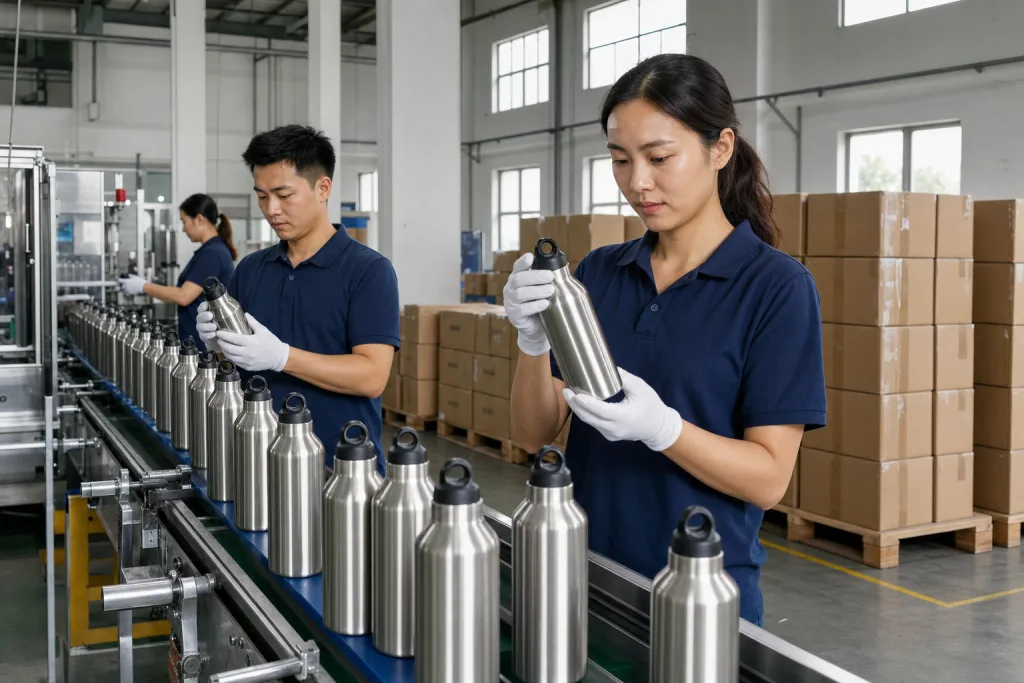
Quality control should be built into the order, not discussed after production. At BottleForge Industrial in Zhejiang, our normal inspection points include incoming material check, vacuum test, coating adhesion check, logo position check, leak test, and final AQL inspection. We run 2-hour vacuum checks on insulated bottles before packing, then QC uses a 3M tape pull on printed logos when the ink has cured. Our monthly output is about 300,000 stainless bottles and tumblers, with standard MOQ from 500 pcs for many stock models and 3,000 pcs for new color runs or special lids.
For AQL, many buyers use 2.5 for major defects and 4.0 for minor defects. Major defects include leakage, wrong logo, severe dents, unsafe sharp edges, failed insulation, or wrong material. Minor defects include small coating specks, slight color variation within agreed tolerance, or minor carton marks. Define this before production. If your customer will reject a 0.5 mm cosmetic dot on matte black coating, say it early; matte finishes show defects faster than gloss, and we have seen this go sideways when the PO only says “premium finish.”
MOQ, lead time, and price reality
MOQ is not factory stubbornness. It comes from coating line setup, logo jig setup, raw material buying, carton printing, and how many hands the line needs. On one cup line, a 15-minute color purge and a new laser fixture can eat half a shift. A canteen factory can still run 200 pcs, but the unit price looks ugly because that setup cost gets spread over too few bottles.
For stock-shape custom drinkware, a practical MOQ is 500 pcs for simple logo decoration, 1,000 pcs for custom powder coating, and 3,000-5,000 pcs for new mold lids, special shapes, or custom canteen body tooling. A canteen customizable program with six colors usually means 500 pcs per color, not 500 pcs total. We saw a buyer flag a PO that said “500 pcs all colors” and the math did not work. Ask that question before you tell your sales team six colors are approved.
China lead time is simple if you line up artwork and deposit early. Sampling usually takes 5-10 days for logo samples on existing bottles. Bulk production takes 25-35 days after deposit and artwork approval. Sea freight to Europe or North America can take another 25-40 days depending on port, season, and customs flow. Air freight works, but on stainless bottles the freight bill can wipe out your margin in one shot.
Price has to be compared on the same Incoterm and packing basis. FOB Ningbo and DDP warehouse are not the same number. A USD 3.60 FOB bottle can land at USD 5.20-6.50 after freight, duty, inspection, warehousing, and local delivery. We once caught a PO typo that swapped FOB for DDP, and the buyer had to resend it. If you are a canteen vendor or distributor buyer, build your margin from landed cost, not factory unit price.
Cheap samples are easy. Repeat orders at the same color, logo position, carton strength, and delivery window are the real test. That is where serious canteen manufacturers pull away from trading noise.
How to choose your supplier
Your supplier choice should follow the order, not a slogan. A one-color logo bottle is routine work for many canteen vendors. A retail-ready growler set with printed box, barcode, insert, and mixed cartons needs real project control. On the line, a single logo pass can move fast; a 6-part gift set needs packing-table checks and carton code matching. The wrong question is who is cheapest.
Ask direct questions. Does the canteen supplier make stainless bodies in-house or buy them from another shop? Are coating and logo printing internal or subcontracted? What is the defect rate on matte coating? Can they provide pre-production samples before bulk? Can they pack by SKU, color, or FNSKU for marketplace fulfillment? Can they support BSCI, ISO 9001, or customer audit requirements? QC pulled a sample after a 48-hour leak test, and that is the kind of answer you want, not sales talk.
If you work with canteen distributors across several markets, ask about document discipline too. Commercial invoice, packing list, HS code, test reports, carton marks, and photo records should match line by line. A PO typo on one carton mark can hold up a 1,200-carton booking at the warehouse gate. This is not admin work. A good China supplier will treat paperwork as part of the shipment, not something to fix after the truck leaves.
The best promotional drink bottle for your campaign is the one that fits the user, the budget, the compliance market, and the delivery date. If a quotation is 20% lower than everyone else, check material grade, wall thickness, coating, lid quality, packaging, and inspection scope before you clap. We have seen this go sideways on a 0.35 mm wall where the spec called for 0.5 mm, and the caliper caught it in 10 seconds. Sometimes the price gap comes from better line efficiency. More often, a piece of the spec has been cut out.
Send your bottle brief for a practical factory quote
Share capacity, quantity, logo method, market, and delivery date. We will suggest a workable specification before quoting.
Frequently asked questions
What is the normal MOQ for a custom promotional drink bottle?
For most stock stainless steel bottles, 500 pcs is a workable MOQ for one logo on an existing color. If you need custom powder coating, expect 1,000 pcs per color. For a new lid, new mold body, or fully customized canteen shape, 3,000-5,000 pcs is more realistic. Packaging also affects MOQ. A printed color box may require 1,000 pcs, while a plain white box can be done at lower quantities. Always ask whether the MOQ is per order, per color, or per SKU.
Which material is best for promotional drinkware?
For mid-range and premium promotional use, 304 stainless steel is the safest choice. It is durable, widely accepted for food contact, and works well with powder coating and laser engraving. Tritan is good for transparent sports bottles, especially when weight matters. Glass looks clean but needs stronger packaging and has higher breakage risk. Aluminum is cheap and light, but it is usually single-wall and less premium. For most B2B custom drinkware orders, a 500-750 ml double-wall 304 stainless bottle gives the best balance of price, function, and perceived value.
How long does production take in China?
For an existing bottle shape, expect 5-10 days for a logo sample and 25-35 days for mass production after artwork, deposit, and sample approval. If you need a custom color, printed retail box, or special accessory, add 5-10 days. Sea freight from China to Europe or North America commonly takes 25-40 days port-to-port or longer during peak season. If your event date is fixed, start sourcing at least 10-12 weeks before the delivery deadline. Rush orders are possible, but they reduce your inspection and correction window.
Is laser engraving better than screen printing?
Laser engraving is better for durability because it does not rely on surface ink. It is excellent for stainless steel bottles with powder coating and works well for simple logos, names, and small text. Screen printing is better when you need a colored logo, larger artwork, or lower cost on high quantities. A one-color screen print is often cheaper than laser engraving at 1,000 pcs, but it needs proper curing and adhesion testing. If your bottle will be used daily for 12 months or more, laser is usually the safer choice.
What should I check before approving a pre-production sample?
Check capacity, weight, color, logo size, logo position, lid fit, gasket smell, leak performance, coating defects, and packaging. Fill the bottle with water, invert it for 30 minutes, and shake it over paper to check leakage. Compare the logo against your approved artwork, not only by eye but with a ruler. For powder coating, ask for Pantone or RAL tolerance, but understand that metal surface and lighting affect perception. If the sample has a gift box, drop one packed unit from about 80 cm to see whether the retail packaging survives normal handling.