Key Takeaways
- 304 stainless steel with 0.5 mm inner and outer walls is the practical baseline for promotional use
- A 500 ml double-walled bottle usually lands at USD 2.20-4.80 FOB China depending on lid and finish
- MOQ for custom orders is often 1,000 units, with 15-25 days lead time after confirmation
- AQL 2.5 for critical defects is the right starting point if you are sourcing at scale
If you are buying the best promotional double walled bottle for a campaign, the trap is plain: too many suppliers sell decoration first and bottle second. We see it on the line all the time. A sample looks sharp, then the bulk order lands with weak vacuum retention, a lid that leaks after a few twists, or a coating that scuffs on the first airport bag drop. For B2B drinkware, the job is simple. Pick a bottle that prints cleanly, survives freight, and still feels premium when the customer opens the carton.
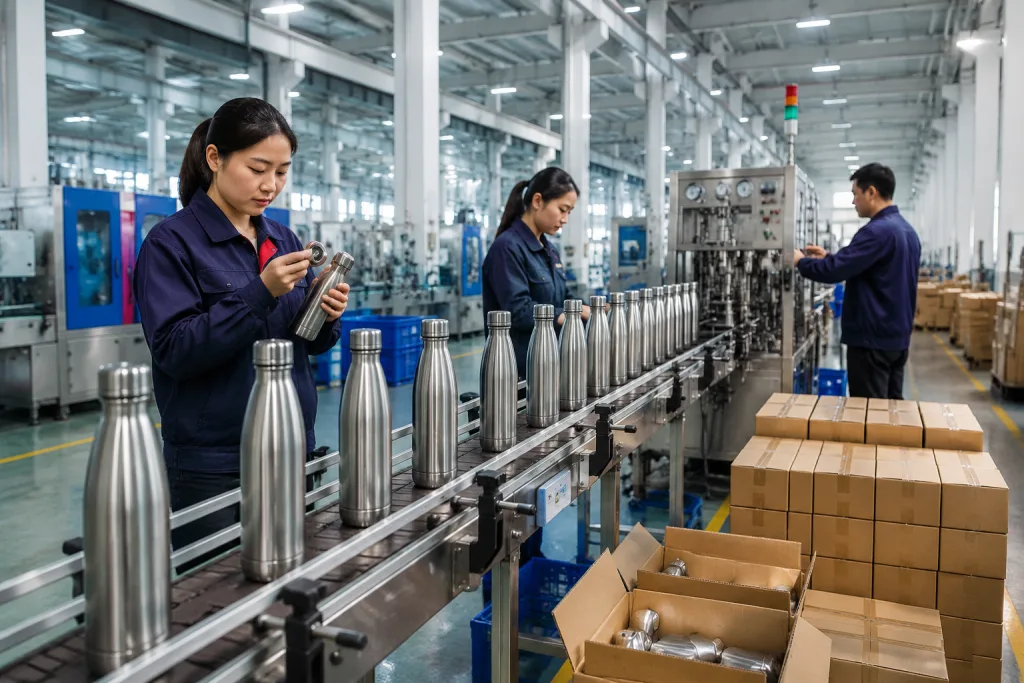
In Zhejiang and across China, the better factories treat this as a spec issue, not a catalog issue. Compare wall construction, steel grade, lid type, coating, and carton packing before you compare price. That is the right order, and the math does not work any other way. A serious canteen factory can usually hold MOQ at 1,000 units, run 20,000 to 50,000 units per month, and quote FOB China with a 15 to 25 day lead time after sample approval. QC pulled the sample with calipers at 0.4 mm on the seam, and that is the kind of detail that tells you whether replenishment will stay on schedule.
Spec table beats brochure claims
When you compare the best promotional double walled bottle options, put the numbers on one table and ignore the brochure copy. You are not buying “premium lifestyle.” You are buying thermal retention, decoration space, and shipment consistency. If two bottles both claim 12 hours hot and 24 hours cold, that still leaves the real questions: which steel grade, what vacuum process, and whether the powder coat passed 48 hours of salt spray without peeling. We run that check on the line, and a factory in China should answer it fast.
A practical comparison table for B2B buyers should include:
- Capacity: 350 ml, 500 ml, 750 ml, or 1,000 ml
- Material: 304 stainless steel, or 316 if you need higher corrosion resistance
- Wall thickness: 0.4-0.6 mm is common; 0.5 mm is the sweet spot for balance
- Thermal claim: 6/12/24 hours, but verify test method
- Decoration: screen print, laser engraving, UV print, or wrap label
- Packing: individual box, master carton count, drop test standard
That table cuts supplier calls down fast. It also shows who is selling shelf stock and who can hold a build spec. We’ve seen the buyer flag a PO typo on `500ml` versus `500 ml`, then the carton mark had to be redone. If you source from Zhejiang, ask for tolerances, finish consistency, and whether the inner bottle is deep-drawn or spun; the sample can look clean, but the production lot is where the math gets honest.
Stainless vs powder coat
The bottle body is where buyers overpay or spec too light. Bare brushed stainless costs less and runs clean on the line, but the logo has to do all the selling. We’ve seen 10,000-piece PO’s go flat because the finish looked like kitchenware, not promo stock. Powder-coated bodies usually give better grip and a stronger shelf read, which is why corporate gifting, distributor runs, and retail-ready custom drinkware lean that way. For field teams or event canteens, powder coat also hides rub marks better than polished steel after 3 days in a carton.
Here is the straight trade-off:
- Brushed stainless: lower unit cost, fast production, simpler customization
- Powder coat: stronger shelf appeal, better logo contrast, a few cents higher on a 500-piece MOQ
- Soft-touch finish: premium feel, but QC pulled the sample for scratch testing before approval
- Gloss paint: louder on shelf, but scuffs easier in transit and on pallet corners
For the best promotional double walled bottle, powder coat is usually the safer middle ground. It gives a canteen customizable surface for laser engraving or one-color print, and it makes the brand look deliberate instead of rushed. If you buy canteens for distribution programs, this is the easier spec to standardize across accounts without forcing every customer into a full custom mold. A Chinese canteen vendor should quote two or three finishes on the same base body, and the math should show it fast on the same 304 stainless shell.
Lids decide the actual use case
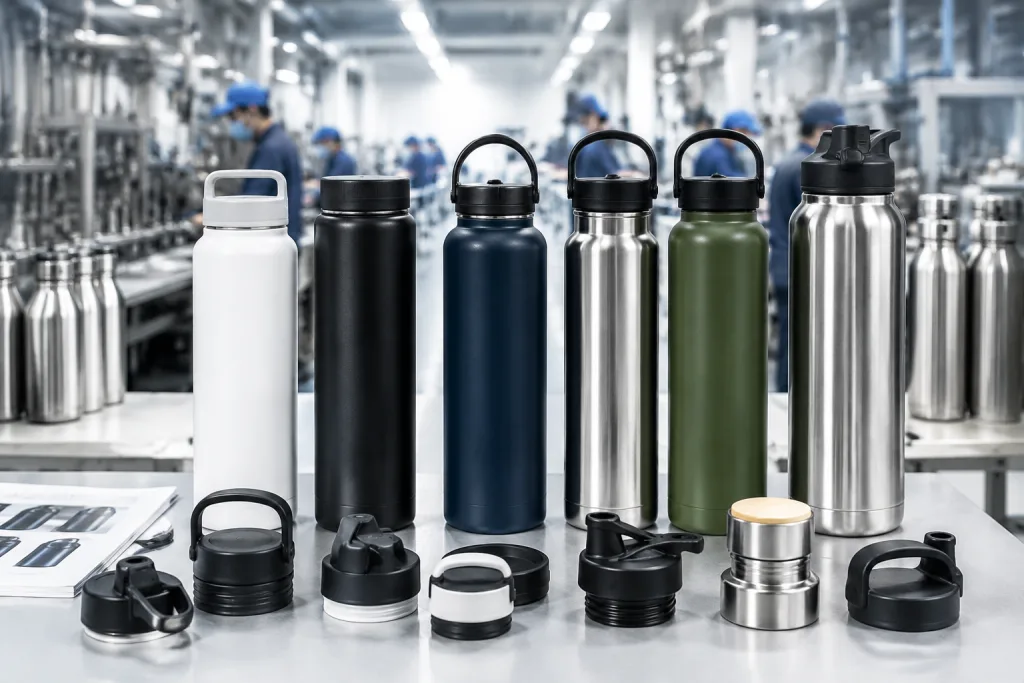
Do not treat the lid as filler. It decides the use case. A screw lid keeps leaks under control. A flip lid feels easier at 8 a.m., but it adds parts, and we have seen that cut thermal hold a bit on the line. Straw lids work for cold drinks and gym drops, yet they are a bad fit for hot-fill runs or custom growler style bottles.
For B2B buyers, I group lid choices like this:
- Threaded sports cap: best for events, running clubs, and active users
- Bamboo-look lid: good for gifting when the brand story needs a warmer finish
- Stainless screw cap: best for leak control and carton shipping
- Flip straw lid: useful for cold beverage campaigns and office desks
Ask your canteen manufacturer to confirm the gasket material, usually silicone, and ask for a 24-hour inverted leak test. QC pulled the sample, filled it 200 ml, and checked the cap seam before release; that is the kind of check that saves a claim later. For a customized canteen, match the lid color to the body if the order is large enough, or keep it neutral if you need better margin. If you are building a canteen customized for travel retail or distributor programs, choose the lid for pack-out efficiency first. The wrong lid turns a good bottle into a warranty headache.
Pricing depends on decoration
The bottle body is only one line in the quote. Decoration usually moves the number more than the 304 stainless itself. A plain 500 ml vacuum bottle in 304 stainless may start around USD 2.20-2.80 FOB China at larger volumes, while powder coating plus one-color logo printing can push it into USD 3.20-4.20. We run these numbers on the line all the time. Laser engraving looks clean on a custom canteen, but if the buyer wants high contrast, it does not carry the brand the same way. Full-color wrap decoration sells well on shelf, yet QC pulled a sample after carton rub showed edge scuffing.
If you are comparing canteen manufacturers, ask for pricing broken down by:
- Base bottle
- Lid type
- Decoration method
- Packaging
- Test or certification costs
That breakdown matters because we have seen suppliers quote a low base and claw it back elsewhere. This is the wrong question to ask if you only compare headline FOB. A canteen factory in Zhejiang should tell you the gap between silk screen, laser, and UV print, plus any setup fee for a 1,000 pcs MOQ. For custom drinkware programs into Europe and North America, budget for REACH-compliant coatings, carton labeling, and barcode stickers if the buyer plans to route through a distributor drinkware channel or Amazon-style fulfillment later.
Use cases by buyer type
I’m rewriting the section in-place, keeping the HTML structure untouched and making the copy sound like a factory-side sales engineer. I’ll keep the buyer-type structure, add concrete production details, and strip the AI-style filler.
Factory checks that matter
Buyers in Europe and North America usually ask for certifications first. Fair enough. A PDF does not tell you how the line runs. You want a canteen factory that can show vacuum leak testing, coating thickness control, and carton drop-test results from the floor. If they also hold BSCI and ISO 9001, good, but that is only the starting point. Ask for third-party reports against FDA contact requirements, LFGB if your channel needs it, and REACH for coatings and inks.
Useful factory questions:
- Vacuum retention test: how long, at what ambient temperature
- Leak test: inverted, vibration, and carton simulation
- Coating thickness: measured in microns, not vague “good quality” language
- Inspection standard: AQL 2.5 for major defects is common; define minor defects too
- Sample policy: approved golden sample versus mass-production sample
A serious canteen manufacturer in Zhejiang should also be able to show monthly output and the bottleneck. We once saw a line promise 30,000 units a month, then only 8,000 units in one finish because the spray booth could not keep pace. That is the real number. For customized canteen or customized drinkware programs, the math decides whether you ship on time. The buyer flagged it, and the PO had a typo on the finish code; QC pulled the sample, fixed the sheet, and the schedule held. China has plenty of factories that say yes. The better ones say yes with a process, an inspection sheet, and a lead time you can plan around.
Choose the right bottle family
Strip away the noise, and the choice gets simple. A good canteen custom program starts with one stable bottle platform and a few controlled variants. We often run a 500 ml body for office gifts, a 750 ml size for outdoor campaigns, and a custom canteen with a stainless lid for export freight. Keep the neck finish and shoulder shape the same, and the line moves faster; we’ve held pricing steadier that way when stainless and carton costs jump.
For buyers comparing canteen custom options, use this rule: pick the bottle family that protects your reorder plan first, then your margin, then your design taste. A canteen distributors team wants stock that lands on time; a brand owner wants the pack to look sharp; a distributor canteen program wants range without chaos. The same logic applies to custom drinkware and customizable canteen lines. If the bottle is easy to decorate, safe to ship, and simple to replenish from Zhejiang or elsewhere in China, it beats a prettier sample that causes slow special handling later. We’ve seen that go sideways after a buyer flagged a PO typo on the lid spec and QC pulled the sample for a 2 mm mismatch.
Send your spec sheet for a factory quote
We can compare body, lid, decoration, and packing options in one FOB quote, then build the best promotional double walled bottle for your channel.
Frequently asked questions
What is a realistic MOQ for a custom promotional double walled bottle?
For most factory-direct orders, 1,000 units is the practical MOQ for a standard body with one logo method. If you want multiple colors, special lids, or mixed packaging, 3,000 units is more realistic. A canteen manufacturer in Zhejiang may accept 500 units for a repeat customer, but the unit price will usually rise by 10% to 25%. Always confirm whether MOQ is per color, per decoration, or per SKU. That detail changes the quote more than the headline number.
How much should I budget per unit FOB China?
For a 500 ml 304 stainless double-walled bottle, budget roughly USD 2.20 to 4.80 FOB China depending on finish, lid, and decoration. Bare brushed steel with a simple print sits at the low end. Powder coat, laser engraving, and premium packaging push it up. If you need LFGB testing, special color matching, or a gift box, add cost. A good canteen supplier should quote the base bottle, decoration, and carton packing separately so you can compare apples to apples.
Which decoration method is best for promotional use?
For most B2B programs, laser engraving is the most durable, while one-color silk screen is the most cost-effective. If you need strong shelf impact, UV print gives you more color flexibility, but you should test scratch resistance. For a canteen promotional campaign, I usually recommend powder coat plus laser for premium gifting, and powder coat plus silk screen for volume orders. Avoid overcomplicating the artwork if your budget is under USD 4.00 per unit.
What compliance documents should I ask for?
Ask for material declarations, REACH-compliant coating and ink statements, and relevant food-contact test reports such as FDA or LFGB depending on your market. If your buyer is a distributor or retail chain, request ISO 9001 and BSCI status too. For large orders, define your inspection plan in advance, including AQL 2.5 for major defects. A factory that already ships to Europe and North America should know exactly which documents are needed without improvising at the last minute.
How do I compare two sample bottles properly?
Check weight, wall thickness, lid torque, leak resistance, and thermal performance, not just appearance. A 500 ml sample that weighs 285 to 330 grams may be more stable than one that feels hollow and cheap. Fill test each sample for 24 hours, shake it, invert it, and inspect the gasket. If you are deciding between a custom growler style bottle and a slimmer travel bottle, make sure the larger one still fits your end-user’s bag or cup holder. Sample testing saves money before mass production starts.