Key Takeaways
- For a 500 ml custom vacuum flask, realistic MOQ starts around 1,000 pcs per color for powder coating and 3,000 pcs for fully custom mold work
- 304 stainless steel is standard for inner liners; 316 is useful for saltwater or acidic beverage positioning but adds cost
- A serious thermos factory should run 100% vacuum testing plus AQL final inspection before shipment
- Normal lead time is 30-45 days after artwork approval for repeat orders, longer for new lids or tooling
If you sell outdoor gear or run promo programs, a stainless flask is not just a logo carrier. It has to survive backpacks, winter car trunks, dish racks, and impatient end users. We have seen two 500 ml quotes sit 6 cents apart, then QC pulled the sample and found a loose push-button cap, 0.32 mm outer wall, and coating that failed the 3M tape test after 24 hours. Same shape. Different risk.
As a manufacturer thermos team in Zhejiang, China, we see one buyer mistake at least 10 times a month: picking the lowest FOB price before locking the use case. This is the wrong question to ask. A retail outdoor bottle and a conference giveaway can share the same 500 ml body, but they should not share the same wall gauge, lid budget, or inspection plan, and the line needs those details before we cut the logo film or book carton packing.
Start with the real use case
The best custom vacuum flask for an outdoor retailer is seldom the cheapest promotional thermos on a quote sheet. Start with one plain product job: “keeps coffee hot during a 6-hour hike,” “fits a car cup holder for commuters,” or “premium client gift under USD 6.50 FOB Ningbo.” We use that sentence to lock the body size, lid type, finish, and packaging before the first sample request. Otherwise the line wastes 3-5 days cutting samples that the buyer rejects after measuring a cup holder with a 72 mm gauge.
For outdoor retail, we usually quote 500 ml to 750 ml capacity, 304 stainless steel inner and outer walls, 0.40-0.50 mm body thickness, and powder coating tested by cross-hatch adhesion. For promotional brands, 350 ml to 500 ml often works better because carton weight stays under control and the unit price still has space for logo, gift box, and freight. A 500 ml customized thermos with powder coating and one-color logo might sit around USD 4.20-6.20 FOB depending on lid, finish, and order volume. A more retail-ready flask with handle lid, gift box, and premium coating can move into the USD 6.80-9.50 range. On our floor, QC pulled a 750 ml sample last month at 312 g body weight, and the buyer flagged it as “too heavy for day hikes.” Fair point.
Do not ask only for “thermos bulk price.” That is the wrong question to ask. Ask the thermos supplier to quote against the sales channel and the retail expectation. A distributor thermos for outdoor shops needs stronger shelf packaging and fewer cosmetic defects, so we run closer checks on coating dust, rim scratches, and color bands under the light box. A corporate thermos promotional order may accept a simpler white box, but logo color control must be tight because the brand manager will notice a wrong Pantone before they notice a 20-minute heat retention difference. We have seen this go sideways from one typo on a PO: “PMS 186C” entered as “PMS 168C.”
Procurement rule: decide whether the bottle is a product, a gift, or a campaign tool before you approve the sample.
Specs that actually change performance
Most stainless vacuum flasks are built with double-wall bodies and a vacuum gap between the inner liner and outer shell. Do not accept “stainless steel” as the material spec. Ask the thermos manufacturer to write out the inner liner grade, outer shell grade, cap plastic, gasket material, and coating compliance on the PI. On our line, QC checks incoming coils with an XRF gun before deep drawing; one buyer once sent back a PO that said “SS inside” and the math doesn’t work when purchasing has to price 201, 304, and 316 from that. For European and North American orders, 304 stainless steel is the normal liner choice. For marine, fishing, or endurance sports channels, 316 stainless gives a stronger anti-corrosion story, but it adds USD 0.30-0.80 per unit depending on bottle size and the weekly steel price.
Heat retention claims need discipline. A solid 500 ml flask should keep water above 60°C after 6-8 hours when tested from a 95°C starting temperature at room temperature. Bigger bottles often test better because the surface area-to-volume ratio is lower. Ask for the curve. If a supplier’s thermos quote says “24 hours hot” with no test method, ask for the temperature log, ambient conditions, fill volume, and cap position. We run this on a simple test bench with a calibrated probe inserted after set intervals; last month QC pulled a sample at 8 hours and found 58.7°C, so we did not let sales print 60°C on the carton. Marketing copy is cheap. Test data is not.
Caps cause more trouble than new buyers expect. A screw cap with a silicone gasket is the safer choice and gives fewer complaints after shipment. A push-button lid sells well in retail photos, but it needs tighter leak testing, cleaner plastic tooling, and better control of spring fit. A handle lid can lift perceived value for outdoor retail, but check whether the handle pin and hinge survive 3,000 open-close cycles. We’ve seen this go sideways when the buyer flagged hinge whitening after a drop test from 1.2 m. For kids or family camping products, ask for ASTM or relevant food-contact testing for plastics and coatings, then match the report name to the exact lid model.
- Inner steel: 304 as standard for most export orders; 316 when the product is sold as premium or used near salt water.
- Gasket: food-grade silicone with a clean fit in the groove; removable is better when the mouth size allows it.
- Coating: powder coating or spray paint, checked by cross-cut adhesion tape and abrasion rubs before mass packing.
- Testing: vacuum check, leak test, drop test, coating check, then final AQL inspection before we ship.
Customization choices and their tradeoffs
A customizable thermos can mean a 20W fiber-laser logo, a screen print, or a new mold, so pin down the custom level before you quote. Laser engraving is the cleanest route. It sits about 0.05-0.1 mm deep on the line, so it holds up on outdoor gear and does not peel. It works best on stainless finish or powder coat where the mark has enough contrast. Silk screen printing is cheaper for simple logos with one or two colors, but curved bodies and textured coatings can blur the edges. Heat transfer and full-wrap printing give stronger shelf impact, yet they add setup time and we always run abrasion checks before release.
For promo brands, logo accuracy is where the buyer flags us first. Send vector artwork, Pantone numbers, logo size in millimeters, and the exact distance from the base or lid line. “Center logo on front” is not a spec. A thermos vendor should send a digital proof, then a pre-production sample if the order value supports it. For orders above 5,000 pcs, we push for a physical sample because a USD 80-150 sample cost is small next to a rejected shipment. We had one PO with a 3 mm placement typo, and QC caught it on the steel ruler before the line started.
Color is another trap. Powder coating MOQ is usually 1,000 pcs per color at our Zhejiang factory, while custom Pantone spray can need 2,000-3,000 pcs depending on paint supply. If you need six colors at 500 pcs each, ask whether the thermos factory has stock colors close to your palette. Stock black, white, navy, forest green, and stainless can cut lead time by 7-10 days. We check the first rack under a D65 light box, and if the buyer wants one shade split across half a dozen SKUs, the math does not work.
Fully customized thermos work, such as a new lid, exclusive body profile, silicone boot, or retail display packaging, needs a tooling talk. Simple lid mold changes can start from USD 1,500-4,000. New body tooling runs higher and may need 45-60 days before mass production. For a campaign that launches in six weeks, choose an existing factory thermos shape and spend the budget on decoration and packaging instead. We have seen this go sideways when the buyer insists on a new lid and a fixed ship date; the T0 sample from the mold shop still needs trim and fit checks before we run volume.
MOQ, price, and lead time realities
MOQ is not a penalty from thermos manufacturers. It comes from real setup work: coating line cleaning, logo jig adjustment, carton ordering, and stainless steel line efficiency. For a standard 500 ml bulk thermos using an existing mold, a practical MOQ is 1,000 pcs per color for custom logo work. Below that, the math often fails; the spray booth still needs the same 2-hour color change and the pad-printing plate still costs the same. Thermos bulk orders of 3,000-5,000 pcs get better unit economics because setup costs spread across more bottles and carton loading improves. For mixed-color retail assortments, negotiate a total MOQ with color split limits, for example 3,000 pcs total with no color below 500 pcs. We had one buyer ask for 12 colors at 200 pcs each; QC could manage it, but production hated it, and the unit price jumped by USD 0.38.
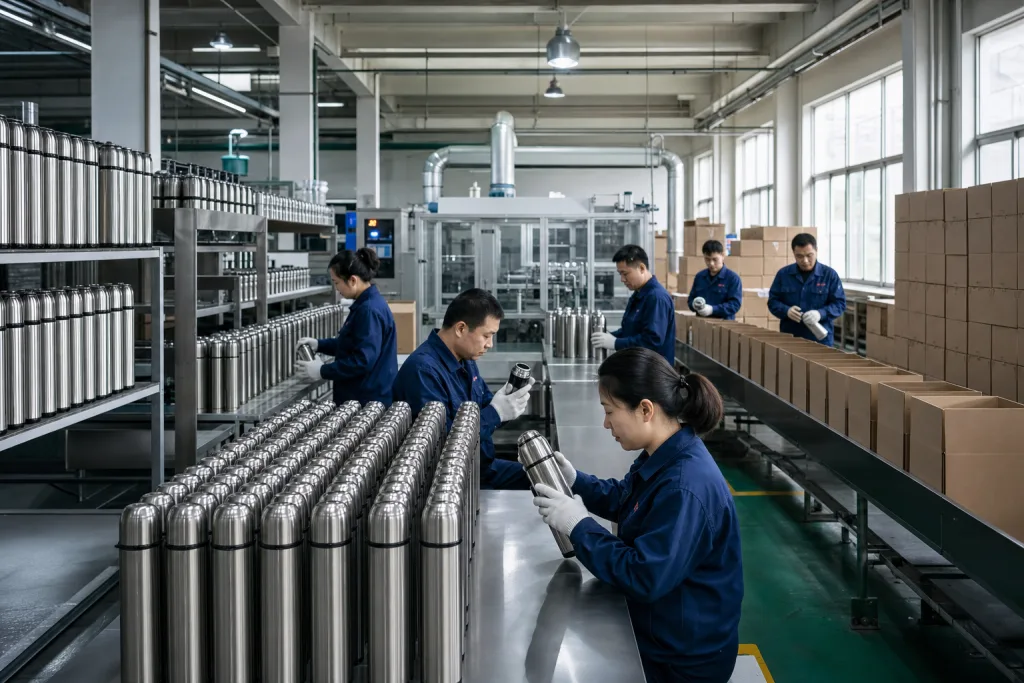
Lead time depends on how many approvals you add. A normal timeline from a China supplier thermos factory looks like this: 3-5 days for digital proof, 7-10 days for decorated sample, 30-45 days for mass production after deposit and artwork approval, then ocean freight or air shipment. In peak season before Q4, add 10-15 days. Fast approvals matter. We once lost 6 days because the PO said “matte black,” while the artwork file called out Pantone Black 6C with a gloss logo. At BottleForge Industrial in Hangzhou, Zhejiang, our stainless bottle lines can handle about 450,000 units per month across vacuum flasks, travel tumblers, and sports bottles, but capacity still gets tight when 4 distributor thermos programs arrive in the same week. The line gets crowded.
For FOB pricing, ask the manufacturer thermos sales engineer to separate product cost, decoration cost, packaging cost, and testing cost with line items. That makes comparison cleaner. A quote bundled into one number can hide a 300 gsm gift box instead of 400 gsm, lower-grade cap plastic, or no third-party testing. We have seen this go sideways when the buyer approved the cheapest quote, then QC pulled the sample and found the lid thread felt loose after 20 open-close cycles. If you sell into Europe, budget for LFGB or EU food-contact testing when required, plus REACH checks for coatings. For North America, FDA food-contact documentation and California Proposition 65 screening may be relevant depending on your customer.
Payment terms are usually 30% deposit and 70% before shipment for new customers. If you are a repeat thermos distributor with stable forecasts, you can discuss staged shipments, blanket PO, or reserved capacity. Factories in China like predictability; buyers like flexibility. Fair enough. The practical middle ground is a 3-month forecast, one blanket PO, and release orders every 30 days so we can book steel coil, lids, cartons, and coating slots without guessing. If the forecast moves by 20% every week, the factory will price in the risk.
Quality checks before you ship
A stainless vacuum flask can look perfect and still fail. We see it weekly. Vacuum loss, micro-leaks, weak powder coating, and lid gasket problems rarely show at the packing table under normal LED lights. Your purchase order should lock the tests, not just the logo size and carton mark. At minimum, require 100% vacuum testing on the line, leak testing after lid assembly with inverted bottles for 30 minutes, and final inspection using AQL, commonly AQL 2.5 for major defects and 4.0 for minor defects. For premium outdoor retail, tighten cosmetic limits; one REI-style buyer once rejected a lot over 0.5 mm black specks near the laser logo.
Ask the thermos supplier for a defect classification list before the deposit is paid. Major defects include leakage, wrong material, unsafe burrs, severe dents, failed vacuum, wrong logo, and broken caps. Minor defects include small coating specks, light scratches within an agreed size, or slightly uneven print edges. Put sizes in writing: for example, coating specks under 0.3 mm outside the logo area allowed, scratches over 5 mm rejected. Without this list, every inspection becomes an argument, and we have seen a buyer flag “rough mouth rim” after QC already pulled the sample and passed it with a 0.05 mm feeler gauge.
Drop testing should match the sales channel. A promotional thermos mailed in a gift box may need carton drop testing from 76 cm based on ISTA-style handling. An outdoor retail flask should survive reasonable bottle-level drops too, though no stainless flask is dent-proof. Be careful with claims such as “unbreakable.” This is the wrong question to ask. Stainless steel dents, powder coating chips, and plastic lids crack if the wall thickness, PP grade, or lid thread design is weak; we once changed a cap mold after 8 out of 32 samples cracked at the hinge after a 1.2 m drop.
For compliance, keep documents organized: material declaration, food-contact test report, coating test, factory audit if required, and BSCI or social compliance status for larger retailers. Around 6 out of 10 outdoor retailers we ship to in Europe and North America ask for these files before the first shipment, not after. A good thermos manufacturers team should know the difference between an internal test report, a third-party lab report, and a retailer-specific protocol. The math does not work if documents are checked after production; one missing LFGB page can turn a 12-day booking plan into an 18-day delay at peak season.
- Approve golden sample with signed label and dated photos; we usually add the PO number, color code, and logo position in mm.
- Confirm carton drop test and master carton weight under buyer limit, especially when the buyer caps cartons at 15 kg.
- Use AQL inspection before balance payment, especially for first orders; check logo, leakage, vacuum, coating, and barcode scan results.
- Keep one retained sample from mass production for dispute control, sealed with date, inspector name, and carton batch number.
Checklist for supplier selection
Choosing between thermos suppliers gets easier once you stop chasing the lowest FOB line. The first quote is often the wrong question to ask. A serious stainless thermos factory should answer working questions without a two-day pause: monthly capacity in pieces, inner-wall steel grade, recent vacuum test records, MOQ for custom coating, and normal loading port. We run a 0.08 MPa vacuum decay check on pulled samples; if a supplier cannot show that kind of record, the risk moves to your side of the table.
Use this checklist before you place a purchase order for the best custom vacuum flask program:
- Factory identity: confirm whether you are dealing with a real thermos manufacturer, trading company, or mixed supplier. Trading is not automatically bad, but responsibility must be clear. Ask who signs the PI, who owns the mold, and who pays if QC rejects 320 scratched lids.
- Existing mold library: ask for current 350 ml, 500 ml, 750 ml, and 1 L options to avoid unnecessary tooling. A shared body can cut sampling from 18 days to 12 days when the lid, cap, and carton die-line are already on the line.
- Decoration capability: quote laser engraving, silk screen, pad printing, heat transfer, powder coating, and custom packaging as separate cost lines with setup charge, MOQ, and reject allowance. QC pulled one matte-black sample last month because the logo sat 2 mm off center.
- Compliance: request FDA, LFGB, REACH, or other reports based on your sales market. Check the report holder name against the factory name on the business license; we have seen buyers get stuck because the lab report belonged to a different cup workshop.
- Inspection plan: require vacuum retention, leak testing, coating adhesion, carton drop, and AQL final inspection. Tape test with 3M 600 and a 1.2 m carton drop are basic checks, not premium service.
- Export experience: ask for carton labeling, barcode, FNSKU if you sell through fulfillment channels, and pallet specs. One typo on an FNSKU sticker can turn a clean shipment into 48 cartons sitting in a fulfillment warehouse.
For outdoor retailers, give extra weight to construction and after-sales defect rate. For promotional brands, focus on color tolerance, logo position, and ship date. If you are buying through a thermos distributor or need a distributor thermos assortment, standardizing two proven bodies usually beats launching ten shapes at small quantity. Less drama. It cuts sample cycles, prevents spare-cap mix-ups, and reduces reorder mistakes when the buyer sends a PO with “750ML lid” but no lid code.
A reliable supplier thermos partner in China should push back on a weak brief. If you ask for a matte white bottle with a large black logo, they should warn you about dirt visibility and carton rubbing; we saw gray scuff marks after 600 km of truck movement from Zhejiang to Ningbo. If you ask for a push-button lid at the lowest price, they should explain leakage risk and gasket tolerance in mm. That is the difference between order taking and engineering support.
Send your flask brief for a factory quote
Share capacity, quantity, logo method, target market, and delivery date. We will return practical specs, MOQ, and FOB pricing.
Frequently asked questions
What MOQ should I expect for a custom stainless thermos?
For an existing 500 ml or 750 ml stainless flask, expect 1,000 pcs per color for custom logo and standard powder coating. If you use stock body colors and laser engraving, some factories may discuss 500 pcs, but the unit price will be higher. Fully custom colors usually start around 2,000-3,000 pcs per color because paint setup and coating line cleaning are real costs. New mold projects normally need 3,000-5,000 pcs per first order, plus tooling fees. If your launch needs multiple colors, ask for a combined thermos bulk MOQ with controlled color splits.
How do I compare two vacuum flask quotations fairly?
Put both quotes into the same structure: capacity, steel grade, body thickness, lid material, finish, logo method, packaging, test reports, Incoterm, and lead time. A USD 4.80 FOB quote may be worse than USD 5.35 if it uses thinner steel, a cheaper cap, no gift box, or no AQL inspection. Ask each thermos supplier to state whether the price includes sample cost, carton marks, barcode labels, and third-party testing. Also compare payment terms and port. A Ningbo FOB quote from Zhejiang, China, may have different inland cost than a shipment from another region.
Is laser engraving better than screen printing for outdoor bottles?
For outdoor retail, laser engraving is usually the safer choice because it is permanent and resists abrasion. It also looks premium on powder-coated or stainless surfaces. The limitation is color: laser marks are normally metal-tone or coating-contrast, not Pantone-matched. Screen printing is better when brand color accuracy is essential, especially for promotional thermos programs, but it needs adhesion testing and careful curing. For large logos on curved bottles, request a physical sample. A 60 mm wide print can look different on a 500 ml slim flask than on a straight-wall tumbler.
What documents do European and North American buyers usually need?
For Europe, many buyers ask for LFGB or EU food-contact testing, REACH compliance for coatings, and sometimes BSCI or similar social audit information. For North America, FDA food-contact material declarations are common, and some customers request California Proposition 65 screening. Outdoor retailers may add their own restricted substance list. You should also keep a material declaration, production inspection report, and packing list with carton dimensions and gross weight. If the flask is for Amazon-style fulfillment, add barcode or FNSKU labeling requirements before production, not during final packing.
How long does a custom thermos order take from China?
For a repeat order with an existing body and approved artwork, 30-45 days production after deposit is normal. New logo samples add 7-10 days. Custom color matching may add another 5-7 days, especially if you require a physical color panel. New lid or body tooling can push the project to 60-90 days before shipment. Ocean freight to North America or Europe then adds several weeks depending on port and season. If your campaign date is fixed, reserve production capacity early and approve artwork within 48 hours of receiving the proof.