Key Takeaways
- A serious RFQ for the best custom thermos should include capacity, steel grade, wall thickness, lid type, logo method, packing, MOQ, and FOB port
- For a customized thermos, expect realistic MOQ from 1,000 pieces per color for stock shapes and 3,000-5,000 pieces for private mold or special coating
- Sample approval should check heat retention at 6 and 12 hours, leak rate, coating adhesion, logo position tolerance, and carton drop strength
- Bulk PO terms should name AQL level, spare parts ratio, FNSKU or barcode rules, shipping marks, and defect responsibility before production starts
A good stainless thermos is simple until you buy 5,000 pieces with weak heat retention, thin cartons, or a lid that cracks after the first drop test. Outdoor retailers need bottles that hold temperature, resist dents, pass material checks, and survive parcel shipping. Promotional buyers care more about logo position, color repeatability, and a ship date that does not miss the campaign window. QC pulled one 750 ml sample last month with a 1.2 mm logo shift; the buyer flagged it before we even reached carton testing.
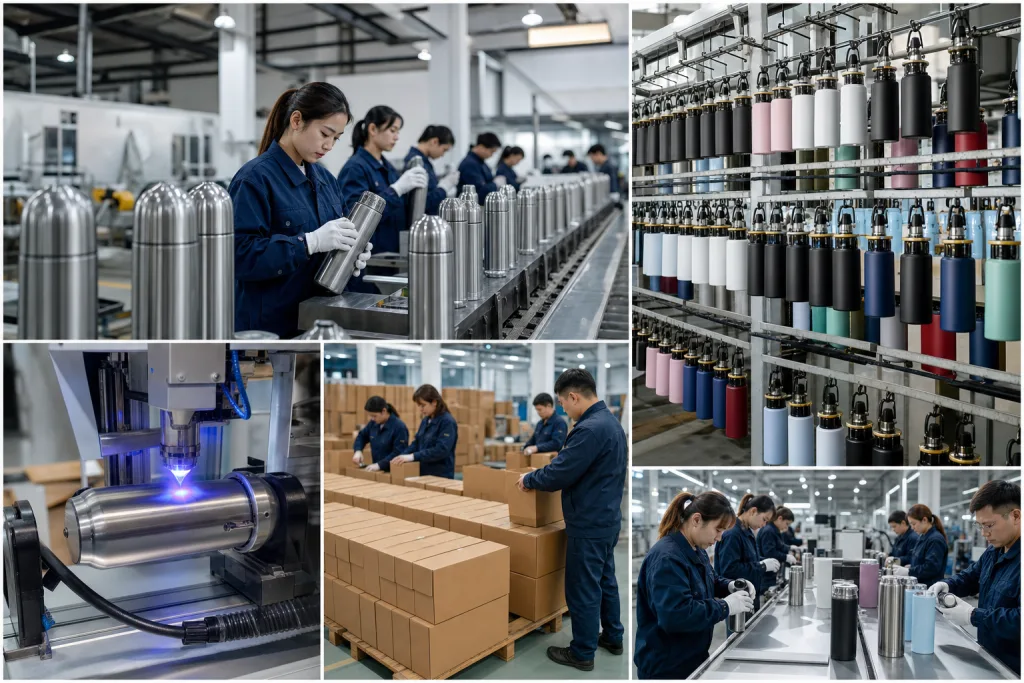
If you are comparing a thermos supplier in China, “what is your best price?” is the wrong question to ask. Ask what product spec, finish, test standard, MOQ, logo process, packing method, and inspection level you are buying. Our factory in Hangzhou, Zhejiang produces up to 480,000 stainless drinkware units per month, and we see the same bulk thermos problems again and again: unclear artwork files, PO typos on Pantone codes, cartons under 12 kg burst strength, and inspection plans agreed too late. The math does not work if a cheap quote turns into rework, air freight, or missed retail delivery.
Start With A Useful RFQ
Most bad thermos custom projects start with a 9-word message: “Please quote 500 ml vacuum flask with logo.” That is not enough for a thermos manufacturer to price cleanly. We run two 500 ml stainless vacuum bottles on the same line and see a 25-40% cost swing from 0.4 mm versus 0.5 mm steel, cap thread design, coating system, PP handle parts, and whether the color box uses 250 gsm or 350 gsm paper.
For the best custom thermos RFQ, write it like a purchase spec, not a mood board. Send capacity, target retail price, intended user, market, order quantity, target ship date, logo artwork, packaging type, and delivery term; if any item is still open, mark it “TBC” so sales and engineering do not guess. If you sell to outdoor retailers, say the real use case: hiking/camping or daily commuting is enough to start. A cold-weather bottle needs a lid that opens with gloves; the cheap conference thermos lid often fails that brief, and we have seen buyers flag this after the first hand sample.
A clean RFQ line can look like this: 750 ml double-wall vacuum stainless thermos, 304 inner and outer, powder coating, leakproof screw cap with cup, laser logo one position, color box, MOQ 2,000 pcs, FOB Ningbo, EU market, REACH compliant, delivery before 15 September.
Ask the thermos factory to quote at least two options: one stock mold and one upgraded version. For example, a 600 ml stock customizable thermos may quote at USD 4.20-5.10 FOB Ningbo at 3,000 pcs, while a heavier outdoor model with 0.5 mm outer wall, cup lid, and better coating may sit at USD 6.10-7.40. That price gap is normal. The wrong question is “why is yours expensive”; the right one is whether the supplier thermos quote shows wall thickness, coating process, carton specs, and test standard. QC pulled a sample last month where the PO said “mat black” instead of “matte black,” and that tiny typo still cost 3 days of artwork confirmation.
Choose The Bottle Construction
The build is simple on paper: inner stainless wall, outer stainless wall, vacuum gap, welded base, lid system, and surface finish. On the line, small choices decide whether the bottle passes carton-drop testing or comes back after one winter season with dented shoulders and loose lids.
For most North American and European outdoor channels, we recommend SUS304 stainless steel for both inner and outer walls. Some manufacturers thermos quotes use 201 stainless for the outer shell to cut USD 0.18-0.35 per piece. It can work for dry indoor promotional use, but it is not our first choice for outdoor retail because the rust risk is higher around the base weld and rolled mouth. QC pulled one 201-shell sample last year after a 48-hour salt spray check; the buyer flagged brown spots near the logo edge. For premium orders, 316 stainless inner wall is possible, but the added cost makes sense only for marine, saltwater, or high-end wellness positioning.
Wall thickness matters. A lot of low-cost bulk thermos models run around 0.35-0.40 mm stainless. A stronger outdoor model often uses a 0.45-0.55 mm outer wall. You feel it. The bottle sits heavier in hand, resists dents better, and is less likely to deform during 1.0 m drop tests onto plywood over concrete. The trade-off is weight and price. If your customer sells ultralight hiking gear, do not overbuild; the math does not work when the finished 750 ml bottle jumps from 410 g to 485 g. If they sell hunting, camping, and workwear products, the heavier wall can become a selling point.
For vacuum performance, ask for test data at 6 hours and 12 hours. A realistic 500-750 ml stainless thermos filled with 95°C hot water should retain roughly 65-75°C after 6 hours and 45-55°C after 12 hours, depending on lid design and ambient temperature. Catalog claims like “keeps hot 24 hours” are the wrong question to ask. Ask your thermos supplier to write down the test method, starting temperature, room temperature, fill volume, and whether the lid was opened during testing; our lab sheet uses a digital probe thermometer and records readings at 22°C room temperature.
Put Logo And Finish Into The PO
Logo decoration is where a lot of promotional thermos POs go off the rails. A logo in a PDF is not a production spec. On our line, the order needs the decoration method, logo width in mm, distance from rim or base, color code, artwork file type, and the allowed tolerance. If the buyer skips one line, QC will still ask for it.
The wrong question is “which method is best.” The bottle material decides it. We run a 20 W fiber laser for bare stainless and powder-coated shells, and that mark stays put in wet storage and hand washing. Silk screen printing still works for simple promo runs, but on a 120T mesh screen the ink life depends on curing and the ink lot. Pad printing suits small curved logos, not big wrap graphics. Heat transfer and full-wrap sublimation fit coated bottles, while embossed or debossed metal badges go on premium gift sets.
Powder coating is the default for a durable customizable thermos, but the spec should name the finish. We check it with a cross-hatch knife, 3M tape, and scratch rubs near the seam. A good coat should pass adhesion and basic tape pull. If you want a Pantone match, put the tolerance in writing; powder on stainless does not track paper swatches exactly. On one 5,000-piece run, QC pulled the sample against the plaque and the buyer still wanted a second shade check, which saved a repaint.
Your PO line item should look something like this: Logo: laser engraving, one side, 42 mm wide, centered 95 mm from bottle base, artwork AI file BF-Logo-V3, position tolerance ±2 mm. Body finish: matte powder coating, Pantone 5535C reference, approved by physical sample dated 12 May. We once saw a PO type “52 mm” against a 42 mm mockup. That 10 mm mistake cost a full sample round.
A thermos vendor that tells you to “confirm later” is asking for trouble. In Zhejiang, we book coating, printing, and packing by day, and a late logo change usually adds 5-10 days. If the coated shells are already on the rack, rework charges are normal. We’ve seen this go sideways on a 20,000-piece order because the buyer changed the logo after the first box was packed.
Sample Before You Negotiate Hard
Price negotiation before sample testing is theater. We run enough thermos projects to know the trap: a buyer squeezes USD 0.20, then the cap leaks or the coating scuffs after 2 days. A sample that costs a few dollars is cheap insurance, and this is the wrong question to skip.
There are three sample stages. First is the existing sample from a stock mold. It checks hand feel, size, lid action, and basic finish. If the shelf is stocked, we can usually ship it in 3-7 days. Second is the logo sample, often 7-12 days depending on printing or laser slot on the line. Third is the pre-production sample, made with final material, color, logo, packing, and accessories. QC pulled that one before we start bulk, and that is the sample your PO should match.
For each sample, check use, not showroom looks. Fill it with boiling water, close the lid, turn it over for 30 minutes, and set it on white paper so any leak shows fast. Use a kitchen scale for capacity: 1 ml of water is about 1 gram. Weigh the bottle and write it down. Open and close the lid 30-50 times. Drop the empty bottle from 80-100 cm onto plywood or rubber flooring to see how the cap and base hold up. For parcel e-commerce, ask for a 76 cm carton drop test after packing. We have seen this go sideways when the foam insert is 2 mm too thin.
If you sell on marketplaces or ship to retailer DCs, confirm barcode, FNSKU, carton label, and master carton size at sample stage. A nice-looking manufacturer thermos turns into a warehouse headache if one digit is wrong; we once caught a PO typo on the FNSKU before the cartons left Hangzhou. Sample approval should be written out: model number, color, logo method, packaging, approved defects, and date. Do not trust chat history as your spec sheet.
Build The Bulk PO Line By Line
A bulk PO for thermos bulk production should leave no room for guessing. If your PO only says “2,000 pcs custom thermos,” the line will make choices for you, and that is where orders go sideways. A workable PO tells the thermos factory exactly what to make, how to pack it, how QC should inspect it, and what the factory must do if the lot fails. We have seen a PO where “500ml” was typed as “50ml” on one line; QC caught it against the approved sample with a digital caliper and scale before carton printing started.
Useful PO line items include product model and capacity, material and steel grade, wall thickness if critical, lid material, gasket material, finish and Pantone color, logo size and position, individual packaging, master carton quantity, carton marks, barcode rules, spare parts ratio, inspection level, shipment term, payment term, and required documents. Do not just write “black logo.” Put the artwork file name, print method, logo width in mm, and approved sample date. For EU orders, include LFGB or food contact expectations where relevant, REACH for coating and restricted substances, and packaging waste markings if your channel requires them. For US orders, ask about FDA food-contact material documentation and state-specific requirements if applicable. The buyer often flags barcode placement after mass packing; by then, changing 167 cartons is not fun.
For inspection, AQL is the common language. A typical setup is General Inspection Level II, AQL 2.5 for major defects and 4.0 for minor defects. Critical defects, such as sharp metal burrs, serious leakage, wrong material, or unsafe contamination, should be 0. Define major defects in plain words: leaking cap after a 30-minute inverted test, wrong logo, coating scratch over 3 mm, vacuum failure after the hot-water test, broken cup lid, incorrect barcode, or carton shortage. This is the wrong question to ask: “Will your QC check it?” Ask what fixture, gauge, sample size, and defect photos will be used.
Payment terms for a new customized thermos order from China are often 30% deposit and 70% before shipment after inspection. For repeat buyers with stable volume, other terms can be discussed. Lead time is usually 30-45 days after deposit and final sample approval for stock mold orders, and 60-90 days if private mold tooling or a new lid system is involved. Our Hangzhou, Zhejiang team normally schedules stainless thermos production in weekly batches, so approval on Monday can ship in 35 days, while approval on Friday may stretch to 42 days. We run the welding, polishing, vacuum pumping, and packing slots by batch; one late logo confirmation can push your cartons behind another buyer’s 5,000 pcs order.
Control Inspection And Shipping Risk
Bulk production is not finished just because the bottles look clean on the packing table. Outdoor retailers and promo buyers usually come back to 4 failure points: leakage, vacuum loss, coating scratches, and crushed cartons. We tell buyers to inspect around those risks, not around a 6-page checklist that misses the obvious. QC pulled one matte black sample last month with a 0.3 mm rim chip; the bottle looked fine from 1 meter away, but the buyer flagged it in their warehouse photos.
Ask the thermos suppliers to run 100% basic leak testing during assembly, including upside-down and side-lay checks after the lid is torqued. For final inspection, the third-party inspector can sample by AQL and add function tests. A working inspection checklist covers appearance, logo size and position, color comparison, capacity, weight, lid torque, leak test, vacuum temperature test, barcode scan, carton drop test, and packing quantity verification. Check mixed-color orders twice. We have seen distributor thermos orders pass total quantity, then fail because the PO said 1,200 navy and 800 white, while the line packed 1,000 and 1,000.
Shipping term changes how much control you keep. FOB Ningbo or FOB Shanghai is common for Zhejiang factories, and it works well when your forwarder knows drinkware cartons and booking cutoffs. If you are new to importing, FOB gives you cleaner control than chasing a supplier’s unknown freight agent. DDP is fine for small promotional orders, but the math gets messy when customs duty, delivery appointment fees, and residential surcharges are buried in one price. For Amazon or marketplace shipments, lock FNSKU labels, polybag warnings if used, carton weight limits, and pallet requirements before mass packing starts; re-labeling 86 cartons after sealing is slow work.
Packaging is the wrong place to save USD 0.05 without testing. A standard color box plus 5-layer export carton works for many wholesale orders, but heavier 1 L outdoor bottles often need dividers or a stronger carton with better edge crush strength. Keep master cartons under 18-22 kg where possible. Retailers hate crushed gift boxes. Claims after delivery are hard to settle fairly if nobody agreed on a carton drop test, and we have seen this go sideways when the inspector found 4 dented color boxes only after the truck had already arrived.
Decide What Makes It Best
The best custom thermos is not the most expensive one. It is the model that fits your sales channel, gross margin, test risk, and reorder plan. A distributor thermos for hardware stores may need a rugged folding handle, 1 L capacity, black powder coating at 60–80 μm, and a carton that survives a 10 kg stack test. A promotional brand may need 5,000 pieces of 500 ml bottles with exact Pantone color and logo approval finished before the campaign ship date. An outdoor retailer may prefer a 750 ml customized thermos with cup lid, thicker coating on the bottom edge, and a retail box that states the heat-retention test without overpromising. QC checks this with a thermometer probe, not catalog photos.
Before you place the PO, decide your non-negotiables. For outdoor use, we run 304 stainless steel, leakproof lid structure, stable vacuum performance, and powder coating adhesion as the first checks; carton strength comes right after, because crushed corners still cause chargebacks. For a thermos promotional program, logo clarity, color consistency, MOQ flexibility, and delivery schedule matter more than adding another lid option nobody asked for. For a distributor thermos line, reorder stability matters: the same mold, same lid, same gasket, and same packaging must be available six months later. We have seen this go sideways when a buyer approved a cheap lid in March, then asked for a refill order in September and found the gasket size had changed by 1.5 mm.
There is also a supplier choice behind the product choice. A good thermos manufacturer should answer technical questions without hiding behind catalog language. They should tell you when your target price is unrealistic, when a logo is too small for clean printing, or when a special coating will add 10 days. This is the wrong question to ask: “Can you match this price?” Ask what changed in steel grade, lid tooling, coating thickness, or inspection level. Last month QC pulled a sample where the laser logo looked clean at 30 mm wide, but failed at 18 mm because the letters filled in after polishing.
If you are building a long-term stainless drinkware range, treat your first order as the start of a product system: shared lids, shared cartons, consistent colors, and predictable MOQ. The math works when a 500 ml bottle and 750 ml thermos share one PP lid family and one inner tray size. We ship fewer mixed cartons, the line changes molds less often, and your reorder stays cleaner. That is how thermos distributors and outdoor brands cut cost without damaging quality.
Send Your Thermos RFQ For A Practical Quote
Share capacity, quantity, logo artwork, market, and deadline. We will return workable specs, MOQ, FOB pricing, and sample timing.
Frequently asked questions
What MOQ should I expect for a custom stainless thermos?
For a stock mold custom thermos, a realistic MOQ is usually 1,000 pieces per color if the body color is standard, and 2,000-3,000 pieces per color for custom powder coating. If you need a private mold, new lid, special handle, or exclusive shape, expect 3,000-5,000 pieces and tooling charges. Some thermos suppliers may offer 300-500 pieces, but the unit price will be higher and logo options may be limited. For outdoor retail, we usually suggest starting at 2,000-3,000 pieces so coating, logo setup, carton printing, and FOB handling costs are spread properly.
How much does a bulk thermos order cost from China?
A typical 500-750 ml stainless vacuum thermos from China can range from about USD 3.80 to USD 8.50 FOB Ningbo or Shanghai, depending on steel thickness, lid type, coating, logo method, and packaging. A low-cost promotional thermos may sit near the lower end. A stronger outdoor model with powder coating, cup lid, heavier wall, and retail color box will cost more. Freight, duty, inspection, and inland delivery are not included in FOB pricing. For accurate comparison, ask every thermos vendor to quote the same specification and packing method.
Which logo method is best for a promotional thermos?
For durability, laser engraving is usually the safest choice, especially on powder-coated stainless bottles. It will not peel and works well for outdoor retailers. Silk screen printing is better for simple one- or two-color logos when cost matters and the bottle is not expected to face heavy abrasion. Heat transfer can produce larger graphics but needs careful adhesion testing. For a promotional thermos campaign, define the logo size, position tolerance, Pantone color, and artwork file in the PO. Always approve a physical logo sample before bulk production, because screen color and bottle coating can look different in real light.
What tests should I require before shipping?
At minimum, require leak testing, vacuum heat-retention testing, logo and color inspection, coating adhesion check, barcode scan, quantity verification, and carton drop test. Use AQL General Inspection Level II, with AQL 2.5 for major defects and 4.0 for minor defects, unless your retailer requires stricter rules. Critical safety defects should be zero tolerance. For heat retention, record starting water temperature, room temperature, and results after 6 and 12 hours. For parcel shipping, a 76 cm drop test on the packed carton is a practical requirement. These checks are more useful than simply asking for photos.
How long does thermos custom production take?
For a stock mold customized thermos, normal lead time is 30-45 days after deposit and final sample approval. Logo samples often take 7-12 days, while existing samples may ship in 3-7 days if available. Custom powder coating, special packaging, or high-volume seasonal orders can add 5-15 days. Private mold projects usually need 60-90 days because tooling, trial production, testing, and sample approval take time. If you have a fixed retail launch or promotional event, build in at least two weeks for inspection, booking, and export handling from China.