Key Takeaways
- A practical MOQ for custom stainless thermos orders starts at 1,000 pcs per color, with sharper FOB pricing above 3,000 pcs
- 304 stainless steel vacuum flasks usually add USD 0.40-1.20 per pc over lighter promotional constructions
- Normal production lead time is 35-55 days after deposit and artwork approval, excluding sea freight
- Logo, coating, lid tooling, packaging, and AQL inspection can change landed cost by 8-25%
The best custom thermos flask for your range is not the one with the prettiest render. It is the one that ships on the agreed ETD, holds temperature after a 6-hour test, passes AQL 2.5 inspection, and still leaves margin after freight, duty, warehouse fees, and retail markdowns. We have seen buyers compare 5 quotes that looked “same same” on email, then QC pulled the sample and found 201 steel in the outer shell, a loose push-button lid, and powder coating 18μm thinner than the approved sample.
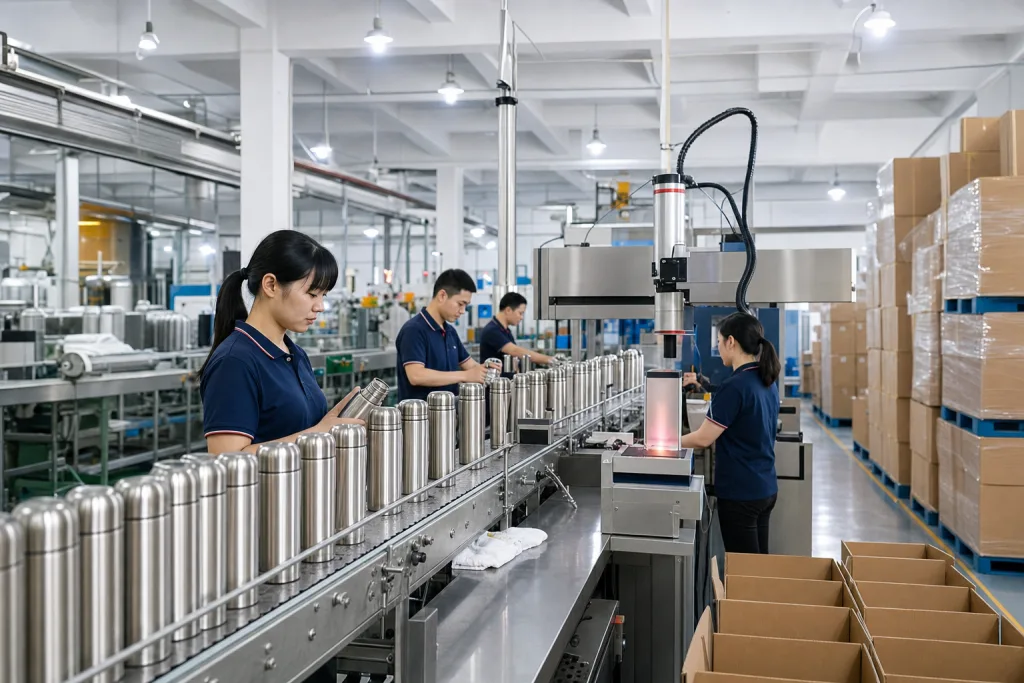
From our stainless workshop in Zhejiang, China, we see the same buying mistake every season: buyers ask for one “bulk thermos price” before they lock capacity, wall thickness, finish, logo method, carton drop test, and launch date. Wrong question. A 500ml flask with laser logo and a 1.2mm gift box does not run like a 750ml flask with full-body powder coating and retail barcode stickers. On the line, those details decide whether we ship in 12 days or 18 days, and whether the math works after the buyer flags a 3mm logo shift on the pre-production sample.
Start With The Real Unit Cost
A buyer often asks, “What is your best custom thermos flask price?” My answer is usually: what failure rate can your channel live with? A 500 ml stainless thermos with 304 inner and outer shell, copper lining, powder coating, leakproof screw lid, and printed retail box is not the same product as a thin-wall promotional thermos built for a 30-day campaign. QC pulled one sample last month where the lid looked fine on the desk, then leaked after 20 seconds on the inverted shake test.
For a normal 500 ml factory thermos order from Zhejiang, China, realistic FOB Ningbo or Shanghai ranges are often USD 3.20-4.20 for basic stainless finish, USD 3.80-5.20 for powder coating with one-position logo, and USD 5.00-7.50 for heavier outdoor retail specifications with better lids and stronger packaging. Larger 750 ml and 1,000 ml models can add USD 0.70-2.40 depending on steel weight and cap design. We run carton drop checks at 76 cm for retail packs, and that one test alone can change the box, insert, and master carton cost.
The main cost drivers are steel grade, body weight, vacuum performance, surface treatment, decoration, lid complexity, and packaging. Steel is not just “stainless.” Most export thermos manufacturer orders use 304 food-contact stainless for the inner wall. Some buyers choose 201 outer shell to save cost, but outdoor retailers usually prefer 304/304 because returns hurt more than the saving. The math doesn't work if a USD 0.18 steel saving creates a 2% complaint rate on Amazon or supermarket shelves.
Wall thickness also matters. A 0.4 mm inner wall and 0.5 mm outer wall is common for 6 bottle shapes we ship every quarter. If you request a heavier outdoor feel, the factory may increase material weight by 8-15%. That does not sound dramatic until you multiply it across 5,000 pcs and add sea freight. A good supplier thermos quote should show capacity, material, finish, logo, packaging, MOQ, and incoterm. If the quote only says “stainless thermos customized bottle,” you do not yet have a quote you can compare. Ask for the measured weight in grams; we use a digital scale on the line, and buyer POs with “same as sample” but no weight target have gone sideways.
MOQ Tiers Change The Math
MOQ is where 7 out of 10 custom thermos projects become workable or die in costing. For standard bodies with existing molds, our usual MOQ is 1,000 pcs per color. For mixed colors under one order, 500 pcs per color may be possible if the total reaches 2,000-3,000 pcs, but the unit price normally rises because the powder-coating booth still needs cleaning, the Pantone chip still gets checked under a D65 light box, and QC still pulls samples after baking.
For outdoor retail, the better planning range is 3,000-5,000 pcs. At this tier, a thermos supplier can buy 304 stainless coil with less waste, keep the coating line running for a full shift, and pack export cartons without switching inserts every hour. Less stopping helps. At 10,000 pcs+, the price improvement is real, often 5-12% versus 1,000 pcs, but only if the design is stable. Reworking a lid by 0.3 mm, changing Pantone color after PP sample approval, or splitting into six carton styles can erase the saving fast.
Promotional thermos buyers sometimes push for 300 or 500 pcs. That works for domestic printing on blank stock, but it is weak for a true thermos custom project from China. The math doesn't work. You may get a higher unit cost, limited colors, no custom retail packaging, and fewer options for pre-production sampling; last month a buyer flagged this only after seeing their PO had “matte black” while the artwork called for “satin black.” If you need a distributor thermos program with steady replenishment, launch with 2,000-3,000 pcs and keep the mold, artwork, and carton specification locked for repeat runs.
- 500 pcs: possible only for stock bodies or sample-market testing, usually expensive.
- 1,000 pcs: normal starting point for logo and color customization.
- 3,000 pcs: better balance for promotional brands and regional outdoor retailers.
- 10,000 pcs: strong pricing, but needs disciplined forecasting.
If a thermos vendor promises full customization at 200 pcs with retail-grade QC, ask where the cost is being hidden. We have seen this go sideways: thin cartons, rushed leak testing, or a “free” color match that fails after the first dishwasher check.
Decoration Is Not Just A Logo
The word customizable thermos can mean 6 different shop-floor jobs. A one-color silk screen logo on a straight bottle is cheap and fast; we run that on a semi-auto screen printer with a simple jig. A 360-degree wrap with gradient powder coat, laser engraving, debossed silicone boot, custom cap color, and printed gift box is not “just decoration.” It is a different routing sheet, different QC points, and usually a different lead time.
Common decoration costs for bulk thermos orders are fairly predictable after artwork is clean. Silk screen printing adds USD 0.08-0.25 per pc depending on color count and position. Laser engraving often adds USD 0.15-0.45 per pc, but it gives a durable retail look and avoids ink adhesion problems on textured coating; QC pulled samples last month where black ink failed the 3M tape test on hammertone paint. Heat transfer or full-wrap graphics can add USD 0.35-0.90 per pc and usually needs 12 days for artwork proofing instead of 5 days for a front logo. Custom powder coating usually adds USD 0.30-0.80 per pc over plain stainless, with matte or speckled finishes at the higher end.
For promotional thermos campaigns, a front logo and a white box may be enough. For outdoor retail, shelf presence and carton strength matter as much as the bottle; we have seen buyers flag crushed corners after a 1.2 m carton drop test, even when the flask itself passed. A printed retail box can add USD 0.25-0.70 per pc. A kraft box is cheaper, but the math doesn't work if your brand sells at a premium price. FNSKU or EAN labels, suffocation warnings for polybags, and master carton markings should be locked before mass production, because a wrong digit on the PO can stop packing for half a day.
One practical rule: approve logo size on a physical sample, not only on a PDF mockup. Curved stainless bodies make logos look wider or lower than expected. On a 500 ml bottle, a front logo around 35-55 mm wide usually looks balanced. On a 1,000 ml flask, you can go larger, but the print position must avoid the shoulder radius; our line uses a 2 mm positioning tolerance on the fixture, and that small shift shows near the curve. A careful thermos manufacturer will flag this before printing 5,000 mistakes.
Lids, Leaks, And Temperature Claims
The lid creates the most returns. We see it on the line: QC pulls 32 samples from a 3,000 pcs lot, fills them to 90%, lays them sideways for 30 minutes, and one bad silicone ring already means trouble. A stainless body can look clean, but a soft gasket, a 0.2 mm thread mismatch, or a weak hinge turns a good customized thermos into a service complaint. For outdoor retailers, we run screw lids with replaceable silicone seals, PP or Tritan food-contact parts, and a simple build that opens cleanly with gloves or cold hands.
Temperature claims need discipline. A typical double-wall vacuum flask can keep hot water above useful drinking temperature for 6-12 hours, but capacity, starting water temperature, room temperature, lid design, and test method change the result. The 1,000 ml bottle wins against the 350 ml bottle because it holds more liquid mass. Simple math. If your gift box says “24 hours hot,” we need test data from a defined setup, such as 95°C water, 20°C ambient, lid closed, and readings at 6, 12, and 24 hours. Catalog wording is not evidence.
Our Zhejiang facility runs vacuum testing, leak testing, and appearance inspection before packing. Current monthly capacity for stainless vacuum drinkware is about 420,000 units/month across standard bottles, travel tumblers, and manufacturer thermos flask lines. For export orders, we recommend AQL inspection at Critical 0, Major 2.5, Minor 4.0. Buyers can also request third-party inspection before shipment, usually adding 1-2 days and a few hundred dollars depending on location. Last month a buyer flagged lid printing shifted by 1.5 mm; QC pulled the sample, stopped packing, and the pad-printing jig was reset before the cartons were sealed.
Regulatory documents also decide which product is safe to quote. For Europe, ask for LFGB on food-contact parts, REACH review on coatings, and declarations covering stainless steel, silicone, and plastics. For North America, match the sales channel against ASTM-related physical testing, FDA food-contact expectations, and Prop 65 review. This is the wrong place to save 80 dollars on paperwork. A thermos suppliers quote without material compliance detail is not enough for a serious retail launch, and we have seen orders get stuck because the PO said “304 stainless” while the test request listed “201 body.”
Lead Time From Sample To Vessel
Lead time is easier to control than most buyers expect, as long as key decisions land early. For an existing stainless thermos body with a standard lid, we run a clean sequence. Digital artwork confirmation takes 1-3 days, assuming the logo file is usable and the Pantone code is not missing from the PO. A logo sample or pre-production sample takes 7-12 days after artwork approval. Mass production takes 30-45 days after deposit and sample approval. Final inspection, booking, and loading add another 3-7 days; QC still checks coating adhesion with 3M tape and pulls cartons for drop testing before the truck leaves Hangzhou.
A realistic factory-to-port timeline is 40-65 days for most thermos bulk programs. Sea freight to the US West Coast can add about 18-28 days port-to-port in normal conditions. Northern Europe is often 30-40 days port-to-port. Air freight saves days, but the math often does not work on stainless drinkware because a 500ml flask in a color box and export carton is not light; we have seen buyers cut margin by USD 1.20 per piece just to catch a promo date.
Custom tooling changes the calendar. A new lid mold can take 25-40 days before proper sampling. A custom body mold takes more time and needs engineering review for vacuum performance, cup holder diameter, carton efficiency, and coating yield. The 72mm car-cup-holder request sounds simple until the insulation gap, base curve, and powder coating thickness are all on the drawing. If you are building a distributors thermos program for spring outdoor sales, do not start development in February and expect calm production. We have seen this go sideways.
The fastest projects are not always the simplest designs; they are the best prepared. Send capacity, target FOB price, order quantity, delivery country, logo files, Pantone colors, packaging style, compliance market, and preferred ship date in the first inquiry. Better yet, attach the AI or PDF artwork and tell us whether the logo is laser, silk print, or full-wrap decal. Then a thermos factory can answer like an engineer, not guess like a trader.
Where Not To Save Money
Some savings are safe. Some are trouble. Safe cuts: use an existing mold such as our 500 ml straight-wall body, reduce colorways from 6 to 2, keep the logo on one side, pack in a standard export carton, and share a repeat-order forecast so the manufacturer thermos line can book 304 stainless coil and lids early. The wrong places to cut are wall thickness without a vacuum test, unconfirmed inner steel grade, low-cost silicone gaskets, weak powder coating, or final inspection. QC pulled one sample last month with a 0.42 mm outer wall against a 0.50 mm drawing; the price looked good, but the dent test failed.
For a promotional brand giving away 2,000 bottles at a winter event, a simpler lid and white box can pass the job. For an outdoor retailer selling at USD 24.99-39.99, the math changes. Retail returns, one-star reviews, and chargebacks cost more than the USD 0.30 saved on coating or the USD 0.18 saved on packaging. We have seen this go sideways: the buyer flagged chips around the bottom rim after one camping weekend, and the customized thermos looked cheap before the second PO was even discussed.
Ask your thermos manufacturers for test records, not “no problem” replies. We run cross-hatch coating adhesion with 3M tape, 100% leak test at the line, vacuum performance sampling after 24 hours, carton drop test on the packed export carton, torque or thread fit review on the lid, and a dishwasher warning check when the coating is not dishwasher-safe. At least 7 out of 10 powder-coated projects should be marketed as hand-wash recommended unless dishwasher cycles have been validated. One buyer once asked us to delete that warning to make the gift box cleaner; bad idea.
For most outdoor and promotional buyers, the best custom thermos flask is not the lowest FOB item. It is the lowest-risk item that still meets your margin target.
China sourcing works well when the specification is written clearly. Zhejiang has a deep stainless drinkware supply chain, but the factory still needs fixed decisions before production: mold code, coating supplier, lid drawing, gasket material, carton mark, and AQL 2.5 checklist. If you need a thermos promotional order for a fixed campaign date, allow 12 days for pre-production samples and about 18 days for mass production after approval on a normal 3,000 pcs run. For a long-term thermos distributor range, protect consistency first: same mold, same coating supplier, same lid, same inspection checklist, with every reorder change written down, even a 1 mm logo move or a typo on the PO.
Price Your Custom Thermos Project With Real Specs
Send capacity, quantity, logo files, packaging needs, and delivery market. We will quote MOQ, FOB cost, sample time, and production schedule clearly.
Frequently asked questions
What MOQ should I expect for the best custom thermos flask?
For a real custom stainless thermos, expect 1,000 pcs per color as the normal starting MOQ when using an existing mold. If you need three colors, plan around 3,000 pcs total unless you accept higher pricing. Below 1,000 pcs, most suppliers thermos options are stock bodies with logo printing only. For outdoor retail, 3,000-5,000 pcs is usually the healthier first order because packaging, coating, inspection, and freight costs spread better. New lid or body tooling may require 5,000-10,000 pcs to make the project commercially reasonable.
How much does a bulk thermos order cost from China?
For a 500 ml stainless vacuum flask from China, a practical FOB range is USD 3.20-4.20 for a basic stainless finish, USD 3.80-5.20 with powder coating and one logo, and USD 5.00-7.50 for a heavier outdoor retail specification. A 750 ml or 1,000 ml model normally adds USD 0.70-2.40. Packaging, color count, lid structure, and testing can move the final cost by 8-25%. Always compare quotes using the same material, capacity, logo method, carton, AQL level, and incoterm.
How long does custom thermos production take?
For an existing mold, allow 7-12 days for a pre-production sample after artwork approval and 30-45 days for mass production after deposit and sample sign-off. Inspection, booking, and loading usually add 3-7 days. A realistic factory-to-port timeline is 40-65 days. If you need new tooling, add 25-40 days for a lid mold and potentially more for a custom body. Sea freight then adds around 18-28 days to the US West Coast or 30-40 days to Northern Europe in normal conditions.
Which logo method is best for a promotional thermos?
For low to mid-volume promotional thermos orders, silk screen printing is usually the most economical at about USD 0.08-0.25 per pc for simple designs. Laser engraving costs more, often USD 0.15-0.45 per pc, but it is more durable and looks better on powder-coated or stainless finishes. Full-wrap heat transfer can reach USD 0.35-0.90 per pc and needs tighter artwork control. If the bottle will be sold in outdoor retail, laser engraving or high-quality screen printing is safer than very cheap ink.
What quality checks should a thermos supplier include?
At minimum, request food-contact material confirmation, 100% leak testing, vacuum performance sampling, coating adhesion checks, visual inspection, and carton drop testing. For export retail orders, AQL Critical 0, Major 2.5, Minor 4.0 is a practical inspection standard. Europe buyers should ask about LFGB, REACH, and food-contact declarations. North America buyers may need FDA-related food-contact documentation, Prop 65 review, and channel-specific packaging rules. Put these requirements in the purchase order before production, not after the goods are packed.