Key Takeaways
- A serious bulk thermos order usually starts at 1,000 pcs per color for custom coating and 3,000 pcs for new mold work
- For outdoor retail, 304 stainless steel with 0.5 mm outer wall is a safer baseline than ultra-light 0.35 mm bodies
- Vacuum insulation should be checked by batch testing, not only by catalog claims like 12 hours hot or 24 hours cold
- A reliable China thermos factory should quote lead time, AQL level, carton specs, compliance documents, and spare part policy before deposit
You are not buying a shelf product. You are buying 5,000 bottles that need to keep coffee hot, survive a 1.2 m drop test, print your logo without ghosting, and land before the retail launch or promo handout date. The best custom thermos bottle is not always the heaviest one, the cheapest one, or the one with the biggest temperature claim on the sales sheet. That is the wrong question to ask.
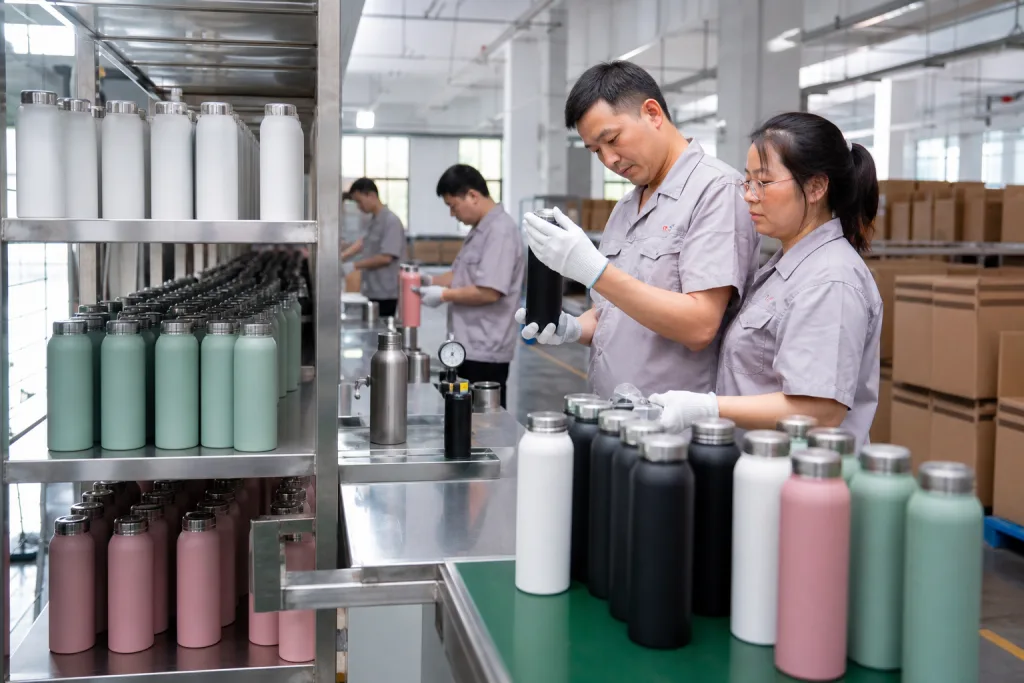
For outdoor retailers and promotional brands, the risk usually hides in small details: 0.4 mm steel instead of 0.5 mm, powder coating that chips at the rim after tape testing, vague FDA paperwork, or a thermos supplier that says yes to every logo method. We run these jobs from our factory base in Zhejiang, China, and we see the same buying mistakes 12 to 15 times each season. Last month QC pulled a sample where the PO said “matte black,” but the approved sample card was Pantone 426C gloss; the buyer flagged it after carton printing had started. Here is the practical Q&A and checklist we use with new B2B buyers.
What Makes A Thermos Worth Customizing?
A custom thermos deserves your logo only if the base bottle is stable first. Decoration will not rescue weak vacuum, a lid that seeps after 3 shakes, or outer steel that picks up dents before it reaches the shelf. Before Pantone colors or gift box artwork, ask the thermos manufacturer for the construction sheet: stainless grade, wall thickness, lid material, gasket material, capacity tolerance, and coating process. We run this check with a digital caliper, a 95°C hot water test, and one carton drop before we talk about printing.
For most outdoor and promotional thermos programs, we recommend 304 stainless steel for both inner and outer walls. The inner wall touches liquid, so it must pass food-contact requirements such as LFGB, FDA, or GB 4806 depending on the market. For Europe, 7 out of 10 buyers we quote ask for REACH and LFGB reports before sample approval. For North America, FDA food-contact compliance and sometimes ASTM-related packaging or lead/cadmium checks are common. QC pulled one sample last month where the PO said “304 inner,” but the supplier test file only covered the lid; that is the kind of gap buyers flag fast.
Wall thickness matters more than catalogs admit. A 0.35 mm outer wall can reduce weight and FOB cost, but it dents faster during field use and carton compression. A 0.5 mm outer wall is a better baseline for outdoor retail. For large-capacity models like 750 ml or 1,000 ml, some buyers choose 0.6 mm outer steel if the product is positioned as a premium trail, camping, or worksite bottle. The math does not work if you save USD 0.18 on steel and then lose margin on crushed cartons; we have seen this go sideways after a 12 kg stack test.
Checklist before you approve any customized thermos sample:
- Steel: 304 inner and 304 or 201 outer, declared clearly on the quote sheet and test file.
- Wall: 0.5 mm outer wall for retail-grade durability, checked with a caliper on the cut sample.
- Lid: PP or Tritan with silicone gasket, no odor after hot water test at 95°C.
- Vacuum: no condensation on body after ice water test; QC should record the room temperature too.
- Finish: powder coating, spray paint, or raw steel matched to use case, with tape test results before mass production.
A good manufacturer thermos partner will answer these points without turning the conversation into a guessing game. If the sales rep needs 2 days to confirm basic steel grade, push back. The line already knows.
MOQ, Price, And Real Factory Limits
The lowest quote on a custom thermos often becomes the most expensive PO after delays, rework, and rejected cartons. Ask where the factory can bend, and where the line is locked. At our Zhejiang, China facility, standard stainless thermos output is about 420,000 units per month across drink bottles, travel tumblers, and food jars. That capacity gives us room on welding and assembly, but it does not cancel coating line minimums, carton printing minimums, or accessory supplier minimums. We see this go sideways when a buyer approves USD 0.08 savings, then QC pulls 312 cartons for color mismatch under the D65 light box.
For a standard model with laser engraving on stock colors, MOQ can be as low as 500 pcs per design. For custom powder coating, plan on 1,000 pcs per color because the spraying booth needs a full color run and cleaning time. For custom lid color, custom silicone boot, or special handle parts, 3,000 pcs is more realistic. For a full new mold, you should expect 8,000 to 20,000 pcs annual volume or tooling cost that may run from USD 2,000 to USD 12,000 depending on complexity. Small orders can work. Custom parts cannot be treated like stock parts.
Typical FOB China pricing for a 500 ml to 750 ml double-wall stainless thermos custom order is usually USD 3.20 to USD 7.80 per unit, before premium packaging. The price moves with steel thickness, coating type, lid structure, logo method, testing scope, and order volume. A promotional thermos for a one-time campaign can sit at the lower end. A retail-ready outdoor bottle with molded handle lid, silicone boot, retail box, and higher AQL inspection will sit higher. One buyer flagged a USD 4.10 quote last month; after adding 0.5 mm outer wall steel, FDA test, and a 350 gsm color box, the real price was USD 4.86.
Use this buying checklist when comparing thermos suppliers:
- Is the quote FOB Ningbo or Shanghai, or EXW China?
- Does the price include logo setup, sample fee, and inner box?
- Is the MOQ per color, per logo, or per total order?
- What is the deposit and balance term: 30/70, 50/50, or LC?
- Are spare lids and replacement gaskets available at 1% to 3% extra?
A serious thermos vendor will put these numbers in writing before sampling. Get it on the PI, not only in a chat screenshot. We once had a PO typo showing “500 pcs total” instead of “500 pcs per color,” and production planning caught it only when the ERP sheet hit the coating line.
Which Logo Method Should You Choose?
The right decoration method depends on how the bottle will be used. A distributor thermos for a trade show and a hiking bottle for outdoor retail are different jobs. We ask how it will be washed, handled, shipped, and photographed because a buyer will ask for a 55 mm logo, then the line finds it crowds the shoulder. A caliper and a carton drop test tell us more than a pretty mockup.
Laser engraving is the safest pick for stainless steel and powder-coated bottles. It does not peel, it holds up better in dishwasher cycles, and QC pulled the sample after 20 tape pulls with no lift. On 304 stainless, we usually keep the mark around 0.15 mm deep so the cut stays clean. The limit is color: laser shows base metal or cuts into the coating, so it is not the answer if the customer wants a bright full-color logo. For outdoor retail, membership gifts, and corporate promotional thermos programs, durability wins.
Silkscreen printing works best for one-color or two-color logos on smooth cylindrical surfaces. It is cost-effective for thermos bulk orders, with a typical setup fee of USD 30 to USD 80 per color depending on artwork. On the line, we run a 60T mesh and a wrap jig sized to the body diameter, usually within a 280 mm print window. The weak point is abrasion on powder-coated curved bodies. Ask for a 3M tape test and alcohol rub test before approval; we have seen a buyer flag a sample after the logo smeared at the first warehouse wipe.
UV printing gives more color and detail, which suits lifestyle graphics and limited promotional drops. It takes longer through curing and usually costs more than silkscreen, but it can make a customizable thermos feel retail-ready without a new mold. Heat transfer can wrap larger areas, though durability depends on process control. If the film temperature drifts by 10°C, the edge starts to lift. We have seen that go sideways on a matte body with gradient art, so we watch the curing lamp and the wrap pressure closely.
Our practical rule: choose laser for long-life outdoor use, silkscreen for tight-cost promotion, and UV or heat transfer when the artwork itself sells the cup.
For every thermos customized with a logo, send vector artwork in AI, EPS, or PDF. Put the logo size in millimeters, not just “large” or “centered.” We have corrected more than one PO where the buyer typed 50 cm instead of 50 mm, and that typo burns a shift on the pad printer. Approve a pre-production sample before mass production, especially when the brand color needs a Pantone match under D65 light.
Insulation Claims Need Testing
Any thermos supplier can print “12 hours hot, 24 hours cold” in a catalog. The real question is the test setup. Starting water temperature, room temperature, bottle capacity, lid structure, and fill level all change the reading. We have seen a narrow 500 ml bottle with a 44 mm mouth beat a wide-mouth 1,000 ml food flask by 8°C at the 12-hour mark, even though both use double-wall vacuum insulation.
For procurement, do not buy from sales copy alone. Ask for the factory thermos test method. A basic hot retention test should fill the bottle with water at 95°C, close the lid within 60 seconds, place it in a 20°C to 25°C room, and measure after 6, 12, and 24 hours with a calibrated probe thermometer. For a good 500 ml stainless custom thermos, we normally see 65°C to 75°C after 6 hours and 45°C to 55°C after 12 hours, depending on shape and cap design. Cold retention can be checked with 4°C water or ice water, but the math gets messy once ice volume changes during the test.
Vacuum failure is the part buyers often miss. A small percentage of units can lose vacuum during welding, polishing, powder coating, or transit; on one 18,000 pcs run, QC pulled 27 samples that warmed too fast after the bottom weld station. A reliable thermos factory should run vacuum checks during production, not only on finished cartons. For bulk thermos inspection, we recommend adding a temperature retention spot test to the final QC plan. It takes time. The math still works, because one failed retail claim can cost more than the extra half-day of testing.
Buyer checklist for insulation:
- Request test data for the same capacity and lid, not a similar model; a 500 ml screw cap result does not prove a 750 ml flip lid order.
- Define acceptable temperature after 6 or 12 hours in the purchase order, for example 68°C minimum after 6 hours at 20°C to 25°C room temperature.
- Check whether coating or laser engraving happens before or after vacuum testing, because the line can expose weak vacuum after heat curing.
- Include 3 to 5 retained samples from mass production for future claims, sealed with carton number and production date.
If your promotional brand promises “all-day hot,” define the temperature and hour count before artwork approval. Otherwise the buyer flagged it later, and we have seen that go sideways on packaging claims.
Retail Packaging Versus Promotional Packing
Packaging is not just a box. It changes landed cost, damage claims, warehouse handling, and how your brand looks on a shelf or in an unboxing video. We see buyers lose USD 0.18 to USD 0.35 per bottle because the box spec was treated as an afterthought. A promotional thermos for an event may only need a white tuck box and master carton. A distributor thermos for outdoor retail usually needs a printed color box, barcode, warning text, country of origin, capacity marking, plus a hang tag or instruction leaflet if the retailer asks for it. The line needs the final dieline before packing trial, not after bottles are already sleeved.
For North American retail, buyers often ask for UPC, carton markings, and FNSKU labeling when stock will move through marketplace fulfillment. One buyer flagged a 2 mm barcode quiet-zone issue after we had printed 3,000 boxes; that mistake should be caught on the PDF proof, not at incoming inspection. For Europe, packaging may need multilingual recycling marks, importer details, CE only if there is an electronic accessory, and country-of-origin labeling. Stainless thermos bottles do not usually need CE by themselves, but food-contact documentation still matters. This is the wrong question to ask if the buyer says, “Can we skip the marks to save cost?” Ask which warehouse will reject the goods.
Carton strength is often ignored until the first shipment arrives with crushed corners. We have seen this go sideways. For sea freight, we normally use 5-ply export cartons with 150 lb to 200 lb burst strength depending on bottle weight. A 500 ml customized thermos in a color box may pack 24 pcs per master carton, while a 1,000 ml bottle may pack 12 pcs. QC pulled the sample carton last month after a corner split on the third drop from 76 cm, and we changed the carton flute before mass packing. If you sell through distributors thermos channels, ask them about warehouse drop tests and pallet height limits before finalizing carton size.
Packaging checklist:
- Confirm barcode type: UPC, EAN, or FNSKU, and check scan distance on one printed sample before mass printing.
- Check carton dimensions and gross weight before freight booking; a 1 cm size change can affect pallet count.
- Use drop testing for retail boxes when unit value exceeds USD 6.00 FOB, especially for powder-coated bottles in color boxes.
- Approve printed warning text and material claims before mass printing, including 304 stainless, BPA free, or capacity wording.
- Keep packaging MOQ separate from bottle MOQ; 5,000 boxes and 3,000 bottles is a common mismatch.
A good thermos supplier will send dielines early. Do not wait until production week three to start box artwork. We ship faster when the box file, barcode, and carton mark are locked before the first pre-production sample leaves Hangzhou.
Quality Control Before Shipment
Your best protection is a QC plan signed before deposit, not a loose promise in the chat. For custom thermos orders, we normally recommend inspection under ANSI/ASQ Z1.4, general inspection level II, with AQL 2.5 for major defects and AQL 4.0 for minor defects. For premium retail programs, some buyers use AQL 1.5 for major defects. That tighter standard sounds nice on a sourcing brief, but the math does not work unless you allow extra inspection hours and sorting cost. Last month QC pulled 200 pcs from a 5,000 pcs run and found 7 lids with weak thread engagement on the torque gauge.
Major defects include leaking lids, sharp edges, visible dents, wrong logo, severe coating scratches, failed vacuum, wrong capacity, or incorrect packaging. Minor defects include tiny dust spots in paint, slight color variation within approved tolerance, or small carton printing imperfections. Critical defects are anything unsafe: metal burrs, broken plastic inside the cap, strong chemical odor, or non-food-safe material substitution. We once stopped a line because a 304 stainless body passed appearance check, but the inner cap insert had a 0.6 mm burr near the drinking spout.
A factory thermos inspection should include appearance, capacity, leak test, logo position, coating adhesion, carton drop condition, barcode scan, and random temperature retention. For leak testing, we fill bottles with water, close the lid, invert them, then shake or lay them flat for 10 minutes on the test bench. Simple test. It catches bad seals fast. For coating, cross-hatch or tape test works well, especially for powder-coated promotional orders that sit in backpacks, cup holders, and warehouse bins before the end user ever opens the carton.
If you are sourcing from China for the first time, use a third-party inspection company or ask your thermos manufacturers to support video inspection plus retained samples. At BottleForge Industrial in Zhejiang, China, our standard lead time is 25 to 35 days after sample approval for common models, and we keep pre-shipment photos, carton measurements, and inspection records for repeat orders. We also measure master cartons with a tape and scale, because buyers have flagged 1 cm carton-size differences when their forwarder recalculated CBM.
The best custom thermos bottle order is boring at shipment stage. No surprises, no mystery cartons, no last-minute change in steel grade, and no “almost same” logo color. If the PO says Pantone 286C and the approved sample says 286C, we ship 286C, not the closest blue left in the powder room.
Final Buyer Checklist Before Deposit
Before you pay a deposit to any thermos suppliers, put the commercial and technical details into one signed file. We have seen 9 disputes in the last 12 months start the same way: buyer approved a clean sample, but the purchase order only said “500 ml black bottle with logo.” Too thin. For a real manufacturer thermos production run, that PO leaves the line guessing on powder coating, laser position, carton pack, and even whether 304 stainless means inner wall only or both walls.
Your PO should state model number, capacity, steel grade, wall thickness if agreed, lid material, coating type, Pantone color, logo method, logo size, packaging, barcode, carton quantity, compliance reports, inspection standard, FOB port, lead time, payment term, and penalty or remedy for late shipment if needed. Attach approved artwork and sample photos. Put the logo size in mm, not “same as sample”; our laser operator will ask for a 42 mm x 18 mm file before he sets the jig. If the order is for outdoor retail, also include spare part requirements such as extra lids, silicone rings, straws, brushes, or boots. We’ve seen this go sideways when a buyer expected 3% spare lids, but the PO showed zero.
For a new thermos custom project, we suggest this timeline: 3 to 7 days for quotation and artwork check, 7 to 12 days for sample, 2 to 4 days for sample review by your team, 25 to 35 days for mass production, and 7 days for inspection and export paperwork. Sea freight to the West Coast of North America may take around 18 to 28 days port-to-port, while Europe often runs 28 to 40 days depending on route and season. Don’t compress the sample stage to save 3 days; the math doesn't work if QC pulled the sample and found the lid thread tight by 0.3 mm after tooling was already released.
Deposit checklist:
- Approved physical sample or detailed digital approval sheet, with photos of logo position, lid fit, color chip, and base stamp.
- Signed PI showing MOQ, unit price, mold cost, and packaging cost; check the currency, because one PO typo from USD to RMB can stop booking for 2 days.
- Compliance documents matched to your destination market, not a random FDA or LFGB report from a different model.
- AQL inspection level and defect definitions agreed in writing, including scratches over 5 mm, coating pinholes, leaking lids, and barcode scan failure.
- Shipping marks, pallet requirements, and forwarder details confirmed before the cartons are printed.
A serious thermos distributor or promotional brand does not need to overcomplicate sourcing. Ask better questions. You need fewer assumptions, not a thicker email chain. The strongest supplier thermos relationship starts with exact specifications, honest limits, and a PO that the merchandiser, production line, QC inspector, and freight forwarder can all read without calling twice.
Send Your Thermos Specs For A Factory Quote
Share capacity, logo, quantity, packaging, and target market. We will reply with MOQ, FOB pricing, sample timing, and compliance options.
Frequently asked questions
What MOQ should I expect for the best custom thermos bottle?
For existing stainless thermos models, MOQ is usually 500 pcs for laser engraving on stock colors and 1,000 pcs per color for custom powder coating. If you need custom lid color, silicone boot, or gift box printing, expect 1,000 to 3,000 pcs. New mold development normally needs higher volume, often 8,000 pcs or more annually, unless you pay separate tooling. For promotional thermos projects with a tight budget, start with a stock body and custom logo. It reduces sampling time, lowers risk, and keeps FOB pricing more predictable.
Is 304 stainless steel always necessary for a custom thermos?
For the inner wall, yes, 304 stainless steel is the standard we recommend for drink contact. Some low-cost thermos manufacturers use 201 stainless steel for the outer wall to reduce price, which may be acceptable for dry exterior use if disclosed clearly. For outdoor retail, we prefer 304 inner and 304 outer, especially when the bottle will be used in wet, salty, or rough conditions. Ask your thermos supplier to state material grade on the quotation and support it with test reports if your market requires LFGB, FDA, or REACH documentation.
How long does a customized thermos order take from China?
For standard models from China, a realistic timeline is 7 to 12 days for a decorated sample and 25 to 35 days for mass production after approval and deposit. Add 3 to 7 days for final inspection, export documents, and loading. Sea freight may take about 18 to 28 days to the US West Coast and 28 to 40 days to many European ports. Custom mold work can add 20 to 45 days before production. If your launch date is fixed, start sourcing at least 90 days before you need goods in your warehouse.
Which logo method lasts longest on a bulk thermos order?
Laser engraving is usually the most durable method because it does not rely on ink sitting on the coating surface. It is a strong choice for outdoor retailers, corporate gifts, and distributor thermos programs where users may wash and carry the bottle daily. Silkscreen is cheaper and works well for simple one-color logos, but it should pass tape and rub testing. UV printing is better for full-color artwork but needs careful adhesion checks. For orders above 1,000 pcs, always approve a pre-production sample using the exact coating and logo process.
What inspections should I require before shipping thermos bulk orders?
Use ANSI/ASQ Z1.4 sampling with general inspection level II as a practical baseline. AQL 2.5 for major defects and 4.0 for minor defects is common; premium retail buyers may use AQL 1.5 for major defects. Inspection should cover appearance, logo position, coating adhesion, leakage, capacity, barcode scan, carton marking, and random insulation testing. For stainless thermos products, also check for sharp edges, odor in lids, and vacuum failure. If you are new to a thermos vendor, a third-party pre-shipment inspection is worth the cost.