Key Takeaways
- A practical MOQ for a custom thermal bottle is usually 1,000-3,000 pcs per color, depending on coating and logo method
- For 304 stainless steel vacuum bottles, a 0.5 mm inner wall and 0.4-0.5 mm outer wall is a normal commercial range
- Plan 25-35 days for mass production after sample approval, plus 7-10 days for pre-production sampling
- Use AQL 2.5 for major defects and test at least 32 pcs from a 5,000 pc shipment for leak and appearance checks
You are not buying a bottle. You are buying a repeatable retail or promotional SKU that has to arrive on time, hold temperature, pass compliance, and match the artwork your buyer approved. The best custom thermal bottle for one program can be the wrong choice for another if the lid leaks at the silicone ring, the powder coat fails a 3M tape pull, or the 5-layer export carton collapses after distributor handling.
Here is a normal order we run: a European distributor books 5,000 stainless steel thermal bottles for a spring campaign. Production sits with a canteen factory in Zhejiang, China, with custom color, logo, insert card, and export cartons. It looks simple on the PO, then QC pulled the sample and found the logo 2 mm too low, the buyer flagged the carton mark font, and the line lost 2 days waiting for final Pantone approval. That is where the math changes.
Start With The Actual Sales Channel
Start with the sales channel, not the bottle size. A 750 ml bottle for a retail shelf lives by different rules than a giveaway at a trade show. This is the wrong question to ask if you jump straight to color or logo. On our line, QC pulled the sample and checked lid torque at 18-22 N·cm before anyone touched print approval. If you skip that step, you pay for features the buyer never wanted.
For this case, the customer is a canteen distributor selling into outdoor stores and corporate gifting accounts in Germany, France, and the Netherlands. They want a 750 ml custom canteen style thermal bottle with a screw lid, carry loop, powder coating, and one-color logo. Their landed cost target is tight, so the FOB China price has to stay near USD 4.20-5.10, depending on the final packaging. We once had a PO typo on the pack spec and the buyer flagged it the same day; that kind of slip eats time fast.
That target already points to the right build. A flip lid with multiple molded parts is the wrong fit here. A full wrap print can be done, but it adds sampling risk and slows sign-off. A vacuum-insulated 304 stainless steel body with a PP lid and silicone seal is the cleaner option. Our sample room measured the powder coat at 60-80 μm, and that still held up under the abrasion check. If the buyer also wants a custom growler or customizable growler for the same distributor program, we quote it as a separate mold family, not as a simple capacity change.
A good canteen manufacturer should ask about sales channel before quoting. Are you selling through Amazon FBA, retail distributors, promotional agencies, subscription boxes, or company stores? Each channel changes carton drop resistance, barcode placement, FNSKU labeling, and inspection standards. A distributor canteen moving to multiple warehouses may need 24 pcs per master carton, while a retail-ready item may need individual color boxes and GS1 barcodes. We ship both, but we do not use the same pack plan for both, because the math does not work.
Lock The Bottle Specification Early
After the sales channel is fixed, write the bottle spec before the logo color debate takes over. For the best custom thermal bottle order, we lock five points first: capacity, steel grade, wall thickness, lid construction with gasket material, and the insulation test target. Simple rule. On our side, the merchandiser enters these into the spec sheet before engineering opens the lid drawing in CAD.
For a 750 ml customized canteen, a common construction is 304 stainless steel for the inner wall, 201 or 304 stainless steel for the outer wall depending on price position, and food-grade PP for the lid. If you sell in the EU, ask your canteen supplier for LFGB or EU food contact test history. For North America, FDA food contact compliance is the usual baseline. If the coating has direct skin contact, REACH and California Proposition 65 may also matter. We have seen buyers approve a matte black sample, then flag coating paperwork 9 days before shipment; that is how a clean order turns messy.
Wall thickness is where new buyers get misled. A factory can cut cost with thinner steel, but dents show up fast after forming and polishing. A normal commercial range is about 0.5 mm for the inner wall and 0.4-0.5 mm for the outer wall before forming. Heavier construction feels better and improves dent resistance, but it raises material cost and carton weight. For a promotional giveaway, a lighter build can pass if the budget is tight. For a retail canteen customized for outdoor use, I would not push the wall too thin; QC pulled one 0.35 mm outer-wall sample last year and the shoulder dented after a single 80 cm drop test.
Thermal performance should be written as a test result, not a slogan. A reasonable target for a 750 ml stainless vacuum bottle is hot water above 55°C after 12 hours when filled with 95°C water at 20°C room temperature. For cold retention, buyers often ask for 24 hours, but test conditions vary by ice ratio, fill level, and whether the lab opens the lid during checks. Put the method on the specification sheet. The marketing claim can come later; the math does not work if procurement buys one standard and the Amazon listing promises another.
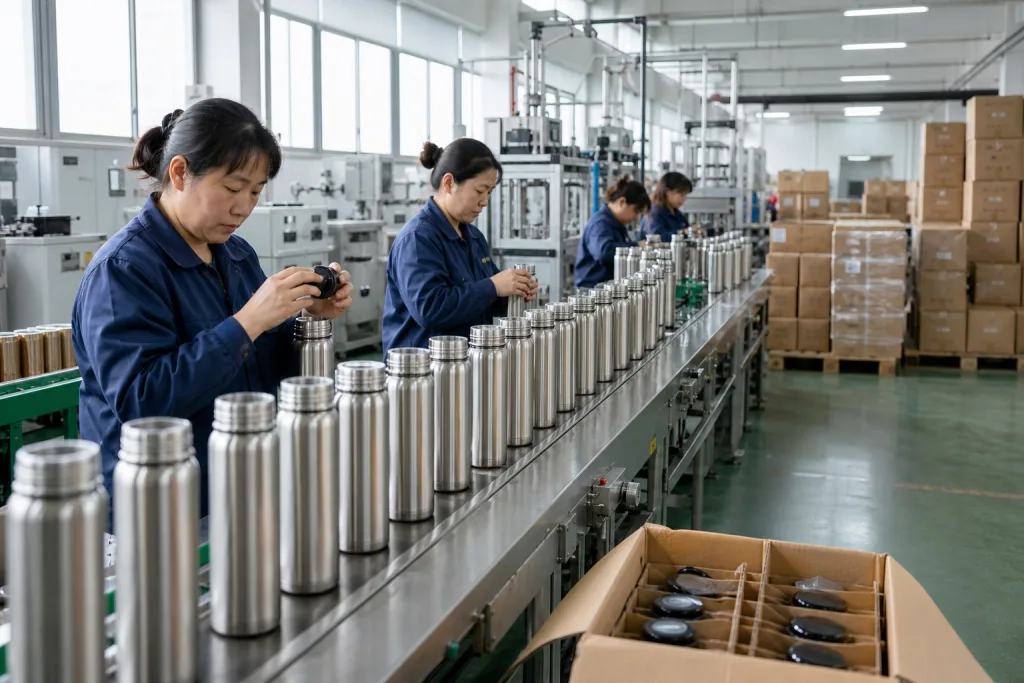
At our Zhejiang facility, a standard order of 5,000 pcs can usually be scheduled into a 300,000 units/month drinkware line if material and artwork are approved before the production window closes. The line planner needs the steel coil, powder code, lid BOM, and carton mark confirmed before we run. Exact specifications save time because one PO typo, like “750 ml” on page one and “700 ml” on the packing page, can hold sampling for 2 days.
Choose Branding Without Killing Yield
Customizable drinkware only has value if the logo stays clean after the line runs 5,000 pcs, not just on one desk sample. One sample hides problems. At volume, the wrong decoration process gives you 3% to 8% rejects, a 2-day rework queue, and the usual fight over what “acceptable variation” means when QC pulled the sample under a D65 light box.
For this buyer, we would run powder coating with laser engraving or one-color silkscreen. Laser engraving lasts because the beam cuts through the coating and shows the 304 stainless surface below. It suits line logos, simple text, and outdoor brands. Silkscreen is better for a solid color logo, but adhesion depends on coating thickness, ink batch, curing temperature, and whether the operator wiped the surface with alcohol before loading the jig.
If you want a canteen customizable in 3 or 4 body colors, this is the wrong question to ask: “Can we use the same logo method on every color?” Matte black, cream, and metallic blue do not behave the same. Low-contrast engraving on silver coating can look weak. White silkscreen on dark coating usually reads well, but fine lines under 0.25 mm can break on the screen. Full-color heat transfer works for promo artwork, but unit cost jumps and we still need abrasion testing, usually 500 rubs with a weighted cloth before we trust it.
For this order, we would make one pre-production sample in the final powder coating color, with the final logo size, final lid, and final packaging. A digital mockup is not enough. We have seen this go sideways when the PDF looked fine, then the bottle body turned 1 shade warmer after curing at 180°C. The sample should be checked under office light and daylight because some coatings shift visually. If you are matching a brand color, use Pantone coated reference for print and a physical coating swatch for the bottle body. Powder coating will not match paper Pantone perfectly.
Experienced canteen vendors will mark the artwork file with print area, curve distortion, and minimum line width before tooling the screen or engraving fixture. If your logo wraps near the body radius, expect slight visual distortion; on a 72 mm bottle diameter, even a 35 mm-wide logo can bend more than the buyer expects. Fix it before mass production. Debating it during final inspection in China wastes time, and the math does not work when the booking date is already locked.
Price The Order Like A Factory Does
Buyers often ask for the lowest unit price first, then add details later. That is the wrong question to ask. We run cost from steel weight, lid parts count, coating line time, logo method, packaging spec, scrap rate, testing, inland truck, and margin. Change one item and the FOB moves. QC pulled a sample on the scale last week and the same bottle jumped 16 g after a thicker lid insert went in.
For a 5,000 pc 750 ml thermal bottle order from China, a realistic FOB Ningbo or Shanghai range sits at USD 4.20-5.80, depending on steel grade, coating, lid complexity, and packaging. A basic white box lands at USD 0.12-0.20. A printed color box sits at USD 0.25-0.45. Insert cards, barcode labels, silica gel, and individual polybags add small amounts, but across 5,000 pcs they are not free. We had one buyer flag a PO that said “750ml” in the spec line and “750 ml” in the carton art; the box had to be reworked before booking.
MOQ is tied to process. For stock colors with logo only, some canteen suppliers ship 500-1,000 pcs. For a custom powder coating color, 1,000-3,000 pcs per color is the practical floor because the coating line needs cleaning loss and setup time. For molded custom lids or a fully customized growler, the MOQ moves to 5,000-10,000 pcs, plus mold cost. The math does not bend for a small order; the line still needs the same wash, cure, and reset.
Payment terms should stay boring and clear. A common structure is 30% deposit and 70% balance before shipment after inspection. If you need credit terms, expect the factory to ask for order history, insurance, or a higher price. FOB means you control ocean freight from the China port; EXW means you also handle pickup and export steps. Most B2B drinkware buyers use FOB because the handoff is cleaner. We once saw a PO with “Ningbe” typed instead of Ningbo, and that one letter sent the shipping clerk back to the desk.
One practical warning: do not compare two canteen manufacturers only by the first quoted unit price. Ask what is included. If one quote includes AQL inspection support, EU test reports, thicker carton, and final sample, while another quote excludes all of it, the cheaper quote is not cheaper after the first claim. QC pulled a batch that looked fine on the line, then found two lid seals loose at 0.6 N·m during pull testing. We've seen this go sideways more than once.
Sample Approval Is A Control Point
The pre-production sample is the control point where you stop expensive mistakes before they reach the line. For this order, the buyer should sign off on three items with evidence: product function with a filled leak test, brand appearance against the approved artwork, and packing method against the carton spec. If the sample is approved casually, the factory will produce against that sample. We have seen this go sideways when a buyer approved a photo on WeChat, then flagged a 3 mm logo shift during final inspection.
A good sample approval checklist covers capacity verification, empty weight, lid fit, thread smoothness, seal compression, coating color, logo position, logo durability, carton marking, and barcode scan. Use a digital scale, caliper, torque feel by hand, and a barcode scanner, not just eyes. For thermal testing, fill the bottle with hot water, record starting temperature, then check at 6 and 12 hours. For leak testing, fill the bottle, close the lid, invert it for 30 minutes, then shake it in several positions. This does not replace lab testing, but it catches obvious design or assembly faults before QC pulls 80 pcs from mass production and finds the same issue across the batch.
Sampling normally takes 7-10 days if the base bottle exists and only coating and logo are customized. If a canteen factory must open a new lid mold, you may need 25-40 days before a real sample exists. The math does not work if the event date is fixed and the buyer still wants new tooling, new packaging, and air shipment approval in the same week. In Hangzhou we run coating, printing, and assembly in separate slots, so losing one sample approval window can move shipment from 12 days of buffer to 18 days of delay.
For customized drinkware, written approval matters. Send approval with photos, Pantone or coating reference, logo file version, packaging dieline, and allowed tolerances. For example: logo centerline tolerance ±2 mm, minor coating specks acceptable under 0.5 mm outside the front display area, no exposed metal dents accepted. These numbers do not sound fancy. They make inspection cleaner, because the inspector can put a 0.5 mm speck under a light box and decide pass or fail instead of arguing by email at 11 p.m.
If you are working with multiple canteen distributors or regional sales teams, nominate one person to approve the sample. Too many late opinions create rework and missed production slots in Zhejiang. We had one PO where the buyer's EU team approved matte black, the US team wanted soft-touch black, and the packing file still said glossy black; the line waited 2 days while everyone corrected the same typo.
Inspect Before The Cartons Leave
Final inspection is not a formality. It is the last cheap checkpoint before goods leave China and land in your warehouse with no easy fix. For a 5,000 pc order, we run ANSI/ASQ Z1.4 sampling with AQL 2.5 for major defects and AQL 4.0 for minor defects unless the contract calls for stricter levels. Some premium retail buyers use AQL 1.5 for appearance, but the math does not always work: one 0.6 mm paint chip can trigger sorting, repacking, and a 2-day delay on the line.
For the best custom thermal bottle shipment, inspection should cover appearance, function, packaging, and quantity. Major defects include leaking lids, broken threads, wrong logo, severe dents, rust, sharp edges, incorrect material, or carton shortage. Minor defects include small coating dust, slight logo position variation, or small packaging scuffs within agreed limits. Critical defects, such as contamination or unsafe sharp metal burrs, should have zero tolerance. QC pulled one sample last month with a burr inside the mouth rim; that carton stopped right there.
Specific tests are simple but they catch expensive mistakes. Randomly select at least 32 pcs for leak checks in a 5,000 pc order, more if the first failures appear. Check 20-30 pcs for logo rub resistance using dry and wet cloth, not a thumb wipe on one showroom sample. Measure bottle height and diameter against the approved spec with a digital caliper so your retail shelf tray or gift box still fits. Scan barcodes from several cartons, not just one sample. If FNSKU labels are used, confirm they are readable and placed on the correct side of the individual box; Amazon buyers have flagged 3 mm label drift before.
Cartons deserve attention. A 750 ml bottle packed 24 pcs per master carton may weigh 10-14 kg depending on packaging. Use 5-ply export cartons for distributor growler or distributor canteen programs where cartons may be handled several times. Drop damage often comes from weak cartons, not bad bottles. We have seen this go sideways when a buyer approved the bottle but ignored a soft 4-ply carton; the corner crush showed up after the second warehouse transfer.
If inspection fails, ask for a written rework plan with photos and a re-inspection date. Do not accept “we checked again” as a report. Ask which station reworked it, how many pcs were sorted, and whether QC used the same AQL 2.5 table on the second pass. A reliable canteen supplier will not enjoy the delay, but they will understand the process.
Plan The Next Reorder Now
The first order teaches you what the spreadsheet missed. On our line, the 750 ml size often moves faster in outdoor retail, while corporate buyers keep asking for 500 ml; the buyer flagged that the laser logo looked sharp on black but washed out on beige after a 0.3 mm depth change. Canteen promo accounts usually push for a lower unit price, while retail buyers come back with gift boxes and spare gaskets in the PO.
Use that first shipment to set your reorder standard. Keep the approved sample, final artwork, carton marks, inspection report, and test records in one folder; we keep the signed master sample in a red file sleeve, and QC pulled it first when a 2024 PO typo showed the wrong lid code. When you reorder, quote the exact production code and sample approval date. For customized canteen programs with several colors, that matters because a small coating shift shows up fast when old stock sits next to new stock.
If sales stay strong, ask the canteen manufacturer for a forecast instead of throwing emergency POs at the problem. A rolling 90-day forecast of 15,000 pcs across three colors lets the factory reserve coating slots and raw material; our powder coat line runs in 8-hour blocks, and a late release burns one block fast. You can still release smaller purchase orders, but the supply chain stops lurching around. Emergency orders are a tax, and the math does not work.
For a wider range, keep tooling discipline tight. A custom canteen, customized growler, and travel tumbler can share the same brand look without sharing the same lid or body mold. Ask your Zhejiang supplier which parts we can standardize: lid gasket size, color box structure, carton quantity, care leaflet, or barcode label layout; a 38 mm gasket and a 42 mm gasket look close on paper, then fail the cap test. Trying to merge every part is the wrong question.
The best custom thermal bottle is not the most complicated one. It is the bottle your customers accept, your warehouse can handle, your compliance file can defend, and your supplier can repeat without drama. If the carton comes in 8 kg over your shelf limit or the cap fails a 1.2 m drop test, we start over. We have seen that go sideways.
Send Your Thermal Bottle RFQ For Factory Review
Share capacity, quantity, logo file, market, and target price. We will return practical specs, MOQ, lead time, and FOB options.
Frequently asked questions
What MOQ should I expect for the best custom thermal bottle?
For a standard stainless steel thermal bottle with your logo, many canteen suppliers in China can discuss 500-1,000 pcs if the body color is already in stock. For a custom powder coating color, plan on 1,000-3,000 pcs per color because the coating line has setup loss. If you need a new lid mold, special body shape, or a customized growler series, MOQ often rises to 5,000-10,000 pcs. For B2B buyers, I suggest requesting price breaks at 1,000, 3,000, 5,000, and 10,000 pcs so you can see where the real cost step-down happens.
How long does a custom thermal bottle order take from approval to shipment?
If the bottle shape already exists, allow 7-10 days for pre-production samples and 25-35 days for mass production after written approval. Add time for lab testing if you need LFGB, REACH, FDA, or other market documentation; third-party tests may take 5-12 working days depending on scope. Ocean freight to Europe or North America is separate and can add 25-45 days port to port. For fixed-event promotional orders, build a buffer of at least 15 days because artwork changes, coating rework, or inspection sorting can affect the schedule.
Which logo method is best for customized drinkware?
For stainless steel powder-coated bottles, laser engraving is usually the most durable choice because it removes the coating and exposes the metal below. It works best for simple logos and text. Silkscreen is better when you need a specific logo color, but very fine details under about 0.25 mm may not print consistently on a curved surface. Heat transfer can handle full-color graphics, but it costs more and should be abrasion-tested. For a distributor drinkware program, I normally recommend laser engraving for outdoor or premium retail and silkscreen for budget promotional campaigns.
What inspections should I require before paying the balance?
Use a final random inspection based on ANSI/ASQ Z1.4. For most commercial custom drinkware orders, AQL 2.5 for major defects and AQL 4.0 for minor defects is reasonable. Inspect appearance, logo position, coating defects, lid fit, leak performance, carton strength, barcode readability, and quantity. For a 5,000 pc order, test at least 32 pcs for leakage and check cartons from different pallet positions. If the shipment is for retail, also confirm color boxes, FNSKU or barcode labels, warning text, and carton marks before the 70% balance payment is released.
Can one canteen supplier make bottles, growlers, and promotional drinkware?
Yes, many established canteen manufacturers can supply thermal bottles, sports bottles, travel tumblers, and custom growler items, but not every factory is equally strong in every category. A vacuum bottle line, plastic sports bottle line, and large growler line may use different tooling, welding, polishing, and coating setups. Ask for production photos, monthly capacity, test reports, and samples from the exact product family you want. If you are building a distributor growler and canteen customizable range, it is smarter to standardize packaging and QC requirements while letting each product use the right construction.