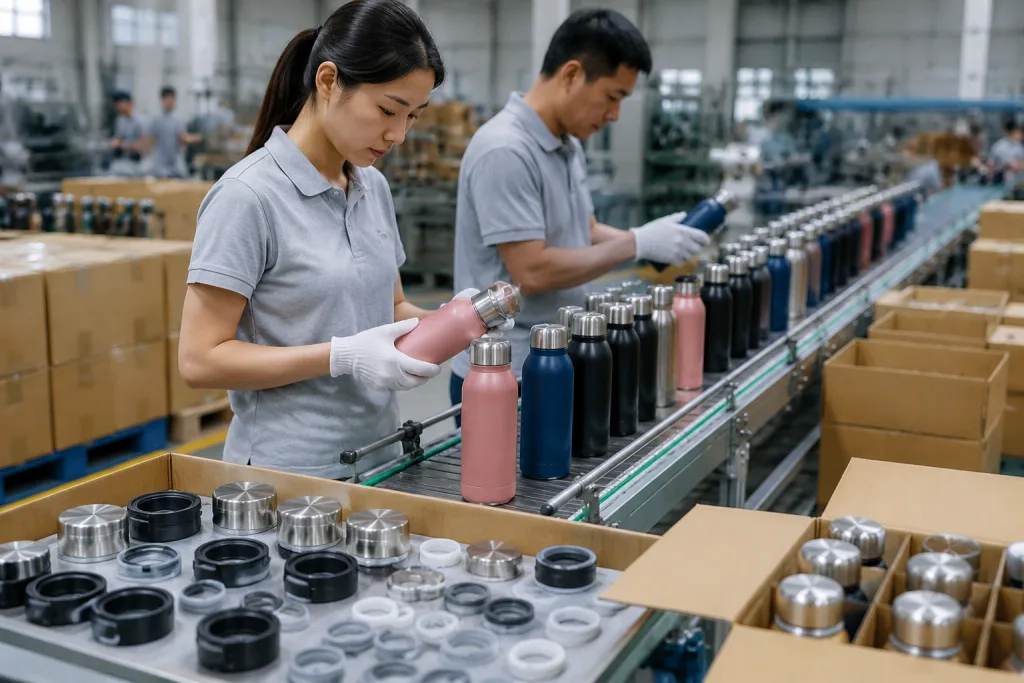
Key Takeaways
- A 0.6 mm wall can dent and feel cheap; 0.8-1.0 mm is safer for premium stainless orders.
- Request AQL 2.5 for major defects and 4.0 for minor defects on pre-shipment inspection.
- Expect MOQ from 500 to 3,000 units depending on print method, lid complexity, and mold status.
- For export orders from China, confirm REACH, LFGB, FDA, and packaging rules before production starts.
If you buy the best custom reusable water bottle by color and logo alone, you are gambling with your margin. The bottle that looks fine in a render can arrive with weak lids, thin walls, crooked branding, or a finish that fails after two washes. In B2B, the real job is not picking a pretty SKU. It is locking down the failure points before a canteen factory in China cuts tooling or starts a production run.
That is why smart buyers treat custom drinkware like a spec sheet, not a mood board. A canteen manufacturer in Zhejiang can make 50,000 to 120,000 units per month, but output does not protect you from bad seals, off-color powder coat, or label rejection at Amazon. If you want a custom canteen, customizable drinkware, or even a custom growler line that survives retail, you need to understand where products fail and how to spec them out.
Where bottles usually fail
The first mistake is treating the bottle body as the whole product. On custom drinkware, the lid, gasket, coating, threads, and artwork usually fail before the steel shell does. We’ve seen a stainless bottle pass a casual sample check and still leak because the cap thread pitch is off by 0.3 mm or the silicone ring is undersized. That is how a retail canteen turns into a return pile.
Watch for these failure modes:
- Leakage from weak gasket compression, warped caps, or poor thread tolerance.
- Coating loss from under-cured powder coat or weak pretreatment on the line.
- Logo wear from thin screen print ink, shallow laser depth, or bad curing.
- Odor or taste from low-grade silicone, recycled liners, or contamination.
A solid canteen factory talks in tolerances, not adjectives. Ask for lid leak testing at 100 kPa or 1 meter drop performance, then ask whether they test every batch or only random samples. The buyer flagged a sample once because the torque trace hit 0.8 N·m on one cap and 1.4 N·m on the next; the math does not work. If you are sourcing a canteen supplier in Zhejiang or elsewhere in China, the paper trail matters as much as the sample. A good supplier can show incoming inspection records, torque tests, and line-finished QA photos. A weak canteen vendor sends one pretty sample and hopes you stop there.
Choose the right body spec
The bottle body is where buyers pay for the wrong spec or save 0.15 USD and regret it after the first freight claim. For a best custom reusable water bottle program, the material has to match the channel. 304 stainless fits mainstream insulated SKUs. 316 makes sense when corrosion load is real, not just because a sales sample sounds premium. On plastic lines, copolyester and Tritan-style materials show up often, but we check odor, stain pickup, and compliance first. Transparency is the easy part.
For insulated stainless, we usually run a body wall around 0.8 mm to 1.0 mm on retail orders. Below 0.6 mm, the bottle feels light in hand and dents faster in carton transit. QC pulled a 0.58 mm sample once, and the buyer flagged it before the line even finished packing. If you are building a custom canteen for outdoor or promo programs, that extra wall also helps when distributors stack cartons too high. For a distributor drinkware program in Europe or North America, ask for REACH and food-contact paperwork that matches the lot. LFGB is the right test if the bottle goes into Germany or serious retail.
Do not let a canteen manufacturer hide weak steel behind a polished sample. Ask for material certificates, weld seam photos, and whether the inner tank uses one-piece draw or welded construction. We have seen a PO typo on wall thickness turn a 0.8 mm request into 0.7 mm, and the math does not work on that kind of mistake. The answer changes durability, cost, and scrap rate. Compare grade, wall thickness, and reject rate. Unit price alone is the wrong question.
Printing fails faster than steel
Most logo defects are plain, not dramatic. You see fuzzy edges, color drift, or a mark that starts flaking after 3 dishwasher cycles. That is why artwork choice has to match the line. Screen print works for one- or two-color branding, but the ink film needs the right thickness and a proper bake. Laser engraving holds up on stainless, yet on a brushed finish we have seen it come out too shallow or too dark. UV print can look clean on flat plastic, and it cracks when the bottle flexes or the primer job is off.
For a canteen promotional order, the right question is not “what looks best on a render.” It is “which failure can the buyer live with?” If the bottle goes out at events and gets light use, a single-color screen print is usually fine. If the customer wants a retail piece, we run laser engraving or a full-wrap print instead. Ask the canteen supplier for a visual spec: Pantone target, position tolerance, and scratch resistance. A 1.5 mm logo shift may pass on a giveaway. On a retail custom drinkware line, it gets flagged fast because shelf presentation matters.
Good decoration is not the logo itself. It is whether the logo survives handling, washing, and transport.
For a custom growler or customizable growler in beverage service, durability matters more because the bottle gets washed often and handled by staff, not end users. QC pulled the sample on a 64 oz growler order last month because the print rubbed at the shoulder after 20 wipes. If your buyer is a canteen distributor or the owner of a distributor growler program, ask for approval on the exact decoration method, not a blank bottle with a sticker mock-up. We have seen that shortcut go sideways.
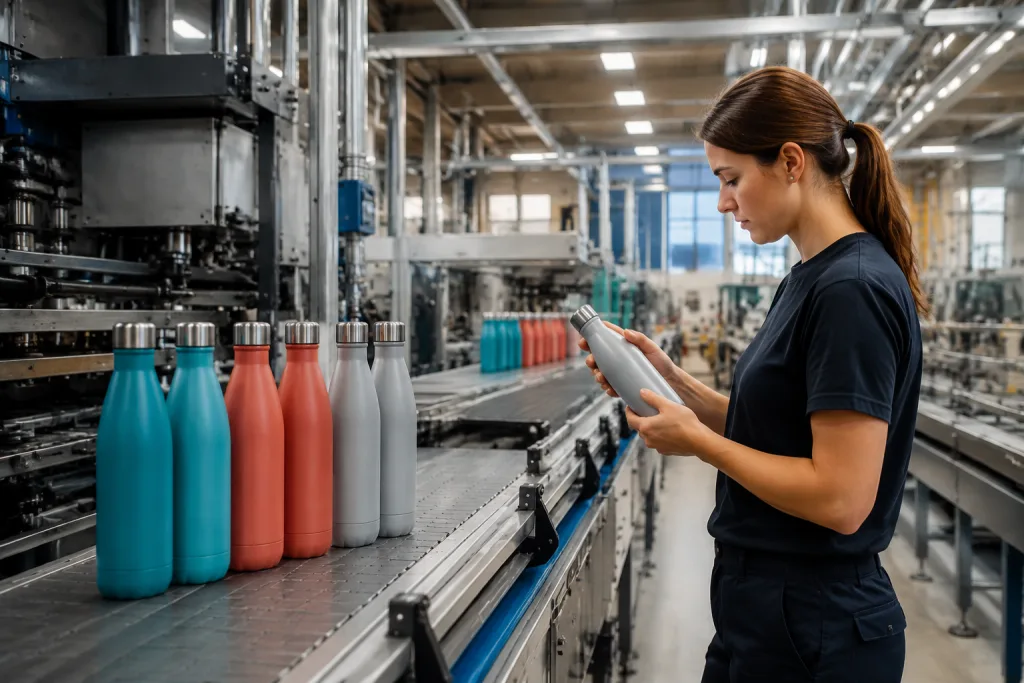
Lid and seal are the real risk
If you want fewer claims, start with the closure system. A lid fails for ordinary reasons: silicone that is too soft, rough mold finishing, a vent that traps pressure, or tolerance stack-up across the cap, insert, and neck finish. The body can pass, then the bottle still leaks in a carton because the cap never seats the same way twice. This is where seasoned buyers earn their margin by asking the dull questions first.
Specify:
- Silicone hardness in the 50-70 Shore A range, depending on lid type.
- Torque requirements for screw caps so the cap is neither loose nor over-tightened.
- Drop and leak tests on finished assemblies, not separate parts.
- Spare gasket policy for export cartons and replacements.
For a customized canteen, ask whether the lid tooling is standard or custom. Standard lids cut risk and keep MOQ lower. Custom lids make the SKU look different, but they add failure points, a longer lead time, and more tooling cost. On a 1,000-unit order, that is the wrong trade if the buyer wants a clean launch. We had a case where QC pulled the sample and the gasket sat 0.8 mm high; the buyer flagged it before shipment, and that saved a carton-level leak claim. If you buy from a canteen vendor in China, ask for assembly samples from the actual production line. Office-built samples are not the same as the line.
Factory control beats sample approval
A single approved sample proves only one thing: that one unit passed once. If the factory cannot hold the spec across 5,000 or 20,000 pieces, the sample is just a photo prop. The real test is whether the canteen factory can repeat the same wall thickness, same lid fit, and same leak result on the line with the same tooling, same shift, and the same incoming resin or 304 stainless. We see this go sideways when a buyer approves a perfect hand sample and the first carton run comes in with cap torque drift.
Run a simple control stack: approved golden sample, pre-production sample, inline inspection, and pre-shipment inspection. For serious orders, ask for AQL 2.5 on major defects, 4.0 on minor defects, and 0 for criticals like leakage or food-contact contamination. If the seller says they do not work to AQL, that is the wrong question to ask. A canteen supplier should also show carton drop tests, color checks under the same light box, and dimensional verification on random units with a caliper, not guesses from the desk.
Do not ignore lead time. A straightforward customized drinkware order often takes 35 to 45 days after sample approval. Add custom mold work, special coating, or printed retail packaging, and 50 to 70 days is more realistic. We had a buyer flag a PO typo on the print artwork once, and that alone pushed the ship date by 12 days. A canteen distributor who needs holiday inventory cannot live on optimistic promises. A canteen manufacturer who gives exact milestones is usually the one worth keeping.

Packaging is part of quality
Packaging failures stay cheap right up until the chargeback lands. The bottle can pass QC and still lose at retail if the carton pinches the cap, the insert scuffs the coating, or the master carton fails the drop test. We’ve seen that on the line. For Amazon or distributor programs, packaging is part of the spec, not a side note.
Ask for the inner box spec, divider board thickness, and the carton burst number. If you are sending FNSKU labels for Amazon FBA, confirm whether the factory applies them or your 3PL does it. One buyer flagged a PO typo on a 20,000-unit run because barcode labels were mixed across SKUs; that kind of mess is avoidable. If you sell through a distributor canteen channel, barcode scan rate and carton count accuracy matter as much as logo placement.
For export from China, make the packing list match the actual unit count, inner pack layout, and gross weight. A 2-ounce mismatch per unit turns into real freight variance on a 10,000-unit order. That is the wrong question to ask if someone says “it’s only a little off.” At 18 days by sea or 12 days by air, the math hits fast, and pallet height limits do not forgive sloppy packing. Good packaging keeps the bottle saleable; weak packaging turns a clean run into a claims file.
What to demand before PO
Before you send the purchase order, get a file set that leaves no gray area. A solid canteen manufacturer or canteen supplier should hand over the technical sheet, artwork proof, material declaration, test report, and production schedule. If one piece is missing, the risk lands on your desk. We’ve seen a buyer flag a PO typo on lid color and the whole line wait 2 days while QC pulled the sample.
At minimum, ask for:
- Material specs for body, lid, seal, and coating.
- Compliance records for REACH, FDA, LFGB, and any market-specific rules.
- Inspection plan with AQL levels and defect definitions.
- Production schedule with tooling, sample, and shipment milestones.
- Replacement policy for leakage, print defects, or carton damage.
If you are choosing between a custom canteen and a more standard customizable canteen, the trade-off is simple: uniqueness versus control. A standard body with custom print usually runs safer, faster, and cheaper. A fully customized canteen or customized growler makes sense when margin depends on the design. We’ve seen that math work at 3,000 pcs, and we’ve seen it go sideways at 500 pcs when the cap tooling missed the 28 mm spec. Either way, the best custom reusable water bottle is the one that ships clean, survives transport, and keeps working after repeated use. That is where a disciplined distributor drinkware buyer wins. It is also where a canteen vendors list gets shorter fast.
Spec your bottle before you place the PO
Send your target market, quantity, and decoration method. We’ll match the bottle spec, QC plan, and lead time to your channel.
Frequently asked questions
What MOQ should I expect for a custom reusable water bottle?
For a standard bottle with existing molds, MOQ is often 500 to 1,000 units per color or print. If you want a custom lid, special coating, or new mold, 3,000 units is more realistic. In Zhejiang and other China factories, MOQ usually depends on decoration method and packing, not just the body shape. Screen print and laser engraving can stay lower than full-color wrap or custom packaging. Always confirm whether MOQ applies per design, per size, or per carton configuration before you approve artwork.
How do I check if the bottle will leak in production?
Do not rely on one hand-screwed sample. Require a leak test on finished assembled units, ideally with inverted hold and drop testing. Many buyers use a 24-hour upside-down test plus a 1-meter drop on a filled bottle for validation. For a real order, request sample approval on production tooling, then set AQL 2.5 for major defects and zero tolerance for leakage. If the canteen factory cannot explain how they test lids, threads, and gaskets together, the order is still risky.
What certifications matter for Europe and North America?
For Europe, REACH and food-contact compliance are the usual baseline, and LFGB is important when you want stronger market confidence in Germany and adjacent markets. For North America, FDA food-contact requirements are commonly requested. If the bottle includes decoration inks, coatings, or silicone, the compliance scope should cover all contact and non-contact components. Ask the canteen supplier for test reports tied to the exact material batch, not a generic certificate from last year.
Is stainless better than plastic for promotional orders?
Not always. Stainless is better when you want premium perceived value, better insulation, and a longer life cycle. Plastic can work for lighter promotional budgets and lower freight cost. If you are targeting retail, stainless usually gives you better margin control; if you are buying for event giveaways, plastic may hit the price point better. The key is not material alone but wall thickness, lid quality, and print durability. A thin stainless bottle can feel worse than a well-made plastic one if the spec is weak.
What lead time should I plan for?
For a straightforward custom drinkware order using existing molds, expect about 35 to 45 days after sample approval. If you need custom mold work, special coating, or retail packaging, 50 to 70 days is more realistic. Add time if you are shipping from China during peak season or if you need third-party inspection before booking freight. A good canteen manufacturer in Zhejiang will give you a production calendar with tooling, material purchase, line production, and packing dates.