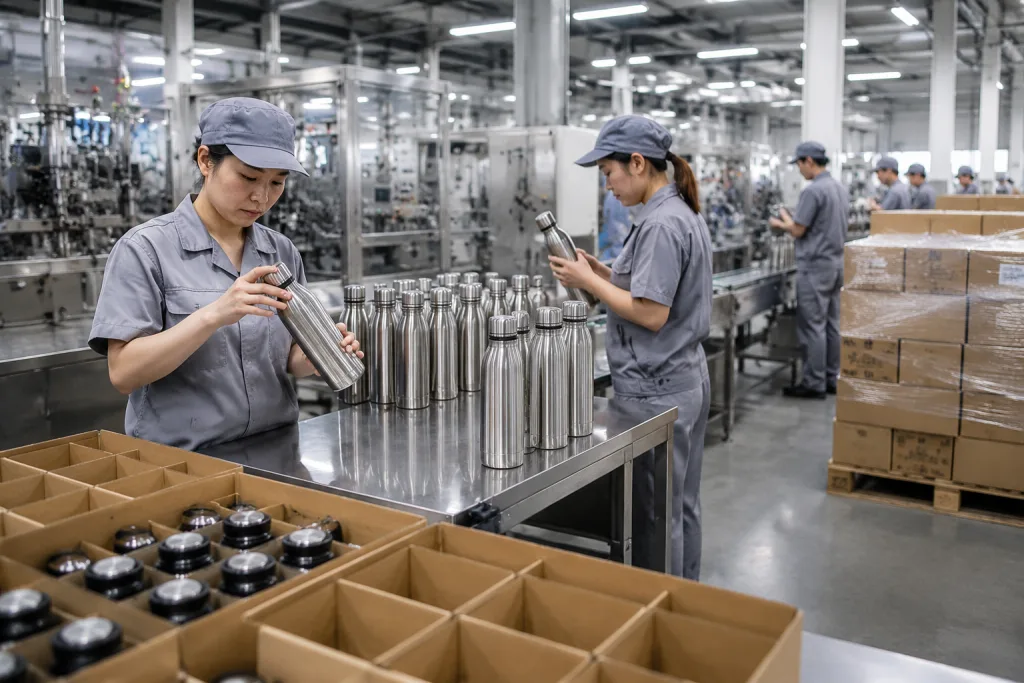
Key Takeaways
- 304 stainless steel is the practical baseline; 316 usually adds 12-18% to unit cost.
- For a 750 ml bottle, 0.40-0.45 mm inner wall is a safer commercial spec than 0.30 mm.
- Typical MOQ from a canteen factory in Zhejiang starts at 1,000-3,000 pcs per SKU.
- Normal factory lead time is 25-35 days after sample approval, plus 5-7 days for packing and booking.
Buyers often start with a style question and end up with a spec sheet problem. The bottle looks right, then the 0.6 mm wall is too thin, the lid leaks in transit, the logo rubs off after three dishwasher cycles, and the carton count misses your freight model. If you are sourcing the best custom refillable water bottle for retail, corporate gifting, or distributor programs, you need to read the spec sheet the way we do on the line in Zhejiang: material, capacity, closure, finish, tolerances, and packing all move cost and risk.
That is especially true in China, where the same silhouette can come out as a $1.40 promo item or a $4.90 retail piece depending on steel grade, lid tooling, and decoration. We run that split every week. A solid canteen manufacturer will spell out the trade-offs, and a weak one will just quote FOB and leave the surprises for later; we saw a buyer flag a 2 mm lid mismatch after sampling, and the math does not work if you skip that check. If you buy custom drinkware for Europe or North America, compare the specs line by line before you compare sample photos.
Start with the use case
The best custom refillable water bottle is not the prettiest one. It is the one that survives the channel you sell into. A gym buyer needs different specs than an airline gift program, and both differ from a trade show giveaway. If the bottle lives in backpacks, we look at weight, seal performance, and scratch resistance. If it sits on shelves as customized drinkware, print repeatability and carton presentation matter more.
Buyers often ask for a canteen custom solution before they define the use case. That is the wrong question. Start with numbers: hot or cold only, single-wall or vacuum, hand wash or dishwasher safe, 500 ml or 1 L, and whether the bottle must pass REACH and LFGB in Europe or FDA-related supply expectations in the US. On our line, a 0.5 mm wall change can shift hand feel and denting, and that shows up fast in QC. A China supplier can move quickly, but only if you tell them the end market and the abuse pattern. We’ve seen 50 retail returns cost more than a modest spec upgrade on day one.
- Gym and outdoor use: prioritize grip, leak resistance, and dent tolerance.
- Corporate gifting: prioritize logo area, matte finish, and box presentation.
- Distributor programs: prioritize carton consistency, stable MOQ, and repeatable color control.
Read the steel grade first
Material is where a lot of canteen factories hide cost. 201 stainless steel is cheaper, but for the best custom refillable water bottle it is usually the wrong call unless the target is a very low-cost promo channel. 304 stainless steel is the workhorse grade for most customized canteen and customized drinkware programs. It gives the right balance of corrosion resistance, price, and supply in Zhejiang and across China. 316 stainless steel fits salty environments, harsher cleaning, or premium positioning, and the buyer should expect a higher price plus a longer sourcing lead time for some parts.
For most buyers, the clean spec is 304 inside and outside, with a powder coat or sprayed finish on the exterior if grip matters. On one 500 ml run, QC pulled the sample and found the coating held at 60°C wash cycles, while the buyer flagged a PO typo that changed 304 to 201; that kind of mistake costs time fast. If the bottle is a custom growler for beer or a customized growler for hospitality resale, the steel grade matters even more because odor control and residue resistance affect repeat use. Ask for material certificates, not just a verbal claim. A real canteen factory should show traceability for the steel coil and confirm that coatings and inks fit the destination market. If your supplier cannot explain why 304 is enough for your program, that is the wrong question to ask on the wrong spec.
Typical commercial note: 304 stainless steel is often the best value point; 316 should be a deliberate upgrade, not a default.
- 304: best balance for most retail and promotional bottles.
- 316: premium or harsher-use applications.
- 201: only for aggressive price targets where performance can be compromised.
Wall thickness changes everything
Wall thickness looks like a dull spec until the buyer flags dents or temperature loss. A 0.30 mm inner wall on a vacuum bottle may clear a casual sample check, but it dents easier, feels thin in hand, and the thermal curve moves around. For a 500-750 ml bottle, 0.40-0.45 mm on the inner wall is the safer commercial target. Outer wall thickness usually runs a bit higher based on forming and coating, but the real job is even metal flow and a clean weld seam.
This is where canteen manufacturers in China separate fast talk from stable output. A stronger forming line and tighter QC cut pinholes, vacuum loss, and seam trouble; we run that check on the line with vacuum retention testing and drop tests before packing. Ask how many pieces they pull per lot under AQL. A serious factory should speak clearly about AQL 2.5 for major defects and 4.0 for minor defects, or a buyer-approved equivalent. If a plant ships 100,000 units a month, your 3,000-piece order still needs the same discipline. The math does not change, and we have seen this go sideways when a buyer accepted “same line, same quality” without a test report. The same standard should hold whether you source a canteen customized for retail or a canteen promotional run for events.
Weight matters too. A 750 ml stainless bottle around 260-330 g usually feels solid without getting heavy in a backpack. If the bottle comes in much lighter, ask what got shaved off. Usually it is steel, and QC pulled the sample for a wall gauge check as soon as that number showed up.
Choose the lid like a closure system
The lid is where leak claims start. Screw caps, flip tops, sport lids, and bamboo-top designs all fail in different ways. For the best custom refillable water bottle, the closure has to match how the buyer actually uses it. We run torque checks on the line because a cap that feels fine by hand can still walk loose after 12 open-close cycles. A screw cap with a food-grade silicone gasket is still the safest default. A flip lid is easier for active use, but it needs a tougher hinge and cycle testing that goes past the first 500 swings.
Ask your canteen supplier for torque spec, gasket material, and cycle life. Food-grade silicone is standard; low-grade TPE costs less, and we’ve seen it harden early after storage at 45°C. If the bottle is a custom drinkware program for North America, test the lid with carbonated liquid only when you plan to sell it that way. The buyer flagged it once on a PO typo: “sparkling-safe” got copied into the spec, and we had to redo the paperwork. For a canteen distributor, one solid lid across three sizes often beats a decorative mechanism that cracks in transit. If you sell into more than one region, check whether the lid parts come from the same lot each time, because lot variation is what creates returns.
- Screw lid: simplest build, strongest seal, lowest warranty risk.
- Flip lid: better one-hand use, higher tooling and QC burden.
- Straw lid: good for sports, not the right call for hot liquids.
Decoration should survive use
Decoration is a wear decision, not just a branding call. Screen printing stays the low-cost route for a simple logo on a canteen promotional order. Laser engraving looks clean on stainless and will not peel, but the mark can be subtle. Heat transfer, UV print, and powder-coated color with logo reveal each carry different cost and failure points. If you are sourcing customized canteen units for premium retail, a laser logo on brushed steel can sell better than a big printed graphic that chips after two wash cycles.
For a canteen custom project, ask how the print is cured and whether the artwork sits on raw metal, powder coat, or lacquer. That decides scratch resistance and dishwasher behavior. We run this check on the line with a sample rub test, and the weak jobs show up fast. A canteen vendor should give you print area limits and minimum line thickness. Small text below 1.2 mm stroke often drops out in mass production. If you need a custom logo for a distributor drinkware program, keep the artwork simple and verify Pantone matching within a realistic tolerance, usually around Delta E 2-3 for better lines. Chasing perfect color is the wrong question to ask; the buyer flags the sample faster than any spec sheet does.
For a custom growler or customized growler, the surface finish matters because beer buyers spot scratch patterns fast. Matte black powder coat with laser mark still gives a strong commercial result when you want a premium feel without blowing up the unit price. QC pulled the sample after a 1.5 mm scuff test, and that is the kind of result that matters on shelf.
Packing and compliance are part of the spec
Some buyers split packaging from the product spec. That is the wrong question to ask. A retail-ready bottle and a bulk-packed bottle change freight cost, breakage rate, and pick-and-pack labor. If the channel is Amazon or DTC, lock carton count, inner box size, barcode location, and FNSKU labels before we run production. If the shipment goes to a distributor canteen program, master carton strength and pallet layout matter more than a printed sleeve.
For Europe, bring up REACH, LFGB, and food contact declarations where they apply. For North America, line up FDA-related material expectations and any buyer compliance forms. A Zhejiang canteen factory should not flinch when you ask for test reports. We ship this every week. QC pulled the sample, then the buyer flagged a 2 mm print shift on the sleeve, and that is the kind of issue you want caught before loading. Know which lab tests are standard for custom drinkware, which coatings pass, and which colors need extra migration checks. China has plenty of capable suppliers, but documentation discipline varies. Ask for AQL inspection, carton drop testing, and, if the order is large, a third-party pre-shipment check. It costs less than a container hold.
- Use retail cartons only when the channel needs shelf presentation.
- Use export master cartons with clear gross and net weights for distributor orders.
- Confirm barcode, case pack, and pallet height before you approve production.
Price depends on trade-offs
Buyers often ask for a target price before the spec is fixed, but bottle cost follows a few hard levers. A plain 500 ml 304 stainless steel bottle with a basic screw cap and one-color logo can land around USD 1.40-2.10 FOB China at a 3,000-piece MOQ, depending on finish and packaging. Add powder coating, a more complex lid, and retail boxing, and the price moves into USD 2.60-4.20. A premium custom drinkware piece with 316 steel, laser engraving, and an upgraded carton will go higher. We run these quotes every week.
That is not inflation. It is spec. The right question is where the money goes: mold amortization, coating complexity, or small-order inefficiency. We had one buyer flag a PO typo on the lid color code and the sample had to be rerun, so the quote changed by USD 0.18 before we shipped anything. Ask whether you are talking to a factory or a trading layer. If you need repeat supply, request tiered pricing at 1,000, 3,000, and 5,000 pieces, then compare the unit cost line by line. A real canteen supplier will also state lead time clearly: often 25-35 days after sample approval, with rush orders only if the line is open and the artwork is simple.
If you are building a canteen distributor program, a slightly higher FOB can still win once you count fewer damaged cartons, fewer returns, and less time spent answering complaints. We saw this go sideways when a buyer chased the lowest quote and ended up paying for replacements on a 420 mm carton that failed drop testing.
How to compare samples fairly
Sample comparison needs a controlled test, not a showroom contest. Order the same capacity, same lid, same print method, and same finish from each canteen vendor you are checking. Then compare fill weight, lid torque, vacuum retention after 24 hours, leak performance, logo clarity, and carton damage. If one sample feels lighter, put it on the scale. If a lid loosens after five open-close cycles, that is a product problem, not a nice-to-have detail.
For a canteen customized to your brand, set the pass line before the sample lands on your desk. Decide whether you will accept a 0.3 mm logo shift, a slight color delta, or a minor texture variation. Ask for a pilot run if the order will go beyond 10,000 units. We have seen buyers skip this step, approve a loose sample, then blame the line when the mass run matches that approval. The right custom refillable water bottle is the one that holds your spec sheet every time, not the one with the best photo. If you are comparing canteen manufacturers, take the one that gives straight answers on tolerances, packing, and test methods over the one that only says “premium quality.”
That is the job: turn a broad idea into a bottle that ships clean, sells clean, and gets reordered.
Send your bottle spec, get a factory quote
We can review your capacity, lid, finish, and packing spec and quote a custom drinkware order with clear MOQ, lead time, and FOB terms.
Frequently asked questions
What is the best material for a custom refillable water bottle?
For most B2B buyers, 304 stainless steel is the best value choice. It handles daily use, supports vacuum insulation well, and keeps unit cost reasonable. If you need higher corrosion resistance for premium retail or tougher environments, 316 is the upgrade, but expect roughly 12-18% higher cost. For low-price promotions, 201 stainless can cut price, but it is usually not the right long-term spec for a branded bottle. Ask for material certificates and confirm the coating and lid materials match your market’s food-contact expectations.
What MOQ should I expect from a canteen factory?
A realistic MOQ from a canteen factory in Zhejiang is usually 1,000-3,000 pcs per SKU for standard shapes and 3,000-5,000 pcs if you need custom tooling, special lids, or unusual finishes. If a supplier offers 200 pcs on a fully customized bottle, the price is often padded or the quality risk is high. For distributor programs, ask for price breaks at 1,000, 3,000, and 5,000 pcs so you can compare landed cost, not just the headline FOB number.
How long is the lead time for customized drinkware?
Typical lead time is 25-35 days after sample approval for standard stainless bottles, plus 5-7 days for packing and booking depending on the season. If you need new tooling for a custom canteen or custom growler, add another 10-20 days for mold work and sample revisions. Rush orders can be possible, but only if the factory has open capacity and the artwork is simple. Always confirm whether the timeline is factory time or includes sea freight, because those are very different numbers.
Which logo method lasts longest on a custom canteen?
Laser engraving usually lasts the longest because it does not peel or fade like surface print. It works especially well on brushed stainless and premium customized canteen or customized growler programs. Powder coat with laser reveal also performs well. Screen printing is cheaper and fine for canteen promotional items, but it is more vulnerable to abrasion and dishwasher wear. If the bottle will be washed often or sold at retail, ask for a logo durability test and review whether the stroke width is strong enough for mass production.
What compliance documents should I request from canteen suppliers?
For Europe, request REACH-related declarations and, where relevant, LFGB or food-contact documentation. For North America, ask for material declarations and any buyer-required compliance forms tied to food-contact use. Also request carton specs, AQL inspection terms, and a sample approval record. A good canteen supplier in China should provide traceability for steel and coatings, plus clear labeling guidance. If they cannot explain which tests were done and by whom, treat that as a warning sign, not a paperwork delay.