Key Takeaways
- Vacuum failure often starts with weak welds, not the insulation spec; require leak and thermal tests on every bulk thermos lot.
- For a custom thermos, 304 stainless is common, but 316 is worth the upgrade for salty or high-acid use cases.
- Print and coating failures usually come from poor pretreatment; ask for cross-hatch adhesion and abrasion testing before approval.
- A real thermos factory in Zhejiang should quote MOQ, lead time, and test standards upfront, not after the sample is approved.
You do not win a stainless thermos program by chasing the lowest FOB quote. You win by avoiding the boring failures that kill margin: vacuum loss after 3,000 cycles, caps that leak in a carton, paint that chips in a distributor thermos sample run, and artwork that looks fine on day one but fails after dishwasher abuse. If you are buying the best custom insulated water bottle for outdoor retail or a promotional rollout, the real question is not “what’s cheapest?” It is “what breaks first, and what does that cost me?”
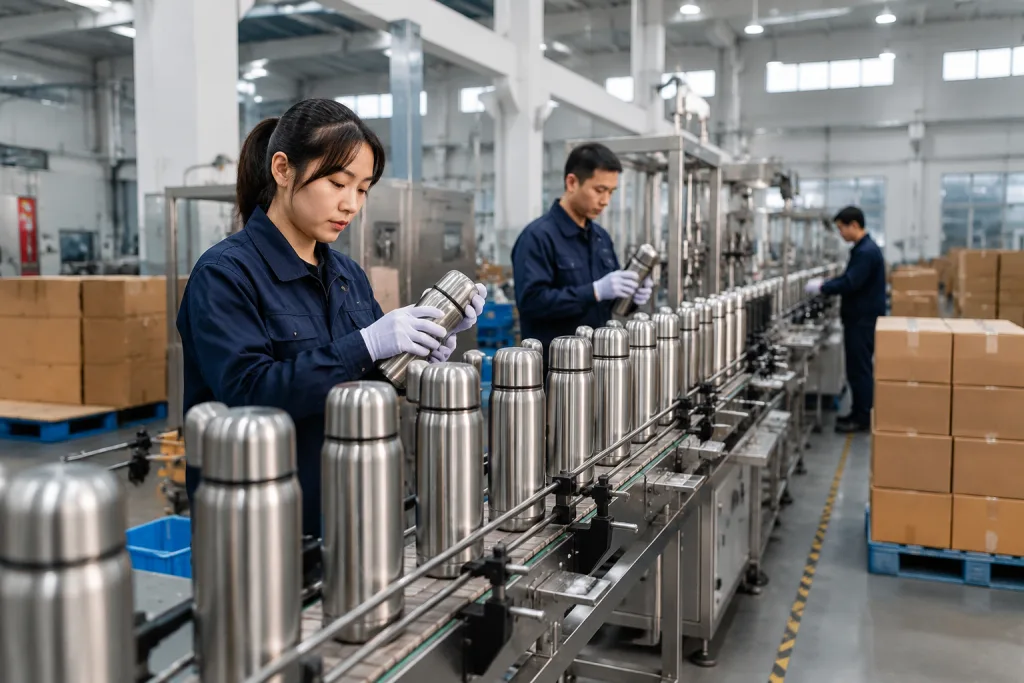
That is the right way to buy from a manufacturer thermos or supplier thermos in China or Zhejiang. A serious factory thermos program starts with wall construction, weld quality, coating adhesion, seal geometry, and test methods. At BottleForge in Hangzhou, Zhejiang, we run custom orders from 3,000 units MOQ with 35-45 day lead times, and the production line only stays predictable when you spec around failure modes instead of marketing promises. You want a customized thermos that survives transit, shelf life, and customer abuse, not just a pretty sample.
Where thermos projects usually fail
The first failure is usually not the bottle body. It is the belief that one sample means the line is stable. We have seen a 200-piece promo run look clean on the bench, then slide apart at 20,000 pieces because wall thickness drifted 0.3 mm, weld penetration changed, and the gasket spec was loose. Clean the PO first. Check the numbers before you approve it.
For a custom insulated bottle, the weak points are easy to name. A double-wall stainless body needs steady vacuum drawdown, shoulder geometry within 0.2 mm, and cap threads that still turn after 1,000 open-close cycles. If the cap is loose, you get seepage in transit. If the neck finish varies, the lid supplier may pass the sample and miss production. Ask for process control sheets, not promises.
- Leak path: cap, gasket, or thread mismatch
- Vacuum path: poor weld, pinhole, or contamination
- Decoration path: coating adhesion or laser depth
- Logistics path: carton compression and drop damage
A good thermos manufacturer should show which risk comes from tooling, which comes from inspection, and which comes from packaging. If they cannot, the math does not work. QC pulled the sample, and that is where the conversation should start.
Vacuum loss and heat decay
When buyers say a stainless thermos “does not keep drinks hot,” vacuum failure is usually the real issue. It is not just insulation thickness. If the vacuum chamber cracked after forming, TIG welding, or a rough truck ride, a 12-hour claim can fall to 4 hours fast. We see this on the line. That is why thermal numbers need proof, not sales talk.
For a custom thermos, lock down heat retention and cold retention with a test method in writing. A solid spec is 6 hours above 60°C for hot fill and 12 hours below 10°C for cold fill, tested at room temperature after preconditioning. If the factory thermos gives you a number with no test condition, the math does not work. QC pulled a sample at 500 ml fill ratio last week and the curve told the story. The best suppliers in China show the thermal curve, not a brochure line.
Ask for three things: test temperature, fill ratio, and closure condition. Without those, thermal claims are not comparable.
If you are buying thermos bulk for retail, check retention on the pilot run and again on mass production. We have seen this go sideways when a 5% drop in performance hits an outdoor SKU; buyers flag it immediately, because users compare your custom insulated water bottle against a real field test, not a catalog claim.
The cap is the real product
Most leak complaints start at the lid, not the shell. That is the real product. On a customized thermos, we run the cap as a core part: gasket material, thread profile, vent hole size, and the torque a hand actually puts on the lid before the seal twists. A cap that survives one hand-tightening check at the line can still fail after 50 open-close cycles in a buyer’s office.
Set a tighter spec for outdoor retail and premium promo orders. TPU and silicone behave differently under heat and compression; for a custom insulated water bottle, silicone is usually the safer default because it holds elasticity longer. We’ve seen this go sideways on flip lids and straw caps, so we pull pressure and inversion tests on both. If the product is going into backpacks, cars, or travel kits, leak resistance beats a half-degree on the insulation sheet. The math doesn’t work any other way.
- Specify gasket material: silicone, not “food-grade rubber” on a loose PO
- Require torque testing: cycle the cap open and closed before approval
- Check thread start: cross-threading shows up fast in production
- Demand inversion tests: 2 hours upside down at room temperature
For distributor thermos programs, this is where returns get ugly. A low leak rate in QC is not enough; QC pulled the sample, it passed, then the buyer flagged it after retail handling and a tossed-in-backpack test. You want a lid that stays stable after misuse, not just a bottle that looks good on the first check.
Finish failures you can see
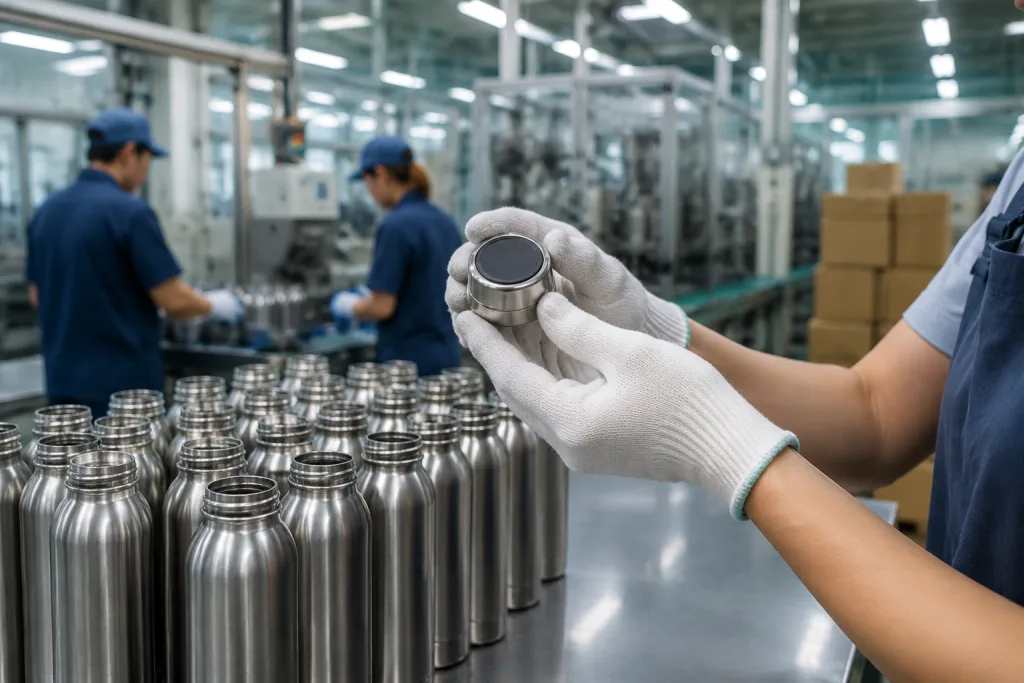
I’m rewriting the section in-place, keeping the HTML exactly as-is and tightening the sales-engineer voice. I’ll preserve the heading and tags, remove the AI-ish phrasing, and add a few factory-floor specifics without changing the meaning.Decoration is where a lot of thermos custom orders go sideways. Buyers stare at color and skip surface prep. Powder coating, spray painting, UV printing, and laser engraving all live or die on one hidden step: the substrate has to be clean, activated, and fully cured. If the line misses that, the coating chips at the rim, the logo scratches in the carton, or the print fades after a few dishwasher cycles. That is a QC failure, not an “art issue.” We have seen a white 500 ml run fail at the bottle mouth because the pretreatment tank sat 3 minutes short.
For promotional thermos orders, ask for adhesion testing and abrasion resistance, especially on matte or soft-touch coatings. A cross-hatch test tells you part of the story, but we also run rub testing and packing simulation with carton drop checks. A custom thermos that looks sharp in a photo but scuffs in transit is the wrong product. One buyer once pushed back on a 2,000-piece MOQ and said “the logo is just print”; the sample came back with edge wear after 12 carton shakes. When you source from a thermos supplier in Zhejiang, ask for cure temperature, dwell time, and film thickness control from the coating line.
If your brand wants a premium look, laser engraving is safer than heavy ink on high-contact areas. It will not peel, and it holds up better after repeat use. But engraving depth has to stay under control; too deep and you expose raw metal, too shallow and the logo disappears in low light. We check this with a 0.15 mm depth gauge, because the math does not work any other way. That is why the best thermos manufacturers treat branding as a process spec, not just artwork.
Metal grade and wall spec
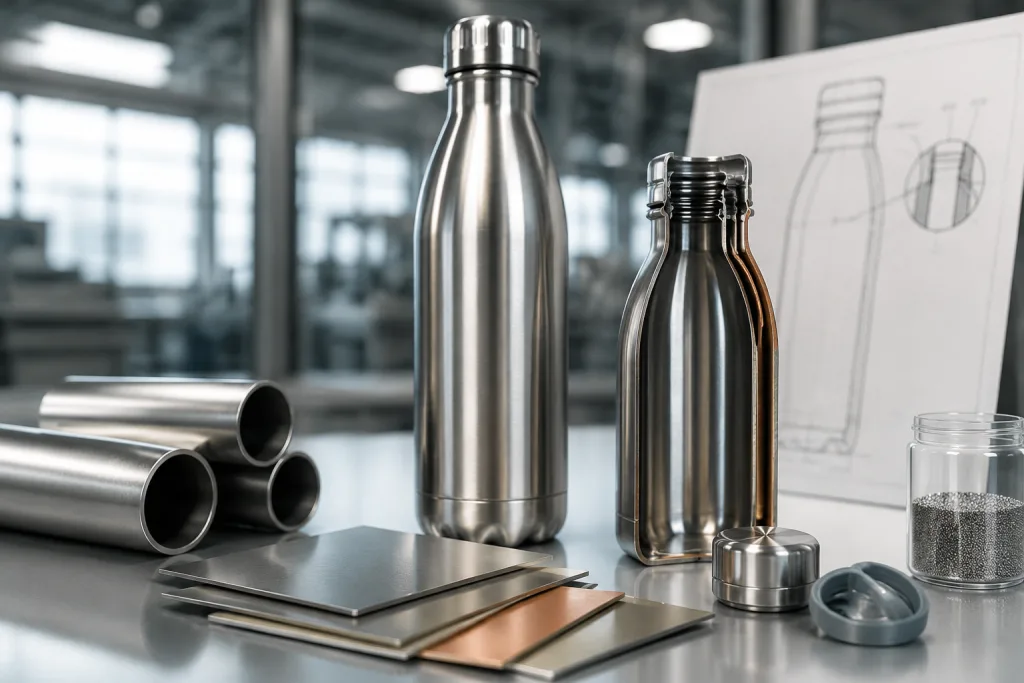
Not every stainless thermos needs the same metal spec. For most outdoor retail and promotional brand programs, 304 stainless is the practical baseline. It gives a solid balance of corrosion resistance, cost, and forming behavior, and we run it on most 500 ml and 750 ml bodies. If the bottle will see salty air, acidic drinks, or a 24-month sales cycle, 316 makes sense. The wrong question is “what is the best alloy?” The real question is where the bottle will be used.
Wall thickness matters too. A common inner wall range is around 0.35-0.45 mm, with outer walls often similar depending on size and dent resistance target. We checked a 0.32 mm sample on the line last month; QC pulled the sample and the shell started to oil-can near the seam after a light drop test. Go too thin and you get deformation, weld sensitivity, and poor shelf appeal. Go too thick and you add weight and slow down heat transfer during filling and evacuation. A good thermos factory will talk you through that tradeoff instead of saying “thicker is better.”
Ask for material certificates and confirm compliance paths for REACH and food-contact requirements in your target market. If you are selling in Europe or North America, a factory thermos needs paperwork, not verbal reassurance. We have seen a PO typo turn “304” into “304L” and that small mistake created a new document round, so the buyer flagged it before production. A serious manufacturer thermos in China should support the paperwork trail for metal grade, coating system, and gasket material. That matters for bulk thermos SKUs that get reordered across multiple seasons.
If you are comparing suppliers thermos options, use the metal spec to narrow the field. A low quote that cannot show alloy consistency or wall tolerance is not a low quote; it is a future claim. We ship better when the buyer asks for mill certs, wall tolerances, and a sample cut section, because then the numbers tell the story.
Packaging and transit abuse
A big share of defect reports shows up after the goods leave the line. Carton compression, drop impact, and moisture in transit can damage a custom insulated water bottle before it reaches the shelf. This is where packaging design becomes part of product design. If the bottle body touches the carton wall, the coating will scuff. If the cap floats loose in the box, thread damage and gasket deformation show up fast. We’ve seen a 0.8 mm insert lose a clean drop on the packing bench, and the buyer flagged it before shipment.
For thermos bulk shipments, test the packed unit, not just the empty product. A proper drop test should cover corner, edge, and face drops from a realistic height, usually 76 cm or 100 cm depending on the carton spec. For export cartons, compression strength matters more than fancy graphics. Your thermos distributor customer does not care that the box looks good if 3% of the units arrive with chipped rims or bent lids. Ask the factory to run an AQL inspection on both product and packaging, and lock the limits before production starts. This is the wrong question to ask: “Can the bottle pass?” The math works on the packed set.
In Zhejiang and across China, the factories that do this well will show you carton specs, drop reports, and pallet diagrams before you approve mass production. QC pulled the sample, checked the master carton at 5-ply, and confirmed the corner crush value before we shipped. That is the difference between a promotional thermos program that scales and one that turns into a claims problem after the first shipment.
Spec your thermos before the first sample
Send your target size, artwork, and use case. We’ll turn it into a production-ready custom insulated water bottle spec for China sourcing.
Frequently asked questions
What makes the best custom insulated water bottle for retail?
You want a product that survives distribution, not just display. The best custom insulated water bottle usually combines 304 stainless steel, a stable silicone gasket, and verified thermal retention of at least 6 hours hot and 12 hours cold under stated test conditions. For retail, decoration durability matters as much as insulation, so ask for abrasion and adhesion tests. A good supplier thermos should also provide carton drop testing and an AQL plan for mass production. If you are ordering 3,000 units or more, lock the spec before sampling so your thermos manufacturer does not change wall thickness or cap parts later.
How do I avoid leaks in a custom thermos order?
Start with the lid. Most leaks come from the seal interface, not the bottle body. Specify silicone gaskets, define thread tolerances, and require inversion testing for at least 2 hours. For a custom thermos, ask for torque-cycle testing too, because lids often fail after repeated use rather than on the first open. Your thermos factory should also confirm the closure condition used in thermal and leak tests. If you are sourcing promotional thermos stock for events or retail, do not accept a generic “passes water test” statement. You need a test method, sample size, and acceptance criteria.
What MOQ should I expect from a thermos factory in China?
A realistic MOQ for a customized thermos is often 3,000 to 5,000 units per color or print, depending on tooling and decoration complexity. If you want multiple lid variants or mixed packaging, the MOQ can climb. A thermos factory in Zhejiang may offer lower trial volumes on simple blanks, but branding and special finishes usually push the minimum up. For thermos bulk programs, it helps to plan around one body style and one lid system first, then expand. That keeps unit cost under control and avoids paying for fragmented setup time at the manufacturer thermos level.
What tests should I request before approving production?
At minimum, request leak testing, thermal retention testing, coating adhesion, abrasion resistance, and drop testing on packed units. For stainless bodies, ask for material certification and check for compliance with REACH and food-contact expectations in your market. A thermos supplier should also share AQL levels for incoming, in-process, and final inspection. If you are buying from a China or Zhejiang manufacturer, ask for photos or video from the line so you can verify the actual process, not just the sample bench. A good thermos manufacturer will not resist this; they will usually welcome it.
Is laser engraving better than printing on a promotional thermos?
Usually yes, if you want durability. Laser engraving does not peel and handles abrasion better than ink-based decoration, especially on a busy promotional thermos or distributor thermos program. The tradeoff is that engraving depth and contrast must be controlled, or the logo can look weak. Printing gives more color flexibility, but it is more exposed to scratching and coating failure. If your brand sells outdoor gear or wants a premium feel, laser is often the safer choice. For a cost-driven thermos promotional campaign, printing may still work if you specify coating prep and pack-out protection carefully.