Key Takeaways
- A realistic beer tumbler wholesale MOQ is usually 1,000–3,000 pcs per SKU for custom logo orders
- Double-wall stainless beer tumblers normally need 25–40 days after artwork and deposit approval
- 304 stainless steel at 0.4–0.5 mm wall thickness is the common export-grade starting point
- Packaging, barcode, and AQL terms should be confirmed before sample approval, not after production
Beer tumbler wholesale looks simple until you send one RFQ and get three different quotes back. One supplier prices a 12 oz stainless cup, one sends a double-wall vacuum tumbler, and one quotes a growler because the buyer wrote “beer cup” on the brief. We ship these orders every week, and the same mistake still burns 20–35 days before the line even starts. The math does not work if the spec is loose.
We run drinkware out of Zhejiang, China, and QC pulled the sample table last month to show the usual failure points: unclear capacity, weak artwork files, MOQ guesses that miss by 2,000 pcs, and cartons that fail a 76 cm drop test. A clean RFQ should split beer tumbler bulk, beer growler wholesale, canteen wholesale, and alcohol flask wholesale before you ask for FOB pricing. One PO typo on “304 stainless” can shift the whole quote. We have seen that go sideways fast.
Start with the drinking use case
The first procurement question is not price. It is what the buyer will pour into the cup and where it will be sold. A 16 oz beer tumbler for a brewery taproom is not the same product as a 64 oz bulk growler for take-home beer, and we should not quote either one like a general bulk canteen order. Last month a buyer sent one RFQ called “beer bottle cup,” and QC pulled the sample only to find the lid spec belonged to a growler, not a tumbler.
For beer tumbler wholesale, most North American and European buyers choose 12 oz, 16 oz, or 20 oz capacities. The 16 oz size is the safest starting point because it fits common draft pours, leaves foam headspace, and still looks strong on a retail shelf. Safe does not mean boring. A 12 oz cup works better for tasting rooms, festivals, and gift sets where the buyer wants lower unit weight and more pieces per carton. A 20 oz tumbler fits beer plus iced coffee or soft drinks, but check the carton cube; on our line, a wider 20 oz body can add 8–12 mm to the master carton width and push up freight cost.
If your brief says drinkware bulk without narrowing the function, the supplier may quote a cheaper single-wall cup. The spreadsheet will look good. The math does not work if your customers expect a cold-holding vacuum tumbler and get a thin wall cup that sweats on the table. Ask for double-wall vacuum insulation if the product must hold cold beer for 4–6 hours. Ask for powder coating if the tumbler will be used outdoors or on brewery patios. Ask for a brushed or electropolished interior if easy cleaning matters; we have seen beer residue show up during rinse checks when the inner wall polishing was skipped.
For related categories, keep the names separate in your RFQ: beer growler bulk for 32 oz or 64 oz sealed vessels, wholesale canteen for outdoor hydration bottles, and alcohol flask bulk for small pocket flasks. A factory can make these items, but the tooling, leak testing, cap structure, and packaging are different. Mixing them under one “best wholesale drinkware” request creates slow replies and weak comparisons. We have seen this go sideways when a PO typo listed “64 oz tumbler” while the buyer expected a sealed growler; the cap torque test, silicone gasket, and drop-test packing were all wrong.
What should your RFQ include?
A tight RFQ saves more time than 6 rounds of bargaining. For beer tumbler wholesale bulk, send one clear table, not a WeChat line saying “quote your best price.” The factory has to price stainless sheet, powder loss, logo setup, inner box, carton strength, and AQL 2.5 inspection risk. If those fields are missing, you are comparing guesses; we’ve seen this go sideways when a buyer later added a barcode sticker and the carton spec changed from 5-layer to 7-layer.
Use this checklist before you contact a China factory:
- Capacity: 12 oz, 16 oz, 20 oz, 24 oz, 32 oz, or mixed assortment; tell us the split by size, such as 3,000 pcs of 20 oz and 2,000 pcs of 24 oz.
- Construction: single-wall for low-cost promo orders, double-wall air insulated for lighter retail items, or double-wall vacuum insulated when the buyer expects cold beer performance.
- Material: 304 stainless steel interior, 201 or 304 exterior, or fully 304 stainless; QC will check this with an XRF gun, so do not leave it vague.
- Finish: powder coating with Pantone code, spray painting with gloss level, stainless polish with visible grain direction, matte texture, or sublimation coating for full-wrap artwork.
- Logo: laser engraving with artwork size in mm, silk screen with color count, pad print for small marks, embossing with tooling needs, or full-wrap print with bleed area.
- Packing: white box, color box, kraft box, retail sleeve, master carton count, and barcode needs; one buyer once typed 48 pcs/carton on the PO, while the approved carton drawing said 24 pcs/carton.
- Compliance: LFGB, FDA, REACH, CA Prop 65, or food-contact documentation for your market; tell us the target country before sample testing starts.
- Trade terms: FOB Ningbo, FOB Shanghai, EXW Zhejiang, or DDP if you need landed cost support; the freight math is different for 8.5 kg cartons versus 14 kg cartons.
At BottleForge Industrial in Zhejiang, a normal custom beer tumbler in bulk starts around 1,000–3,000 pcs per color and logo, depending on finish. Our practical production capacity for stainless drinkware is about 450,000 units per month, with standard lead time of 25–40 days after deposit and approved pre-production sample. Small plain-stock orders are possible, but custom retail packaging usually moves the MOQ because the box line has a separate setup and printing waste. The math doesn’t work for 300 pcs with a new color box unless the buyer accepts a higher unit price.
If you also need canteen bulk, growler wholesale, or alcohol flask wholesale bulk in the same shipment, separate each line by SKU. Do not bundle them into one line item. We run carton CBM, inspection level, and export documents by SKU, and QC pulled the sample differently for a 64 oz growler than for a 6 oz flask. That small split on the RFQ avoids wrong HS code notes, short carton labels, and last-minute document fixes before we ship.
Material choices that affect price
The lowest quote is usually low for a metal reason. Stainless grade, wall thickness, vacuum scrap rate, and coating route all hit the unit price. For beer tumbler wholesale, we usually put 304 stainless steel on all food-contact surfaces. Some factories quote 201 stainless on the outer wall to save about USD 0.12–0.25 per piece on a 10,000 pcs order. That can pass in dry markets, but we have seen 201 outer shells show rust dots after 72 hours in a salt-spray cabinet, especially when buyers sell near coastal bars or customers abuse dishwashers.
Wall thickness changes the quote fast. A normal tumbler body uses about 0.4–0.5 mm stainless sheet. Go below 0.4 mm and the body dents more easily during carton drop tests and parcel delivery. Simple as that. For premium drinkware wholesale programs, buyers sometimes ask us to run a heavier gauge body after their retail team flags dented samples, but the extra steel adds grams per cup and pushes up ocean freight. The math does not work if the target retail price stays the same.
Vacuum insulation needs a closer look. The line has to weld the inner and outer shells, pump the vacuum, seal the base, and check heat transfer. If you get a suspiciously low price for double-wall vacuum beer tumbler bulk, ask how they test it, not just whether they test it. We run a common cold retention check with 4°C water, 20–25°C room temperature, and a 6-hour measurement; QC records the start and end temperature on the inspection sheet. It is not a lab certificate, but it catches weak vacuum batches before packing.
Powder coating costs more than basic spray painting, but it gives better scratch resistance and a denser hand feel. For brewery merchandise, powder coating with laser engraving is the usual safe choice because the logo will not peel and the contrast stays sharp after bar use. For promotional drinkware bulk, silk screen printing is cheaper and works fine for simple one-color artwork; our MOQ for one screen is often lower than a full-wrap setup. Full-wrap printing looks good, but the buyer flagged a 1.5 mm seam misalignment on one PO last year, so artwork control cannot be casual.
If you source beer growler wholesale bulk or alcohol flask in bulk on the same RFQ, do not copy the tumbler material decision across the sheet. This is the wrong question to ask. Growlers need stronger caps and leak testing, usually with an inverted 24-hour check after torque tightening. Flasks need smooth welds, tight screw caps, and clean polishing around the mouth; QC pulled samples before for black compound left inside the neck after buffing.
MOQ and pricing without guessing
Buyers often ask for the lowest MOQ first. Fair question. But MOQ by itself is the wrong question to ask. It only means something after we confirm decoration, color, packaging, and inspection rules. A plain stainless tumbler may be available from stock at 300–500 pcs, especially if the warehouse already has 12 cartons left from a repeat run. A custom powder-coated beer tumbler wholesale order with laser logo and printed box usually starts at 1,000–3,000 pcs per SKU. If you need six colors, the factory may count each color as a separate MOQ because the coating line has to clean the spray gun and powder booth between colors.
For a 16 oz double-wall stainless beer tumbler in bulk, a realistic FOB China range might be around USD 3.20–6.80 per piece depending on steel grade, lid, finish, logo, and packaging. A simple single-wall cup can be lower. A premium vacuum insulated tumbler with retail box, slider lid, and powder coating will sit higher. We run the costing sheet line by line: 304 stainless body, PP lid, silicone ring, logo process, inner box, master carton, and labor. Prices move with stainless steel cost, exchange rate, and order volume, so a quote from 90 days ago may not hold. Last month one buyer pushed back on USD 0.18 for a thicker 5-layer carton, then QC pulled the sample after a 76 cm drop test split one corner.
When comparing wholesale drinkware quotes, look at the full landed math. A lower unit price can lose its advantage if the carton is oversized, the master carton fails drop testing, or the supplier uses a port that increases inland trucking. We ship from Zhejiang, so FOB Ningbo is often efficient for our line. FOB Shanghai may also work depending on consolidation plans, but the math changes if the forwarder needs an extra pickup or warehouse handling fee. For Amazon or 3PL programs, ask for FNSKU labeling, carton marks, and palletization early. We have seen this go sideways because one PO typed “carton mark on two sides” while the buyer’s routing guide required four sides.
For combined orders such as wholesale growler, wholesale canteen, and beer tumbler wholesale bulk, ask the factory whether material purchasing can be consolidated. Sometimes the MOQ per SKU stays the same, but the total order gives better packing material pricing or shared inspection cost. That is a real saving, not a fake discount. For example, if we buy the same black powder for a 32 oz growler and a 16 oz tumbler, the powder supplier may price a 200 kg batch better than two small 80 kg batches.
Do not pressure a supplier to hide cost. Ask them to separate body, lid, logo, packaging, and freight assumptions. You will see where the money goes, and bad math gets exposed fast.
Logo and packaging questions buyers miss
Brand owners care about shelf look. Procurement cares whether the same logo position, box color, and carton label repeat across 5,000 or 50,000 units. Those two jobs meet at artwork and packaging control; last month QC pulled 32 random tumblers from the line and found a 2 mm logo drift on one cavity, which is exactly the kind of small miss buyers see first.
For beer tumbler wholesale, we run laser engraving and one-color silk screen most often. Laser engraving works well on powder coating because the laser removes the coating and shows the stainless beneath; it suits brewery logos with bold shapes and survives normal washing. Silk screen is the better choice when the buyer needs Pantone 186 C or another fixed brand color, but dishwasher use can rub it down faster. Pad printing fits curved spots or small badges. Full-wrap heat transfer or sublimation coating gives more print area, but color approval must be tighter, usually with a signed sample under D65 light in the QC room.
Send vector artwork in AI or EPS format; PDF is fine only if the paths are still editable. A low-resolution PNG copied from a website is not production artwork. If your brand guideline says Pantone 186 C or 35 mm logo width, put that in the RFQ, not in a follow-up email after tooling. The factory should send a digital mockup first, then a physical pre-production sample before mass production. We do not recommend skipping that sample for drinkware wholesale programs unless the SKU is an unchanged reorder; saving one USD 45 courier fee is the wrong place to cut cost.
Packaging is where 7 out of 10 “best wholesale drink bottle” programs get expensive late. A retail color box needs dielines, CMYK artwork, barcode placement, warning text, country-of-origin marking, and a carton that can pass a basic drop test. A brewery gift box may need an insert card with pour instructions. A distributor may only need a kraft box plus SKU sticker. Those choices move unit cost by USD 0.15–0.80 or more, and we have seen this go sideways when the PO says “gift box” but the buyer expected a 350 gsm color box with matte lamination.
If your order includes beer growler in bulk, canteen wholesale, or alcohol flask wholesale, keep the brand language consistent but do not force the same box structure. A 64 oz growler needs heavier board than a 16 oz tumbler. The math does not work if both items share one thin retail box just to make the shelf set look uniform; after a 12 kg master carton drop, the growler corner is usually the first place QC finds crushing.
Quality control before shipment
Inspection terms belong on the PO before the line starts, not after 86 cartons are taped shut. For export drinkware bulk orders, we usually see AQL inspection under General Inspection Level II. About 7 out of 10 buyers we ship for set AQL 2.5 for major defects and 4.0 for minor defects. Critical defects should be zero tolerance, including sharp rim edges found with a cotton-wipe check, contamination inside the cup, broken glass components if any, or caps that leak during an inverted test.
For beer tumbler wholesale, your QC checklist should cover appearance, measured capacity in ml, logo position within the approved ±1 mm tolerance, coating adhesion, odor, lid fit, insulation performance, carton marks, barcode scan, and packaging drop test. Coating adhesion can be checked by cross-hatch tape testing with 3M tape. Lid leakage needs a real test, not a desk guess. We run water to the fill line, close the lid, shake 10 times, then invert for 30 seconds. Most beer tumblers use splash-resistant lids, not fully leakproof lids. If you require leakproof performance, ask for a different lid design and a written test standard; otherwise the buyer flags it at delivery and the math does not work.
Food-contact compliance depends on your sales market. European buyers often ask for LFGB, REACH, and sometimes BSCI or Sedex factory audit documents. US buyers may ask for FDA food-contact material declarations, CA Prop 65 assessment, and CPSIA if the product is marketed for children. If the item is a kids bottle, ASTM and age grading may enter the conversation. For adult beer tumblers, be careful with claims. “Keeps beer cold 24 hours” is usually marketing exaggeration unless you have lab data, and we have seen this go sideways when a PO says 24 hours but the approved sample only passed 6 hours at a 20°C room test.
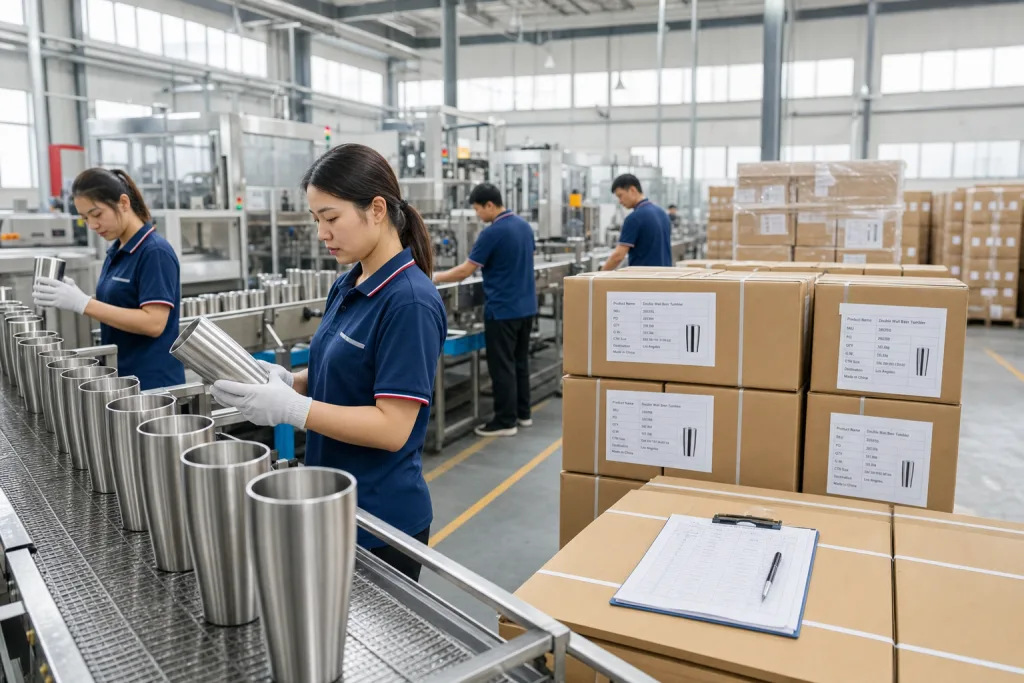
In our Zhejiang, China production workflow, mass production starts after deposit, artwork sign-off, and approved sample. During production, we track welding, polishing, coating, logo, assembly, and packing as separate stations, with QC pulled samples logged by time and operator number. For a normal 3,000–10,000 pc custom wholesale drinkware order, a pre-shipment inspection 2–3 days before loading gives enough time to fix minor carton marks, wrong barcode stickers, or a typo like “stianless” on the shipping mark. It does not give enough time to remake defective coated bodies. For high-value SKUs, we run a mid-production check when 30% of goods are finished.
How to choose the supplier
The best wholesale drinkware supplier is not always the factory with 600 catalog pages. It is the one that asks annoying questions before quoting. If a supplier does not ask about ml capacity, logo process, 5-layer carton packing, target compliance market, or FOB/CIF terms, they are quoting a shelf item and planning to fix the mess later. We see this on RFQs every week: the PO says “beer cup,” but the attached artwork is for a 20 oz tumbler with a 43 mm logo area.
For beer tumbler wholesale, ask for line photos or short videos from similar mass production, not edited studio shots. Ask whether the factory runs welding and coating in-house or sends them out. Subcontracting is normal in China. The point is control. Ask for monthly capacity, current lead time, MOQ by color, sample fee, mold fee if any, and the written action plan if inspection fails. QC pulled one matte black sample last month because the powder coat showed pinholes near the bottom radius; that finding matters more than a smooth sales deck.
Check communication speed, but check technical answers harder. A serious export sales engineer should explain why a 0.5 mm body costs more than 0.4 mm, why matte white powder coating shows fingerprints and carton dust, and why a retail box raises damage risk when the master carton uses weak B-flute board. Short answer: the math doesn’t work. If you are buying canteen bulk, growler bulk, alcohol flask wholesale, and beer tumbler bulk together, you need a supplier who can separate SKU details on the line, including lid type, insert card, barcode sticker, and outer carton mark.
For a first order, keep the project tight: 1 or 2 tumbler sizes, 2 colors, 1 logo method, and 1 packaging format. Boring is safer. After the first shipment passes sell-through and claim rates stay under 1–2%, expand into beer growler wholesale, wholesale canteen, or alcohol flask wholesale bulk. Ordering 12 SKUs at once looks efficient on a spreadsheet, but we’ve seen this go sideways when the buyer flagged mixed lids in carton 37 during AQL 2.5 inspection.
Send your beer tumbler RFQ for factory review
Share capacity, logo, quantity, packaging, and destination market. We will return practical MOQ, FOB pricing, lead time, and sampling advice.
Frequently asked questions
What is the normal MOQ for beer tumbler wholesale orders?
For custom beer tumbler wholesale, expect 1,000–3,000 pcs per SKU as a practical MOQ. SKU usually means one capacity, one color, one logo, and one packaging format. If you want 16 oz tumblers in black, white, and navy, the supplier may treat that as three MOQs. Plain stock can sometimes start at 300–500 pcs, but logo and retail box options become limited. For beer tumbler wholesale bulk with powder coating and laser engraving, 3,000 pcs gives the factory better coating efficiency and lower unit cost. If you are testing a new market, ask for a smaller pilot order with a higher unit price instead of forcing an unrealistic MOQ.
How much should a 16 oz stainless beer tumbler cost?
A 16 oz stainless beer tumbler in bulk commonly falls around USD 3.20–6.80 FOB China, depending on structure and decoration. Single-wall stainless is cheaper, while double-wall vacuum insulation, 304 stainless interior, powder coating, slider lid, laser logo, and retail color box all add cost. Packaging alone may add USD 0.15–0.80 per unit. If one quote is 25% lower than the others, ask what has been removed: steel grade, wall thickness, vacuum performance, coating quality, or inspection allowance. Always compare FOB port, carton quantity, CBM, and payment terms, not only the unit price.
Can I combine beer tumblers, growlers, canteens, and flasks in one order?
Yes, but treat them as separate SKUs in the purchase order. Beer tumbler bulk, beer growler bulk, canteen bulk, and alcohol flask bulk products use different lids, welding processes, leakage checks, and carton structures. A 64 oz beer growler wholesale item needs stronger sealing and heavier packaging than a 16 oz tumbler. A pocket flask needs polishing and cap-thread control more than insulation testing. Combining items may help with shared shipping, inspection, and brand packaging work, but it usually does not eliminate MOQ per SKU. Ask for a mixed container plan with carton dimensions, gross weight, and CBM for each item.
Which logo method is best for brewery merchandise?
For brewery merchandise, powder coating plus laser engraving is usually the most durable choice. The laser removes the coating and exposes stainless steel, so the logo will not peel like a weak print. It also handles repeated outdoor use better. Silk screen is still useful for one-color promotional runs when budget matters, and pad printing works on small curved positions. If you need exact Pantone colors or complex graphics, ask for print samples before mass production. For a 3,000 pc beer tumbler wholesale order, paying for one physical sample is cheaper than discovering after production that the logo is too small or the color is wrong.
What quality documents should I request before shipment?
Request the final approved sample record, material declaration, food-contact compliance documents for your market, and pre-shipment inspection report. European buyers may ask for LFGB, REACH, and factory social audit documents such as BSCI where applicable. US buyers often request FDA food-contact declarations and CA Prop 65 review. For inspection, define AQL before production; many buyers use General Inspection Level II with AQL 2.5 major and 4.0 minor. The report should check capacity, appearance, coating, logo, lid fit, barcode scan, carton marks, and packaging condition. For vacuum products, include a basic insulation test on random samples.