Key Takeaways
- A practical beer tumbler MOQ starts around 1,000 pieces per color for powder coating and 500 pieces for laser logo on stock colors
- 304 stainless steel is the default for food-contact beer tumblers; 316 is rarely needed unless the buyer has a premium marine-use brief
- AQL 2.5 for major defects and 4.0 for minor defects is a sensible inspection baseline for export drinkware
- Typical production lead time in Zhejiang, China is 30-45 days after sample approval and deposit
Buying from beer tumbler vendors looks simple until the pre-production sample lands on your desk, QC pulled the sample for a 0.3 mm lip gap, and your sales team asks why the landed cost moved by USD 0.42. A 16 oz stainless beer tumbler can sit on a retail shelf, go out as a brewery giveaway, run through a 3-day festival, or feed a distributor drinkware program. Each use case changes the steel grade, lid fit, coating, logo process, and inspection plan.
From our factory base in Zhejiang, China, we see buyers lose 7 to 12 days when they ask for “a nice tumbler” before fixing the sales channel. Wrong first question. Are you selling to breweries, building a canteen promotional range, or pairing a custom growler with a tumbler for outdoor accounts? Start with four decisions: product structure, decoration, compliance, and order economics. On the line, those choices decide whether we run powder coating, laser marking, or full carton drop testing before shipment.
Decide the selling channel first
The right beer tumbler spec depends on who pays for it and where it gets used. A brewery taproom usually wants weight in the hand, a sharp logo edge, and repeat orders around 500-2,000 pieces. A retail distributor canteen program is stricter: same PMS shade across 6 cartons pulled by QC, scannable barcode labels, and export cartons that pass a 1.2 m drop test. A festival buyer often pushes back on $0.08 per piece before asking about coating thickness. Different game.
For B2B buyers, we split orders into sales channels before we talk specs with beer tumbler vendors. First, promotional beer tumblers: 12-16 oz, single-wall or basic double-wall, one-color logo, packed in egg-crate bulk cartons with 24 or 48 pieces per master carton. Second, retail beer tumblers: double-wall vacuum, powder coating, individual box, hang tag or sleeve, GS1 barcode, plus QC limit samples for logo position, coating scratches, and lid fit. Third, outdoor drinkware sets: tumbler plus custom canteen, customizable growler, or cooler accessory, usually sold through distributor growler or camping channels. Last month QC pulled the sample because the sleeve said “stainlees” instead of “stainless.” Small typo, big delay.
This decision changes the MOQ. A stock-color laser engraved tumbler can work at 500 pieces if we run it on an existing black, white, or stainless body. A custom PMS powder coat normally needs 1,000 pieces per color because the coating line loses material during gun cleaning, oven adjustment, and color change. The math doesn't work at 300 pieces unless the buyer accepts a surcharge. If you need a canteen customized to match the tumbler, the canteen factory may also require 1,000-3,000 pieces depending on mold and cap type, and a new PP cap gasket test can add 7-10 days.
Be careful with vendors who quote one low price before asking your channel. A canteen vendor or tumbler supplier that knows export work should ask about sales packaging, drop test expectations, carton marks, compliance documents, and whether the goods ship FOB Ningbo, FOB Shanghai, or under your forwarder’s consolidation plan. We’ve seen this go sideways: buyer approved bulk pack, then their retailer demanded inner boxes after production, and 2 workers spent 18 hours repacking 1,200 pieces on the line.
Choose the body construction carefully
Most serious beer tumblers use 304 stainless steel for both inner and outer walls. For beer, soda, and cold cocktails, 304 is the safe middle ground: it resists rust from acidic drinks, passes normal food-contact briefs, welds cleanly on the laser seam, and still lets the FOB price work. The common wall thickness range is about 0.4-0.5 mm for the inner wall and 0.5-0.6 mm for the outer wall, depending on shape and target weight. Go thinner and the quote looks nice. Then QC pulled the sample after a 60 cm drop test and found two dents on the shoulder of a wide-mouth body.
Double-wall vacuum insulation is the default if the tumbler will retail above USD 6.00 FOB. It keeps beer cold for roughly 2-3 hours instead of sweating on the table after 20 minutes, which matters on bar tops and event tables. Single-wall stainless can work for low-cost canteen promotional projects, but buyers should not market it as insulated. We’ve seen this go sideways when a PO says “vacuum beer cup” but the approved sample is single-wall. For a beer tumbler, I prefer a wider base than a tall slim profile because it feels more stable after a customer has walked away from the counter with a full pour.
Lids are another trade-off. A simple clear push-on lid is cheap, often USD 0.25-0.45 depending on material and gasket. A sliding lid can add USD 0.35-0.70. For beer, 6 out of 10 brewery buyers we quote skip the lid, but distributors often want one because it raises perceived value on a shelf set. The buyer flagged this last spring: the PP lid on the tumbler looked milkier than the Tritan lid on the matching growler. If you also sell custom canteen or customized growler items, keep lid materials consistent across the range, such as PP for budget orders or Tritan for clearer retail sets, depending on the compliance brief.
Ask beer tumbler vendors for actual capacity to the brim and practical fill capacity. A “16 oz” tumbler may hold 480 ml to the rim but only 430-450 ml comfortably with foam. This is the wrong place to guess. We run the capacity check with a digital scale and water at room temperature, then mark the practical fill line in mm from the rim. That small detail avoids complaints from brewery buyers who measure pours closely and do not want customers arguing over a short pint.
Match decoration to order reality
Decoration is where good-looking samples turn into expensive line problems. Laser engraving is the safest choice for stainless or powder-coated beer tumblers, especially from 500 pieces upward; on our line we run it with a rotary jig and check logo height with a 0.5 mm steel ruler. It holds up better than most print options and leaves a clean edge. The trade-off is color. Laser shows bare metal or a tonal burn mark, not bright PMS ink. If the buyer needs a red brewery badge or a white taproom logo, quote silkscreen or heat transfer instead.
Silkscreen works best for one or two colors on straighter bodies. On tapered tumblers, check artwork distortion before mass production. A full-wrap design looks easy on a PDF, but it can shift 1-2 mm at the seam if the fixture has play; QC pulled one sample last year where the hop icon overlapped the barcode by 3 mm. Heat transfer and water transfer handle gradients, photos, and wrap artwork with more detail, but the math doesn't work for every promo order because setup cost rises and abrasion failure shows up fast when the coating is weak.
For a canteen customizable range, I usually tell buyers to standardize decoration zones. Use one front logo area across beer tumblers, custom canteen bottles, and customized growler products, then lock the position in the spec sheet with height from bottom and max print width in mm. Cleaner catalog. Fewer artwork mistakes. It also lets a canteen supplier or tumbler factory run repeat orders faster because the fixture, print position, and packing mark are already approved.
Require a pre-production sample with the real coating, real logo, and real packaging. A plain metal sample only proves shape. It does not prove powder coat gloss, laser contrast, print adhesion, or color match; the buyer flagged this once after the carton PO said “matte black” but the approved sample was semi-gloss. For coated items, ask for a cross-hatch adhesion check and a basic rubbing test using a 1 kg load for 50 passes. If the product is dishwasher-safe, define the test honestly. We’ve seen this go sideways: 7 out of 10 powder-coated stainless items should stay hand-wash recommended even when a sales team wants the stronger claim.
Set compliance before price negotiation
Set compliance before you squeeze the last USD 0.10 out of the quote. For Europe, buyers usually ask for LFGB or EU food-contact testing, REACH for relevant substances, and sometimes BSCI or Sedex audit status at the factory. For North America, FDA food-contact expectations, California Proposition 65 screening, and ASTM-related packaging or labeling rules can apply, depending on the retailer. If the beer tumbler is for a kids program or a campus program, the bar goes up fast. Last week QC pulled a sample with a 0.3 mm lid flash, and the buyer still blocked it because the report set was wrong.
A professional China drinkware supplier should be able to tell you which tests cover the material, which ones cover the coating, and which ones cover the finished article. Do not accept a five-year-old stainless steel test report as proof for a new powder-coated tumbler. The coating, lid, gasket, ink, and packaging may all need separate review. We have seen a PO typo turn 304 into 340 stainless on paper, and that mistake can hold up release for days. If you are a canteen distributor selling to national accounts, keep the test reports tied to the SKU, material list, and production batch.
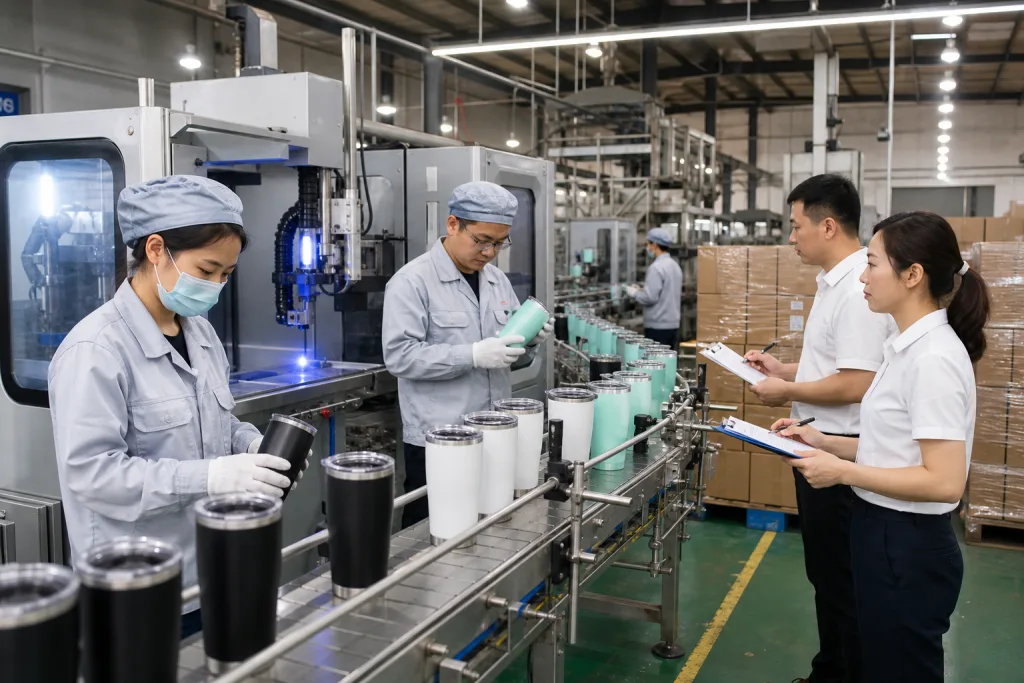
Factory audits are not paperwork. At BottleForge Industrial in Zhejiang, our export lines are set up for repeatable production: roughly 600,000 stainless drinkware units per month across tumblers, bottles, canteens, and growlers, with inline vacuum testing and final AQL inspection. The line runs on a fixed sequence, and a 2 kPa vacuum drop gets caught before cartons close. That scale matters when you need 18,000 pieces split across three colors and four logo versions by a fixed retail launch date. We have seen buyers ask for 18,000 pieces in 12 days and then act surprised when the schedule does not work.
For inspection, AQL 2.5 major and 4.0 minor is a practical starting point. Define major defects clearly: leaking, sharp edges, poor vacuum performance, wrong logo, severe dents, and food-contact contamination. Minor defects can include small coating specks, slight carton scuffing, or tiny print deviations within agreed limits. Put the defect list in the purchase order, not only in email chat. QC pulled the sample, found a 1 mm weld mark, and the buyer flagged it because nobody had written the limit down.
Read quotations like an engineer
A beer tumbler quote is not a unit price. Ask for capacity, top and bottom diameter in mm, height, net weight, steel grade, coating type, logo method, packing method, MOQ, sample cost, mold cost if any, lead time, payment term, and Incoterm. We still see quote sheets with “16 oz cup” and nothing else; last month QC pulled a sample that was 238 g against a quoted 270 g body. If two beer tumbler vendors are USD 0.40 apart, check whether you are comparing steel thickness, inner carton spec, inspection cost, or just a missing line item.
As a rough FOB China range, a 16 oz double-wall stainless beer tumbler with powder coating and laser logo may land around USD 3.20-5.20 depending on weight, finish, lid, and order quantity. Add individual kraft box packaging and the cost may increase by USD 0.25-0.60. Add a full-color sleeve with 4C printing, a barcode sticker in the buyer’s SKU format, and a master carton drop-test requirement, and the price moves again. The line does not pack “just the cup”; we run cartons, dividers, polybags, silica gel if requested, and carton marks that must match the PO. That is where cheap quotes go sideways.
Payment terms sit inside the real cost. A common term is 30% deposit and 70% balance before shipment after inspection. For established buyers, staged payments or LC terms may be possible, but smaller first orders usually stay simple because the math doesn't work on extra bank handling for a 1,000 pcs trial. Sample lead time is normally 7-12 days for laser on an available body, 12-18 days for custom coating, and 25-35 days if you need a new mold or special lid. On the factory floor, one missing Pantone code can hold powder coating for 2 days before the color chip is approved.
If you are comparing canteen suppliers, canteen manufacturers, and beer tumbler vendors in one sourcing round, normalize the quote sheet. Put all prices into FOB Ningbo or FOB Shanghai, with the same packaging, logo area, carton test, and inspection level. Same basis first. We had a buyer flag a USD 0.32 gap, then found one vendor quoted bulk pack and another quoted a 350 gsm color box with barcode and AQL 2.5 inspection. The cheapest line often becomes the most expensive purchase order once corrections start.
Plan logistics and replenishment
Drinkware looks compact in a catalog but eats container space fast. A 16 oz boxed stainless tumbler may pack 24 pieces per master carton, with carton dimensions around 55 x 37 x 28 cm depending on box design. On our line, a 3 mm taller gift box once cut 40HQ loading by 1,152 pcs. Cube kills the plan before gross weight does. If your distributor drinkware business ships mixed SKUs, lock carton sizes early so the warehouse can stack cleanly and your forwarder does not come back with a freight surcharge after booking.
For Amazon or marketplace programs, confirm FNSKU labeling, suffocation warnings for polybags, carton weight limits, and prep requirements before production. We had QC pull a carton because the FNSKU was 4 mm too close to the box edge; the buyer flagged it during the first FBA inbound check. A canteen vendor that only runs bulk promotional orders may miss marketplace receiving rules. If you sell to retail distributors, ask whether inner cartons, PDQ trays, or pallet labels are required. Put these details on the proforma invoice and packing instruction before the deposit is paid. Verbal notes get lost.
Lead time planning matters more than buyers expect. A realistic timeline is 3-5 days to confirm quote details, 7-18 days for samples, 3-5 days for sample shipping and approval, 30-45 days for mass production, 2-5 days for inspection and booking, then ocean freight. If your launch is in June, starting in late April is the wrong question to ask; the math does not work. For one beer tumbler program, the buyer approved artwork on day 12, then changed the lid logo on day 15, which pushed sample approval from 12 days to 18 days.
Replenishment is easier when you control colors. Instead of launching eight colors at 1,000 pieces each, a safer first run is three proven colors at 2,000-3,000 pieces per color with shared lids and cartons. We ship faster when powder coating stays on two spray booths, not six changeovers in one afternoon. The same logic applies to canteen distributor programs: fewer body colors, more logo versions. You carry lower inventory risk while still offering customers a canteen custom or tumbler custom option.
Build a vendor scorecard
A scorecard has to fit on one page, or the buying team stops using it after two RFQ rounds. We score five buckets, but not evenly: product fit with the target beer tumbler brief, factory capability with real line capacity, compliance files that match the material, communication accuracy, and payment or freight terms. Price matters. It should not carry 80% of the decision. We had one buyer chase a USD 0.18 per piece saving, then lose 20 days because the vendor booked coating after the holiday rush; the promo missed the first weekend.
For product fit, check whether the vendor can support the adjacent SKUs your account will ask for later: beer tumbler and custom growler first, then customizable canteen, kids bottle, sports bottle, and retail packaging with barcode placement checked against the dieline. For factory capability, ask for monthly capacity by size, which processes are in-house, coating line temperature range, vacuum testing method, and recent export markets by shipment month. For compliance, request current food-contact reports and social audit documents, not a screenshot from 2021. For communication, send 6 exact questions in one email and see whether they answer each line or paste catalog text; we run this test before we quote large programs.
Good canteen manufacturers and drinkware factories in Zhejiang, China will push back when a spec is risky. If your artwork sits 8 mm from a curved bottom edge, they should flag distortion before sampling. If your matte coating scratches under a 3M tape pull or coin rub, they should offer a tougher finish and show the test result. If your MOQ is too low for a special color, they need to explain coating loss, gun cleaning, and setup cost instead of pretending it is free. The math does not work below one rack on some colors.
When you narrow the list, place a pilot order before a national rollout. A 1,000-3,000 piece order tells you more than ten polished sample photos. You will see carton crush strength, color drift between cartons, logo repeatability at the pad-print fixture, inspection results, and how the team handles a real problem when QC pulled the sample. Ask for the AQL report and carton drop photos. That is the practical way to choose among canteen vendors, tumbler factories, and customized drinkware suppliers without gambling your whole season.
Send your beer tumbler RFQ for engineering review
Share quantity, logo, packaging, and market requirements. We will return a practical spec, MOQ, FOB price, and production timeline.
Frequently asked questions
What MOQ should I expect from beer tumbler vendors?
For an existing stainless beer tumbler body, MOQ is usually 500 pieces if you accept stock color and laser engraving. For a custom powder-coated color, plan on 1,000 pieces per color because the coating line has setup loss and cleaning time. If you need a new lid, new shape, or a matching custom canteen and customized growler set, MOQ can move to 3,000 pieces or more. Buyers sometimes ask for 100 pieces, but at that level the unit price, sample handling, and export paperwork make it inefficient for a true factory order.
Is 304 stainless steel enough for beer tumblers?
Yes, 304 stainless steel is the normal choice for beer tumblers, canteen customized projects, and most export custom drinkware. It offers good corrosion resistance for beer, water, soft drinks, and normal cleaning. 316 stainless steel is more expensive and usually only makes sense for a premium brief involving marine use, high salt exposure, or a very specific brand claim. For most B2B buyers, money is better spent on stable wall thickness, a good powder coating, reliable vacuum performance, and proper food-contact testing rather than upgrading every part to 316.
How long does a custom beer tumbler order take from China?
A normal timeline is 7-12 days for a laser sample on an existing tumbler, or 12-18 days if you need custom powder coating. After sample approval and deposit, mass production usually takes 30-45 days in Zhejiang, China, depending on quantity and season. Add inspection, booking, and freight time. Ocean shipping to North America or Europe often adds 25-40 days port to port. If you also order a distributor canteen or customizable growler in the same shipment, align the slowest SKU first so the container does not wait.
Which logo method is best for brewery merchandise?
Laser engraving is the most durable and lowest-risk method for brewery merchandise, especially on powder-coated stainless beer tumblers. It will not peel like weak ink, and it handles repeat washing better. If the brewery logo must use exact colors, silkscreen can work for one or two colors, but artwork position on tapered bodies needs careful checking. For full-color graphics, heat transfer is possible, but you should request adhesion and abrasion testing before approval. For repeat distributor drinkware programs, keep one standard logo size and position across tumbler, custom canteen, and custom growler SKUs.
What should I include in an RFQ to canteen suppliers and tumbler factories?
Send capacity in oz or ml, target dimensions, steel grade, single-wall or vacuum, coating color, logo method, packaging, quantity by color, destination market, compliance needs, Incoterm, and target delivery date. Add whether you need barcode labels, FNSKU, retail box, master carton marks, or palletization. If you are comparing canteen suppliers, canteen manufacturers, and beer tumbler vendors, use the same RFQ format for every supplier. This avoids fake savings where one quote excludes the lid, individual box, inspection requirement, or test report cost.