Key Takeaways
- A serious beer tumbler vendor should confirm steel grade, wall thickness, lid material, and AQL level before quoting
- Typical MOQ is 1,000-3,000 pcs per color for powder coated beer tumblers, with 35-45 day mass production
- Laser engraving is durable but slower; silk screen and pad printing fit larger promotional runs
- For North America and Europe, confirm LFGB, REACH, FDA food-contact, Prop 65, or relevant ASTM requirements before production
Buying beer tumblers looks simple until 3 quotations land on your desk and none describe the same cup. One beer tumbler vendor quotes 304 stainless steel, another writes “food grade steel,” and the third skips lid material, carton drop test, and logo method. We see this on the line often: the PO says 500 ml, the artwork says 16 oz, and QC pulls a sample measuring 473 ml to the rim. If you are buying for retail, brewery merchandise, events, or distributor drinkware programs, those blanks turn into 12 days of email checking, claim risk, and lost margin.
The cheapest quote is the wrong question to ask. Price means little until you fix the product structure, logo process, order model, and compliance level. From Zhejiang, China, we usually see buyers get cleaner production when they lock 4 points before sampling: capacity tolerance in ml, powder coating or polishing finish, white box or color box packaging, and AQL 2.5 inspection standard. We ship better when the spec is tight; the math does not work when a buyer compares a laser logo cup with a full-wrap print cup and treats them as the same item.
Start With The Use Case
Your first decision is where the tumbler will be sold or used. This is the wrong question to skip. A brewery taproom gift item needs clean branding and a nice hand feel; a stadium promotion gets judged on price, packing speed, and dent resistance. Retail shelf product needs barcode labels and cartons that survive handling, while an outdoor canteen promotional set usually needs lids and tougher coating. Last month QC pulled 32 pcs from a pilot carton because the buyer wrote “gift box” on the PO, but the artwork showed a bulk stadium giveaway.
For beer tumblers, most B2B buyers choose between 12 oz, 16 oz, and 20 oz. A 12 oz size works for sampler sets and compact gift boxes. A 16 oz tumbler is the safer general beer size. A 20 oz model fits outdoor, tailgate, and travel orders, usually with a sliding lid. We run more 16 oz beer tumbler samples than the other two sizes, roughly 6 out of every 10 RFQs on this item. If your program also includes a custom growler or customized growler, keep the color and logo system consistent so the line looks planned, not patched together after the buyer flagged it.
The next choice is insulation. Single-wall stainless is cheaper, lighter, and fine for short events. Double-wall vacuum construction holds temperature better and feels closer to retail drinkware. For a 16 oz vacuum beer tumbler, a realistic target is 0.4-0.5 mm inner wall and 0.5-0.6 mm outer wall in 304 stainless steel. Thinner walls cut cost, but the math often fails after carton transit; our incoming team has measured 0.32 mm walls with a digital micrometer and found dents around the bottom radius before logo printing even started.
As a canteen manufacturer in Zhejiang, we also ask who controls the brand experience. If you are a canteen distributor or distributor growler buyer, you may need neutral packaging and multiple logo versions. If you are a brand owner, you likely need color matching, barcode labels, retail cartons, and a tighter cosmetic AQL. Same cup, different order. We have seen this go sideways when a PO used one SKU for 4 logo colors, then the warehouse asked for separate carton marks two days before shipment.
Define The Factory Type
Not every beer tumbler vendor is a factory, and not every factory fits your order. A trading company can work for a mixed 6-SKU trial order with towels, openers, and drinkware in one shipment. A direct canteen factory is the better choice when you need control over welding, polishing, coating, and repeat orders. We see the wrong structure show up later in vague replies: “we will check,” “standard quality,” or “almost same color.” Not enough. Last month a buyer flagged a powder-coated black sample that was 1.8 Delta E off the approved swatch, and the middleman could not say which coating line made it.
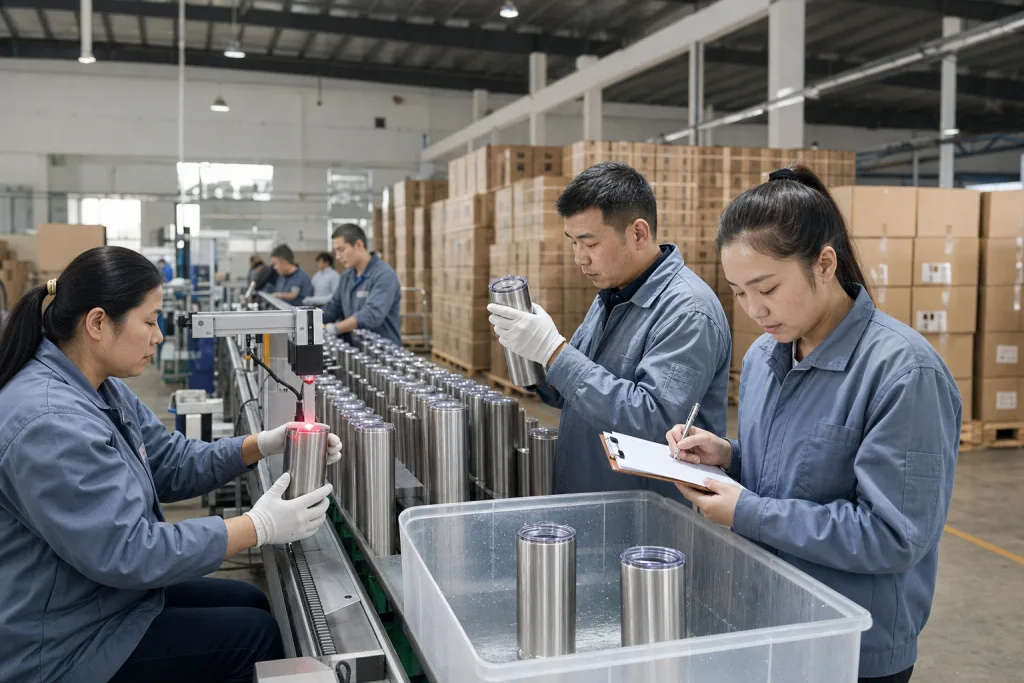
Ask whether the supplier controls vacuum testing, powder coating, and packing internally. Around 7 out of 10 stainless drinkware factories in China outsource coating or lid molding, which is normal, but the main vendor still has to own the quality process. A capable canteen supplier should provide production flow, inspection points, and responsibility for defective rates. BottleForge Industrial in Hangzhou, Zhejiang, for example, supports about 450,000 stainless drinkware units per month across tumblers, bottles, and canteens, with normal beer tumbler production lead time of 35-45 days after artwork and deposit approval. On our line, QC pulls samples from each welding batch and runs the vacuum leak test before polishing; if the seam fails, the lot does not move to coating.
For a first order, ask for photos or documents covering these points:
- Material declaration for 304 or 316 stainless steel, not only “food grade” wording.
- Vacuum leakage test method and holding time.
- Powder coating adhesion test, usually cross-hatch tape test.
- Carton drop test standard, especially for Amazon FBA or distributor drinkware shipments.
- Factory audit status such as BSCI, Sedex, ISO 9001, or customer audit reports.
The label “canteen vendors” covers a wide range of companies. Some can make a canteen customized with logo only. Others can develop a new lid, handle, mouth diameter, and packaging system. If your project may expand from beer tumblers into customizable canteen, custom canteen, or custom drinkware collections, choose a partner with tooling and engineering support, not only a catalogue seller. This is where the math does not work with a pure catalogue supplier: one new PP lid mold can take 18-25 days before trial shots, and we still need to check fit with a 0.20 mm feeler gauge before mass production.
Choose Customization Without Guessing
Decoration is where 7 out of 10 first-time B2B tumbler projects lose time. A logo that looks clean on a flat PDF can break on a curved, powder coated beer tumbler, especially near the radius where the jig cannot hold the cup perfectly level. Before artwork approval, decide how much scratch resistance, color accuracy, and shelf appeal the branding needs. A beer tumbler vendor should choose the method from the surface finish, order quantity, and actual use case. Not the fastest line slot. We have seen buyers approve a mockup at 60 mm wide, then flag the bulk goods because the same logo looked stretched after wrapping around the cup wall.
Laser engraving is the toughest choice on powder coated stainless steel. It cuts through the coating and shows the metal underneath. Good for brewery logos, corporate gifts, and reusable merchandise that gets washed 200+ times. The trade-off is cost and speed. On a 2,000 pc order, laser may add USD 0.18-0.45 per piece depending on logo size and machine time. Fine artwork is risky when the line width drops below 0.3 mm; QC pulled one sample last month because the hop leaves in a brewery logo filled in after engraving. The math does not work if the buyer wants a large wraparound laser logo and a tight promo deadline.
Silk screen printing fits one or two solid colors on larger orders. It is common for canteen promotional programs because the setup cost spreads out once the quantity moves past 1,000 pcs. Pad printing handles small logos and uneven areas where a screen frame will not sit right. Heat transfer can show gradients and full-color artwork, but adhesion needs a cross-cut tape test on textured powder coating before we ship bulk. For retail-quality customizable drinkware, request a pre-production sample with final coating, final logo, and final curing process. Check the boring stuff too. One PO came in with “warm gray” in the email and “cool gray” on the artwork file.
Color is another trap. “Matte black” from one canteen supplier will not always match the next batch unless you give a Pantone reference and keep a retained sample in the factory file. For powder coating, expect a working tolerance even with Pantone matching; 1 spray gun setting or 5 minutes of oven time can shift the look under D65 light. If your brand color is strict, approve a metal spray plate before mass production. For canteen customizable lines with multiple SKUs, set one master color standard across beer tumbler, bottle, and customizable growler items. This is the wrong place to save two days.
Do not approve mass production from a digital mockup alone. Pay for a physical sample. The USD 80-150 sample cost is cheaper than rejecting 3,000 pcs at destination.
Price The Whole Landed Program
A low FOB price can still lose money. Price the full landed beer tumbler program: product, logo, lid, spare parts, inner box, master carton, testing, inspection, ocean or air freight, duties, and destination handling. A serious beer tumbler vendor should break these out line by line, not hide them in one “best price” number. We run into this often: the PO says 24 pcs/ctn, but the forwarder quotes on 18 pcs/ctn after QC measures the real carton at 54 x 38 x 32 cm. Freight math changes fast.
As a rough China FOB range, a 16 oz double-wall stainless beer tumbler may fall around USD 2.40-4.20 depending on steel gauge, coating, lid, logo method, and packaging. A single-wall event tumbler can be lower. Retail gift packaging, inserted instruction cards, silicone boot, or color box may add USD 0.15-0.80 per unit. If the quote is 20% below the market, ask where the saving comes from: 0.35 mm steel instead of 0.45 mm, weak powder coating, recycled plastic lid, skipped inspection, or a carton spec that crushes under 12 kg stacking. We have seen this go sideways when the buyer only compared the cup price.
MOQ is not only a factory preference. It is tied to material purchasing, coating line setup, printing fixtures, and packing speed on the line. For standard beer tumbler molds, most canteen manufacturers can support 1,000 pcs per color. For custom PMS powder coating, 2,000-3,000 pcs per color is more realistic because the coating room needs cleanup, test panels, and a stable batch before mass spray. For a fully customized canteen or new lid mold, tooling may be USD 1,500-8,000 and MOQ can rise to 5,000 pcs. The wrong question is “What is your lowest MOQ?” Ask what cost changes at 1,000, 2,000, and 5,000 pcs.
Payment terms also matter. A typical China export order is 30% deposit and 70% balance before shipment after inspection. For established canteen distributors with repeated programs, staged shipments or credit terms may be discussed, but new buyers should not expect open account terms on the first order. QC pulled the sample before shipment, then the buyer flagged a logo color mismatch against PMS 186C; that is exactly why the balance waits until inspection is finished. If you are a distributor canteen buyer serving several end clients, consolidate colors and logos where possible. Fewer coating changeovers. Lower mixed-carton risk.
Set Compliance Before Artwork
Set compliance before you spend 10 working days moving a logo from 42 mm to 38 mm. European and North American buyers do not follow the same checks, so the tumbler has to be built and tested for the destination market from the first sample. Your beer tumbler vendor should ask the ship-to country, sales channel, and age group before artwork starts. We ask this on the quote sheet. If a supplier just says “send AI file,” the buyer should slow down.
For food-contact stainless drinkware, common documents include FDA food-contact conformity for the United States, LFGB testing for Germany and broader EU confidence, REACH for restricted substances, and California Prop 65 screening when selling into that state. If the product is intended for children, ASTM, CPSIA, small parts, and coating heavy metal limits may apply. For adult beer tumblers, the lid, gasket, paint, and ink are often the risk points, not the stainless body alone. QC pulled one 20 oz beer tumbler sample last season because the silicone gasket had no matching material declaration, even though the cup body was 304 stainless.
Ask whether testing covers the exact final product or only a similar previous model. A report from another SKU is useful background, but it will not protect you if your final tumbler uses a different powder coating, printed ink, or plastic lid. This is the wrong place to save 300 dollars. For customized drinkware, each changed component can change compliance risk, so the final material list should match the test file line by line. If you are importing to the EU, request material declarations and test reports that match the final material list. If you sell through marketplaces, keep digital copies ready because document requests can arrive 6 months after delivery, usually when nobody remembers the PO typo in the lid color code.
Quality inspection should be defined with AQL levels before the line starts. A common setup is AQL 2.5 for major defects and AQL 4.0 for minor defects, with critical defects at zero tolerance. Define what counts as major: vacuum failure, sharp edge, logo missing, wrong barcode, lid leakage beyond the agreed test, or rust spots. Define minor: small dust point, slight color variation, or acceptable polishing mark. Be specific. For example, we run a 100% leak check on lids by inverting the filled tumbler for 10 minutes, then the inspector records failures by carton number. A serious canteen vendor will accept this discussion before production, because vague quality wording turns into arguments when the buyer flags 2 cartons at destination.
Plan Packaging And Logistics Early
Packaging is not decoration after the tumbler comes off the line. It changes unit cost, carton CBM, damage claims, and whether the channel will even receive the goods. A brewery retail tumbler often works with a kraft box and one-color print; last month a buyer flagged a 2 mm barcode quiet-zone issue on that exact setup. A corporate gift set usually needs an EVA insert plus sleeve, especially if the logo face must stay clean in transit. A warehouse distributor order may only need bulk packing with SKU labels. If you sell online, ask about carton strength and barcode scanning before you spend money on glossy graphics. Wrong order.
For Amazon FBA-style shipments, confirm FNSKU labels, suffocation warnings for polybags if used, master carton labels, and maximum carton weight before we cut the first carton sample. We see about 8 out of 10 buyers target cartons under 15 kg to reduce handling damage, and that target is sensible. QC pulled one master carton at 16.8 kg last season; the buyer rejected the packing plan before production started. For retail chains, confirm ISTA testing, inner carton quantities, and display tray requirements if their DC uses automated handling. A carton can pass China warehouse loading and still fail after ocean freight, rail transfer, and last-mile delivery in North America.
A practical beer tumbler packing plan is simple: one unit in polybag or tissue, one color box or white box, 24 pcs per master carton, five-ply export carton, and corner protection if the gift box has sharp printed edges. We run a 60 cm drop check on packed samples when the gift box looks weak. For powder coated tumblers, avoid direct metal contact inside the carton. Foam sheet is cheap. Sorting scratched cups at destination is not. We have seen this go sideways when a buyer tried to save USD 0.03 per unit on dividers and then paid local labor to rework 1,200 pcs.
Lead time starts from approved artwork and pre-production sample, not from your first email. This is the wrong question to ask if you are only asking “how fast can you ship?” A normal schedule from Zhejiang, China is 5-7 days for artwork confirmation, 7-12 days for physical sample, 35-45 days for mass production, 2-4 days for final inspection, then shipping time. Our merchandiser will usually lock the carton mark at the same time as the sample; one typo on a PO, such as 500 ml printed as 500ml on the side mark, can cost 1 day. Ocean freight to the US West Coast may be around 18-25 days port-to-port in normal conditions; Europe often runs 28-35 days depending on port pair. Build at least 10 days of buffer for seasonal congestion if your launch date is fixed.
Use Samples To Make The Call
Samples are not souvenirs. They are the call-sheet. Before you commit to 3,000 or 10,000 pcs, run the sample the way the buyer will use the finished beer tumbler. Fill it with 4°C liquid, leave it 30 minutes, check condensation on the body, test lid fit, inspect the rim, wash it, scratch the coating in a hidden spot, and compare the logo against the approved file. On our QC table, we pull the sample under a 6500K light box and see the small defects that photos hide. If you are also sourcing a canteen custom or distributor growler line, put all three side by side and judge the hand feel and finish together.
Ask for three sample types if the project matters. First, a stock sample for shape and basic build. Second, a logo sample for decoration approval. Third, a pre-production sample with final material, final color, final logo, and final packaging. The third sample is the one that should match your purchase order line by line. We keep one approved sample by the laser bench and one sealed in the carton room. Simple. If the PO says matte black but the sealed sample says satin black, the buyer will flag it and the line will pay for it.
When comparing canteen suppliers, do not score price alone. Score reply accuracy, technical questions, sample consistency, document quality, and whether the supplier can define defects in writing. On our side, the wrong question is “Can you do it cheaper?” The better question is “What happens if the lid gap is 0.3 mm and the logo shifts 1 mm?” Good canteen manufacturers will push back on vague briefs. We had a buyer send a PO with a missing pantone code and a typo on the carton spec. That sort of mistake lands on the packing line. If a supplier says yes to every request without asking about market, compliance, or packaging, be careful.
The best beer tumbler vendor for you is the one that fits your channel and risk level. A simple event giveaway can live with wider cosmetic tolerance and plain packaging. A retail product with repeat orders needs stable color, controlled coating, documented compliance, and a replenishment plan that does not miss the next 5,000 pcs. On the assembly bench, a 0.5 mm shade shift looks small on paper and ugly in a retail tray. Your job is to make those trade-offs visible before the purchase order is signed.
Send Your Beer Tumbler Specification For Review
We will check material, MOQ, decoration, packaging, compliance, and FOB cost before you commit to tooling or mass production.
Frequently asked questions
What MOQ should I expect from a beer tumbler vendor?
For existing stainless steel beer tumbler molds, a realistic MOQ is usually 1,000 pcs per color if you accept standard colors and simple logo decoration. For custom Pantone powder coating, plan for 2,000-3,000 pcs per color because coating line setup and powder purchasing create fixed costs. If you need a new lid, new body shape, or a full custom canteen family, MOQ may move to 5,000 pcs or more. Some China suppliers advertise 300 pcs, but the unit price, color options, and inspection control are usually weaker.
How long does beer tumbler production take in China?
For a standard customized beer tumbler order, expect 7-12 days for a physical sample and 35-45 days for mass production after sample approval and deposit. Add 2-4 days for final inspection and booking preparation. Ocean freight from China to North America may add about 18-35 days depending on port, routing, and season. Europe often needs longer. If your program includes custom growler, custom canteen, or several colorways, add at least one extra week for artwork, color approval, and packing coordination.
Which logo method is best for brewery merchandise?
For long-term brewery merchandise, laser engraving on powder coated stainless steel is usually the safest choice because it will not peel like weak ink. It costs more, often around USD 0.18-0.45 per piece depending on logo size, but it feels premium and survives normal washing better. For large canteen promotional campaigns, silk screen printing can be more economical, especially with one-color logos above 3,000 pcs. If you need full-color art, request a heat transfer sample and perform adhesion and dishwasher-related checks before approval.
What compliance documents should I request?
For the US, request FDA food-contact documentation and consider Prop 65 screening if selling into California. For the EU, LFGB and REACH are common buyer expectations. If the tumbler includes plastic lids, silicone gaskets, coatings, or printed inks, test those components, not only the stainless steel body. For children’s products, CPSIA and ASTM requirements may apply. Ask for reports matching the final SKU, material list, and decoration method. A report for a similar canteen customized last year is useful, but it is not the same as testing your final product.
How do I compare quotations from canteen vendors fairly?
Put all quotations into one comparison sheet with capacity, steel grade, inner and outer wall thickness, lid material, coating type, logo method, packaging, MOQ, lead time, FOB port, test reports, and AQL agreement. A USD 0.30 difference can be real, or it can hide thinner steel, weaker cartons, or missing inspection. Ask each canteen vendor to quote the same specification and show optional costs separately. For distributor canteen or distributor drinkware programs, also compare replenishment capability and color consistency across repeat orders.